Kundenverhalten und Nutzer-Events
Search or filter to find the Currents events you need. These schemas include other app or website activity such as sessions, custom events, and purchases tracked through the platform.
Schemabereich und zugehörige Ressourcen
Speicherschemata gelten für die Flat-File-Event-Daten, die wir an Data-Warehouse-Speicherpartner (Google Cloud Storage, Amazon S3 und Microsoft Azure Blob Storage) senden. Einige der hier aufgeführten Kombinationen von Events und Zielen sind noch nicht allgemein verfügbar. Informationen darüber, welche Events von verschiedenen Partnern unterstützt werden, finden Sie in unserer Liste der verfügbaren Partner und auf den jeweiligen Seiten.

Diese Events sind auch als SQL-Tabellen im Query Builder, in SQL-Segmenterweiterungen und in Snowflake Data Sharing verfügbar. Informationen zu SQL-Tabellenschemata und Spaltendetails finden Sie in der SQL-Tabellenreferenz.
Wenden Sie sich an Ihre Braze-Vertretung oder öffnen Sie ein Support-Ticket, wenn Sie Zugang zu zusätzlichen Event-Berechtigungen benötigen. Wenn Sie auf dieser Seite nicht finden, was Sie suchen, sehen Sie sich unsere Bibliothek der Message-Engagement-Events oder unsere Beispieldaten von Currents an.
Erläuterung der Struktur von Kundenverhaltens- und Nutzer-Events sowie Plattformwerte
Event-Struktur
Diese Aufschlüsselung des Kundenverhaltens und der Nutzer-Events zeigt, welche Art von Informationen im Allgemeinen in einem Kundenverhaltens- oder Nutzer-Event enthalten sind. Mit einem soliden Verständnis der Komponenten können Ihre Entwickler:innen und Ihr Business-Intelligence-Strategie-Team die eingehenden Currents-Event-Daten nutzen, um datengestützte Berichte und Charts zu erstellen und andere wertvolle Metriken auszuwerten.
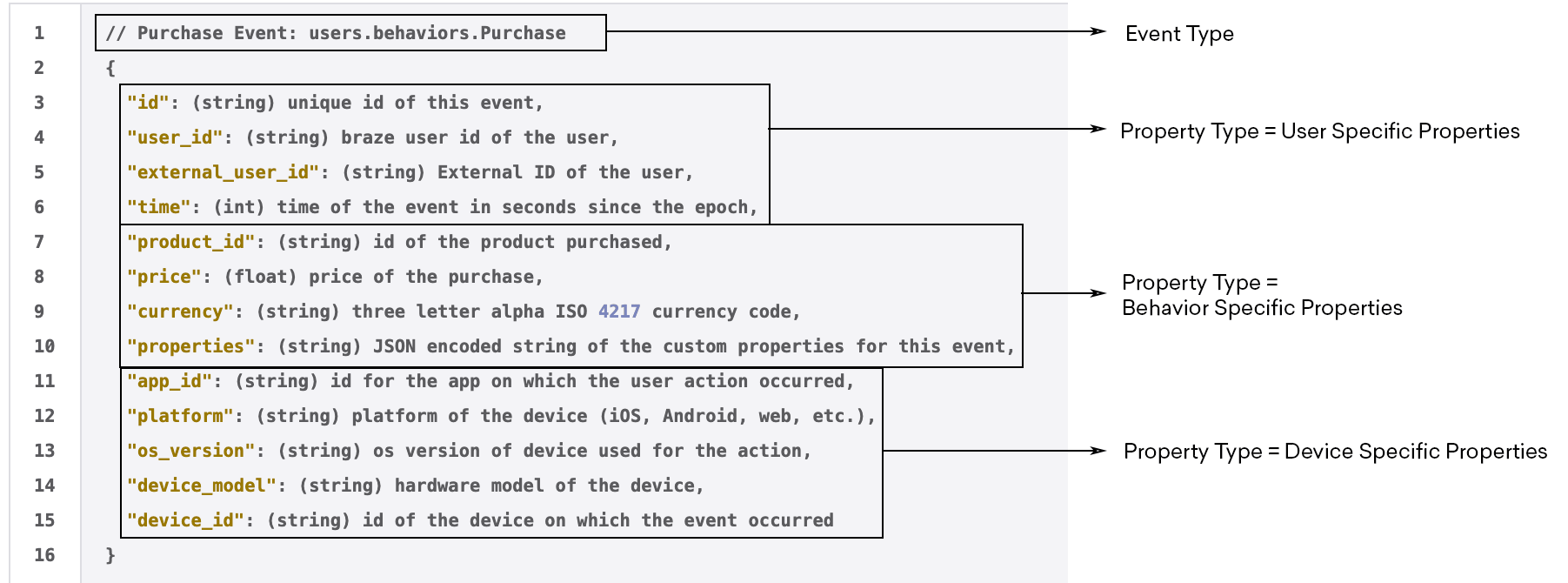
Kundenverhaltens- und Nutzer-Events setzen sich aus nutzerspezifischen Eigenschaften, verhaltensspezifischen Eigenschaften und gerätespezifischen Eigenschaften zusammen.
Plattformwerte
Bestimmte Events geben einen platform-Wert zurück, der die Plattform des Nutzergeräts angibt.
In der folgenden Tabelle finden Sie die möglichen Rückgabewerte:
| Nutzergerät | Plattformwert |
|---|---|
| iOS | ios |
| Android | android |
| FireTV | kindle |
| Kindle | kindle |
| Web | web |
| tvOS | tvos |
| Roku | roku |
Hinweise zu Kundenverhaltens- und Nutzer-Events
- Currents verwirft Events mit übermäßig großen Payloads von mehr als 900 KB.
- Viele der Events in diesem Glossar werden vom SDK initiiert. Einige Events, wie z. B.
token_state_change, können entweder vom SDK oder vom Backend initiiert werden (beispielsweise als Reaktion auf einen Push-Bounce). Die Feldersdk_version,gender,languageundcountrywerden nur für SDK-initiierte Events gesetzt; bei Backend-initiierten Events oder wenn diese Informationen nicht verfügbar oder nicht für die Nutzer:innen gesetzt sind, können diese Feldernullsein.
Events zum Verarbeitungsstatus von API-Anfragen
Dieses Event tritt ein, wenn Braze die Verarbeitung einer angenommenen asynchronen Anfrage an den REST-API-Endpunkt /users/track abgeschlossen hat.
// api.RequestProcessingStatus
{
"api_key_name" : "(required, string) Customer-defined name of the API key used for the request",
"api_key_prefix" : "(required, string) First 8 characters of the API key used for the request",
"app_group_id" : "(required, string) API ID of the workspace the request was made to",
"final_completion_time" : "(required, string) ISO 8601 UTC timestamp at which Braze finished processing the request",
"group_id" : "(optional, string) Request group ID supplied with the request, present only when the request was accepted for group tracking",
"id" : "(required, string) Globally unique ID for this event",
"request_id" : "(required, string) ID of the API request, from the X-Request-ID header supplied by the edge",
"request_received_time" : "(required, string) ISO 8601 UTC timestamp at which Braze accepted the request",
"status" : "(required, string) Processing status of the request",
"time" : "(required, int) UNIX timestamp at which the event happened"
}
// api.RequestProcessingStatus
{
"event_type" : "(required, string) The name of the event type",
"id" : "(required, string) Globally unique ID for this event",
"properties" : {
"api_key_name" : "(required, string) Customer-defined name of the API key used for the request",
"api_key_prefix" : "(required, string) First 8 characters of the API key used for the request",
"app_group_id" : "(optional, string) API ID of the workspace the request was made to",
"final_completion_time" : "(required, string) ISO 8601 UTC timestamp at which Braze finished processing the request",
"group_id" : "(optional, string) Request group ID supplied with the request, present only when the request was accepted for group tracking",
"request_id" : "(required, string) ID of the API request, from the X-Request-ID header supplied by the edge",
"request_received_time" : "(required, string) ISO 8601 UTC timestamp at which Braze accepted the request",
"status" : "(required, string) Processing status of the request"
},
"time" : "(required, int) UNIX timestamp at which the event happened",
"user" : { }
}
Events zu Beziehungstypen von Datenobjekten
Changelog der Beziehungstypen von Datenobjekten
// dataobjects.DoRelType
{
"app_group_id" : "(optional, string) API ID of the workspace this record belongs to",
"cardinality" : "(optional, string) Cardinality of the relationship: one_to_one, one_to_many, or many_to_many",
"created_at" : "(optional, int) UNIX timestamp at which the relationship type was created",
"deleted" : "(optional, boolean) True when the record was deleted",
"deleted_at" : "(optional, int) UNIX timestamp at which the relationship type was deleted",
"forward_name" : "(optional, string) Label for the relationship when viewed from the source object, for example Subaccount",
"forward_name_plural" : "(optional, string) Plural label for the relationship when viewed from the source object",
"from_type_name" : "(optional, string) Type name of the from side",
"id" : "(required, string) Globally unique ID for this create, update, or delete event",
"rel_kind" : "(optional, string) Stable name of the relationship kind",
"reverse_name" : "(optional, string) Label for the relationship when viewed from the target object, for example Parent Account",
"reverse_name_plural" : "(optional, string) Plural label for the relationship when viewed from the target object",
"time" : "(required, int) UNIX timestamp at which the record was created, modified or deleted",
"to_type_name" : "(optional, string) Type name of the to side",
"updated_at" : "(optional, int) UNIX timestamp at which the relationship type was updated"
}
// dataobjects.DoRelType
{
"event_type" : "(required, string) The name of the event type",
"id" : "(required, string) Globally unique ID for this create, update, or delete event",
"properties" : {
"app_group_id" : "(optional, string) API ID of the workspace this record belongs to",
"cardinality" : "(optional, string) Cardinality of the relationship: one_to_one, one_to_many, or many_to_many",
"created_at" : "(optional, int) UNIX timestamp at which the relationship type was created",
"deleted" : "(optional, boolean) True when the record was deleted",
"deleted_at" : "(optional, int) UNIX timestamp at which the relationship type was deleted",
"forward_name" : "(optional, string) Label for the relationship when viewed from the source object, for example Subaccount",
"forward_name_plural" : "(optional, string) Plural label for the relationship when viewed from the source object",
"from_type_name" : "(optional, string) Type name of the from side",
"rel_kind" : "(optional, string) Stable name of the relationship kind",
"reverse_name" : "(optional, string) Label for the relationship when viewed from the target object, for example Parent Account",
"reverse_name_plural" : "(optional, string) Plural label for the relationship when viewed from the target object",
"to_type_name" : "(optional, string) Type name of the to side",
"updated_at" : "(optional, int) UNIX timestamp at which the relationship type was updated"
},
"time" : "(required, int) UNIX timestamp at which the record was created, modified or deleted",
"user" : { }
}
Events zu Feldern von Datenobjekt-Beziehungstypen
Changelog der Felder von Beziehungen zwischen Objekten
// dataobjects.DoRelTypeField
{
"app_group_id" : "(optional, string) API ID of the workspace this record belongs to",
"created_at" : "(optional, int) UNIX timestamp at which the field was created",
"deleted" : "(optional, boolean) True when the record was deleted",
"deleted_at" : "(optional, int) UNIX timestamp at which the field was deleted",
"display_label" : "(optional, string) Display label of the field",
"format" : "(optional, string) JSON Schema format of the field, for example date-time",
"from_type_name" : "(optional, string) Type name of the from side",
"id" : "(required, string) Globally unique ID for this create, update, or delete event",
"json_type" : "(optional, string) JSON type of the field. One of string, number, integer, or boolean",
"name" : "(required, string) Name of the field",
"position" : "(optional, int) Sort position of the field",
"rel_kind" : "(optional, string) Stable name of the relationship kind",
"required" : "(optional, boolean) Whether the field is required",
"time" : "(required, int) UNIX timestamp at which the record was created, modified or deleted",
"to_type_name" : "(optional, string) Type name of the to side",
"updated_at" : "(optional, int) UNIX timestamp at which the field was updated"
}
// dataobjects.DoRelTypeField
{
"event_type" : "(required, string) The name of the event type",
"id" : "(required, string) Globally unique ID for this create, update, or delete event",
"properties" : {
"app_group_id" : "(optional, string) API ID of the workspace this record belongs to",
"created_at" : "(optional, int) UNIX timestamp at which the field was created",
"deleted" : "(optional, boolean) True when the record was deleted",
"deleted_at" : "(optional, int) UNIX timestamp at which the field was deleted",
"display_label" : "(optional, string) Display label of the field",
"format" : "(optional, string) JSON Schema format of the field, for example date-time",
"from_type_name" : "(optional, string) Type name of the from side",
"json_type" : "(optional, string) JSON type of the field. One of string, number, integer, or boolean",
"name" : "(required, string) Name of the field",
"position" : "(optional, int) Sort position of the field",
"rel_kind" : "(optional, string) Stable name of the relationship kind",
"required" : "(optional, boolean) Whether the field is required",
"to_type_name" : "(optional, string) Type name of the to side",
"updated_at" : "(optional, int) UNIX timestamp at which the field was updated"
},
"time" : "(required, int) UNIX timestamp at which the record was created, modified or deleted",
"user" : { }
}
Datenobjekt-Events
Changelog der Datenobjekte
// dataobjects.Object
{
"app_group_id" : "(optional, string) API ID of the workspace this record belongs to",
"attributes" : "(optional, string) Name-keyed attribute JSON. Keys are field names.",
"created_at" : "(optional, int) UNIX timestamp at which the object was created",
"deleted" : "(optional, boolean) True when the record was deleted",
"deleted_at" : "(optional, int) UNIX timestamp at which the object was deleted",
"display_name" : "(optional, string) Display name of the object",
"do_type_name" : "(required, string) The name of the type, for example account",
"id" : "(required, string) Globally unique ID for this create, update, or delete event",
"object_id" : "(required, string) Customer-assigned identifier of the data object",
"time" : "(required, int) UNIX timestamp at which the record was created, modified or deleted",
"updated_at" : "(optional, int) UNIX timestamp at which the object was updated"
}
// dataobjects.Object
{
"event_type" : "(required, string) The name of the event type",
"id" : "(required, string) Globally unique ID for this create, update, or delete event",
"properties" : {
"app_group_id" : "(optional, string) API ID of the workspace this record belongs to",
"attributes" : "(optional, string) Name-keyed attribute JSON. Keys are field names.",
"created_at" : "(optional, int) UNIX timestamp at which the object was created",
"deleted" : "(optional, boolean) True when the record was deleted",
"deleted_at" : "(optional, int) UNIX timestamp at which the object was deleted",
"display_name" : "(optional, string) Display name of the object",
"do_type_name" : "(required, string) The name of the type, for example account",
"object_id" : "(required, string) Customer-assigned identifier of the data object",
"updated_at" : "(optional, int) UNIX timestamp at which the object was updated"
},
"time" : "(required, int) UNIX timestamp at which the record was created, modified or deleted",
"user" : { }
}
Events zu Beziehungen zwischen Datenobjekten
Changelog der Beziehungen zwischen Datenobjekten
// dataobjects.RelDoToDo
{
"app_group_id" : "(optional, string) API ID of the workspace this record belongs to",
"attributes" : "(optional, string) Name-keyed attribute JSON. Keys are field names.",
"created_at" : "(optional, int) UNIX timestamp at which the relationship was created",
"deleted" : "(optional, boolean) True when the record was deleted",
"deleted_at" : "(optional, int) UNIX timestamp at which the relationship was deleted",
"from_object_id" : "(optional, string) Customer-assigned identifier of the from object",
"from_type_name" : "(optional, string) Type name of the from object",
"id" : "(required, string) Globally unique ID for this create, update, or delete event",
"rel_kind" : "(optional, string) Stable name of the relationship kind",
"time" : "(required, int) UNIX timestamp at which the record was created, modified or deleted",
"to_object_id" : "(optional, string) Customer-assigned identifier of the to object",
"to_type_name" : "(optional, string) Type name of the to object",
"updated_at" : "(optional, int) UNIX timestamp at which the relationship was updated"
}
// dataobjects.RelDoToDo
{
"event_type" : "(required, string) The name of the event type",
"id" : "(required, string) Globally unique ID for this create, update, or delete event",
"properties" : {
"app_group_id" : "(optional, string) API ID of the workspace this record belongs to",
"attributes" : "(optional, string) Name-keyed attribute JSON. Keys are field names.",
"created_at" : "(optional, int) UNIX timestamp at which the relationship was created",
"deleted" : "(optional, boolean) True when the record was deleted",
"deleted_at" : "(optional, int) UNIX timestamp at which the relationship was deleted",
"from_object_id" : "(optional, string) Customer-assigned identifier of the from object",
"from_type_name" : "(optional, string) Type name of the from object",
"rel_kind" : "(optional, string) Stable name of the relationship kind",
"to_object_id" : "(optional, string) Customer-assigned identifier of the to object",
"to_type_name" : "(optional, string) Type name of the to object",
"updated_at" : "(optional, int) UNIX timestamp at which the relationship was updated"
},
"time" : "(required, int) UNIX timestamp at which the record was created, modified or deleted",
"user" : { }
}
Events zu Beziehungen zwischen Nutzer:innen und Datenobjekten
Changelog der Beziehungen zwischen Nutzer:innen und Objekten
// dataobjects.RelUserToDo
{
"app_group_id" : "(optional, string) API ID of the workspace this record belongs to",
"attributes" : "(optional, string) Name-keyed attribute JSON. Keys are field names.",
"created_at" : "(optional, int) UNIX timestamp at which the relationship was created",
"deleted" : "(optional, boolean) True when the record was deleted",
"deleted_at" : "(optional, int) UNIX timestamp at which the relationship was deleted",
"do_type_name" : "(required, string) The name of the type, for example account",
"external_user_id" : "(optional, string) [PII] External ID of the related user",
"id" : "(required, string) Globally unique ID for this create, update, or delete event",
"object_id" : "(required, string) Customer-assigned identifier of the data object",
"rel_kind" : "(optional, string) Stable name of the relationship kind",
"time" : "(required, int) UNIX timestamp at which the record was created, modified or deleted",
"updated_at" : "(optional, int) UNIX timestamp at which the relationship was updated",
"user_id" : "(required, string) [PII] Braze user ID of the related user"
}
// User Data Object Relation (dataobjects.RelUserToDo)
{
"event_properties" : {
"app_group_id" : "(optional, string) API ID of the workspace this record belongs to",
"attributes" : "(optional, string) Name-keyed attribute JSON. Keys are field names.",
"braze_user_id" : "(required, string) [PII] Braze user ID of the related user",
"created_at" : "(optional, int) UNIX timestamp at which the relationship was created",
"deleted" : "(optional, boolean) True when the record was deleted",
"deleted_at" : "(optional, int) UNIX timestamp at which the relationship was deleted",
"do_type_name" : "(required, string) The name of the type, for example account",
"object_id" : "(required, string) Customer-assigned identifier of the data object",
"rel_kind" : "(optional, string) Stable name of the relationship kind",
"updated_at" : "(optional, int) UNIX timestamp at which the relationship was updated"
},
"event_type" : "(required, string) The event type name, as it is exported to Amplitude",
"insert_id" : "(required, string) Globally unique ID for this create, update, or delete event",
"library" : "Braze",
"time" : "(required, int) UNIX timestamp at which the record was created, modified or deleted",
"user_id" : "(optional, string) [PII] External ID of the related user"
}
// dataobjects.RelUserToDo
{
"event_type" : "(required, string) The name of the event type",
"id" : "(required, string) Globally unique ID for this create, update, or delete event",
"properties" : {
"app_group_id" : "(optional, string) API ID of the workspace this record belongs to",
"attributes" : "(optional, string) Name-keyed attribute JSON. Keys are field names.",
"created_at" : "(optional, int) UNIX timestamp at which the relationship was created",
"deleted" : "(optional, boolean) True when the record was deleted",
"deleted_at" : "(optional, int) UNIX timestamp at which the relationship was deleted",
"do_type_name" : "(required, string) The name of the type, for example account",
"object_id" : "(required, string) Customer-assigned identifier of the data object",
"rel_kind" : "(optional, string) Stable name of the relationship kind",
"updated_at" : "(optional, int) UNIX timestamp at which the relationship was updated"
},
"time" : "(required, int) UNIX timestamp at which the record was created, modified or deleted",
"user" : {
"external_user_id" : "(optional, string) [PII] External ID of the related user",
"user_id" : "(required, string) [PII] Braze user ID of the related user"
}
}
// User Data Object Relation (dataobjects.RelUserToDo)
{
"event" : "(required, string) The event type name, as it is exported to Mixpanel",
"properties" : {
"$partner_id" : "braze",
"app_group_id" : "(optional, string) API ID of the workspace this record belongs to",
"attributes" : "(optional, string) Name-keyed attribute JSON. Keys are field names.",
"created_at" : "(optional, int) UNIX timestamp at which the relationship was created",
"deleted" : "(optional, boolean) True when the record was deleted",
"deleted_at" : "(optional, int) UNIX timestamp at which the relationship was deleted",
"distinct_id" : "(required, string) [PII] External ID of the related user",
"do_type_name" : "(required, string) The name of the type, for example account",
"$insert_id" : "(required, string) Globally unique ID for this create, update, or delete event",
"object_id" : "(required, string) Customer-assigned identifier of the data object",
"rel_kind" : "(optional, string) Stable name of the relationship kind",
"time" : "(required, int) UNIX timestamp at which the record was created, modified or deleted",
"token" : "(required, string) The Mixpanel API token",
"updated_at" : "(optional, int) UNIX timestamp at which the relationship was updated",
"user_id" : "(required, string) [PII] Braze user ID of the related user"
}
}
// User Data Object Relation Updated (dataobjects.RelUserToDo)
{
"anonymousId" : "(required, string) [PII] Braze user ID of the related user",
"context" : {
"device" : { },
"traits" : { }
},
"event" : "(required, string) The event type name, as it is exported to Segment",
"messageId" : "(required, string) Globally unique ID for this create, update, or delete event",
"properties" : {
"app_group_id" : "(optional, string) API ID of the workspace this record belongs to",
"attributes" : "(optional, string) Name-keyed attribute JSON. Keys are field names.",
"created_at" : "(optional, int) UNIX timestamp at which the relationship was created",
"deleted" : "(optional, boolean) True when the record was deleted",
"deleted_at" : "(optional, int) UNIX timestamp at which the relationship was deleted",
"do_type_name" : "(required, string) The name of the type, for example account",
"object_id" : "(required, string) Customer-assigned identifier of the data object",
"rel_kind" : "(optional, string) Stable name of the relationship kind",
"updated_at" : "(optional, int) UNIX timestamp at which the relationship was updated"
},
"timestamp" : "(required, int) UNIX timestamp at which the record was created, modified or deleted",
"type" : "track",
"userId" : "(optional, string) [PII] External ID of the related user"
}
Datenobjekttyp-Events
Changelog der Datenobjekttypen
// dataobjects.Type
{
"app_group_id" : "(optional, string) API ID of the workspace this record belongs to",
"created_at" : "(optional, int) UNIX timestamp at which the type was created",
"deleted" : "(optional, boolean) True when the record was deleted",
"deleted_at" : "(optional, int) UNIX timestamp at which the type was deleted",
"description" : "(optional, string) A description of the type",
"display_name_plural" : "(optional, string) Plural display name",
"display_name_singular" : "(optional, string) Singular display name",
"icon" : "(optional, string) URL of the icon for the type",
"id" : "(required, string) Globally unique ID for this create, update, or delete event",
"is_built_in" : "(required, boolean) True for a type created from a built-in template",
"time" : "(required, int) UNIX timestamp at which the record was created, modified or deleted",
"type_name" : "(optional, string) API type name, for example account",
"updated_at" : "(optional, int) UNIX timestamp at which the type was updated"
}
// dataobjects.Type
{
"event_type" : "(required, string) The name of the event type",
"id" : "(required, string) Globally unique ID for this create, update, or delete event",
"properties" : {
"app_group_id" : "(optional, string) API ID of the workspace this record belongs to",
"created_at" : "(optional, int) UNIX timestamp at which the type was created",
"deleted" : "(optional, boolean) True when the record was deleted",
"deleted_at" : "(optional, int) UNIX timestamp at which the type was deleted",
"description" : "(optional, string) A description of the type",
"display_name_plural" : "(optional, string) Plural display name",
"display_name_singular" : "(optional, string) Singular display name",
"icon" : "(optional, string) URL of the icon for the type",
"is_built_in" : "(required, boolean) True for a type created from a built-in template",
"type_name" : "(optional, string) API type name, for example account",
"updated_at" : "(optional, int) UNIX timestamp at which the type was updated"
},
"time" : "(required, int) UNIX timestamp at which the record was created, modified or deleted",
"user" : { }
}
Events zu Feldern von Datenobjekttypen
Changelog der Felder von Datenobjekttypen
// dataobjects.TypeField
{
"app_group_id" : "(optional, string) API ID of the workspace this record belongs to",
"created_at" : "(optional, int) UNIX timestamp at which the field was created",
"deleted" : "(optional, boolean) True when the record was deleted",
"deleted_at" : "(optional, int) UNIX timestamp at which the field was deleted",
"display_label" : "(optional, string) Display label of the field",
"do_type_name" : "(required, string) The name of the type, for example account",
"format" : "(optional, string) JSON Schema format of the field, for example date-time",
"id" : "(required, string) Globally unique ID for this create, update, or delete event",
"json_type" : "(optional, string) JSON type of the field. One of string, number, integer, or boolean",
"name" : "(required, string) Name of the field",
"position" : "(optional, int) Sort position of the field",
"required" : "(optional, boolean) Whether the field is required",
"time" : "(required, int) UNIX timestamp at which the record was created, modified or deleted",
"updated_at" : "(optional, int) UNIX timestamp at which the field was updated"
}
// dataobjects.TypeField
{
"event_type" : "(required, string) The name of the event type",
"id" : "(required, string) Globally unique ID for this create, update, or delete event",
"properties" : {
"app_group_id" : "(optional, string) API ID of the workspace this record belongs to",
"created_at" : "(optional, int) UNIX timestamp at which the field was created",
"deleted" : "(optional, boolean) True when the record was deleted",
"deleted_at" : "(optional, int) UNIX timestamp at which the field was deleted",
"display_label" : "(optional, string) Display label of the field",
"do_type_name" : "(required, string) The name of the type, for example account",
"format" : "(optional, string) JSON Schema format of the field, for example date-time",
"json_type" : "(optional, string) JSON type of the field. One of string, number, integer, or boolean",
"name" : "(required, string) Name of the field",
"position" : "(optional, int) Sort position of the field",
"required" : "(optional, boolean) Whether the field is required",
"updated_at" : "(optional, int) UNIX timestamp at which the field was updated"
},
"time" : "(required, int) UNIX timestamp at which the record was created, modified or deleted",
"user" : { }
}
Events zu Nutzer-Beziehungstypen
Changelog der Beziehungstypen zwischen Nutzer:innen und Objekten
// dataobjects.UserRelType
{
"app_group_id" : "(optional, string) API ID of the workspace this record belongs to",
"cardinality" : "(optional, string) Cardinality of the relationship: one_to_one, one_to_many, or many_to_many",
"created_at" : "(optional, int) UNIX timestamp at which the relationship type was created",
"deleted" : "(optional, boolean) True when the record was deleted",
"deleted_at" : "(optional, int) UNIX timestamp at which the relationship type was deleted",
"do_type_name" : "(required, string) The name of the type, for example account",
"forward_name" : "(optional, string) Label for the relationship when viewed from the object, for example \"user\"",
"forward_name_plural" : "(optional, string) Plural label for the relationship when viewed from the object",
"id" : "(required, string) Globally unique ID for this create, update, or delete event",
"rel_kind" : "(optional, string) Stable name of the relationship kind",
"reverse_name" : "(optional, string) Label for the relationship when viewed from the user, for example \"account\"",
"reverse_name_plural" : "(optional, string) Plural label for the relationship when viewed from the user",
"time" : "(required, int) UNIX timestamp at which the record was created, modified or deleted",
"updated_at" : "(optional, int) UNIX timestamp at which the relationship type was updated"
}
// dataobjects.UserRelType
{
"event_type" : "(required, string) The name of the event type",
"id" : "(required, string) Globally unique ID for this create, update, or delete event",
"properties" : {
"app_group_id" : "(optional, string) API ID of the workspace this record belongs to",
"cardinality" : "(optional, string) Cardinality of the relationship: one_to_one, one_to_many, or many_to_many",
"created_at" : "(optional, int) UNIX timestamp at which the relationship type was created",
"deleted" : "(optional, boolean) True when the record was deleted",
"deleted_at" : "(optional, int) UNIX timestamp at which the relationship type was deleted",
"do_type_name" : "(required, string) The name of the type, for example account",
"forward_name" : "(optional, string) Label for the relationship when viewed from the object, for example \"user\"",
"forward_name_plural" : "(optional, string) Plural label for the relationship when viewed from the object",
"rel_kind" : "(optional, string) Stable name of the relationship kind",
"reverse_name" : "(optional, string) Label for the relationship when viewed from the user, for example \"account\"",
"reverse_name_plural" : "(optional, string) Plural label for the relationship when viewed from the user",
"updated_at" : "(optional, int) UNIX timestamp at which the relationship type was updated"
},
"time" : "(required, int) UNIX timestamp at which the record was created, modified or deleted",
"user" : { }
}
Events zu Feldern von Nutzer-Beziehungstypen
Changelog der Felder von Beziehungen zwischen Nutzer:innen und Objekten
// dataobjects.UserRelTypeField
{
"app_group_id" : "(optional, string) API ID of the workspace this record belongs to",
"created_at" : "(optional, int) UNIX timestamp at which the field was created",
"deleted" : "(optional, boolean) True when the record was deleted",
"deleted_at" : "(optional, int) UNIX timestamp at which the field was deleted",
"display_label" : "(optional, string) Display label of the field",
"do_type_name" : "(required, string) The name of the type, for example account",
"format" : "(optional, string) JSON Schema format of the field, for example date-time",
"id" : "(required, string) Globally unique ID for this create, update, or delete event",
"json_type" : "(optional, string) JSON type of the field. One of string, number, integer, or boolean",
"name" : "(required, string) Name of the field",
"position" : "(optional, int) Sort position of the field",
"rel_kind" : "(optional, string) Stable name of the relationship kind",
"required" : "(optional, boolean) Whether the field is required",
"time" : "(required, int) UNIX timestamp at which the record was created, modified or deleted",
"updated_at" : "(optional, int) UNIX timestamp at which the field was updated"
}
// dataobjects.UserRelTypeField
{
"event_type" : "(required, string) The name of the event type",
"id" : "(required, string) Globally unique ID for this create, update, or delete event",
"properties" : {
"app_group_id" : "(optional, string) API ID of the workspace this record belongs to",
"created_at" : "(optional, int) UNIX timestamp at which the field was created",
"deleted" : "(optional, boolean) True when the record was deleted",
"deleted_at" : "(optional, int) UNIX timestamp at which the field was deleted",
"display_label" : "(optional, string) Display label of the field",
"do_type_name" : "(required, string) The name of the type, for example account",
"format" : "(optional, string) JSON Schema format of the field, for example date-time",
"json_type" : "(optional, string) JSON type of the field. One of string, number, integer, or boolean",
"name" : "(required, string) Name of the field",
"position" : "(optional, int) Sort position of the field",
"rel_kind" : "(optional, string) Stable name of the relationship kind",
"required" : "(optional, boolean) Whether the field is required",
"updated_at" : "(optional, int) UNIX timestamp at which the field was updated"
},
"time" : "(required, int) UNIX timestamp at which the record was created, modified or deleted",
"user" : { }
}
Update-Events für zufällige Bucket-Nummern
Dieses Nutzer-Event wird jedes Mal ausgelöst, wenn ein:e neue:r Nutzer:in innerhalb des Workspace erstellt wird. Dabei wird jedem/jeder neuen Nutzer:in eine zufällige Bucket-Nummer zugewiesen, mit der Sie dann gleichmäßig verteilte Segmente aus zufälligen Nutzer:innen erstellen können. Verwenden Sie diese Funktion, um eine Reihe zufälliger Bucket-Nummern zu gruppieren und die Performance Ihrer Kampagnen und Kampagnenvarianten zu vergleichen.

Dieses Currents-Event ist nur für Kund:innen verfügbar, die einen „All Events Connector“ erworben haben, und steht nur für Storage-Event-Konnektoren (wie Amazon S3, Microsoft Azure und Google Cloud Storage) zur Verfügung.
Wenden Sie sich an Ihren Customer-Success-Manager, um dieses Event zu aktivieren und den Backfill für die zufälligen Bucket-Nummern bestehender Nutzer:innen in Ihrem Workspace zu planen.
// users.RandomBucketNumberUpdate
{
"app_group_id" : "(optional, string) API ID of the app group this user belongs to",
"external_user_id" : "(optional, string) [PII] External ID of the user",
"id" : "(required, string) Globally unique ID for this event",
"prev_random_bucket_number" : "(optional, int) Previous random bucket number",
"random_bucket_number" : "(required, int) New random bucket number",
"time" : "(required, int) UNIX timestamp at which the event happened",
"user_id" : "(required, string) [PII] Braze user ID of the user who performed this event"
}
Angepasste Events
Dieses Event tritt ein, wenn ein bestimmtes angepasstes Event getriggert wird. Verwenden Sie es, um zu tracken, wann Nutzer:innen angepasste Events in Ihrer Anwendung ausführen.
// users.behaviors.CustomEvent
{
"ad_id" : "(optional, string) [PII] Advertising identifier",
"ad_id_type" : "(optional, string) One of ['ios_idfa', 'google_ad_id', 'windows_ad_id', 'roku_ad_id']",
"ad_tracking_enabled" : "(optional, boolean) Whether advertising tracking is enabled for the device",
"app_group_id" : "(optional, string) API ID of the app group this user belongs to",
"app_id" : "(optional, string) API ID of the app on which this event occurred",
"device_id" : "(optional, string) ID of the device on which the event occurred",
"device_model" : "(optional, string) Model of the device",
"external_user_id" : "(optional, string) [PII] External ID of the user",
"id" : "(required, string) Globally unique ID for this event",
"name" : "(required, string) Name of the custom event",
"os_version" : "(optional, string) Version of the operating system of the device",
"platform" : "(optional, string) Platform of the device",
"properties" : "(required, string) Custom properties stored as a JSON encoded string",
"received_at_ms" : "(optional, long) UNIX timestamp, in milliseconds, at which Braze received the request that contained this event. For some batched API requests, this is when the batch was queued, which can be a few seconds later.",
"time" : "(required, int) UNIX timestamp at which the event happened",
"timezone" : "(optional, string) Time zone of the user",
"user_id" : "(required, string) [PII] Braze user ID of the user who performed this event"
}
// [Braze Custom Event] (users.behaviors.CustomEvent)
{
"adid" : "(optional, string) [PII] Advertising identifier",
"device_id" : "(optional, string) ID of the device on which the event occurred",
"event_properties" : {
"ad_id" : "(optional, string) [PII] Advertising identifier",
"ad_id_type" : "(optional, string) One of ['ios_idfa', 'google_ad_id', 'windows_ad_id', 'roku_ad_id']",
"ad_tracking_enabled" : "(optional, boolean) Whether advertising tracking is enabled for the device",
"app_group_id" : "(optional, string) API ID of the app group this user belongs to",
"app_id" : "(optional, string) API ID of the app on which this event occurred",
"device_model" : "(optional, string) Model of the device",
"os_version" : "(optional, string) Version of the operating system of the device",
"platform" : "(optional, string) Platform of the device",
"received_at_ms" : "(optional, long) UNIX timestamp, in milliseconds, at which Braze received the request that contained this event. For some batched API requests, this is when the batch was queued, which can be a few seconds later."
},
"event_type" : "(required, string) The event type name, as it is exported to Amplitude",
"idfa" : "(optional, string) [PII] Advertising identifier",
"insert_id" : "(required, string) Globally unique ID for this event",
"library" : "Braze",
"time" : "(required, int) UNIX timestamp at which the event happened",
"user_id" : "(optional, string) [PII] External ID of the user"
}
// users.behaviors.CustomEvent
{
"event_type" : "(required, string) The name of the event type",
"id" : "(required, string) Globally unique ID for this event",
"properties" : {
"ad_id" : "(optional, string) [PII] Advertising identifier",
"ad_id_type" : "(optional, string) One of ['ios_idfa', 'google_ad_id', 'windows_ad_id', 'roku_ad_id']",
"ad_tracking_enabled" : "(optional, boolean) Whether advertising tracking is enabled for the device",
"app_group_id" : "(optional, string) API ID of the app group this user belongs to",
"app_id" : "(optional, string) API ID of the app on which this event occurred",
"device_model" : "(optional, string) Model of the device",
"name" : "(required, string) Name of the custom event",
"os_version" : "(optional, string) Version of the operating system of the device",
"platform" : "(optional, string) Platform of the device",
"received_at_ms" : "(optional, long) UNIX timestamp, in milliseconds, at which Braze received the request that contained this event. For some batched API requests, this is when the batch was queued, which can be a few seconds later."
},
"time" : "(required, int) UNIX timestamp at which the event happened",
"user" : {
"device_id" : "(optional, string) ID of the device on which the event occurred",
"external_user_id" : "(optional, string) [PII] External ID of the user",
"timezone" : "(optional, string) Time zone of the user",
"user_id" : "(required, string) [PII] Braze user ID of the user who performed this event"
}
}
// [Braze Custom Event] (users.behaviors.CustomEvent)
{
"event" : "(required, string) The event type name, as it is exported to Mixpanel",
"properties" : {
"$partner_id" : "braze",
"ad_id" : "(optional, string) [PII] Advertising identifier",
"ad_id_type" : "(optional, string) One of ['ios_idfa', 'google_ad_id', 'windows_ad_id', 'roku_ad_id']",
"ad_tracking_enabled" : "(optional, boolean) Whether advertising tracking is enabled for the device",
"app_group_id" : "(optional, string) API ID of the app group this user belongs to",
"app_id" : "(optional, string) API ID of the app on which this event occurred",
"$device" : "(optional, string) Model of the device",
"device_id" : "(optional, string) ID of the device on which the event occurred",
"distinct_id" : "(required, string) [PII] External ID of the user",
"$insert_id" : "(required, string) Globally unique ID for this event",
"$os" : "(optional, string) Version of the operating system of the device",
"platform" : "(optional, string) Platform of the device",
"received_at_ms" : "(optional, long) UNIX timestamp, in milliseconds, at which Braze received the request that contained this event. For some batched API requests, this is when the batch was queued, which can be a few seconds later.",
"time" : "(required, int) UNIX timestamp at which the event happened",
"token" : "(required, string) The Mixpanel API token"
}
}
// users.behaviors.CustomEvent
{
"anonymousId" : "(required, string) [PII] Braze user ID of the user who performed this event",
"context" : {
"device" : {
"model" : "(optional, string) Model of the device",
"type" : "(optional, string) Platform of the device"
},
"traits" : { }
},
"event" : "(required, string) The event type name, as it is exported to Segment",
"messageId" : "(required, string) Globally unique ID for this event",
"properties" : {
"ad_id" : "(optional, string) [PII] Advertising identifier",
"ad_id_type" : "(optional, string) One of ['ios_idfa', 'google_ad_id', 'windows_ad_id', 'roku_ad_id']",
"ad_tracking_enabled" : "(optional, boolean) Whether advertising tracking is enabled for the device",
"app_group_id" : "(optional, string) API ID of the app group this user belongs to",
"app_id" : "(optional, string) API ID of the app on which this event occurred",
"device_id" : "(optional, string) ID of the device on which the event occurred",
"name" : "(required, string) Name of the custom event",
"received_at_ms" : "(optional, long) UNIX timestamp, in milliseconds, at which Braze received the request that contained this event. For some batched API requests, this is when the batch was queued, which can be a few seconds later."
},
"timestamp" : "(required, int) UNIX timestamp at which the event happened",
"type" : "track",
"userId" : "(optional, string) [PII] External ID of the user"
}
Details zu den Eigenschaften
- Bei angepassten Events wird die Payload auch mit allen angepassten Event-Eigenschaften befüllt, die mit dem Event verknüpft sind.
- Für
ad_id,ad_id_typeundad_tracking_enabledmüssen Sie den Identifier for Advertisers (IDFA) für iOS und die Google Ad ID für Android explizit über die nativen SDKs erfassen. Mehr erfahren Sie hier: iOS, Android. - Wenn Sie Kafka zum Importieren von Currents-Daten verwenden, wenden Sie sich an Ihren Customer-Success-Manager oder Account Manager, um den Feature-Flipper zum Senden von
ad_idzu aktivieren. - Das Feld
timegibt den Zeitpunkt an, zu dem das angepasste Event eingetreten ist, so wie er im Event erfasst wurde. Braze ersetzt ihn nicht durch den Zeitpunkt, zu dem das Event aufgenommen oder verarbeitet wurde. Bei Events, die vom SDK protokolliert werden, ist dies der Zeitpunkt, zu dem das SDK das Event protokolliert hat. Bei Events, die über den/users/track-Endpunkt oder Cloud Data Ingestion gesendet werden, ist dies der in der Anfrage gesendetetime-Wert.
Install-Attribution-Events
Dieses Event wird ausgelöst, wenn eine App-Installation einer Quelle zugeordnet wird. Verwenden Sie es, um zu tracken, woher die Installationen Ihrer App stammen.
// users.behaviors.InstallAttribution
{
"app_group_id" : "(optional, string) API ID of the app group this user belongs to",
"external_user_id" : "(optional, string) [PII] External ID of the user",
"id" : "(required, string) Globally unique ID for this event",
"source" : "(required, string) The source of the attribution",
"time" : "(required, int) UNIX timestamp at which the event happened",
"user_id" : "(required, string) [PII] Braze user ID of the user who performed this event"
}
// Install Attribution (users.behaviors.InstallAttribution)
{
"device_id" : "(optional, string) ID of the device on which the event occurred",
"event_properties" : {
"app_group_id" : "(optional, string) API ID of the app group this user belongs to",
"source" : "(optional, string) The source of the attribution"
},
"event_type" : "(required, string) The event type name, as it is exported to Amplitude",
"insert_id" : "(required, string) Globally unique ID for this event",
"library" : "Braze",
"time" : "(required, int) UNIX timestamp at which the event happened",
"user_id" : "(optional, string) [PII] External ID of the user"
}
// users.behaviors.InstallAttribution
{
"event_type" : "(required, string) The name of the event type",
"id" : "(required, string) Globally unique ID for this event",
"properties" : {
"app_group_id" : "(optional, string) API ID of the app group this user belongs to",
"source" : "(optional, string) The source of the attribution"
},
"time" : "(required, int) UNIX timestamp at which the event happened",
"user" : {
"device_id" : "(optional, string) ID of the device on which the event occurred",
"external_user_id" : "(optional, string) [PII] External ID of the user",
"user_id" : "(required, string) [PII] Braze user ID of the user who performed this event"
}
}
// Install Attribution (users.behaviors.InstallAttribution)
{
"event" : "(required, string) The event type name, as it is exported to Mixpanel",
"properties" : {
"$partner_id" : "braze",
"app_group_id" : "(optional, string) API ID of the app group this user belongs to",
"device_id" : "(optional, string) ID of the device on which the event occurred",
"distinct_id" : "(required, string) [PII] External ID of the user",
"$insert_id" : "(required, string) Globally unique ID for this event",
"source" : "(optional, string) The source of the attribution",
"time" : "(required, int) UNIX timestamp at which the event happened",
"token" : "(required, string) The Mixpanel API token"
}
}
// Install Attribution (users.behaviors.InstallAttribution)
{
"anonymousId" : "(required, string) [PII] Braze user ID of the user who performed this event",
"context" : {
"device" : { },
"traits" : { }
},
"event" : "(required, string) The event type name, as it is exported to Segment",
"messageId" : "(required, string) Globally unique ID for this event",
"properties" : {
"app_group_id" : "(optional, string) API ID of the app group this user belongs to",
"device_id" : "(optional, string) ID of the device on which the event occurred",
"source" : "(required, string) The source of the attribution"
},
"timestamp" : "(required, int) UNIX timestamp at which the event happened",
"type" : "track",
"userId" : "(optional, string) [PII] External ID of the user"
}
Standort-Events
Dieses Event wird getriggert, wenn ein:e Nutzer:in einen bestimmten Standort besucht. Verwenden Sie es, um Nutzer:innen zu tracken, die Standort-Events in Ihrer App triggern.
// users.behaviors.Location
{
"ad_id" : "(optional, string) [PII] Advertising identifier",
"ad_id_type" : "(optional, string) One of ['ios_idfa', 'google_ad_id', 'windows_ad_id', 'roku_ad_id']",
"ad_tracking_enabled" : "(optional, boolean) Whether advertising tracking is enabled for the device",
"alt_accuracy" : "(optional, float) Altitude accuracy of recorded location",
"altitude" : "(optional, float) [PII] Altitude of recorded location",
"app_group_id" : "(optional, string) API ID of the app group this user belongs to",
"app_id" : "(required, string) API ID of the app on which this event occurred",
"device_id" : "(optional, string) ID of the device on which the event occurred",
"device_model" : "(optional, string) Model of the device",
"external_user_id" : "(optional, string) [PII] External ID of the user",
"id" : "(required, string) Globally unique ID for this event",
"latitude" : "(required, float) [PII] Latitude of recorded location",
"ll_accuracy" : "(optional, float) Accuracy of the latitude and longitude of recorded location",
"longitude" : "(required, float) [PII] Longitude of recorded location",
"os_version" : "(optional, string) Version of the operating system of the device",
"platform" : "(optional, string) Platform of the device",
"time" : "(required, int) UNIX timestamp at which the event happened",
"user_id" : "(required, string) [PII] Braze user ID of the user who performed this event"
}
// Location (users.behaviors.Location)
{
"adid" : "(optional, string) [PII] Advertising identifier",
"device_id" : "(optional, string) ID of the device on which the event occurred",
"event_properties" : {
"ad_id" : "(optional, string) [PII] Advertising identifier",
"ad_id_type" : "(optional, string) One of ['ios_idfa', 'google_ad_id', 'windows_ad_id', 'roku_ad_id']",
"ad_tracking_enabled" : "(optional, boolean) Whether advertising tracking is enabled for the device",
"alt_accuracy" : "(optional, float) Altitude accuracy of recorded location",
"altitude" : "(optional, float) [PII] Altitude of recorded location",
"app_group_id" : "(optional, string) API ID of the app group this user belongs to",
"app_id" : "(optional, string) API ID of the app on which this event occurred",
"device_model" : "(optional, string) Model of the device",
"latitude" : "(required, float) [PII] Latitude of recorded location",
"ll_accuracy" : "(optional, float) Accuracy of the latitude and longitude of recorded location",
"longitude" : "(required, float) [PII] Longitude of recorded location",
"os_version" : "(optional, string) Version of the operating system of the device",
"platform" : "(optional, string) Platform of the device"
},
"event_type" : "(required, string) The event type name, as it is exported to Amplitude",
"idfa" : "(optional, string) [PII] Advertising identifier",
"insert_id" : "(required, string) Globally unique ID for this event",
"library" : "Braze",
"time" : "(required, int) UNIX timestamp at which the event happened",
"user_id" : "(optional, string) [PII] External ID of the user"
}
// users.behaviors.Location
{
"event_type" : "(required, string) The name of the event type",
"id" : "(required, string) Globally unique ID for this event",
"properties" : {
"ad_id" : "(optional, string) [PII] Advertising identifier",
"ad_id_type" : "(optional, string) One of ['ios_idfa', 'google_ad_id', 'windows_ad_id', 'roku_ad_id']",
"ad_tracking_enabled" : "(optional, boolean) Whether advertising tracking is enabled for the device",
"alt_accuracy" : "(optional, float) Altitude accuracy of recorded location",
"altitude" : "(optional, float) [PII] Altitude of recorded location",
"app_group_id" : "(optional, string) API ID of the app group this user belongs to",
"app_id" : "(optional, string) API ID of the app on which this event occurred",
"device_model" : "(optional, string) Model of the device",
"latitude" : "(required, float) [PII] Latitude of recorded location",
"ll_accuracy" : "(optional, float) Accuracy of the latitude and longitude of recorded location",
"longitude" : "(required, float) [PII] Longitude of recorded location",
"os_version" : "(optional, string) Version of the operating system of the device",
"platform" : "(optional, string) Platform of the device"
},
"time" : "(required, int) UNIX timestamp at which the event happened",
"user" : {
"device_id" : "(optional, string) ID of the device on which the event occurred",
"external_user_id" : "(optional, string) [PII] External ID of the user",
"user_id" : "(required, string) [PII] Braze user ID of the user who performed this event"
}
}
// Location (users.behaviors.Location)
{
"event" : "(required, string) The event type name, as it is exported to Mixpanel",
"properties" : {
"$partner_id" : "braze",
"ad_id" : "(optional, string) [PII] Advertising identifier",
"ad_id_type" : "(optional, string) One of ['ios_idfa', 'google_ad_id', 'windows_ad_id', 'roku_ad_id']",
"ad_tracking_enabled" : "(optional, boolean) Whether advertising tracking is enabled for the device",
"alt_accuracy" : "(optional, float) Altitude accuracy of recorded location",
"altitude" : "(optional, float) [PII] Altitude of recorded location",
"app_group_id" : "(optional, string) API ID of the app group this user belongs to",
"app_id" : "(optional, string) API ID of the app on which this event occurred",
"$device" : "(optional, string) Model of the device",
"device_id" : "(optional, string) ID of the device on which the event occurred",
"distinct_id" : "(required, string) [PII] External ID of the user",
"$insert_id" : "(required, string) Globally unique ID for this event",
"latitude" : "(required, float) [PII] Latitude of recorded location",
"ll_accuracy" : "(optional, float) Accuracy of the latitude and longitude of recorded location",
"longitude" : "(required, float) [PII] Longitude of recorded location",
"$os" : "(optional, string) Version of the operating system of the device",
"platform" : "(optional, string) Platform of the device",
"time" : "(required, int) UNIX timestamp at which the event happened",
"token" : "(required, string) The Mixpanel API token"
}
}
// Location (users.behaviors.Location)
{
"anonymousId" : "(required, string) [PII] Braze user ID of the user who performed this event",
"context" : {
"device" : {
"model" : "(optional, string) Model of the device",
"type" : "(optional, string) Platform of the device"
},
"traits" : { }
},
"event" : "(required, string) The event type name, as it is exported to Segment",
"messageId" : "(required, string) Globally unique ID for this event",
"properties" : {
"ad_id" : "(optional, string) [PII] Advertising identifier",
"ad_id_type" : "(optional, string) One of ['ios_idfa', 'google_ad_id', 'windows_ad_id', 'roku_ad_id']",
"ad_tracking_enabled" : "(optional, boolean) Whether advertising tracking is enabled for the device",
"alt_accuracy" : "(optional, float) Altitude accuracy of recorded location",
"altitude" : "(optional, float) [PII] Altitude of recorded location",
"app_group_id" : "(optional, string) API ID of the app group this user belongs to",
"app_id" : "(optional, string) API ID of the app on which this event occurred",
"device_id" : "(optional, string) ID of the device on which the event occurred",
"latitude" : "(required, float) [PII] Latitude of recorded location",
"ll_accuracy" : "(optional, float) Accuracy of the latitude and longitude of recorded location",
"longitude" : "(required, float) [PII] Longitude of recorded location"
},
"timestamp" : "(required, int) UNIX timestamp at which the event happened",
"type" : "track",
"userId" : "(optional, string) [PII] External ID of the user"
}
Details zu den Eigenschaften
- Für
ad_id,ad_id_typeundad_tracking_enabledmüssen Sie den Identifier for Advertisers (IDFA) für iOS und die Google Ad ID für Android explizit über die nativen SDKs erfassen. Mehr erfahren Sie hier: iOS, Android. - Wenn Sie Kafka zum Importieren von Currents-Daten verwenden, wenden Sie sich an Ihren Customer-Success-Manager oder Account Manager, um den Feature-Flipper zum Senden von
ad_idzu aktivieren.
Kauf-Events
Dieses Event tritt ein, wenn ein:e Nutzer:in einen Kauf tätigt. Verwenden Sie diese Daten, um zu tracken, wann Nutzer:innen etwas in der Anwendung kaufen.
Käufe sind spezielle angepasste Events und werden mit einem JSON-kodierten String mit angepassten Event-Eigenschaften geliefert – genau wie bei angepassten Events.
// users.behaviors.Purchase
{
"ad_id" : "(optional, string) [PII] Advertising identifier",
"ad_id_type" : "(optional, string) One of ['ios_idfa', 'google_ad_id', 'windows_ad_id', 'roku_ad_id']",
"ad_tracking_enabled" : "(optional, boolean) Whether advertising tracking is enabled for the device",
"app_group_id" : "(optional, string) API ID of the app group this user belongs to",
"app_id" : "(optional, string) API ID of the app on which this event occurred",
"currency" : "(required, string) Currency of the purchase",
"device_id" : "(optional, string) ID of the device on which the event occurred",
"device_model" : "(optional, string) Model of the device",
"external_user_id" : "(optional, string) [PII] External ID of the user",
"id" : "(required, string) Globally unique ID for this event",
"os_version" : "(optional, string) Version of the operating system of the device",
"platform" : "(optional, string) Platform of the device",
"price" : "(required, float) Price of the purchase",
"product_id" : "(required, string) ID of the product purchased",
"properties" : "(required, string) Custom properties stored as a JSON encoded string",
"time" : "(required, int) UNIX timestamp at which the event happened",
"user_id" : "(required, string) [PII] Braze user ID of the user who performed this event"
}
// Purchase (users.behaviors.Purchase)
{
"adid" : "(optional, string) [PII] Advertising identifier",
"device_id" : "(optional, string) ID of the device on which the event occurred",
"event_properties" : {
"ad_id" : "(optional, string) [PII] Advertising identifier",
"ad_id_type" : "(optional, string) One of ['ios_idfa', 'google_ad_id', 'windows_ad_id', 'roku_ad_id']",
"ad_tracking_enabled" : "(optional, boolean) Whether advertising tracking is enabled for the device",
"app_group_id" : "(optional, string) API ID of the app group this user belongs to",
"app_id" : "(optional, string) API ID of the app on which this event occurred",
"currency" : "(required, string) Currency of the purchase",
"device_model" : "(optional, string) Model of the device",
"os_version" : "(optional, string) Version of the operating system of the device",
"platform" : "(optional, string) Platform of the device"
},
"event_type" : "(required, string) The event type name, as it is exported to Amplitude",
"idfa" : "(optional, string) [PII] Advertising identifier",
"insert_id" : "(required, string) Globally unique ID for this event",
"library" : "Braze",
"price" : "(required, float) Price of the purchase",
"productId" : "(required, string) ID of the product purchased",
"time" : "(required, int) UNIX timestamp at which the event happened",
"user_id" : "(optional, string) [PII] External ID of the user"
}
// users.behaviors.Purchase
{
"event_type" : "(required, string) The name of the event type",
"id" : "(required, string) Globally unique ID for this event",
"properties" : {
"ad_id" : "(optional, string) [PII] Advertising identifier",
"ad_id_type" : "(optional, string) One of ['ios_idfa', 'google_ad_id', 'windows_ad_id', 'roku_ad_id']",
"ad_tracking_enabled" : "(optional, boolean) Whether advertising tracking is enabled for the device",
"app_group_id" : "(optional, string) API ID of the app group this user belongs to",
"app_id" : "(optional, string) API ID of the app on which this event occurred",
"currency" : "(required, string) Currency of the purchase",
"device_model" : "(optional, string) Model of the device",
"os_version" : "(optional, string) Version of the operating system of the device",
"platform" : "(optional, string) Platform of the device",
"price" : "(required, float) Price of the purchase",
"product_id" : "(required, string) ID of the product purchased"
},
"time" : "(required, int) UNIX timestamp at which the event happened",
"user" : {
"device_id" : "(optional, string) ID of the device on which the event occurred",
"external_user_id" : "(optional, string) [PII] External ID of the user",
"user_id" : "(required, string) [PII] Braze user ID of the user who performed this event"
}
}
// Purchase (users.behaviors.Purchase)
{
"event" : "(required, string) The event type name, as it is exported to Mixpanel",
"properties" : {
"$partner_id" : "braze",
"ad_id" : "(optional, string) [PII] Advertising identifier",
"ad_id_type" : "(optional, string) One of ['ios_idfa', 'google_ad_id', 'windows_ad_id', 'roku_ad_id']",
"ad_tracking_enabled" : "(optional, boolean) Whether advertising tracking is enabled for the device",
"app_group_id" : "(optional, string) API ID of the app group this user belongs to",
"app_id" : "(optional, string) API ID of the app on which this event occurred",
"currency" : "(required, string) Currency of the purchase",
"$device" : "(optional, string) Model of the device",
"device_id" : "(optional, string) ID of the device on which the event occurred",
"distinct_id" : "(required, string) [PII] External ID of the user",
"$insert_id" : "(required, string) Globally unique ID for this event",
"$os" : "(optional, string) Version of the operating system of the device",
"platform" : "(optional, string) Platform of the device",
"price" : "(required, float) Price of the purchase",
"product_id" : "(required, string) ID of the product purchased",
"time" : "(required, int) UNIX timestamp at which the event happened",
"token" : "(required, string) The Mixpanel API token"
}
}
// Purchased (users.behaviors.Purchase)
{
"anonymousId" : "(required, string) [PII] Braze user ID of the user who performed this event",
"context" : {
"device" : {
"model" : "(optional, string) Model of the device",
"type" : "(optional, string) Platform of the device"
},
"traits" : { }
},
"event" : "(required, string) The event type name, as it is exported to Segment",
"messageId" : "(required, string) Globally unique ID for this event",
"properties" : {
"ad_id" : "(optional, string) [PII] Advertising identifier",
"ad_id_type" : "(optional, string) One of ['ios_idfa', 'google_ad_id', 'windows_ad_id', 'roku_ad_id']",
"ad_tracking_enabled" : "(optional, boolean) Whether advertising tracking is enabled for the device",
"app_group_id" : "(optional, string) API ID of the app group this user belongs to",
"app_id" : "(optional, string) API ID of the app on which this event occurred",
"currency" : "(required, string) Currency of the purchase",
"device_id" : "(optional, string) ID of the device on which the event occurred",
"price" : "(required, float) Price of the purchase",
"product_id" : "(required, string) ID of the product purchased"
},
"timestamp" : "(required, int) UNIX timestamp at which the event happened",
"type" : "track",
"userId" : "(optional, string) [PII] External ID of the user"
}
Details zu den Eigenschaften
- Bei Kauf-Events wird die Payload auch mit den Kauf-Event-Eigenschaften befüllt, die mit dem Event verknüpft sind.
- Für
ad_id,ad_id_typeundad_tracking_enabledmüssen Sie den Identifier for Advertisers (IDFA) für iOS und die Google Ad ID für Android explizit über die nativen SDKs erfassen. Mehr erfahren Sie hier: iOS, Android. - Wenn Sie Kafka zum Importieren von Currents-Daten verwenden, wenden Sie sich an Ihren Customer-Success-Manager oder Account Manager, um den Feature-Flipper zum Senden von
ad_idzu aktivieren.
Events zur ersten Sitzung
Dieses Event tritt ein, wenn ein:e Nutzer:in die erste Sitzung in Ihrer Anwendung startet. Verwenden Sie diese Daten, um zu tracken, wann Nutzer:innen Sitzungen starten.
Wenn ein:e Nutzer:in die erste Sitzung startet, werden sowohl ein FirstSession- als auch ein SessionStart-Event ausgelöst.
// users.behaviors.app.FirstSession
{
"app_group_id" : "(optional, string) API ID of the app group this user belongs to",
"app_id" : "(required, string) API ID of the app on which this event occurred",
"country" : "(optional, string) [DEPRECATED]",
"device_id" : "(optional, string) ID of the device on which the event occurred",
"device_model" : "(optional, string) Model of the device",
"external_user_id" : "(optional, string) [PII] External ID of the user",
"gender" : "(optional, string) [DEPRECATED]",
"id" : "(required, string) Globally unique ID for this event",
"language" : "(optional, string) [DEPRECATED]",
"os_version" : "(optional, string) Version of the operating system of the device",
"platform" : "(optional, string) Platform of the device",
"sdk_version" : "(optional, string) [DEPRECATED]",
"session_id" : "(required, string) UUID of the session",
"time" : "(required, int) UNIX timestamp at which the event happened",
"timezone" : "(optional, string) Time zone of the user",
"user_id" : "(required, string) [PII] Braze user ID of the user who performed this event"
}
// First Session (users.behaviors.app.FirstSession)
{
"device_id" : "(optional, string) ID of the device on which the event occurred",
"event_properties" : {
"app_group_id" : "(optional, string) API ID of the app group this user belongs to",
"app_id" : "(optional, string) API ID of the app on which this event occurred",
"device_model" : "(optional, string) Model of the device",
"os_version" : "(optional, string) Version of the operating system of the device",
"platform" : "(optional, string) Platform of the device",
"session_id" : "(optional, string) UUID of the session"
},
"event_type" : "(required, string) The event type name, as it is exported to Amplitude",
"insert_id" : "(required, string) Globally unique ID for this event",
"library" : "Braze",
"time" : "(required, int) UNIX timestamp at which the event happened",
"user_id" : "(optional, string) [PII] External ID of the user"
}
// users.behaviors.app.FirstSession
{
"event_type" : "(required, string) The name of the event type",
"id" : "(required, string) Globally unique ID for this event",
"properties" : {
"app_group_id" : "(optional, string) API ID of the app group this user belongs to",
"app_id" : "(optional, string) API ID of the app on which this event occurred",
"device_model" : "(optional, string) Model of the device",
"os_version" : "(optional, string) Version of the operating system of the device",
"platform" : "(optional, string) Platform of the device",
"session_id" : "(optional, string) UUID of the session"
},
"time" : "(required, int) UNIX timestamp at which the event happened",
"user" : {
"device_id" : "(optional, string) ID of the device on which the event occurred",
"external_user_id" : "(optional, string) [PII] External ID of the user",
"timezone" : "(optional, string) Time zone of the user",
"user_id" : "(required, string) [PII] Braze user ID of the user who performed this event"
}
}
// First Session (users.behaviors.app.FirstSession)
{
"event" : "(required, string) The event type name, as it is exported to Mixpanel",
"properties" : {
"$partner_id" : "braze",
"app_group_id" : "(optional, string) API ID of the app group this user belongs to",
"app_id" : "(optional, string) API ID of the app on which this event occurred",
"$device" : "(optional, string) Model of the device",
"device_id" : "(optional, string) ID of the device on which the event occurred",
"distinct_id" : "(required, string) [PII] External ID of the user",
"$insert_id" : "(required, string) Globally unique ID for this event",
"$os" : "(optional, string) Version of the operating system of the device",
"platform" : "(optional, string) Platform of the device",
"session_id" : "(optional, string) UUID of the session",
"time" : "(required, int) UNIX timestamp at which the event happened",
"token" : "(required, string) The Mixpanel API token"
}
}
// First Session (users.behaviors.app.FirstSession)
{
"anonymousId" : "(required, string) [PII] Braze user ID of the user who performed this event",
"context" : {
"device" : {
"model" : "(optional, string) Model of the device",
"type" : "(optional, string) Platform of the device"
},
"traits" : { }
},
"event" : "(required, string) The event type name, as it is exported to Segment",
"messageId" : "(required, string) Globally unique ID for this event",
"properties" : {
"app_group_id" : "(optional, string) API ID of the app group this user belongs to",
"app_id" : "(optional, string) API ID of the app on which this event occurred",
"device_id" : "(optional, string) ID of the device on which the event occurred",
"session_id" : "(required, string) UUID of the session"
},
"timestamp" : "(required, int) UNIX timestamp at which the event happened",
"type" : "track",
"userId" : "(optional, string) [PII] External ID of the user"
}
Sitzungsende-Events
Dieses Event tritt ein, wenn ein:e Nutzer:in Ihre Anwendung verlässt und damit die aktuelle Sitzung beendet. Verwenden Sie diese Daten, um zu tracken, wann Sitzungen enden, und berechnen Sie zusammen mit dem entsprechenden Sitzungsstart-Event die Dauer der Sitzung.
// users.behaviors.app.SessionEnd
{
"app_group_id" : "(optional, string) API ID of the app group this user belongs to",
"app_id" : "(required, string) API ID of the app on which this event occurred",
"device_id" : "(optional, string) ID of the device on which the event occurred",
"device_model" : "(optional, string) Model of the device",
"duration" : "(optional, float) Duration of the session in seconds",
"external_user_id" : "(optional, string) [PII] External ID of the user",
"id" : "(required, string) Globally unique ID for this event",
"os_version" : "(optional, string) Version of the operating system of the device",
"platform" : "(optional, string) Platform of the device",
"session_id" : "(required, string) UUID of the session",
"time" : "(required, int) UNIX timestamp at which the event happened",
"user_id" : "(required, string) [PII] Braze user ID of the user who performed this event"
}
// Session End (users.behaviors.app.SessionEnd)
{
"device_id" : "(optional, string) ID of the device on which the event occurred",
"event_properties" : {
"app_group_id" : "(optional, string) API ID of the app group this user belongs to",
"app_id" : "(optional, string) API ID of the app on which this event occurred",
"device_model" : "(optional, string) Model of the device",
"duration" : "(optional, float) Duration of the session in seconds",
"os_version" : "(optional, string) Version of the operating system of the device",
"platform" : "(optional, string) Platform of the device",
"session_id" : "(optional, string) UUID of the session"
},
"event_type" : "(required, string) The event type name, as it is exported to Amplitude",
"insert_id" : "(required, string) Globally unique ID for this event",
"library" : "Braze",
"time" : "(required, int) UNIX timestamp at which the event happened",
"user_id" : "(optional, string) [PII] External ID of the user"
}
// users.behaviors.app.SessionEnd
{
"event_type" : "(required, string) The name of the event type",
"id" : "(required, string) Globally unique ID for this event",
"properties" : {
"app_group_id" : "(optional, string) API ID of the app group this user belongs to",
"app_id" : "(optional, string) API ID of the app on which this event occurred",
"device_model" : "(optional, string) Model of the device",
"duration" : "(optional, float) Duration of the session in seconds",
"os_version" : "(optional, string) Version of the operating system of the device",
"platform" : "(optional, string) Platform of the device",
"session_id" : "(optional, string) UUID of the session"
},
"time" : "(required, int) UNIX timestamp at which the event happened",
"user" : {
"device_id" : "(optional, string) ID of the device on which the event occurred",
"external_user_id" : "(optional, string) [PII] External ID of the user",
"user_id" : "(required, string) [PII] Braze user ID of the user who performed this event"
}
}
// Session End (users.behaviors.app.SessionEnd)
{
"event" : "(required, string) The event type name, as it is exported to Mixpanel",
"properties" : {
"$partner_id" : "braze",
"app_group_id" : "(optional, string) API ID of the app group this user belongs to",
"app_id" : "(optional, string) API ID of the app on which this event occurred",
"$device" : "(optional, string) Model of the device",
"device_id" : "(optional, string) ID of the device on which the event occurred",
"distinct_id" : "(required, string) [PII] External ID of the user",
"duration" : "(optional, float) Duration of the session in seconds",
"$insert_id" : "(required, string) Globally unique ID for this event",
"$os" : "(optional, string) Version of the operating system of the device",
"platform" : "(optional, string) Platform of the device",
"session_id" : "(optional, string) UUID of the session",
"time" : "(required, int) UNIX timestamp at which the event happened",
"token" : "(required, string) The Mixpanel API token"
}
}
// Session Ended (users.behaviors.app.SessionEnd)
{
"anonymousId" : "(required, string) [PII] Braze user ID of the user who performed this event",
"context" : {
"device" : {
"model" : "(optional, string) Model of the device",
"type" : "(optional, string) Platform of the device"
},
"traits" : { }
},
"event" : "(required, string) The event type name, as it is exported to Segment",
"messageId" : "(required, string) Globally unique ID for this event",
"properties" : {
"app_group_id" : "(optional, string) API ID of the app group this user belongs to",
"app_id" : "(optional, string) API ID of the app on which this event occurred",
"device_id" : "(optional, string) ID of the device on which the event occurred",
"duration" : "(optional, float) Duration of the session in seconds",
"session_id" : "(required, string) UUID of the session"
},
"timestamp" : "(required, int) UNIX timestamp at which the event happened",
"type" : "track",
"userId" : "(optional, string) [PII] External ID of the user"
}
Sitzungsstart-Events
Dieses Event tritt ein, wenn ein:e Nutzer:in eine Sitzung startet. Verwenden Sie diese Daten, um zu tracken, wann Nutzer:innen Sitzungen starten.
Wenn ein:e Nutzer:in die erste Sitzung startet, werden sowohl ein FirstSession- als auch ein SessionStart-Event ausgelöst.
// users.behaviors.app.SessionStart
{
"app_group_id" : "(optional, string) API ID of the app group this user belongs to",
"app_id" : "(required, string) API ID of the app on which this event occurred",
"device_id" : "(optional, string) ID of the device on which the event occurred",
"device_model" : "(optional, string) Model of the device",
"external_user_id" : "(optional, string) [PII] External ID of the user",
"id" : "(required, string) Globally unique ID for this event",
"os_version" : "(optional, string) Version of the operating system of the device",
"platform" : "(optional, string) Platform of the device",
"session_id" : "(required, string) UUID of the session",
"time" : "(required, int) UNIX timestamp at which the event happened",
"user_id" : "(required, string) [PII] Braze user ID of the user who performed this event"
}
// Session Start (users.behaviors.app.SessionStart)
{
"device_id" : "(optional, string) ID of the device on which the event occurred",
"event_properties" : {
"app_group_id" : "(optional, string) API ID of the app group this user belongs to",
"app_id" : "(optional, string) API ID of the app on which this event occurred",
"device_model" : "(optional, string) Model of the device",
"os_version" : "(optional, string) Version of the operating system of the device",
"platform" : "(optional, string) Platform of the device",
"session_id" : "(optional, string) UUID of the session"
},
"event_type" : "(required, string) The event type name, as it is exported to Amplitude",
"insert_id" : "(required, string) Globally unique ID for this event",
"library" : "Braze",
"time" : "(required, int) UNIX timestamp at which the event happened",
"user_id" : "(optional, string) [PII] External ID of the user"
}
// users.behaviors.app.SessionStart
{
"event_type" : "(required, string) The name of the event type",
"id" : "(required, string) Globally unique ID for this event",
"properties" : {
"app_group_id" : "(optional, string) API ID of the app group this user belongs to",
"app_id" : "(optional, string) API ID of the app on which this event occurred",
"device_model" : "(optional, string) Model of the device",
"os_version" : "(optional, string) Version of the operating system of the device",
"platform" : "(optional, string) Platform of the device",
"session_id" : "(optional, string) UUID of the session"
},
"time" : "(required, int) UNIX timestamp at which the event happened",
"user" : {
"device_id" : "(optional, string) ID of the device on which the event occurred",
"external_user_id" : "(optional, string) [PII] External ID of the user",
"user_id" : "(required, string) [PII] Braze user ID of the user who performed this event"
}
}
// Session Start (users.behaviors.app.SessionStart)
{
"event" : "(required, string) The event type name, as it is exported to Mixpanel",
"properties" : {
"$partner_id" : "braze",
"app_group_id" : "(optional, string) API ID of the app group this user belongs to",
"app_id" : "(optional, string) API ID of the app on which this event occurred",
"$device" : "(optional, string) Model of the device",
"device_id" : "(optional, string) ID of the device on which the event occurred",
"distinct_id" : "(required, string) [PII] External ID of the user",
"$insert_id" : "(required, string) Globally unique ID for this event",
"$os" : "(optional, string) Version of the operating system of the device",
"platform" : "(optional, string) Platform of the device",
"session_id" : "(optional, string) UUID of the session",
"time" : "(required, int) UNIX timestamp at which the event happened",
"token" : "(required, string) The Mixpanel API token"
}
}
// Session Started (users.behaviors.app.SessionStart)
{
"anonymousId" : "(required, string) [PII] Braze user ID of the user who performed this event",
"context" : {
"device" : {
"model" : "(optional, string) Model of the device",
"type" : "(optional, string) Platform of the device"
},
"traits" : { }
},
"event" : "(required, string) The event type name, as it is exported to Segment",
"messageId" : "(required, string) Globally unique ID for this event",
"properties" : {
"app_group_id" : "(optional, string) API ID of the app group this user belongs to",
"app_id" : "(optional, string) API ID of the app on which this event occurred",
"device_id" : "(optional, string) ID of the device on which the event occurred",
"session_id" : "(required, string) UUID of the session"
},
"timestamp" : "(required, int) UNIX timestamp at which the event happened",
"type" : "track",
"userId" : "(optional, string) [PII] External ID of the user"
}
Live-Activity-Push-to-Start-Token-Änderungs-Events
Dieses Event tritt ein, wenn Braze das Live-Activity-Push-to-Start-Token mit dem/der Nutzer:in synchronisiert.
// users.behaviors.liveactivity.PushToStartTokenChange
{
"activity_attributes_type" : "(optional, string) Live Activity attribute type",
"app_group_id" : "(optional, string) API ID of the app group this user belongs to",
"app_id" : "(optional, string) API ID of the app on which this event occurred",
"device_id" : "(optional, string) ID of the device on which the event occurred",
"external_user_id" : "(optional, string) [PII] External ID of the user",
"id" : "(required, string) Globally unique ID for this event",
"ios_push_token_apns_gateway" : "(optional, int) APNS gateway of the push token, only applies to iOS push tokens, 1 for development, 2 for production",
"push_to_start_token" : "(optional, string) Live Activity push to start token",
"push_token_state_change_type" : "(optional, string) A description of the push token state change type",
"sdk_version" : "(optional, string) Version of the Braze SDK in use during the event",
"time" : "(required, int) UNIX timestamp at which the event happened",
"user_id" : "(required, string) [PII] Braze user ID of the user who performed this event"
}
// Live Activity Push To Start Token Change (users.behaviors.liveactivity.PushToStartTokenChange)
{
"device_id" : "(optional, string) ID of the device on which the event occurred",
"event_properties" : {
"activity_attributes_type" : "(optional, string) Live Activity attribute type",
"app_group_id" : "(optional, string) API ID of the app group this user belongs to",
"app_id" : "(optional, string) API ID of the app on which this event occurred",
"ios_push_token_apns_gateway" : "(optional, int) APNS gateway of the push token, only applies to iOS push tokens, 1 for development, 2 for production",
"push_to_start_token" : "(optional, string) Live Activity push to start token",
"push_token_state_change_type" : "(optional, string) A description of the push token state change type"
},
"event_type" : "(required, string) The event type name, as it is exported to Amplitude",
"insert_id" : "(required, string) Globally unique ID for this event",
"library" : "Braze",
"time" : "(required, int) UNIX timestamp at which the event happened",
"user_id" : "(optional, string) [PII] External ID of the user"
}
// users.behaviors.liveactivity.PushToStartTokenChange
{
"event_type" : "(required, string) The name of the event type",
"id" : "(required, string) Globally unique ID for this event",
"properties" : {
"activity_attributes_type" : "(optional, string) Live Activity attribute type",
"app_group_id" : "(optional, string) API ID of the app group this user belongs to",
"app_id" : "(optional, string) API ID of the app on which this event occurred",
"ios_push_token_apns_gateway" : "(optional, int) APNS gateway of the push token, only applies to iOS push tokens, 1 for development, 2 for production",
"push_to_start_token" : "(optional, string) Live Activity push to start token",
"push_token_state_change_type" : "(optional, string) A description of the push token state change type"
},
"time" : "(required, int) UNIX timestamp at which the event happened",
"user" : {
"device_id" : "(optional, string) ID of the device on which the event occurred",
"external_user_id" : "(optional, string) [PII] External ID of the user",
"user_id" : "(required, string) [PII] Braze user ID of the user who performed this event"
}
}
// Live Activity Push To Start Token Change (users.behaviors.liveactivity.PushToStartTokenChange)
{
"event" : "(required, string) The event type name, as it is exported to Mixpanel",
"properties" : {
"$partner_id" : "braze",
"activity_attributes_type" : "(optional, string) Live Activity attribute type",
"app_group_id" : "(optional, string) API ID of the app group this user belongs to",
"app_id" : "(optional, string) API ID of the app on which this event occurred",
"device_id" : "(optional, string) ID of the device on which the event occurred",
"distinct_id" : "(required, string) [PII] External ID of the user",
"$insert_id" : "(required, string) Globally unique ID for this event",
"ios_push_token_apns_gateway" : "(optional, int) APNS gateway of the push token, only applies to iOS push tokens, 1 for development, 2 for production",
"push_to_start_token" : "(optional, string) Live Activity push to start token",
"push_token_state_change_type" : "(optional, string) A description of the push token state change type",
"time" : "(required, int) UNIX timestamp at which the event happened",
"token" : "(required, string) The Mixpanel API token"
}
}
// Live Activity Push To Start Token Changed (users.behaviors.liveactivity.PushToStartTokenChange)
{
"anonymousId" : "(required, string) [PII] Braze user ID of the user who performed this event",
"context" : {
"device" : { },
"traits" : { }
},
"event" : "(required, string) The event type name, as it is exported to Segment",
"messageId" : "(required, string) Globally unique ID for this event",
"properties" : {
"activity_attributes_type" : "(optional, string) Live Activity attribute type",
"app_group_id" : "(optional, string) API ID of the app group this user belongs to",
"app_id" : "(optional, string) API ID of the app on which this event occurred",
"device_id" : "(optional, string) ID of the device on which the event occurred",
"ios_push_token_apns_gateway" : "(optional, int) APNS gateway of the push token, only applies to iOS push tokens, 1 for development, 2 for production",
"push_to_start_token" : "(optional, string) Live Activity push to start token",
"push_token_state_change_type" : "(optional, string) A description of the push token state change type"
},
"timestamp" : "(required, int) UNIX timestamp at which the event happened",
"type" : "track",
"userId" : "(optional, string) [PII] External ID of the user"
}
Details zu den Eigenschaften
- Braze löst ein „update“-Event mit
push_token_state_change_typeauf"update"aus, wenn ein:e anonyme:r Nutzer:in auf demselben Profil identifiziert wird und bestehende iOS-Live-Activity-Push-to-Start-Tokens auf diesem Profil verbleiben. In diesem Fall ändert sich dieuser_idnicht, undexternal_user_idwird auf die externe ID des/der identifizierten Nutzer:in gesetzt. Dies umfasst die Identifizierung über den/users/identify-Endpunkt und SDK-changeUser, wenn dem anonymen Profil auf dem Gerät eine externe ID zugewiesen wird.
Live-Activity-Update-Token-Änderungs-Events
Dieses Event tritt ein, wenn Braze das Live-Activity-Update-Token mit dem/der Nutzer:in synchronisiert.
// users.behaviors.liveactivity.UpdateTokenChange
{
"activity_id" : "(optional, string) Live Activity identifier",
"app_group_id" : "(optional, string) API ID of the app group this user belongs to",
"app_id" : "(optional, string) API ID of the app on which this event occurred",
"device_id" : "(optional, string) ID of the device on which the event occurred",
"external_user_id" : "(optional, string) [PII] External ID of the user",
"id" : "(required, string) Globally unique ID for this event",
"ios_push_token_apns_gateway" : "(optional, int) APNS gateway of the push token, only applies to iOS push tokens, 1 for development, 2 for production",
"push_token_state_change_type" : "(optional, string) A description of the push token state change type",
"sdk_version" : "(optional, string) Version of the Braze SDK in use during the event",
"time" : "(required, int) UNIX timestamp at which the event happened",
"update_token" : "(optional, string) Live Activity update token",
"user_id" : "(required, string) [PII] Braze user ID of the user who performed this event"
}
// Live Activity Update Token Change (users.behaviors.liveactivity.UpdateTokenChange)
{
"device_id" : "(optional, string) ID of the device on which the event occurred",
"event_properties" : {
"activity_id" : "(optional, string) Live Activity identifier",
"app_group_id" : "(optional, string) API ID of the app group this user belongs to",
"app_id" : "(optional, string) API ID of the app on which this event occurred",
"ios_push_token_apns_gateway" : "(optional, int) APNS gateway of the push token, only applies to iOS push tokens, 1 for development, 2 for production",
"push_token_state_change_type" : "(optional, string) A description of the push token state change type",
"update_token" : "(optional, string) Live Activity update token"
},
"event_type" : "(required, string) The event type name, as it is exported to Amplitude",
"insert_id" : "(required, string) Globally unique ID for this event",
"library" : "Braze",
"time" : "(required, int) UNIX timestamp at which the event happened",
"user_id" : "(optional, string) [PII] External ID of the user"
}
// users.behaviors.liveactivity.UpdateTokenChange
{
"event_type" : "(required, string) The name of the event type",
"id" : "(required, string) Globally unique ID for this event",
"properties" : {
"activity_id" : "(optional, string) Live Activity identifier",
"app_group_id" : "(optional, string) API ID of the app group this user belongs to",
"app_id" : "(optional, string) API ID of the app on which this event occurred",
"ios_push_token_apns_gateway" : "(optional, int) APNS gateway of the push token, only applies to iOS push tokens, 1 for development, 2 for production",
"push_token_state_change_type" : "(optional, string) A description of the push token state change type",
"update_token" : "(optional, string) Live Activity update token"
},
"time" : "(required, int) UNIX timestamp at which the event happened",
"user" : {
"device_id" : "(optional, string) ID of the device on which the event occurred",
"external_user_id" : "(optional, string) [PII] External ID of the user",
"user_id" : "(required, string) [PII] Braze user ID of the user who performed this event"
}
}
// Live Activity Update Token Change (users.behaviors.liveactivity.UpdateTokenChange)
{
"event" : "(required, string) The event type name, as it is exported to Mixpanel",
"properties" : {
"$partner_id" : "braze",
"activity_id" : "(optional, string) Live Activity identifier",
"app_group_id" : "(optional, string) API ID of the app group this user belongs to",
"app_id" : "(optional, string) API ID of the app on which this event occurred",
"device_id" : "(optional, string) ID of the device on which the event occurred",
"distinct_id" : "(required, string) [PII] External ID of the user",
"$insert_id" : "(required, string) Globally unique ID for this event",
"ios_push_token_apns_gateway" : "(optional, int) APNS gateway of the push token, only applies to iOS push tokens, 1 for development, 2 for production",
"push_token_state_change_type" : "(optional, string) A description of the push token state change type",
"time" : "(required, int) UNIX timestamp at which the event happened",
"token" : "(required, string) The Mixpanel API token",
"update_token" : "(optional, string) Live Activity update token"
}
}
// Live Activity Update Token Changed (users.behaviors.liveactivity.UpdateTokenChange)
{
"anonymousId" : "(required, string) [PII] Braze user ID of the user who performed this event",
"context" : {
"device" : { },
"traits" : { }
},
"event" : "(required, string) The event type name, as it is exported to Segment",
"messageId" : "(required, string) Globally unique ID for this event",
"properties" : {
"activity_id" : "(optional, string) Live Activity identifier",
"app_group_id" : "(optional, string) API ID of the app group this user belongs to",
"app_id" : "(optional, string) API ID of the app on which this event occurred",
"device_id" : "(optional, string) ID of the device on which the event occurred",
"ios_push_token_apns_gateway" : "(optional, int) APNS gateway of the push token, only applies to iOS push tokens, 1 for development, 2 for production",
"push_token_state_change_type" : "(optional, string) A description of the push token state change type",
"update_token" : "(optional, string) Live Activity update token"
},
"timestamp" : "(required, int) UNIX timestamp at which the event happened",
"type" : "track",
"userId" : "(optional, string) [PII] External ID of the user"
}
Events zu Statusänderungen von Push-Tokens
Dieses Event tritt ein, wenn ein Push-Token eingefügt, aktualisiert oder entfernt wird. Verwenden Sie es, um die Zustände von Push-Tokens zu tracken.
// users.behaviors.pushnotification.TokenStateChange
{
"app_group_id" : "(optional, string) API ID of the app group this user belongs to",
"app_id" : "(optional, string) API ID of the app on which this event occurred",
"external_user_id" : "(optional, string) [PII] External ID of the user",
"id" : "(required, string) Globally unique ID for this event",
"ios_push_token_apns_gateway" : "(optional, int) APNS gateway of the push token, only applies to iOS push tokens, 1 for development, 2 for production",
"platform" : "(optional, string) Platform of the device",
"push_token" : "(optional, string) Push token of the event",
"push_token_created_at" : "(optional, int) UNIX timestamp at which the push token was created",
"push_token_device_id" : "(optional, string) Device id of the push token",
"push_token_foreground_push_disabled" : "(optional, boolean) Foreground push disabled flag of the push token",
"push_token_provisionally_opted_in" : "(optional, boolean) Provisionally opted in flag of the push token",
"push_token_state_change_type" : "(optional, string) A description of the push token state change type",
"push_token_updated_at" : "(optional, int) UNIX timestamp at which the push token was last updated",
"sdk_version" : "(optional, string) Version of the Braze SDK in use during the event",
"time" : "(required, int) UNIX timestamp at which the event happened",
"time_ms" : "(optional, long) Time in milliseconds when the event happened",
"user_id" : "(required, string) [PII] Braze user ID of the user who performed this event",
"web_push_token_public_key" : "(optional, string) Public key of the push token, only applies to web push tokens",
"web_push_token_user_auth" : "(optional, string) User auth of the push token, only applies to web push tokens",
"web_push_token_vapid_public_key" : "(optional, string) VAPID public key of the push token, only applies to web push tokens"
}
// Push Notification Token State Change (users.behaviors.pushnotification.TokenStateChange)
{
"event_properties" : {
"app_group_id" : "(optional, string) API ID of the app group this user belongs to",
"app_id" : "(optional, string) API ID of the app on which this event occurred",
"ios_push_token_apns_gateway" : "(optional, int) APNS gateway of the push token, only applies to iOS push tokens, 1 for development, 2 for production",
"platform" : "(optional, string) Platform of the device",
"push_token" : "(optional, string) Push token of the event",
"push_token_created_at" : "(optional, int) UNIX timestamp at which the push token was created",
"push_token_device_id" : "(optional, string) Device id of the push token",
"push_token_foreground_push_disabled" : "(optional, boolean) Foreground push disabled flag of the push token",
"push_token_provisionally_opted_in" : "(optional, boolean) Provisionally opted in flag of the push token",
"push_token_state_change_type" : "(optional, string) A description of the push token state change type",
"push_token_updated_at" : "(optional, int) UNIX timestamp at which the push token was last updated",
"time_ms" : "(optional, long) Time in milliseconds when the event happened",
"web_push_token_public_key" : "(optional, string) Public key of the push token, only applies to web push tokens",
"web_push_token_user_auth" : "(optional, string) User auth of the push token, only applies to web push tokens",
"web_push_token_vapid_public_key" : "(optional, string) VAPID public key of the push token, only applies to web push tokens"
},
"event_type" : "(required, string) The event type name, as it is exported to Amplitude",
"insert_id" : "(required, string) Globally unique ID for this event",
"library" : "Braze",
"time" : "(required, int) UNIX timestamp at which the event happened",
"user_id" : "(optional, string) [PII] External ID of the user"
}
// users.behaviors.pushnotification.TokenStateChange
{
"event_type" : "(required, string) The name of the event type",
"id" : "(required, string) Globally unique ID for this event",
"properties" : {
"app_group_id" : "(optional, string) API ID of the app group this user belongs to",
"app_id" : "(optional, string) API ID of the app on which this event occurred",
"ios_push_token_apns_gateway" : "(optional, int) APNS gateway of the push token, only applies to iOS push tokens, 1 for development, 2 for production",
"platform" : "(optional, string) Platform of the device",
"push_token" : "(optional, string) Push token of the event",
"push_token_created_at" : "(optional, int) UNIX timestamp at which the push token was created",
"push_token_device_id" : "(optional, string) Device id of the push token",
"push_token_foreground_push_disabled" : "(optional, boolean) Foreground push disabled flag of the push token",
"push_token_provisionally_opted_in" : "(optional, boolean) Provisionally opted in flag of the push token",
"push_token_state_change_type" : "(optional, string) A description of the push token state change type",
"push_token_updated_at" : "(optional, int) UNIX timestamp at which the push token was last updated",
"time_ms" : "(optional, long) Time in milliseconds when the event happened",
"web_push_token_public_key" : "(optional, string) Public key of the push token, only applies to web push tokens",
"web_push_token_user_auth" : "(optional, string) User auth of the push token, only applies to web push tokens",
"web_push_token_vapid_public_key" : "(optional, string) VAPID public key of the push token, only applies to web push tokens"
},
"time" : "(required, int) UNIX timestamp at which the event happened",
"user" : {
"external_user_id" : "(optional, string) [PII] External ID of the user",
"user_id" : "(required, string) [PII] Braze user ID of the user who performed this event"
}
}
// Push Notification Token State Change (users.behaviors.pushnotification.TokenStateChange)
{
"event" : "(required, string) The event type name, as it is exported to Mixpanel",
"properties" : {
"$partner_id" : "braze",
"app_group_id" : "(optional, string) API ID of the app group this user belongs to",
"app_id" : "(optional, string) API ID of the app on which this event occurred",
"distinct_id" : "(required, string) [PII] External ID of the user",
"$insert_id" : "(required, string) Globally unique ID for this event",
"ios_push_token_apns_gateway" : "(optional, int) APNS gateway of the push token, only applies to iOS push tokens, 1 for development, 2 for production",
"platform" : "(optional, string) Platform of the device",
"push_token" : "(optional, string) Push token of the event",
"push_token_created_at" : "(optional, int) UNIX timestamp at which the push token was created",
"push_token_device_id" : "(optional, string) Device id of the push token",
"push_token_foreground_push_disabled" : "(optional, boolean) Foreground push disabled flag of the push token",
"push_token_provisionally_opted_in" : "(optional, boolean) Provisionally opted in flag of the push token",
"push_token_state_change_type" : "(optional, string) A description of the push token state change type",
"push_token_updated_at" : "(optional, int) UNIX timestamp at which the push token was last updated",
"time" : "(required, int) UNIX timestamp at which the event happened",
"time_ms" : "(optional, long) Time in milliseconds when the event happened",
"token" : "(required, string) The Mixpanel API token",
"web_push_token_public_key" : "(optional, string) Public key of the push token, only applies to web push tokens",
"web_push_token_user_auth" : "(optional, string) User auth of the push token, only applies to web push tokens",
"web_push_token_vapid_public_key" : "(optional, string) VAPID public key of the push token, only applies to web push tokens"
}
}
// Push Notification Token State Changed (users.behaviors.pushnotification.TokenStateChange)
{
"anonymousId" : "(required, string) [PII] Braze user ID of the user who performed this event",
"context" : {
"device" : { },
"traits" : { }
},
"event" : "(required, string) The event type name, as it is exported to Segment",
"messageId" : "(required, string) Globally unique ID for this event",
"properties" : {
"app_group_id" : "(optional, string) API ID of the app group this user belongs to",
"app_id" : "(optional, string) API ID of the app on which this event occurred",
"ios_push_token_apns_gateway" : "(optional, int) APNS gateway of the push token, only applies to iOS push tokens, 1 for development, 2 for production",
"push_token" : "(optional, string) Push token of the event",
"push_token_created_at" : "(optional, int) UNIX timestamp at which the push token was created",
"push_token_device_id" : "(optional, string) Device id of the push token",
"push_token_foreground_push_disabled" : "(optional, boolean) Foreground push disabled flag of the push token",
"push_token_provisionally_opted_in" : "(optional, boolean) Provisionally opted in flag of the push token",
"push_token_state_change_type" : "(optional, string) A description of the push token state change type",
"push_token_updated_at" : "(optional, int) UNIX timestamp at which the push token was last updated",
"time_ms" : "(optional, long) Time in milliseconds when the event happened",
"web_push_token_public_key" : "(optional, string) Public key of the push token, only applies to web push tokens",
"web_push_token_user_auth" : "(optional, string) User auth of the push token, only applies to web push tokens",
"web_push_token_vapid_public_key" : "(optional, string) VAPID public key of the push token, only applies to web push tokens"
},
"timestamp" : "(required, int) UNIX timestamp at which the event happened",
"type" : "track",
"userId" : "(optional, string) [PII] External ID of the user"
}
Details zu den Eigenschaften
- Das Feld
push_token_foreground_push_disabledgibt an, ob das Push-Token Push-Benachrichtigungen im Vordergrund oder im Hintergrund empfangen kann.- Wenn die Nutzer:innen die Berechtigung für Push-Benachrichtigungen auf ihrem Gerät ausdrücklich erteilt haben, ist der Wert
false, und das Token kann Push-Benachrichtigungen im Vordergrund empfangen. - Wenn die Nutzer:innen die Berechtigung für Push-Benachrichtigungen auf ihrem Gerät ausdrücklich abgelehnt haben, ist der Wert
true, und das Token ist nur für Hintergrund-Push-Benachrichtigungen zulässig. - Wenn die Push-Berechtigung noch nicht festgelegt wurde (z. B. wenn die Nutzer:innen noch nicht auf die Betriebssystem-Abfrage reagiert haben), ist der Wert
true, und das Token ist nur für Hintergrund-Push-Benachrichtigungen zulässig. - Dieses Feld kann
nullsein (oder leer, je nach Zielformat) bei älteren SDK-Token-Registrierungen, die den Berechtigungsstatus noch nicht gemeldet haben, sowie bei Web-Push-Tokens. Behandeln Sienullwiefalse(Vordergrund-Push möglich), da Braze weiterhin versucht, Vordergrund-Push-Benachrichtigungen an diese Tokens zu senden. - Ein Push-Sendeversuch aktualisiert dieses Feld nicht. Wenn ein Versand erfolgreich ist, wird kein
TokenStateChange-Event ausgelöst. Wenn ein Versand aufgrund eines ungültigen Tokens einen Bounce verursacht, löst Braze ein „remove“-Event aus und löscht das Token. - Dieses Feld ändert sich nur, wenn Braze ein Token-Status-Update vom SDK erhält (z. B. eine spätere Sitzungssynchronisierung, die den Push-Berechtigungsstatus meldet).
- Wenn die Nutzer:innen die Berechtigung für Push-Benachrichtigungen auf ihrem Gerät ausdrücklich erteilt haben, ist der Wert
- Das Feld
push_token_provisionally_opted_ingilt ausschließlich für iOS-Push-Tokens.- Wenn Sie eine vorläufige Autorisierung eingerichtet haben, wird dieses Feld für vorläufige Tokens auf
truegesetzt. Alle anderen Push-Tokens haben den Wertfalse.
- Wenn Sie eine vorläufige Autorisierung eingerichtet haben, wird dieses Feld für vorläufige Tokens auf
- Das Feld
sdk_versionwird nur ausgefüllt, wenn die Token-Statusänderung durch das SDK initiiert wird.- Wenn ein
changeUser-SDK-Event auftritt, das die Übertragung des Tokens von einem/einer Nutzer:in zu einem/einer anderen triggert, wird das Feldsdk_versionausgefüllt. - Wenn ein Push-Bounce auftritt (beispielsweise aufgrund einer Deinstallation), bleibt das Feld
sdk_versionleer.
- Wenn ein
- Bei jedem Eingang eines Push-Tokens in Braze werden dessen Lebenszyklus-Events aufgezeichnet. Es gibt drei Arten von Token-Änderungs-Events („add“, „update“ und „remove“), die im Feld
push_token_state_change_typeaufgezeichnet werden. - Die Zeitstempelfelder dieses Events haben folgende Bedeutungen:
timeist der UNIX-Zeitstempel in Sekunden, zu dem das Token-Statusänderungs-Event generiert wurde. Er ist bei jedem Event ausgefüllt.time_msbezeichnet denselben Zeitpunkt wietime, jedoch in Millisekunden. Braze hat dieses Feld im Januar 2026 hinzugefügt. Verwenden Sietime_ms, wenn es ausgefüllt ist, andernfallstime.push_token_created_atgibt an, wann das Push-Token erstmals in Braze erstellt wurde. Es ist bei „add“- und „update“-Events ausgefüllt. Bei „add“-Events liegt es sehr nah antimeundtime_ms.push_token_updated_atgibt an, wann das Push-Token zuletzt in Braze aktualisiert wurde. Es ist nur bei „update“-Events ausgefüllt und liegt dort sehr nah antimeundtime_ms.- Weder
push_token_created_atnochpush_token_updated_atist bei „remove“-Events ausgefüllt. Verwenden Sietime_msodertime, um festzustellen, wann das Token entfernt wurde.
- Dieses Event trackt den Status einzelner Push-Tokens. Um Änderungen am globalen Push-Abo-Status von Nutzer:innen zu tracken (z. B. die Abmeldung von Push), verwenden Sie stattdessen Events zur Änderung des globalen Abo-Status.
Event-Typen
Hinzufügen
Ein „add“-Event wird erfasst, wenn ein neues Token registriert wird. Dies geschieht, wenn ein:e Nutzer:in die App zum ersten Mal auf einem neuen Gerät öffnet oder wenn ein Token über den /users/track-Endpunkt mit push_tokens für eine:n Nutzer:in gesetzt wird, der/die zuvor noch keines hatte. Das Feld time_ms gibt an, wann das Hinzufügen-Event stattgefunden hat.

Ab iOS Swift SDK 13.3.0 und Android SDK 40.0.0 werden Push-Berechtigungsstatus und Push-Token gemeinsam gesendet. Bei neuen Registrierungen über diese SDKs wird push_token_foreground_push_disabled bereits beim „add“-Event ausgefüllt (in der Regel false, wenn Benachrichtigungen aktiviert sind).
Ältere Token-Registrierungen können dieses Feld weiterhin als null haben, bis das SDK später den Push-Berechtigungsstatus meldet. Web-Push-Tokens können dieses Feld ebenfalls konstruktionsbedingt als null haben.
Aktualisieren
Ein „update“-Event wird erfasst, wenn sich eine Eigenschaft eines bestehenden Tokens ändert, ohne dass sich der Token-String selbst ändert. Das Token hat denselben String, denselben/dieselbe Nutzer:in und dieselbe App, aber eines oder mehrere der folgenden Felder haben sich geändert: foreground_push_disabled, APNs-Gateway, Web-Push-Schlüssel, provisionally_opted_in oder device_id. Diese Updates stammen aus Token-Status-Synchronisierungs-Events (z. B. wenn das SDK einen neuen Berechtigungsstatus meldet), nicht aus Push-Sendeergebnissen. Das Feld time_ms gibt an, wann das Update-Event stattgefunden hat.
Braze löst außerdem ein „update“-Event mit push_token_state_change_type auf "update" aus, wenn ein:e anonyme:r Nutzer:in auf demselben Profil identifiziert wird und bestehende Push-Tokens auf diesem Profil verbleiben. In diesem Fall ändert sich die user_id nicht, und external_user_id wird auf die externe ID des/der identifizierten Nutzer:in gesetzt. Dies umfasst die Identifizierung über den /users/identify-Endpunkt und SDK-changeUser, wenn dem anonymen Profil auf dem Gerät eine externe ID zugewiesen wird.
In den meisten Fällen führt eine Neuinstallation der App oder eine Backup-Wiederherstellung zu einem neuen „add“-Event mit einem neuen push_token und einer neuen device_id (da das SDK eine neue device_id generiert und das Betriebssystem einen neuen Push-Token-String bereitstellt). Dadurch werden zwei separate Token- und Geräteeinträge im Nutzerprofil erstellt, wobei der ältere Eintrag später durch Uninstall-Tracking oder Kampagnenversand bereinigt wird.
Es wäre äußerst ungewöhnlich, wenn sich nur die device_id ändern würde, ohne dass sich das push_token ändert (dies würde erfordern, dass das Betriebssystem nach der Neuinstallation denselben Token-String zurückgibt).
Entfernen
Ein eigenständiges „remove“-Event wird erfasst, wenn Braze ein Token entfernt. Dafür kann es mehrere Gründe geben:
- Push-Bounce (APNs, FCM oder HMS melden das Token als ungültig oder abgelaufen)
- Deinstallationserkennung durch Silent Push
- Token über die REST API oder den APNs-Feedback-Dienst entfernt
Wenn ein Push-Bounce die Token-Entfernung triggert, löst Braze push_token_state_change_type = "remove" für dieses Token aus. Es wird kein „update“-Event ausgelöst, das push_token_foreground_push_disabled ändert.
Das Feld time_ms gibt an, wann das Entfernen-Event stattgefunden hat.
Bei „remove“-Events werden die folgenden Token-Eigenschaftsfelder nicht ausgefüllt: push_token_created_at, push_token_updated_at, push_token_foreground_push_disabled, push_token_provisionally_opted_in, ios_push_token_apns_gateway, web_push_token_public_key, web_push_token_user_auth und web_push_token_vapid_public_key.
Hinzufügen- und Entfernen-Paare
Gepaarte Hinzufügen- und Entfernen-Events sind zwei verknüpfte Token-Status-Events für denselben Übergang: ein „add“-Event und ein „remove“-Event. Hinzufügen- und Entfernen-Paare lassen sich in zwei Kategorien einteilen:
Token-String-Aktualisierung (derselbe/dieselbe Nutzer:in): Das Betriebssystem rotiert den Token-String auf demselben Gerät (z. B. APNs- oder FCM-Token-Rotation). Das „add“-Event (neues Token) und das „remove“-Event (altes Token) haben dieselbe user_id, dieselbe device_id, unterschiedliche push_token und identische time_ms.
Token-Transfer zwischen Nutzer:innen: Ein Token wird von einem/einer Nutzer:in zu einem/einer anderen verschoben. Das „add“-Event (neue:r Nutzer:in) und das „remove“-Event (alte:r Nutzer:in) haben unterschiedliche user_id, dieselbe device_id, dasselbe push_token und unterschiedliche time_ms (in der Regel weniger als 100 Millisekunden Abstand). Dies wird durch einen der folgenden Fälle getriggert:
- Das SDK ruft
changeUservon einem anonymen Profil zu einem identifizierten Profil auf. Das „remove“-Event hat eine leereexternal_user_id. - Das SDK ruft
changeUservon einem identifizierten Profil zu einem anderen auf. Beide Events haben eine nicht-leereexternal_user_id. - Der
/users/merge-Endpunkt oder die Bereinigung doppelter Nutzer:innen verschiebt die Tokens des verwaisten Nutzerprofils zum überlebenden Profil.
Die Identifizierung auf demselben Profil über den REST-Endpunkt /users/identify oder SDK-changeUser kann einem anonymen Profil eine externe ID zuweisen, ohne die user_id zu ändern.
In diesem Fall löst Braze keine gepaarten Hinzufügen- und Entfernen-Events aus.
Stattdessen löst Braze ein „update“-Event für jedes bestehende Push-Token aus und setzt external_user_id auf die externe ID des/der identifizierten Nutzer:in.
Wenn changeUser Tokens von einem Nutzerprofil zu einem anderen verschiebt, löst Braze weiterhin die im Abschnitt Hinzufügen- und Entfernen-Paare beschriebenen gepaarten Hinzufügen- und Entfernen-Events aus.
Abfrage des aktuellsten aktiven Token-Status
Um den aktuellen Push-Token-Status für jede:n Nutzer:in zu ermitteln, partitionieren Sie die Token-Statusänderungs-Events nach push_token, user_id und app_id, sortieren Sie nach time_ms absteigend und filtern Sie „remove“-Events heraus. Intern wird ein Token anhand seines Token-Strings und der app_id pro Nutzer:in identifiziert. Die Verwendung von device_id als Partitionsschlüssel wird nicht empfohlen, da device_id ein veränderbares Attribut ist und eine Partitionierung danach den Lebenszyklus eines einzelnen Tokens auf mehrere Partitionen aufteilen könnte.
Die folgende SQL-Abfrage gibt den aktuellsten aktiven Token-Status pro Nutzer:in in Snowflake zurück:
WITH latest_token_state AS (
SELECT *,
ROW_NUMBER() OVER (
PARTITION BY PUSH_TOKEN, USER_ID, APP_ID
ORDER BY COALESCE(TIME_MS, TIME * 1000) DESC
) AS rn
FROM USERS_BEHAVIORS_PUSHNOTIFICATION_TOKENSTATECHANGE
)
SELECT
PUSH_TOKEN, USER_ID, EXTERNAL_USER_ID, PUSH_TOKEN_DEVICE_ID,
PUSH_TOKEN_STATE_CHANGE_TYPE, PUSH_TOKEN_FOREGROUND_PUSH_DISABLED,
TIME_MS, PLATFORM, APP_ID
FROM latest_token_state
WHERE rn = 1
AND PUSH_TOKEN_STATE_CHANGE_TYPE != 'remove';