Braze permissions
Learn how to create permission sets, create roles, edit user permissions, and export user permissions, so you can ensure your users only access the workspaces and features they need most.
Create a permission set
Use permission sets to bundle permissions related to specific subject areas or actions. You can apply permission sets to dashboard users who need the same access across different workspaces. To create a permission set, go to Settings > User Management > Permission Sets, then select Create permission set. For a description of each permission, see List of permissions.
Creating a role
Roles allow for more structure by bundling together your individual custom permissions or permission sets with workspace access controls. This is especially useful if you have many brands or regional workspaces in one dashboard. With roles, you can add dashboard users to the appropriate workspaces and directly grant them the associated permissions. To create a role, go to Settings > User Management > Roles, then select Create role. For a description of each permission, see List of permissions.
| Role Name | Workspace | Permissions |
|---|---|---|
| Marketer - Fashion Brands | [DEV] Fashion Brand, [QA] Fashion Brand, [PROD] Fashion Brand | “Marketer PROD” permission set |
| Marketer - Skincare Brands | [DEV] Skincare Brand, [QA] Skincare Brand, [PROD] Skincare Brand | “View Campaigns”, “Edit Campaigns”, “Archive Campaigns”, “View Canvases”, “Edit Canvases”, “Archive Canvases”, “View Content Blocks”, “Edit Content Blocks”, “Archive Content Blocks”, “Launch Content Blocks”, “View Feature Flags”, “Edit Feature Flags”, “Archive Feature Flags”, “View Segments”, “Edit Segments”, “View Banner Templates”, “Edit Banner Templates”, “View Email Templates”, “Edit Email Templates”, “View Media Library Assets”, “Edit Media Library Assets”, “Delete Media Library Assets”, “View Locations”, “Edit Locations”, “Archive Locations”, “View Promotion Codes”, “Edit Promotion Codes”, “Export Promotion Codes”, “View Preference Centers”, “Edit Preference Centers”. |
| User Management - All Brands | [DEV] Fashion Brand, [QA] Fashion Brand, [PROD] Fashion Brand, [DEV] Skincare Brand, [QA] Skincare Brand, [PROD] Skincare Brand | “Edit Dashboard Users”, “View Teams”, “Edit Teams”, “Archive Teams” |
How do permission sets and roles differ from Teams?
You can use Teams, permission sets, and user roles to manage company user access and responsibilities within Braze. Each feature encompasses a different collection of permissions and access-controls.
Key differences
At a high level, each feature has a different scope:
- Permission sets control what company users can do across all workspaces.
- Roles control what company users can do in specific workspaces.
- Teams control the audiences that company users can reach with their messages.
| Feature | What you can do | Scope of access |
|---|---|---|
| Permission sets | Bundle permissions related to specific subject areas or actions (such as for “Developers” and “Marketers”), then apply them to company users who need the same permissions across different workspaces. | Company wide |
| Roles | Bundle individual custom permissions or permission sets and workspace-access controls (such as “Marketer - Fashion Brands”, where the user has certain permissions associated with their role as a marketer and is limited to the “Fashion Brands” workspaces). Then assign a role to company users to directly grant them the associated permissions and workspace access. Users with this level of access are typically managers in more tightly controlled setups with many brands or regional workspaces in one dashboard. |
Specific workspaces |
| Teams | Limit company user access to resources based on the audience (such as customer base location, language, and custom attributes). Users with this level of access typically are responsible for a specific scope within the brand that they’re working on, such as building language-specific content for a multilingual brand. |
Specific dashboard |
Considerations for adding user permissions to Teams
You may encounter difficulties when trying to save permissions in the Braze dashboard, particularly when adding or removing users from a workspace, or adding them to a Team. The Save/Update Users button may become greyed out if the permissions for the user are identical to those they already have at the workspace level. This restriction exists because there is no benefit to having a Team if all users possess the same permissions as the entire workspace.
To successfully add a user to a Team while maintaining the same permissions, don’t assign any permissions at the workspace level. Instead, assign permissions exclusively at the team level.
Limited users
Limited users have specific permissions that allow them to manage certain aspects of the Braze dashboard while having restrictions compared to company admins and workspace admins.
| Scope | Description |
|---|---|
| Permissions | Limited users can edit the permissions of other limited users if they have the “Edit Dashboard Users” permission. They can also create new limited users and modify their permission sets. However, they can’t create or manage company admin accounts. |
| Role limitations | If a limited user has all permissions except “Workspace Admin”, they still have access to all other permissions typically granted to a workspace admin. |
| Visibility of permissions | If a limited user has the “Edit Dashboard Users” permission for one workspace (such as Dev) but not for another (such as Prod), they won’t see the Prod workspace permissions in their dashboard users detail page. |
Compare limited users
| Limited user type | Description |
|---|---|
| Workspace Admin | Workspace Admins have permissions specific to managing Workspaces but do not have the same authority as Company Admins. Limited Users can inherit permissions similar to those of Workspace Admins if they have the necessary permissions checked. |
| Admin (Company Admin) | Company Admins have broader permissions, including the ability to delete any dashboard user, including other Company Admins. However, they cannot delete their own accounts and must contact another Company Admin for that action. |
| View-only access | To access parts of the dashboard, such as the Campaigns page, users must have view permissions assigned to them. |
Limited access error
Users may encounter messages like “You need “View Landing Pages” permissions to access this page”. In such cases, the user and account admin should verify that the required permissions are granted. If they are, try resolving the issue by disabling and then re-enabling the user’s permissions.

It isn’t possible to merge or import user permissions from one dashboard user to another.
Nuances of user permissions
Keep the following behaviors in mind when you assign dashboard access:
- Workspace Admin versus Company Admin: Workspace Admins manage permissions within assigned workspaces. Company Admins have company-wide authority, including deleting other dashboard users.
- Limited users: Limited users with the “Edit Dashboard Users” permission can manage other limited users but cannot create or manage Company Admin accounts.
- Delete Dashboard Users: This company-level permission lets a user who isn’t a Company Admin delete other dashboard users. It’s separate from “Edit Dashboard Users”. A user who has only “Delete Dashboard Users” can open Company Users and delete users, but can’t add users or change their details or permissions. Users with this permission can’t delete Company Admins.
- Edit Dashboard Users scope: On the user detail page, permissions appear only for workspaces the editor can access. A limited user who can edit users in one workspace may not see another workspace’s permission checkboxes.
- Assign permissions button: When you edit a user and they already have workspace-level permissions or permission sets for every workspace you can manage, the Assign permissions button disappears. This happens because there are no additional workspaces left to assign at the workspace level.
- Export User Data: Exporting user data requires workspace-level access in addition to the export permission.
- Composite permissions: Some areas require multiple permissions. For example, configuring Technology Partners typically requires both partner access and a baseline read permission for the related workspace features.
- Import and Update User Data: This permission includes the ability to edit app user profiles through import flows, not only dashboard user records.
Edit a user’s permissions
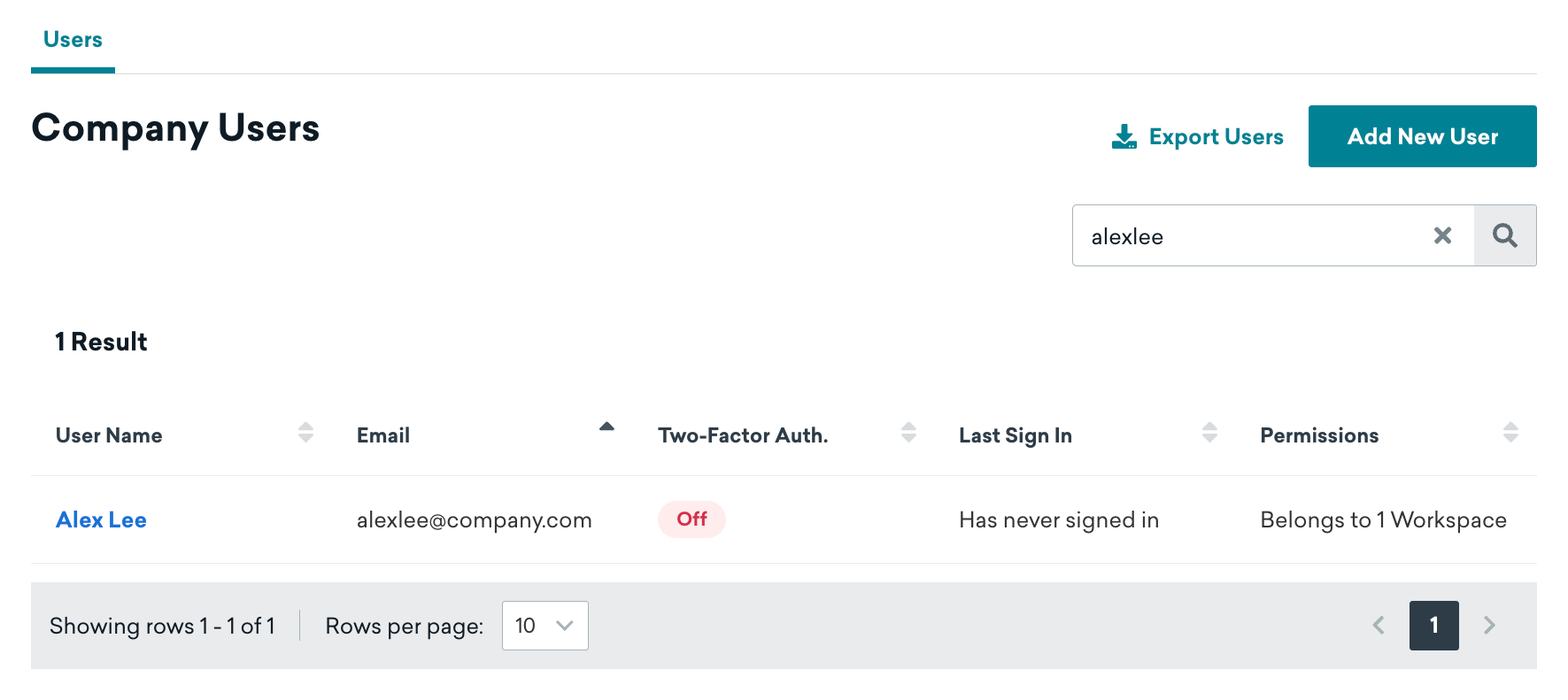
To edit a user’s current admin, company, or workspace permissions, go to Settings > User Management > Company Users, then select their name.
Admin
Admins have access to all features and the ability to modify any company setting. They can:
- Change approval settings
- Add, edit, delete, suspend, or unsuspend other Braze users
- Export Braze users as a CSV
To grant or remove admin privileges, select This user is an admin, then select Update user.

If you remove admin privileges from a user, they won’t be able to access Braze until you assign them at least one company-level or workspace-level permission.
Company
To manage a user’s company-level permissions, check or uncheck the box next to each permission. When you’re finished, select Update user. For a description of each permission, see Company permissions.
Workspace
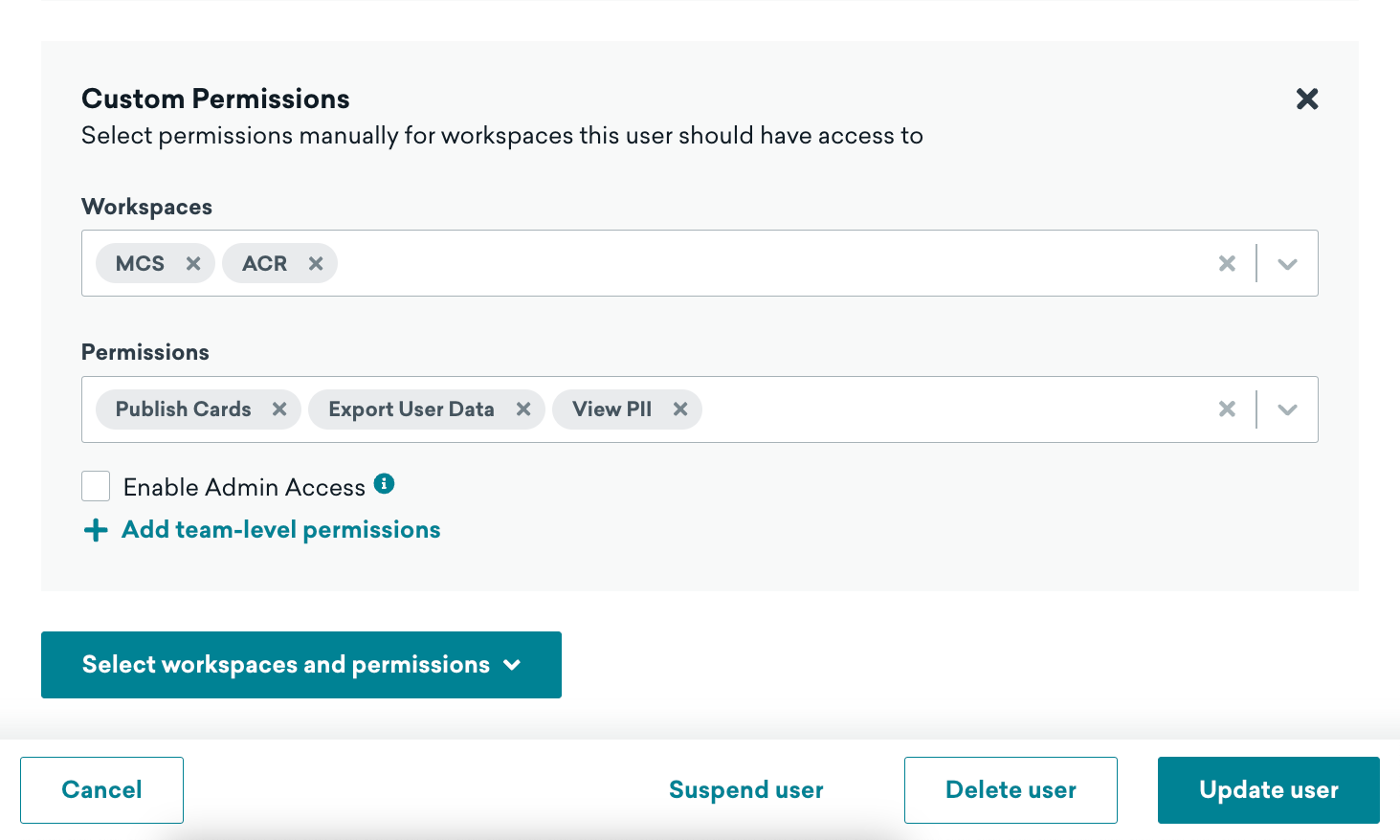
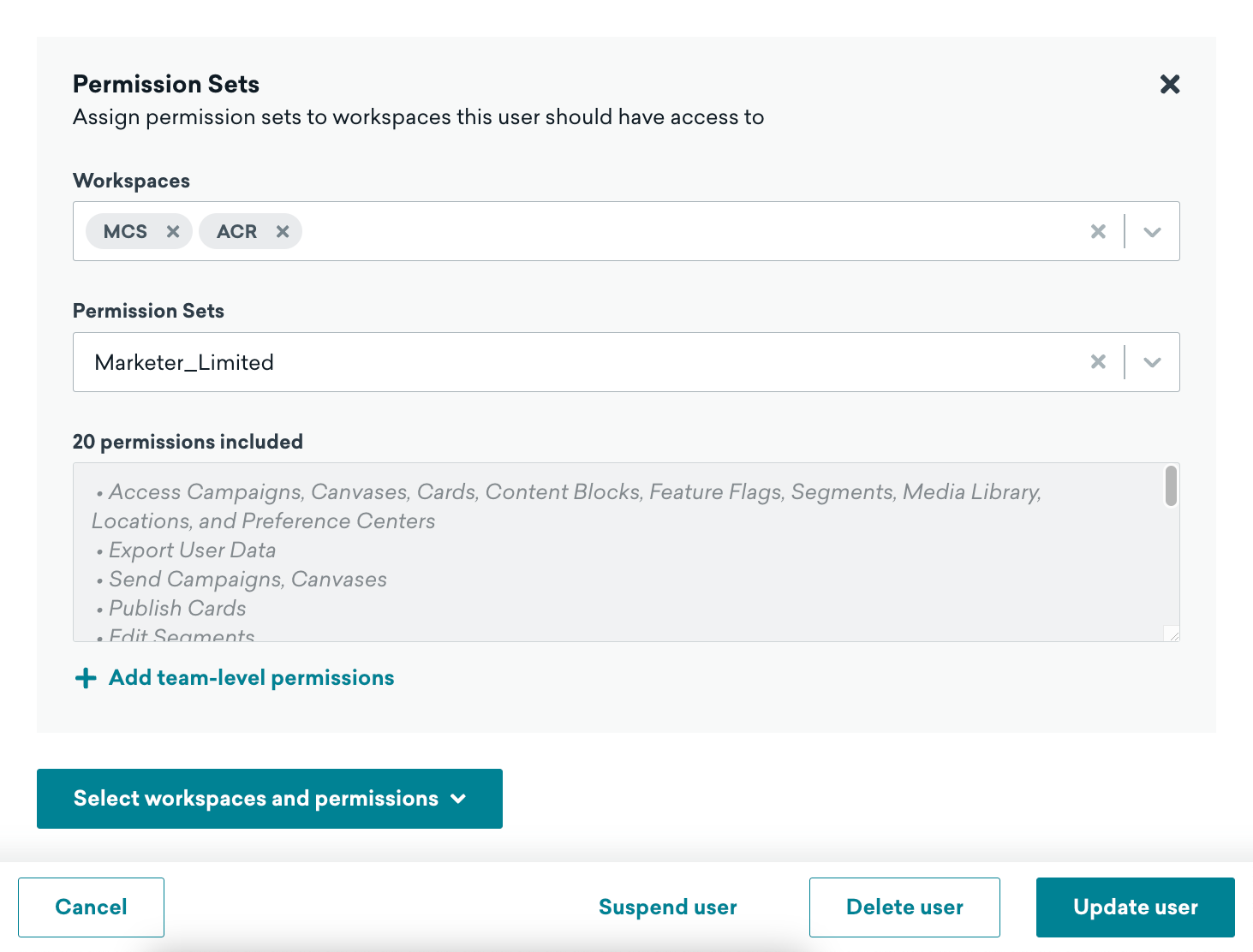
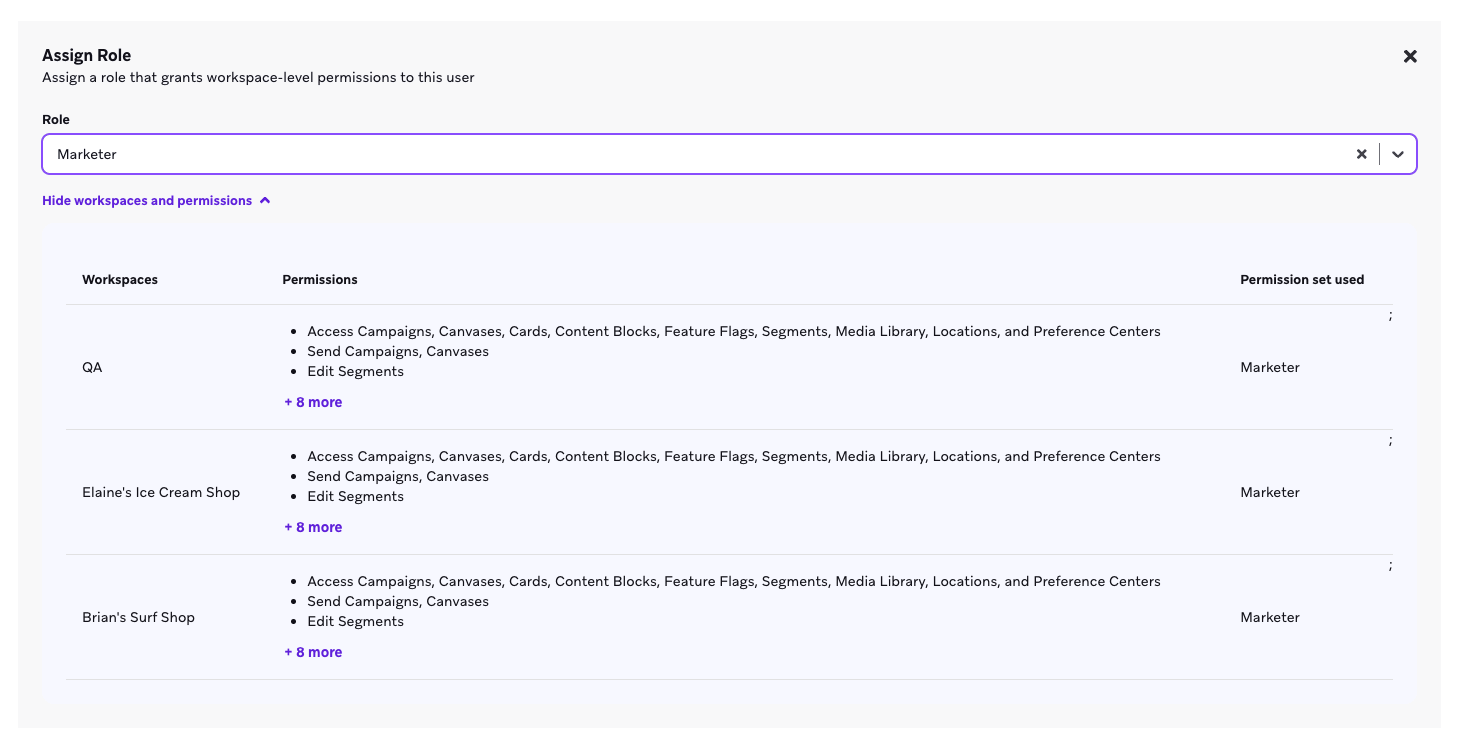
You can give a user different permissions for each workspace they belong to in Braze. To manage their workspace-level permissions, select Select workspaces and permissions, then choose their permissions manually or assign one or more permission sets or a role you previously created. If you need to give a user different permissions for different workspaces, repeat this process as many times as needed. For a description of each permission, see List of permissions.
Under Workspaces, choose one or more workspaces from the dropdown. Then, under Permissions, select one or more permissions. They will be assigned these permissions only for the workspaces you have selected. Optionally, you can select Assign workspace admin access if you’d like to give them full permissions for this workspace instead.
When you’re finished, select Update user.
Under Workspaces, choose one or more workspaces from the dropdown. Then, under Permission Sets, choose one or more permission sets. The user gets every permission included in the selected permission sets, only for the workspaces you selected.
When you’re finished, select Update user.
Under Workspaces, choose one or more workspaces from the dropdown. Then, under Role, choose one role. They will be assigned these permissions only for the workspaces you have selected.
When you’re finished, select Update user.
Exporting user permissions
To download a list of your users and their permissions, go to Settings > User Management > Company Users, then select Export Users. A CSV file will be sent to your email address shortly.
List of permissions
Company permissions apply to the whole company. All other permissions on this list are workspace-level, and you can add them to permission sets and roles.
Company
Company permissions are assigned to each user from the Company tab of their user page. You can’t add them to permission sets or roles.
| Permission name | Description |
|---|---|
| Manage company settings | Allows users to modify permission settings and sender verification. |
| Create and delete workspaces | Allows users to create and delete workspaces. |
| View domain settings | Allows users to view verified domains. |
| Edit domain settings | Allows users to add and delete verified domains and view custom domains. |
| Delete dashboard users | Allows users to delete other dashboard users. Users with this permission can’t delete Company Admins or their own account. To add users or edit their details and permissions, users also need the “Edit Dashboard Users” permission, which is assigned at the workspace or team level. |
Messaging
| Product area | Permission | Definition |
|---|---|---|
| Campaigns | View Campaigns | View campaigns |
| Campaigns | Launch Campaigns | Start, stop, pause, or resume existing campaigns |
| Campaigns | Archive Campaigns | Move campaigns to archive |
| Campaigns | Edit Campaigns | Create and update campaigns. This permission also lets users opt a specific campaign into or out of workspace-level messaging controls such as workspace quiet hours, Message Prioritization, and frequency capping. |
| Campaigns | Approve and Deny Campaigns | Approve or deny campaigns. The approval workflow for campaigns must be turned on for this permission to apply. |
| Canvas | View Canvases | View Canvases |
| Canvas | Archive Canvases | Move Canvases to archive |
| Canvas | Edit Canvases | Create and update Canvases. This permission also lets users opt a specific Canvas into or out of workspace-level messaging controls such as workspace quiet hours, Message Prioritization, and frequency capping. |
| Canvas | Launch Canvases | Start, stop, pause, or resume existing Canvases |
| Canvas | Approve and Deny Canvases | Approve or deny Canvases. The approval workflow for Canvases must be turned on for this permission to apply. |
| Feature flags | View Feature Flags | View feature flags |
| Feature flags | Archive Feature Flags | Move feature flags to archive |
| Feature flags | Edit Feature Flags | Create and update feature flags |
| Frequency Caps | View Frequency Capping Rules | View Frequency Capping Rules |
| Frequency Caps | Edit Frequency Capping Rules | Create and update Frequency Capping Rules |
| Landing pages | View Landing Pages | View landing pages |
| Landing pages | Publish Landing Pages | Make a draft landing page active |
| Landing pages | Edit Landing Page Drafts | Create and save landing page drafts |
| Message Archiving Settings | View Message Archiving Settings | View Message Archiving settings without making changes |
| Message Archiving Settings | Edit Message Archiving Settings | Create and update Message Archiving settings |
| Message Prioritization | View Message Prioritization Settings | View Message Prioritization settings without making changes |
| Message Prioritization | Edit Message Prioritization Settings | Create and update Message Prioritization settings |
| Message Prioritization | Delete Message Prioritization Settings | Delete Message Prioritization settings |
| Quiet Hours | View Quiet Hours Settings | View workspace quiet hours settings without making changes |
| Quiet Hours | Edit Quiet Hours Settings | Create and update workspace quiet hours settings |
| WhatsApp Flows | View WhatsApp Flows | View all WhatsApp Flows |
Audience
| Product area | Permission | Definition |
|---|---|---|
| Global Control Group | View Global Control Group | View Global Control Group setup page |
| Global Control Group | Edit Global Control Group | Create and save changes to the Global Control Group. Users with the “Edit Global Control Group” permission must also be granted permissions for “Edit Campaigns” and “Edit Canvases”. Users with the “Edit Global Control Group” permission are also granted the “View Global Control Group” permission. |
| Locations | Archive Locations | Move locations to archive |
| Locations | View Locations | View locations |
| Locations | Edit Locations | Create and edit locations |
| Segments | View Segments | View segments. Users must have the “View Segments” permission to have the “Edit Segments” or “Archive Segments” permission |
| Segments | View Audience Population | Allows users to view audience size and reachable user counts across campaigns, Canvases, and segments. This permission is managed alongside “View Segments”. |
| Segments | Archive Segments | Archive and un-archive segments. Users with the “Archive Segments” permission must also be granted the “View Segments” permission |
| Segments | Edit Segments | Create and update Segments. Users with the “Edit Segments” permission must also be granted the “View Segments permission” |
| User Data | View Import Users | View CSV user imports without making changes |
| User Data | Import Users | Upload users to the dashboard |
| User Data | Edit User Data | Create and update user data |
| User Data | Export User Data | Download users from the dashboard |
| Duplicate Users | View User Merge Records | View a list of user merge records |
| Users | View User Profiles (PII Redacted) | View user profiles in a PII compliant manner. Users with this permission can’t save or launch campaigns that reference custom attributes marked as PII unless they also have the “View Custom Attributes Marked as PII” permission. The “View User Profiles (PII Redacted)” permission must be enabled before use. Contact your customer success manager to enable it for your workspace. |
| Users | View User Event Properties | View event properties in the Event History tab on user profiles |
| Duplicate Users | Merge Duplicate Users | Combine duplicate users into one user. Duplicates are removed after merging |
| Delete Users | View User Deletion Records | View a list of user deletion records |
| Delete Users | Delete Users | Permanently delete users from the dashboard individually or in bulk |
Template
| Product area | Permission | Definition |
|---|---|---|
| Banner Templates | View Banner Templates | View banner templates |
| Banner Templates | Archive Banner Templates | Move banner templates to archive |
| Banner Templates | Edit Banner Templates | Create and update banner templates |
| Canvas Templates | View Canvas Templates | View Canvas templates |
| Canvas Templates | Archive Canvas Templates | Move Canvas templates to archive |
| Canvas Templates | Create and Edit Canvas Templates | Create and update Canvas templates |
| Content Blocks | View Content Blocks | View Content Blocks |
| Content Blocks | Launch Content Blocks | Publish draft Content Blocks, and edit, archive, and unarchive launched Content Blocks |
| Content Blocks | Archive Content Blocks | Move Content Blocks to archive |
| Content Blocks | Edit Content Blocks | Create Content Blocks and edit draft Content Blocks |
| Email Link Templates | View Email Link Templates | View link templates without making changes |
| Email Link Templates | Edit Email Link Templates | Create and update link templates |
| Email Templates | View Email Templates | View email templates |
| Email Templates | Archive Email Templates | Move email templates to archive |
| Email Templates | Edit Email Templates | Create and update email templates |
| IAM Templates | View IAM Templates | View in-app message templates without making changes |
| IAM Templates | Archive IAM Templates | Move IAM templates to archive |
| IAM Templates | Edit IAM Templates | Create and update in-app message templates |
| Landing Page Templates | View Landing Page Templates | View landing page templates |
| Landing Page Templates | Archive Landing Page Template | Move landing page templates to archive |
| Landing Page Templates | Edit Landing Page Templates | Create and update landing page templates |
| Webhook Templates | View Webhook Templates | View webhook templates without making changes |
| Webhook Templates | Archive Webhook Templates | Move webhook templates to archive |
| Webhook Templates | Edit Webhook Templates | Create and update webhook templates |
| Whatsapp Message Templates | View WhatsApp Message Templates | Allows users to view WhatsApp message templates |
| Whatsapp Message Templates | Edit WhatsApp Message Templates | Allows users to create WhatsApp message templates in the template builder. This feature is currently in early access. |
| WhatsApp Message Templates From Meta | View WhatsApp Message Templates From Meta | View All WhatsApp Templates |
Partner integrations
| Product area | Permission | Definition |
|---|---|---|
| Currents Integrations | View Currents Integrations | View Currents integrations and Data Sharing (Snowflake Data Sharing and Databricks Delta Sharing) |
| Currents Integrations | Edit Currents Integrations | Create, update, and delete Currents integrations and Data Sharing shares |
| Technology Partners | Edit Technology Partners | Create and update technology partners |
Data settings
| Product area | Permission | Definition |
|---|---|---|
| Catalogs | View Catalogs | View catalogs and selections |
| Catalogs | Delete Catalogs | Permanently delete catalogs |
| Catalogs | Export Catalogs | Download catalogs from the dashboard |
| Catalogs | Edit Catalogs | Create and update catalogs and selections |
| Cloud Data Ingestion | Edit Cloud Data Ingestion | Create, update, and delete sources and syncs |
| Custom Attributes | View Custom Attributes | View custom attributes and usage report |
| Custom Attributes | Export Custom Attributes | Download custom attributes from the dashboard |
| Custom Attributes | Delete Custom Attributes | Permanently delete custom attributes |
| Custom Attributes | Blocklist Custom Attributes | Add custom attributes to a blocklist that restricts use in the dashboard |
| Custom Attributes | Edit Custom Attributes | Create and update custom attributes |
| Custom Event Property Segmentation | Edit Custom Event Property Segmentation | Enable and disable segmentation for custom event properties |
| Custom Events | View Custom Events | View custom events and usage report, and add custom events to the daily analytics report email |
| Custom Events | Export Custom Events | Download custom events from the dashboard |
| PII | View PII | View PII |
| Custom Events | Delete Custom Events | Permanently delete custom events |
| Custom Events | Blocklist Custom Events | Add custom events to a blocklist that restricts use in the dashboard |
| Custom Events | Edit Custom Events | Create and update custom events |
| Products | View Products | View products |
| Products | Blocklist Products | Add products to a blocklist that restricts use in the dashboard |
| Products | Edit Products | Create and update products |
| Purchase Property Segmentation | Edit Purchase Property Segmentation | Enable and disable segmentation for purchase event properties |
Settings
| Product area | Permission | Definition |
|---|---|---|
| API Identifiers | View API identifiers | View API identifiers and other identifiers |
| API Keys | View API Keys | View API keys |
| API Keys | Edit API Keys | Create and update API keys |
| API Limits | View API Limits | View API rate limits |
| API Usage Alerts | View API Usage Alerts | View API usage alerts |
| API Usage Alerts | Edit API Usage Alerts | Create and update API usage alerts |
| API Usage Data | View API Usage Dashboard | View the API usage dashboard |
| App Settings | Edit App Settings | Create, edit, and update apps within app settings |
| App Settings | View App Settings | View App Settings page |
| Audience Sync Settings | View Audience Sync Settings | View all settings of their connected Audience Sync partners |
| Dashboard Users | Edit Dashboard Users | View, create, and edit company users. To delete company users, a user needs the company-level Delete dashboard users permission. |
| Email Settings | View Email Settings | View Email Preferences |
| Email Settings | Edit Email Settings | Enable and update Email Preferences |
| Event User Log | View Event User Log | View event user logs |
| Internal Groups | View Internal User Groups | View internal groups |
| Internal Groups | Delete Internal User Groups | Delete internal groups |
| Internal Groups | Edit Internal User Groups | Create and update internal groups |
| Message Activity Log | View Message Activity Log | View message activity logs |
| Multi Language Settings | View Localization Settings | View Multi Language locale settings page |
| Multi Language Settings | Delete Localization Settings | Delete Multi Language locale |
| Multi Language Settings | Edit Localization Settings | Create Multi Language locales |
| Preference Centers | View Preference Centers | View preference centers |
| Preference Centers | Edit Preference Centers | Create and update preference centers |
| Preference Centers | Launch Preference Centers | Make a draft Preference Center active or update an existing one |
| Push Settings | View Push Settings | View Push settings |
| Push Settings | Edit Push Settings | Create and update Push settings |
| SDK Debugger | View SDK Debugger | View SDK Debugger or debugging sessions |
| SDK Debugger | Edit SDK Debugger | Create and download SDK Debugger sessions |
| Tags | View Tags | View tags |
| Tags | Delete Tags | Permanently delete tags |
| Tags | Edit Tags | Create and update tags |
| Teams | View Teams | View Teams |
| Teams | Archive Teams | Move teams to archive |
| Teams | Edit Teams | Create and update teams |
| WhatsApp Settings | View WhatsApp Settings | View all WhatsApp channel settings |
Decisioning Studio
| Product area | Permission | Definition |
|---|---|---|
| Decisioning Studio Agents | View Decisioning Studio Agent | View Decisioning Studio Agents configuration without making changes |
| Decisioning Studio Audience | View Decisioning Studio Audience | See audience details on Decisioning Studio Agent configuration summaries |
Other
| Product area | Permission | Definition |
|---|---|---|
| App Usage | View Usage Data | View usage data |
| Billing | View Billing Details | View billing details |
| Custom Agents | View Agent Console AI Agents | Allows users to view custom AI agents |
| Custom Agents | Archive Agent Console AI Agents | Allows users to archive custom AI agents |
| Custom Agents | Edit Agent Console AI Agents | Allows users to create and update custom AI agents |
| Custom Attributes Marked As PII | View Custom Attributes Marked as PII | View custom attributes marked as PII |
| Dashboard Reports | View Dashboard Reports | View reports without making changes |
| Dashboard Reports | Delete Dashboard Reports | Permanently delete reports |
| Dashboard Reports | Edit Dashboard Reports | Create and update reports |
| Domain Settings | Edit Domain Settings | Add delegated domains and custom domains under Verified Domains |
| Field Level Encryption | Edit Identifier Field-Level Encryption | Enable and update Field-Level Encryption settings |
| Media Library Assets | View Media Library Assets | View media library assets |
| Media Library Assets | Delete Media Library Assets | Remove media library assets from the UI. Deleted assets remain hosted by Braze to prevent breaking messages that reference them. To permanently delete an asset, contact Braze Support. |
| Media Library Assets | Edit Media Library Assets | Create and update media library assets |
| Media Library Assets | Replace Media Library Assets | Replace the file of an existing media library asset while keeping its URL and asset ID stable |
| Messaging Rate Limits | View Messaging Rate Limits | View workspace-level messaging rate limits |
| Messaging Rate Limits | Edit Messaging Rate Limits | Configure and edit workspace-level messaging rate limits |
| Operator | Use BrazeAI OperatorTM | Access and use Braze Operator to answer questions, navigate setup, troubleshoot issues, and brainstorm ideas |
| Placements | View Placements | View Banner placement |
| Placements | Archive Placements | Move Banner placements to archive |
| Placements | Edit Placements | Create and update Banner placements |
| Promotion Codes | View Promotion Codes | View promotion codes |
| Promotion Codes | Export Promotion Codes | Download a list of promotion codes from the dashboard |
| Promotion Codes | Edit Promotion Codes | Create and update promotion codes |
| Subscription Groups | Edit Subscriptions | Create and update subscription groups |
| Transformations | Edit Data Transformation | Create and update data transformations |
| Transformations | View Data Transformation | View data transformations |
| Support Tickets | Create Support Ticket | Create and update Support tickets |