Workspace time zones
Workspace time zones allow admins to define specific time zones for individual workspaces. This makes scheduled campaigns and Canvases (that don’t use local time or Intelligent Timing) send according to the workspace’s designated time zone, rather than the overarching company time zone.

Workspace time zones for message sending are rolling out gradually. You may not see these settings in your dashboard yet.
By default, a new workspace inherits the time zone set for your company. Admins can override this default for one or more workspaces with workspace time zones. When a workspace time zone is set, scheduled campaigns and Canvases within that workspace reference that new time zone for their send times.
For example, if a workspace time zone is set to PST, and a campaign within that workspace is scheduled to send at 3 pm PST, it delivers at 3 pm PST. This holds true even if your company’s overall time zone is different (such as EST, where 3 pm PST is 6 pm EST).
Manage workspace time zones
If you’re an admin, you can access and manage workspace time zones by going to Settings > Admin Settings > Workspace Time Zones.
Here, you can view a list of all your workspaces, their set time zone, and the last time the time zone was edited. Use the search bar to find specific workspaces by name.
Setting a time zone

It may take up to a few minutes for time zone updates to take effect.
- Locate the desired workspace in the list.
- Select the Edit icon next to the workspace name.
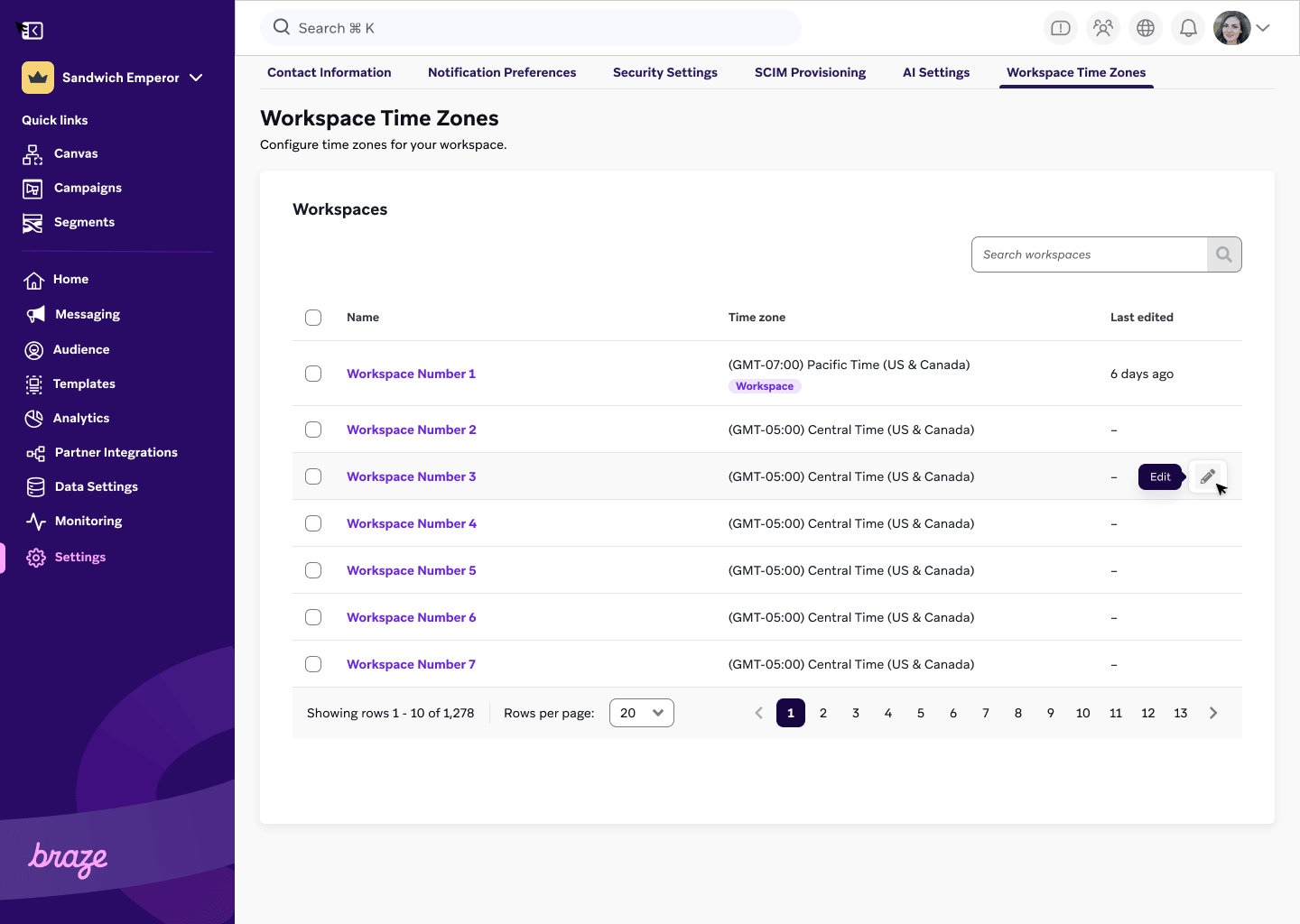
- In the dropdown menu, select the desired time zone for that workspace.
- Select Save.
You can apply a specific time zone to multiple workspaces at one time by doing the following:
- Select the boxes next to all the workspaces you want to update.
- Select Edit time zone.
- From the dropdown menu, select a time zone to apply to all the selected workspaces.
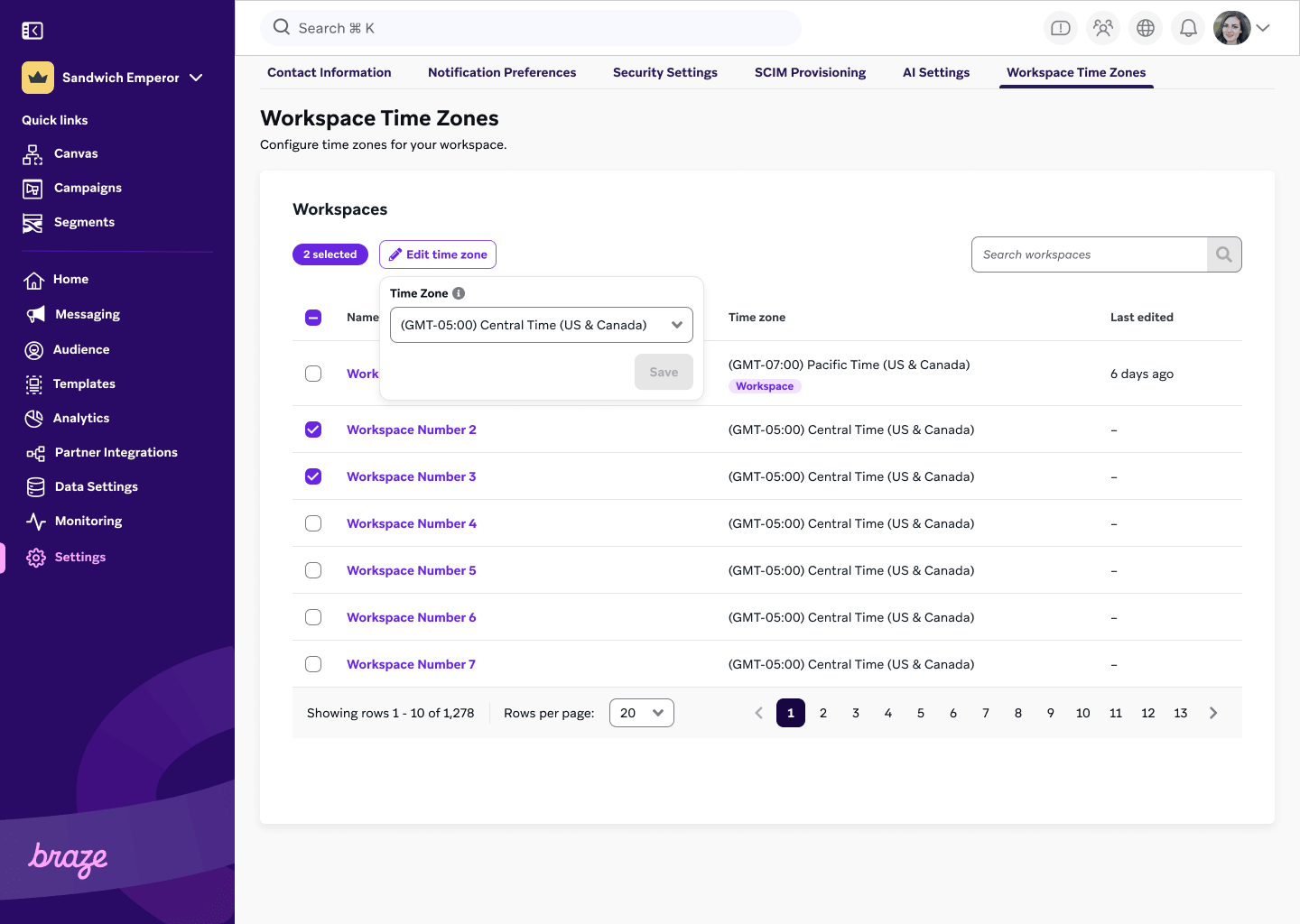
- Select Save.
Impact on campaigns and Canvases
Inform relevant teams and stakeholders within each workspace about any time zone changes to avoid confusion about campaign schedules.
- Local time and Intelligent Timing campaigns: Campaigns and Canvases that use a user’s local time or Intelligent Timing for delivery continue to function as before and are not affected by workspace time zones.
- Scheduled campaigns and Canvases: Any scheduled campaign or Canvas that doesn’t use the user’s local time or Intelligent Timing for delivery sends based on the workspace’s selected time zone.
- Campaigns scheduled before a time zone change: If you scheduled a campaign or Canvas before changing the workspace time zone, Braze keeps the original send time and does not reschedule it. For example, if a campaign is set to send at 7 pm PST and the workspace time zone is changed to EST, the campaign still sends at 7 pm PST (which now corresponds with 10 pm EST). The system continues to reference the original time, but interprets it through the new workspace time zone.
Impact on date-based audience filters
When a workspace time zone is updated, audience filters that use date-only criteria (where no specific time is provided) are re-evaluated based on the new time zone’s boundaries.
For filters such as “Last did custom event X after,” Braze uses the workspace time zone to determine the start and end of the calendar day. Changing this setting shifts the 11:59 pm cutoff point for that specific date.
Example
A workspace updates its time zone from Eastern Time (EST) to Pacific Time (PST).
- Previous cutoff time: 11:59 pm EST
- New cutoff time: 11:59 pm PST (which is 2:59 am EST the following day)
Following this change, a user who performs the custom event at 10 pm PST on March 6, 2026 (which is 1 am EST on March 7, 2026) is now included in the audience, as they fell within the PST calendar boundary for that date.
Impact on performance data
Updating your workspace time zone affects how performance data is aggregated and displayed in your dashboard. Because analytics for data like Daily Active Users (DAU) rely on the workspace time zone to define the start and end of a 24-hour day, a change to this setting shifts those reporting windows.
When you change the time zone, you may notice fluctuations or “shifts” in your historical data. This occurs because the 12 am to 11:59 pm window has moved relative to UTC.
Consider the following example for a workspace that moves its time zone from UTC to PST (UTC-8):
- Before change: A “day” for reporting is measured from 12 am UTC to 11:59 pm UTC.
- After change: A “day” for reporting is now measured from 12 am PST to 11:59 pm PST.
As a result, an event that occurred at 1 am UTC on January 1 would have previously been counted toward January 1 stats. After the change to PST, that same event (which occurred at 5 pm PST on December 31) would be attributed to the previous day’s metrics in the updated report.