CSV import
Learn how to record and update user attributes and custom events using CSV import.
About CSV import
You can use CSV import to record and update the following user attributes and custom events.
| Type | Definition | Example | Maximum file size |
|---|---|---|---|
| Default Attributes | Reserved user attributes recognized by Braze. | first_name, email |
500 MB |
| Custom Attributes | User attributes unique to your business. | last_destination_searched |
500 MB |
| Custom Events | Events unique to your business that represent user actions. | trip_booked |
50 MB |
Using CSV import
Step 1: Download a CSV template
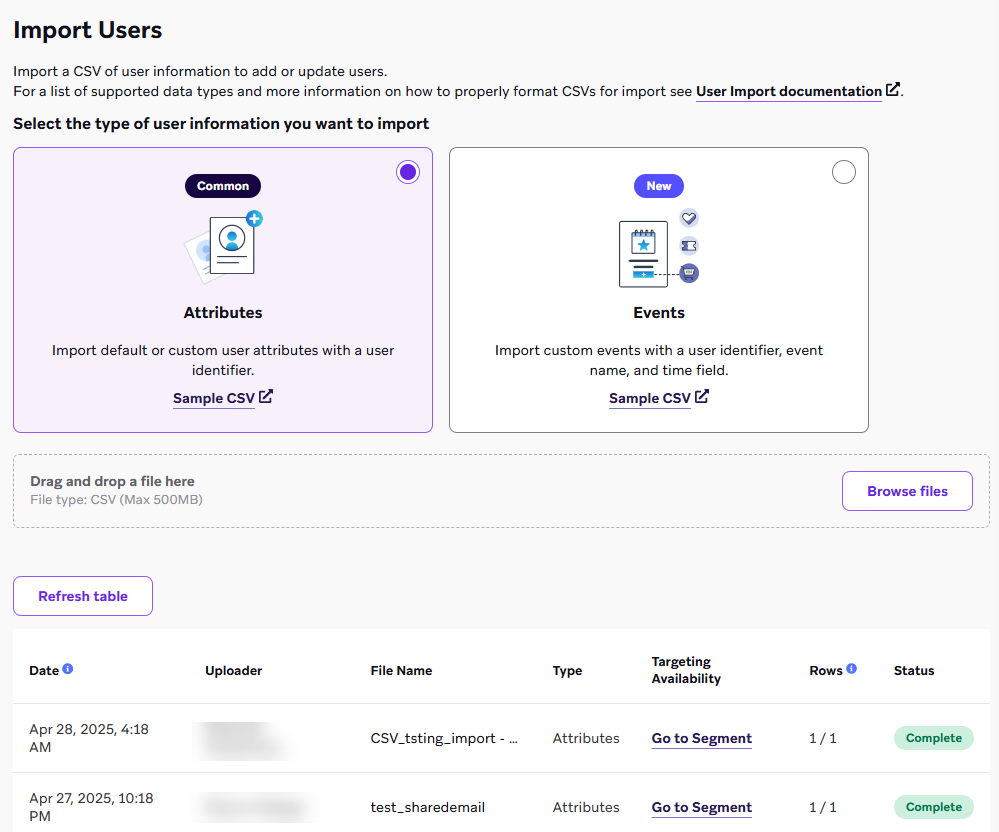
To open CSV import, go to Audiences > Import Users. Here, you’ll find a table that lists details about the most recent imports, such as the upload date, uploader’s name, file name, targeting availability, number of imported rows, and status of the import.
To get you started with your CSV, download a template for attributes or events.
Step 2: Choose an identifier
The CSV you import will need a dedicated identifier. You can choose from the following:
When importing your customer data, you can use an external_id to serve as each customer’s unique identifier. When you provide an external_id in your import, Braze updates any existing user with the same external_id or creates a newly identified user with that external_id set if one is not found.
- Download: CSV Attributes Import Template: External ID
- Download: CSV Events Import Template: External ID
If you’re uploading a mix of users with an external_id and users without, you need to create one CSV for each import. One CSV can’t contain both external_ids and user aliases.
To target users who don’t have an external_id, you can import a list of users with user aliases. An alias serves as an alternative unique user identifier, and can be helpful if you are trying to market to anonymous users who haven’t signed up or made an account with your app.
If you are uploading or updating user profiles that are alias only, you must have the following two columns in your CSV:
user_alias_name: A unique user identifier; an alternative to theexternal_iduser_alias_label: A common label by which to group user aliases
user_alias_name |
user_alias_label |
last_name |
email |
sample_attribute |
|---|---|---|---|---|
| 182736485 | my_alt_identifier | Smith | [email protected] | TRUE |
| 182736486 | my_alt_identifier | Nguyen | [email protected] | FALSE |
When you provide both a user_alias_name and user_alias_label in your import, Braze updates any existing user with the same user_alias_name and user_alias_label. If a user isn’t found, Braze creates a newly identified user with that user_alias_name set.
You can’t use a CSV import to update an existing user with a user_alias_name if they already have an external_id. Instead, this creates a new user profile with the associated user_alias_name. To associate an alias-only user with an external_id, use the Identify users endpoint.
To update existing user profiles in Braze by using an internal Braze ID value instead of an external_id or user_alias_name and user_alias_label value, specify braze_id as a column header.
This can be helpful if you exported user data from Braze through our CSV export option within segmentation and want to add a new custom attribute to those existing users.
You can’t use a CSV import to create a new user using braze_id. This method can only be used to update pre-existing users within the Braze platform.
The braze_id value might be labeled as Appboy ID in CSV exports from the Braze dashboard. This ID will be the same as the braze_id for a user, so you can rename this column to braze_id when you re-import the CSV.
You can omit an external ID or user alias and use either an email address or phone number to import users. Before importing a CSV file with email addresses or phone numbers, check for the following:
- Verify that you don’t have any external IDs or user aliases for these profiles in your CSV file. If you do, Braze will prioritize using the external ID or user alias before the email address to identify profiles.
- Confirm that your CSV file is formatted properly.
If you include both email addresses and phone numbers in your CSV file, the email address is prioritized over the phone number when looking up profiles.
If an existing profile has that email address or phone number, that profile is updated, and Braze doesn’t create a new profile. If there are multiple profiles with that same email address, Braze will use the same logic as the /users/track endpoint where the most recently updated profile will be updated.
If a profile with that email address or phone number doesn’t exist, Braze creates a new profile with that identifier. You can use the /users/identify endpoint to identify this profile later. To delete a user profile, you can also use the /users/delete endpoint.
Step 3: Build your CSV file
You can upload either of the following data types as a single CSV file. To upload more than one data type, upload multiple CSV files.
- User Attributes: This includes both default and custom user attributes. Default user attributes are reserved keys in Braze (such as
first_nameoremail) and custom attributes are user attributes unique to your business (such aslast_destination_searched). - Custom Events: These are unique to your business and reflect actions a user has taken, such as
trip_bookedfor a travel booking app.
When you’re ready to start building your CSV file, refer to the following information:
Required identifiers
While external_id is not required, you must include one of the following identifiers as a header in your CSV file. For details about each one, review Choose an identifier.
external_idbraze_iduser_alias_nameanduser_alias_labelemailphone
Custom attributes
The following data types can be used as custom attributes for CSV import. Column headers that don’t exactly match a default attribute are imported as custom attributes in Braze.
| Data Type | Description |
|---|---|
| Datetime | Must be stored in ISO-8601 format. |
| Boolean | Accepts true or false. |
| Number | Must be an integer or float with no spaces or commas. Floats must use a period (.) as the decimal separator. |
| String | Can contain commas if the value is wrapped in double quotation marks (""). |
| Blank | Blank values won’t overwrite existing values on the user profile, and you don’t need to include all existing user attributes in your CSV file. |
Arrays, push tokens, and custom event data types aren’t supported in user import, as commas in your CSV file will be interpreted as a column separator and cause errors while parsing your file.
To upload these kinds of values, use the /users/track endpoint or Cloud Data Ingestion instead.
Default attributes
When importing default attributes, the column headers you use must exactly match the spelling and capitalization of default user attributes. Otherwise, Braze detects these as custom attributes instead.
The following default attributes are available for user import.
| User Profile Field | Data Type | Description | Required? |
|---|---|---|---|
external_id |
String | A unique user identifier for your customer. | Conditionally. See Required Identifiers. |
user_alias_name |
String | A unique user identifier for anonymous users that’s an alternative to external_id. Must be used with user_alias_label. |
Conditionally. See Required Identifiers. |
user_alias_label |
String | A common label by which to group user aliases. Must be used with user_alias_name. |
Conditionally. See Required Identifiers. |
first_name |
String | The first name of your users as they have indicated (for example, Jane). |
No |
last_name |
String | The last name of your users as they have indicated (for example, Doe). |
No |
email |
String | The email of your users as they have indicated (for example, [email protected]). |
No |
country |
String | Country codes must be passed to Braze in the ISO-3166-1 alpha-2 standard (for example, GB). |
No |
dob |
String | Must be passed in the format “YYYY-MM-DD” (for example, 1980-12-21). This imports your user’s Date of Birth and enables you to target users whose birthday is “today”. |
No |
gender |
String | “M”, “F”, “O” (other), “N” (not applicable), “P” (prefer not to say), or nil (unknown). | No |
home_city |
String | The home city of your users as they have indicated (for example, London). |
No |
language |
String | Language must be passed to Braze in the ISO-639-1 standard (for example, en). Refer to our list of accepted languages. |
No |
phone |
String | A telephone number as indicated by your users, in E.164 format (for example, +442071838750). Refer to User Phone Numbers for formatting guidance. |
No |
email_open_tracking_disabled |
Boolean | true or false accepted. Set to true to disable the open tracking pixel from being added to all future emails sent to this user. Available for SparkPost and SendGrid only. | No |
email_click_tracking_disabled |
Boolean | true or false accepted. Set to true to disable the click tracking for all links within a future email, sent to this user. Available for SparkPost and SendGrid only. | No |
email_subscribe |
String | Available values are opted_in (explicitly registered to receive email messages), unsubscribed (explicitly opted out of email messages), and subscribed (neither opted in nor out). |
No |
push_subscribe |
String | Available values are opted_in (explicitly registered to receive push messages), unsubscribed (explicitly opted out of push messages), and subscribed (neither opted in nor out). |
No |
time_zone |
String | Time zone must be passed to Braze in the same format as the IANA Time Zone Database (for example, America/New_York or Eastern Time (US & Canada)). |
No |
date_of_first_session date_of_last_session |
String | May be passed in one of the following ISO 8601 formats: “YYYY-MM-DD” “YYYY-MM-DDTHH:MM:SS+00:00” “YYYY-MM-DDTHH:MM:SSZ” “YYYY-MM-DDTHH:MM:SS” (for example, 2019-11-20T18:38:57) | No |
subscription_group_id |
String | The id of your subscription group. This identifier can be found on the subscription group page of your dashboard. |
No |
subscription_state |
String | The subscription state for the subscription group specified by subscription_group_id. Allowed values are unsubscribed (not in subscription group) or subscribed (in subscription group). |
No, but strongly recommended if subscription_group_id is used |
Updating subscription group status (optional)
Additionally, you can add users to email or SMS subscription groups through user import. This is particularly useful for SMS, because a user must be enrolled into an SMS subscription group to be messaged with the SMS channel. For more information, refer to SMS subscription groups.
If you are updating subscription group statuses, you must have the following two columns in your CSV:
subscription_group_id: Theidof the subscription group.subscription_state: Available values areunsubscribed(not in the subscription group) orsubscribed(in the subscription group).
| external_id | first_name | subscription_group_id | subscription_state |
|---|---|---|---|
| A8i3mkd99 | Colby | 6ff593d7-cf69-448b-aca9-abf7d7b8c273 | subscribed |
| k2LNhj8Ks | Tom | aea02307-a91e-4bc0-abad-1c0bee817dfa | subscribed |
Only a single subscription_group_id can be set per row in the user import. Different rows can have different subscription_group_id values. However, if you need to enroll the same users into multiple subscription groups, you’ll need to do multiple imports.
Required identifiers
While external_id is not required, you must include one of the following identifiers as a header in your CSV file. For details about each one, review Choose an identifier.
external_idbraze_iduser_alias_nameanduser_alias_labelemailphone
Custom event fields
In addition to the following, your CSV may also contain additional column headers for event properties. These properties should have a column header of <event_name>.properties.<property name>.
For example, the custom event trip_booked may have the properties destination and duration. These can be imported by having the column headers trip_booked.properties.destination and trip_booked.properties.duration.
| User Profile Field | Data Type | Information | Required? |
|---|---|---|---|
external_id |
String | A unique user identifier for your user. | Conditionally. See Required identifiers. |
braze_id |
String | A Braze assigned identifier for your user. | Conditionally. See Required identifiers. |
user_alias_name |
String | A unique user identifier for anonymous users, that’s an alternative to external_id. Must be used with user_alias_label. |
Conditionally. See Required identifiers. |
user_alias_label |
String | A common label by which to group user aliases. Must be used with user_alias_name. |
Conditionally. See Required identifiers. |
email |
String | The email of your users as they have indicated (for example, [email protected]). |
No, and can only be used in the absence of other identifiers. See the following note. |
phone |
String | A telephone number as indicated by your users, in E.164 format (for example, +442071838750). Refer to User Phone Numbers for formatting guidance. |
No, and can only be used in the absence of other identifiers. See the following note. |
name |
String | A custom event of your users. | Yes |
time |
String | The time of the event. May be passed in one of the following ISO-8601 formats: “YYYY-MM-DD” “YYYY-MM-DDTHH:MM:SS+00:00” “YYYY-MM-DDTHH:MM:SSZ” “YYYY-MM-DDTHH:MM:SS” (for example, 2019-11-20T18:38:57) | Yes |
<event name>.properties.<property name> |
Multiple | An event property associated with a custom event. An example is trip_booked.properties.destination |
No |
Step 4: Upload your file
To upload your file, select Attributes or Events, click Browse Files, and upload your CSV. Braze displays a preview of the first few rows and a summary of the detected fields.
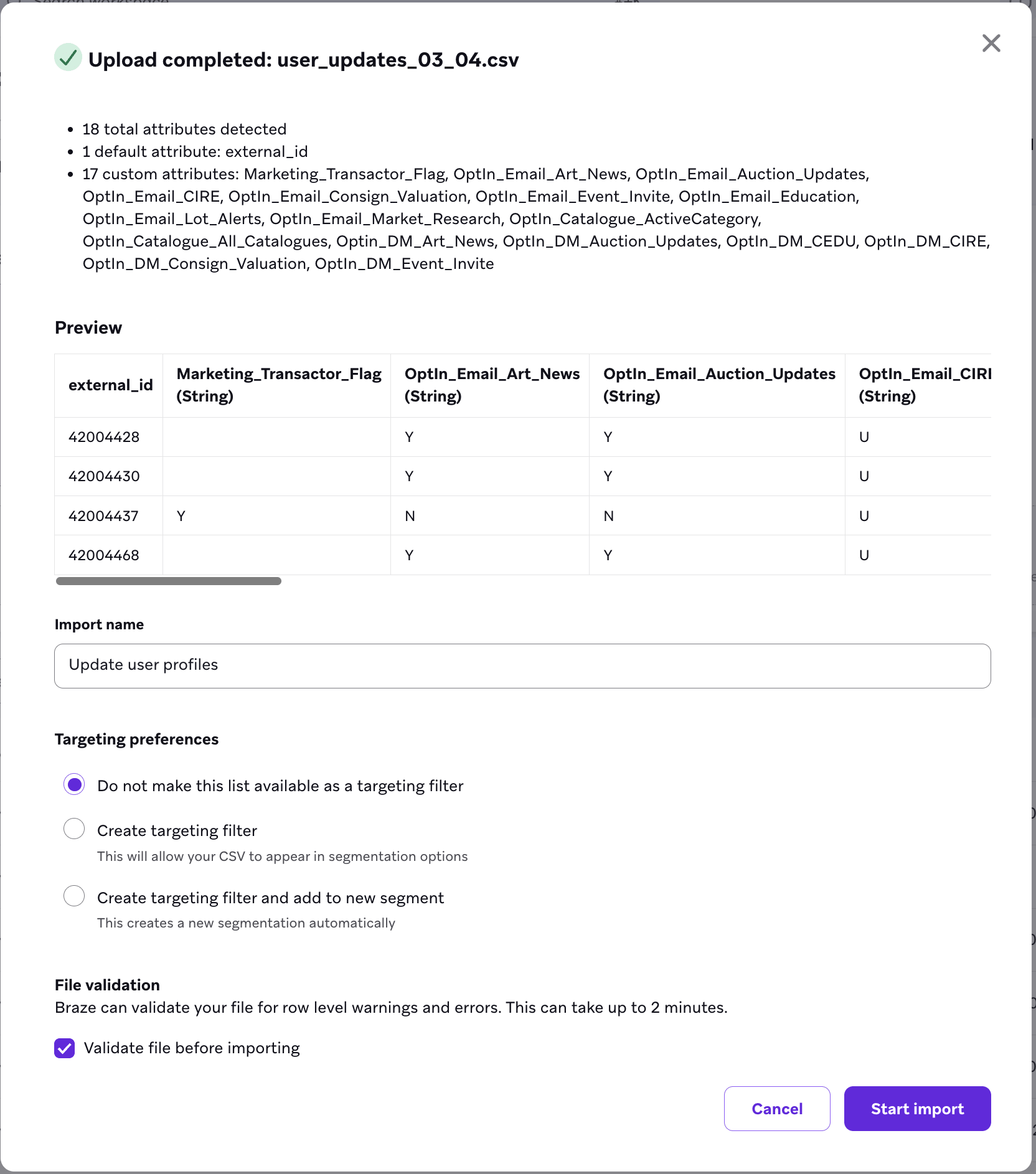
In the Import name field, you can rename your import. By default, the file name is used.
The file preview shows only the first few rows of your file. To check every row before importing, use file validation.
Step 5: Validate your file (optional)
Before starting your import, you can run file validation to check every row for errors and warnings. To validate your file, select Validate file before importing, then click Start import.
Validation can take up to 2 minutes for files at the maximum allowed size. While validation runs, you can select Skip validation to bypass it and proceed immediately.
Validation results
When validation completes, one of the following results appears.
| Result | What it means | Next step |
|---|---|---|
| Validation complete | No issues found. | Select Import data. |
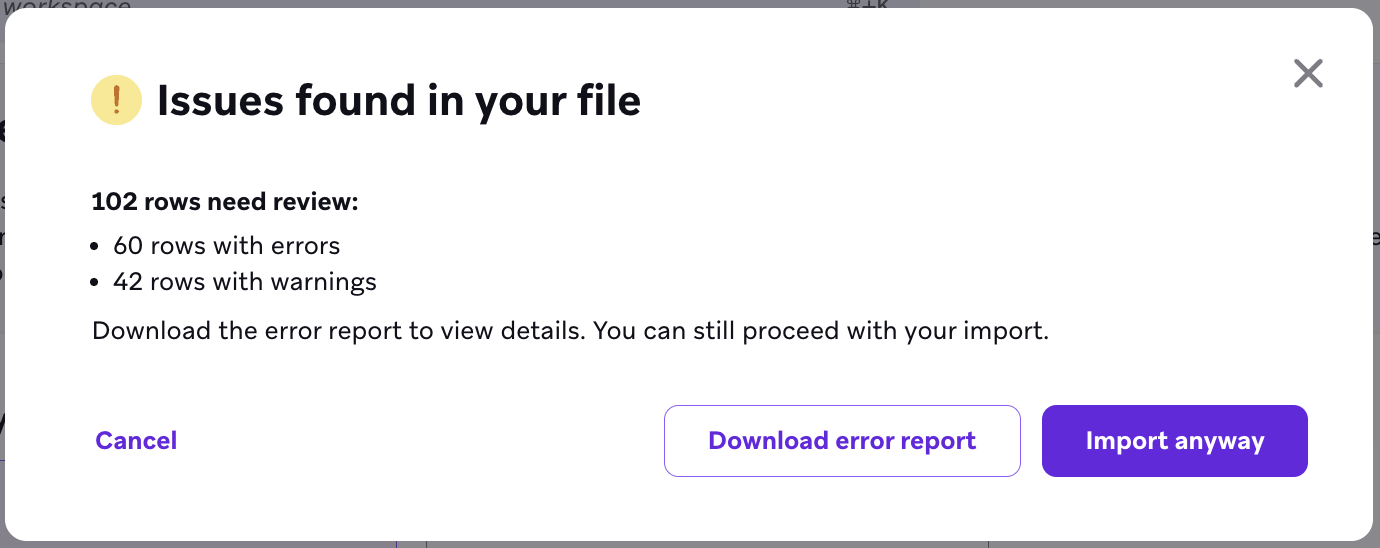
| Issues found | Some rows have errors or warnings. | Download the error report to review them, then select Import anyway to proceed or Cancel to fix your file first. |
| Validation timed out | Validation ran out of time. The rows that were checked had no issues. | Select Import data. A full report will be available in a few minutes. |
| Validation timed out with issues | Validation ran out of time and found errors in some of the rows it checked. | Download the partial report to review what was found, then select Import anyway or Cancel. |
Understanding the error report
The error report is a CSV file that contains every flagged row along with its original data and a description of the issue.
| Issue type | Description |
|---|---|
| Error | The row will be skipped entirely during import. |
| Warning | The row will be imported, but some values will be dropped. |
After reviewing the report, you can correct the issues in your original file and re-upload, or proceed with the import and accept the partial results.
Step 6: Choose targeting preferences
You can also choose from the following targeting preferences. If you don’t need to create a new targeting filter or segment from your import, select Do not make this list available as a targeting filter.
| Option | Description |
|---|---|
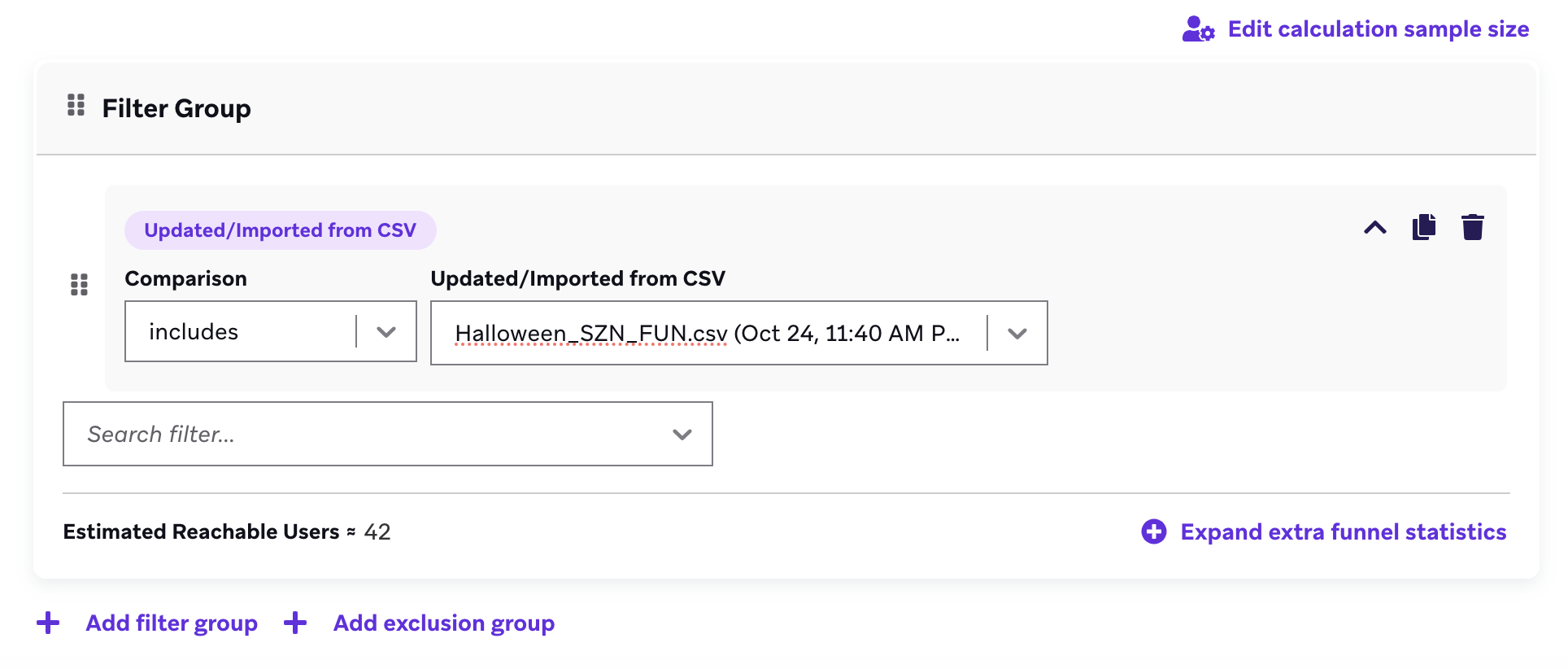
| Targeting filter | To convert your CSV file into a retargeting option when building user segments, choose your file from the Updated/Imported from CSV dropdown, then select Create targeting filter. |
| New segments | To also create a new segment from your new targeting filter, select Create targeting filter and add to new segment . |
Step 7: Start your CSV import
When you’re ready, select Start import. You can track the current progress on the Import Users page, which automatically refreshes every 5 seconds.
You can import more than one CSV at the same time. CSV imports run concurrently, so the order of updates is not guaranteed to be serial. If you require CSV imports to run one after another, wait until a CSV import has finished before uploading a second one.
Import statuses
After starting your import, you can check its status on the Import Users page.
| Status | Description |
|---|---|
| Complete | All rows imported successfully. |
| Partial success | Some rows failed. Select the three-dot menu next to the import to download an error report or the original uploaded CSV. |
| In progress | The import is currently running. |
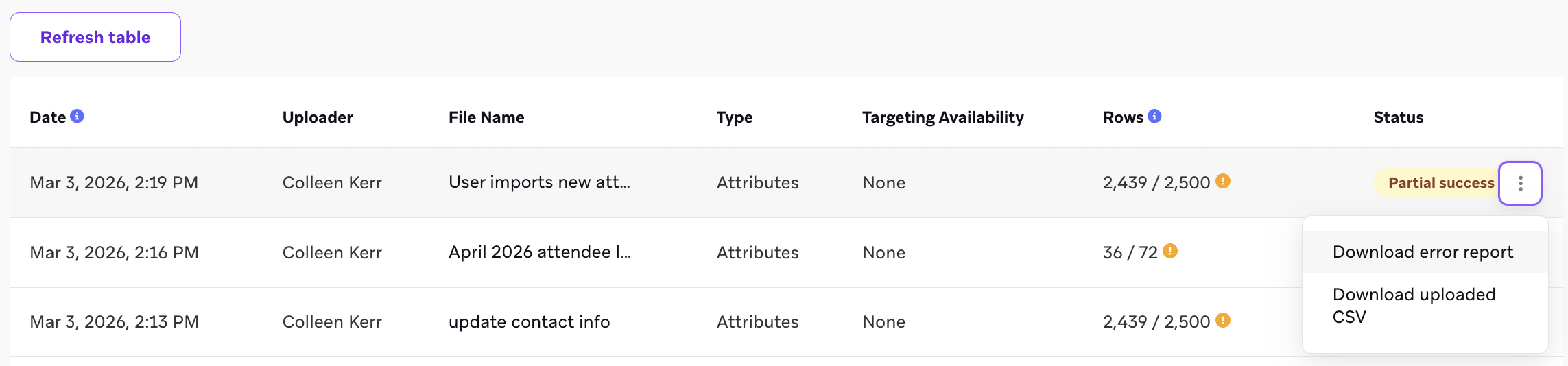
The post-import error report includes rows that failed for reasons validation doesn’t cover, such as when a user doesn’t exist in Braze.
Previously uploaded CSV files are available to download from the Import Users page for 14 days after the upload date. After 14 days, the file is permanently deleted and can no longer be accessed.
Data point considerations
Each piece of customer data imported from a CSV file overwrites the existing value on user profiles and logs a data point, except for external IDs and blank values. If you have any questions about the nuances of Braze data points, your Braze account manager can answer them.
| Consideration | Details |
|---|---|
| External IDs | Uploading a CSV with only external_id doesn’t log data points. This allows you to segment existing Braze users without impacting data limits. However, including fields like email or phone overwrites existing user data and does log data points. CSV imports used only for segmentation do not log data points, such as those containing just external_id, braze_id, or user_alias_name. |
| Blank values | Blank values in your CSV won’t overwrite existing user profile data. You don’t need to include all user attributes or custom events when importing. |
| Subscription states | Updating email_subscribe, push_subscribe, subscription_group_id, or subscription_state does not count toward data point usage. |
Setting language or country on a user through CSV import or API prevents Braze from automatically capturing this information through the SDK.
Troubleshooting
If you used file validation, start with the error report, as it includes the specific issue for each flagged row and a description of how to fix it. For rows that failed during import rather than validation, download the error report by hovering over the row and selecting the button on the Import Users page.
For troubleshooting CSV import, review these common issues below.
File formatting issues
Malformed row
If your upload completed with errors, there may be a malformed row in your CSV file.
To properly import data, there must be a header row. Each row must have the same number of cells as the header row. Rows with a length of more or fewer values than the header row will be excluded from the import. Commas in a value will be interpreted as a separator and can lead to this error. Additionally, all data must be UTF-8 encoded.
If your CSV file has blank rows and imports fewer rows than the total lines in the CSV file, this may not indicate a problem with the import since the blank rows wouldn’t need to be imported. Check the number of lines that were correctly imported and make sure it matches the number of users you’re attempting to import.
Missing row
There are a few reasons why the number of users imported might not match the total rows in your CSV file:
| Issue | Resolution |
|---|---|
| Duplicate external IDs, user aliases, Braze IDs, email addresses, or phone numbers | If there are duplicate external ID columns, this may cause malformed or unimported rows even if the rows are correctly formatted. In some cases, this may not report a specific error. Check for duplicates and remove them before re-uploading. |
| Accented characters | Your CSV may include names or attributes with accents. Ensure the file is UTF-8 encoded to prevent import issues. |
| Braze ID belongs to an orphaned user | If a user was merged into another and Braze cannot associate the Braze ID with the remaining profile, the row won’t be imported. |
| Empty row | Blank rows in the CSV can cause malformed data errors. Check using a plain text editor, not Excel or Sheets. |
Unescaped or unbalanced double quotation marks (") |
Double quotation marks wrap string values that contain commas. If a value itself contains a double quotation mark, escape it by doubling it (""). Unescaped or unbalanced double quotation marks cause a malformed row. |
| Inconsistent line breaks | Mixed line breaks (e.g., \n and \r\n) may cause the first row of data to be treated as part of the header. Use a hex or advanced text editor to inspect and fix. |
| Incorrectly encoded file | Even if accents are allowed, the file must be UTF-8 encoded. Other encodings may work partially but are not fully supported. |
String quotation
Values encapsulated in single ('') or double ("") quotation marks will be read as strings on import.
Incorrectly formatted dates
Dates not in ISO-8601 format won’t be read as datetimes on import.
Data structure issues
Invalid email addresses
If your upload completed with errors, there may be one or more invalid encrypted email addresses. Confirm that all email addresses are encrypted properly before importing them into Braze.
- When updating or importing email address in Braze, use the hashed email value wherever an email is included. These hash email values are provided by your internal team.
- When creating a new user, you must add
email_encryptedwith the user’s encrypted email value. Otherwise, Braze won’t create the user. Similarly, if you’re adding an email address to an existing user who doesn’t have an email, you must addemail_encrypted. Otherwise, Braze won’t update the user.
Data imported as custom attribute
If a piece of default user data (such as email or first_name) is imported as a custom attribute, check the case and spacing of your CSV file. For example, First_name is imported as a custom attribute, while first_name is correctly imported into the “first name” field on a user’s profile.
Change a custom attribute’s data type
If you need to change the data type of an existing custom attribute (for example, from string to boolean), update the data type on the Custom Attributes page in the dashboard before importing your CSV. If the data type in your CSV doesn’t match the attribute’s currently defined data type, the import fails with an error.
Multiple data types
Braze expects each value in a column to be of the same data type. Values that don’t match their attribute’s data type cause errors in segmenting.
Additionally, beginning a number attribute with zero will cause issues because numbers starting with zeros are considered strings. When Braze converts that string, it may be treated like an octal value (which uses digits from zero to seven), meaning it is converted to its corresponding decimal value. For example, if the value in the CSV file is 0130, the Braze profile shows 88. To prevent this issue, use attributes with string data types. However, this data type isn’t available in the segmentation number comparison.
Default attribute types
Some default attributes may only accept certain values as valid for user updates. For guidance, refer to Constructing your CSV.
Trailing spaces and differences in capitalization can cause a value to be interpreted as invalid. For example, in the following CSV file, only the user in the first row (brazetest1) has their email and push statuses updated successfully because the accepted values are unsubscribed, subscribed, and opted_in.
1
2
3
external_id,email,email_subscribe,push_subscribe
brazetest1,[email protected],unsubscribed,unsubscribed
brazetest2,[email protected],Unsubscribed,Unsubscribed
“Select CSV File” is not working
There are several reasons the Select CSV File button may not work:
| Issue | Resolution |
|---|---|
| Pop-up blocker | This may prevent the page from displaying. Confirm that your browser is allowing pop-ups on the Braze dashboard website. |
| Outdated browser | Make sure your browser is up to date; if not, update it to the latest version. |
| Background processes | Close every browser instance, then restart your computer. |
 Edit this page on GitHub