AI marketing campaigns: Plan, execute, and optimize across channels
Published on May 28, 2026/Last edited on May 28, 2026/17 min read
Team Braze
Contents
AI marketing campaigns use predicted behavior to plan, real-time data to execute across channels, and live engagement analytics to optimize, all while the campaign is still running.
Foodora and OneRoof are two of more than seven brands in this guide that have used that combination to drive measurable results. Foodora reduced churn and lifted conversions across 700+ European cities. OneRoof achieved a 218% uplift in property listing clicks by combining intelligent timing with machine learning personalization. Behind both results is the same foundation: planning, cross-channel execution, engagement analytics, and optimization working as a single connected system.
Here we'll look at the capabilities behind those results, and the best practices and automation tools that make them repeatable.
TL;DR
- AI marketing campaigns use predicted behavior, real-time data, and live engagement analytics to plan, execute, and optimize across every channel simultaneously
- Predictive decisioning and AI-powered segmentation replace static rules with individual-level decisions that update continuously as new behavioral signals come in
- Brands across food delivery, streaming, travel, retail, and fitness are seeing measurable gains in conversions, retention, and engagement by connecting data, decisioning, and delivery in one system
- The foundations that make AI campaigns repeatable are clean first-party data, clearly defined KPIs, behavior-triggered messaging, and continuous optimization
Key takeaways
- AI marketing campaigns treat planning, cross-channel execution, engagement analytics, and optimization as one connected system rather than separate activities
- Predictive marketing and AI decisioning go beyond recommending the next best offer. They simultaneously optimize message, channel, timing, frequency, and creative at the individual level
- Journey orchestration coordinates real-time behavioral signals across every touchpoint, so what happens on one channel informs what happens on the next
- AI-powered segmentation continuously updates based on live signals, meaning your audiences always reflect where customers are right now, not where they were when you last ran a report
- The brands seeing the strongest results built the right data foundation first, centralizing first-party data is what gives AI the context to make accurate, timely decisions
- Measuring success across engagement, conversion, retention, and multi-channel ROI gives you a complete picture of whether AI is contributing to sustainable growth
- AI enables smarter, faster, and more personalized campaigns, but only when the goals are specific, the data is centralized, and the system is set up to learn continuously
What are AI marketing campaigns?
AI marketing campaigns use artificial intelligence, machine learning, and data analytics to automate, personalize, and optimize marketing across every stage, from audience selection and content creation through to real-time delivery and performance optimization.
What are the benefits of AI marketing campaigns?
AI-powered campaigns have many advantages. They reduce wasted spend by targeting the right people with the right message at the right time. They improve engagement by delivering content that reflects what each customer actually wants. They also free up marketing teams from manual, repetitive tasks so more time goes toward strategy and creativity. As these campaigns learn continuously, performance compounds.
How AI-driven campaigns differ from traditional marketing
AI-driven campaigns differ from traditional marketing as they don't lock decisions in before launch. With a traditional campaign, you define your audience, write your messages, set a send time, and wait for results.
With AI, your segments update as new behavioral signals come in. Your messaging adapts to individual preferences and predicted intent and timing adjusts to match when each person is most likely to respond. Every interaction feeds back into the system, so your next campaign starts from a more informed position than the last one did.
Core capabilities of AI marketing campaigns
Four capabilities sit behind every effective AI marketing campaign. Together, they take you from knowing what each customer is likely to do next, to delivering the right experience at the right moment across every channel.
1. Predictive marketing and next-best actions
Predictive marketing uses machine learning to work out what each customer is likely to do before they do it. By analysing purchase history, browsing behavior, and engagement frequency, predictive models identify where each person is in their journey and what they're likely to do next.
The Braze Predictive Suite estimates each user's likelihood to complete a specific action, so you can reach the right people at exactly the right moment.
AI decisioning takes this further. Using reinforcement learning, BrazeAI Decisioning Studio simultaneously optimizes every dimension of the interaction, including message, creative, channel, timing, day, frequency, and incentive, at the individual level, updating continuously as new data comes in.
2. Automated marketing and journey orchestration across email, SMS, push, and in-app
Journey orchestration is how you design, build, and launch multi-step customer experiences across every channel from one place. With Braze you can use an intuitive drag-and-drop canvas to create journeys that blend email, push, SMS, WhatsApp, in-app, web, and paid media. These are all triggered by real-time customer behavior and coordinated so that signals from one channel inform what happens on another.
AI sits inside the canvas too, so you can experiment on entire journeys, individual paths, or specific messages. Intelligent automation routes each customer to their best-performing path and sends messages on the channels they engage with most, at the times they're most likely to respond.
If you want to pursue a specific goal, such as reducing churn or increasing conversion, Agentic AI can help you do just that, by operating autonomously within the parameters you set. You own the strategy and the system handles the execution.
3. AI-powered segmentation and dynamic content personalization
AI-powered segmentation uses machine learning to group customers based on predicted behaviour and live engagement signals. It continuously updates as new data comes in, so your segments always reflect where customers are right now. A customer showing early signs of disengagement, for example, can be automatically moved into a re-engagement flow before they've churned.
Dynamic content uses that segmentation to create experiences that adapt to each individual. An email can render differently for each recipient based on their preferences and history for example or a push notification can feature a product recommendation based on recent browsing.
4. Engagement analytics and real-time performance monitoring
Engagement analytics gives you a live view of campaign performance as it unfolds. Open rates, click-through rates, conversions, and channel interaction patterns all update in real time, so you can spot a problem early and act on it.
AI-powered analytics connect these signals across channels into one picture. You can see the full customer journey and understand which touchpoints are actually driving results, without jumping between dashboards.
Seven examples of AI marketing in action
Across industries and markets, brands are using AI marketing campaigns to solve real problems, from scaling personalisation across millions of users to reaching the right customer on the right channel at exactly the right moment. The seven examples below span food delivery, streaming, travel, fitness, property, and retail, but the common thread is consistent: AI-driven decisions producing results that manual approaches couldn't replicate.
- foodora—On-demand
- Pazza Pasta—On-demand
- 8fit—Health & wellness
- Luxury Escapes—Travel & hospitality
- Dayuse—Travel & hospitality
- Cleo—Health & wellness
- Kayo Sports—Media & entertainment
1. How foodora stopped guessing send times and served up a 41% conversion rate
foodora is a food delivery service operating in over 700 cities across Europe, focused on fast, affordable, and personalized customer experiences.
Features/tools used: Intelligent Timing, cross-channel delivery (email, push, in-app)
Challenge: Inconsistent messaging across multiple platforms, no predictive insight into when customers were most likely to engage, leading to low engagement and high churn.
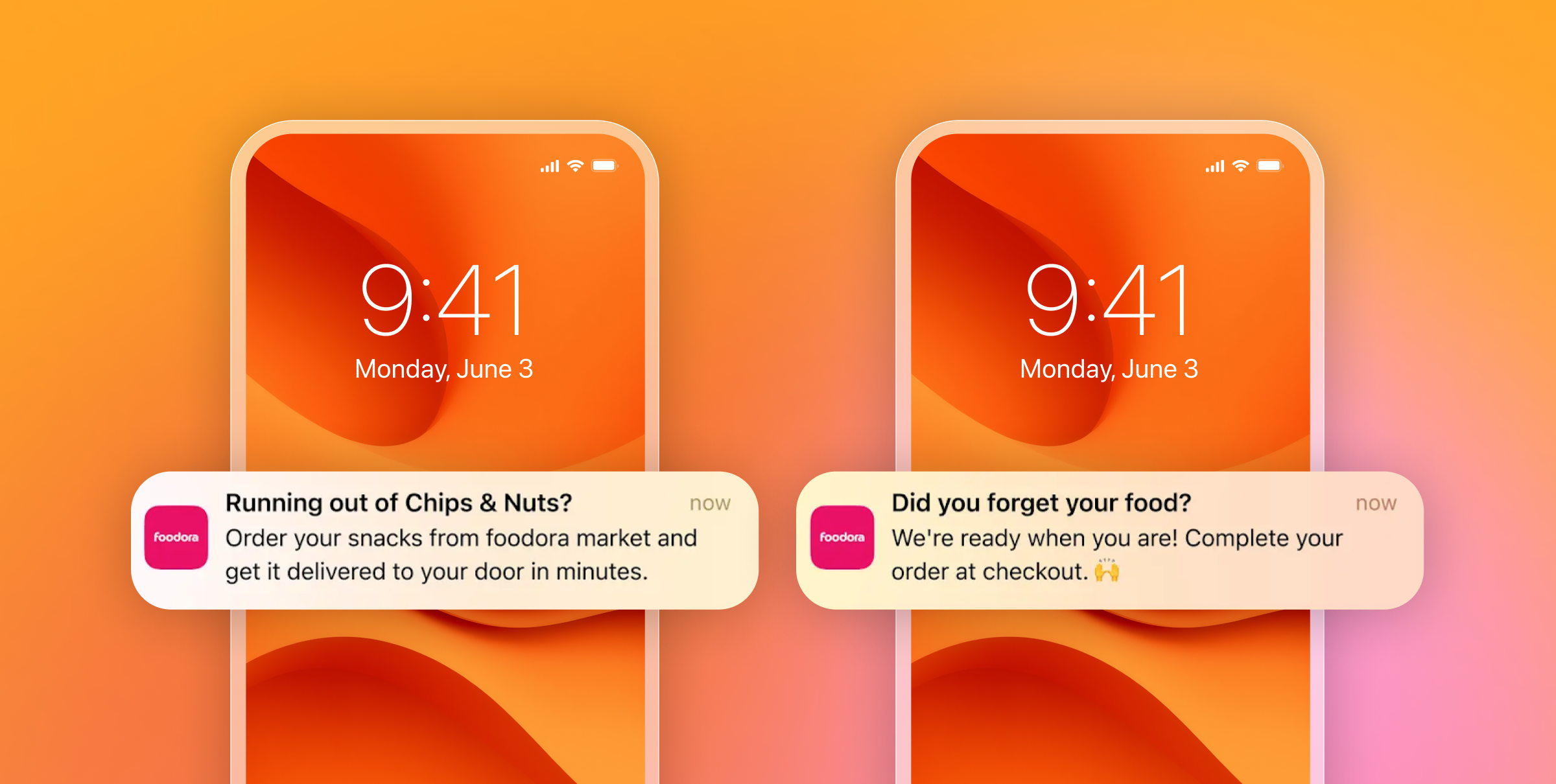
Solution: foodora unified their cross-channel strategy across email, push, and in-app messaging using Braze, and introduced BrazeAI Intelligent Timing to automatically send each message at the moment each individual customer was most likely to respond.
Results:
- 41% conversion rate from messages sent
- 26% reduction in unsubscribe rate with Intelligent Timing
- 6% increase in push direct opens
2. Pasta la vista, email: Pazza Pasta cooks up 6X higher purchase rates on WhatsApp
Pazza Pasta is a German food delivery brand from Circus Group, built around fresh, affordable meals and a mission to make every customer interaction personal and valuable.
Features/tools used: AI Item Recommendations, Personalized Paths, WhatsApp integration, Braze Canvas, Braze Catalogs, automated campaign generation via OpenAI API
Challenge: Pazza Pasta wanted to reach their most engaged customers on WhatsApp with personalized campaigns but needed to do it at scale with a team of just two people.
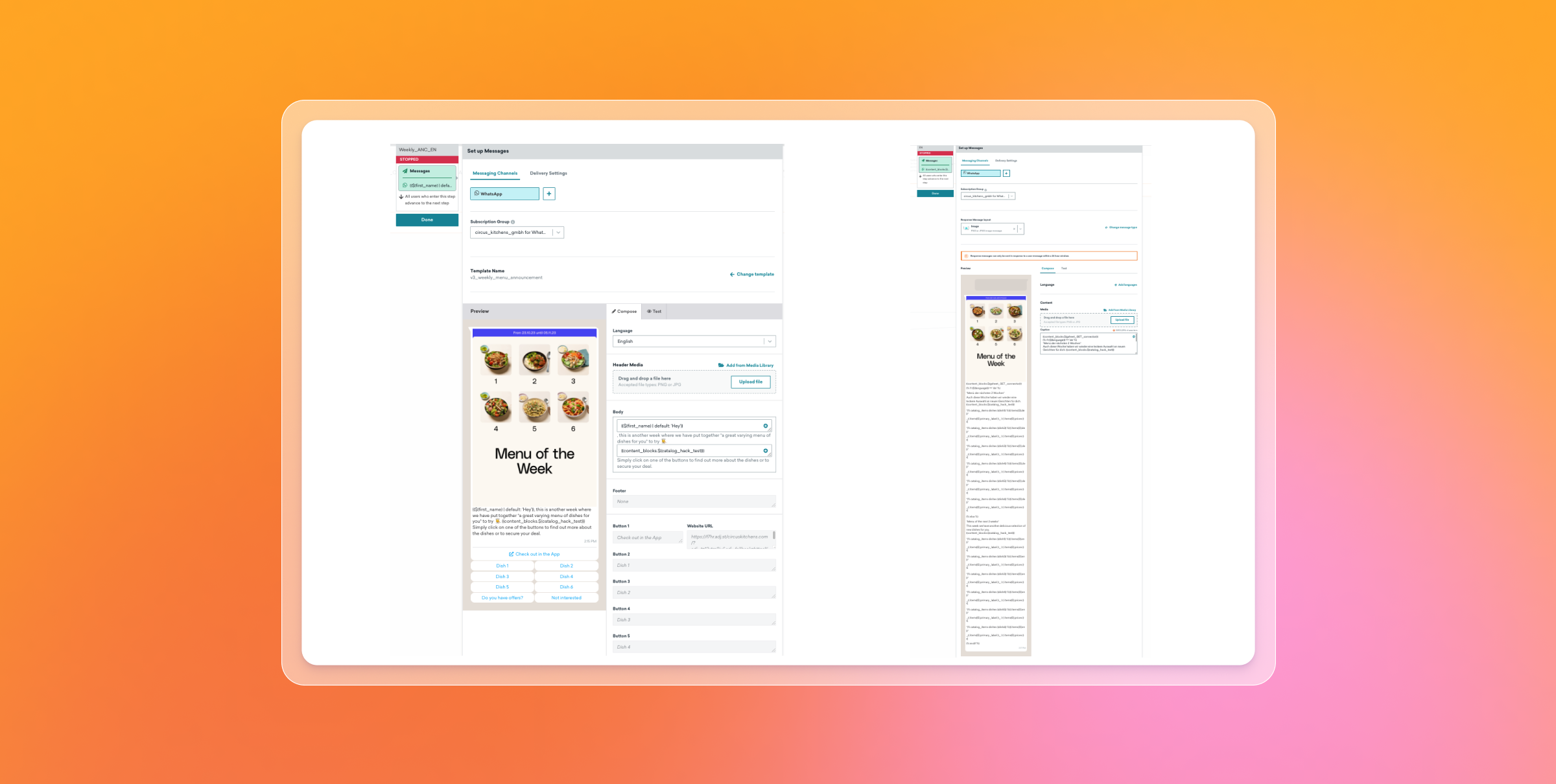
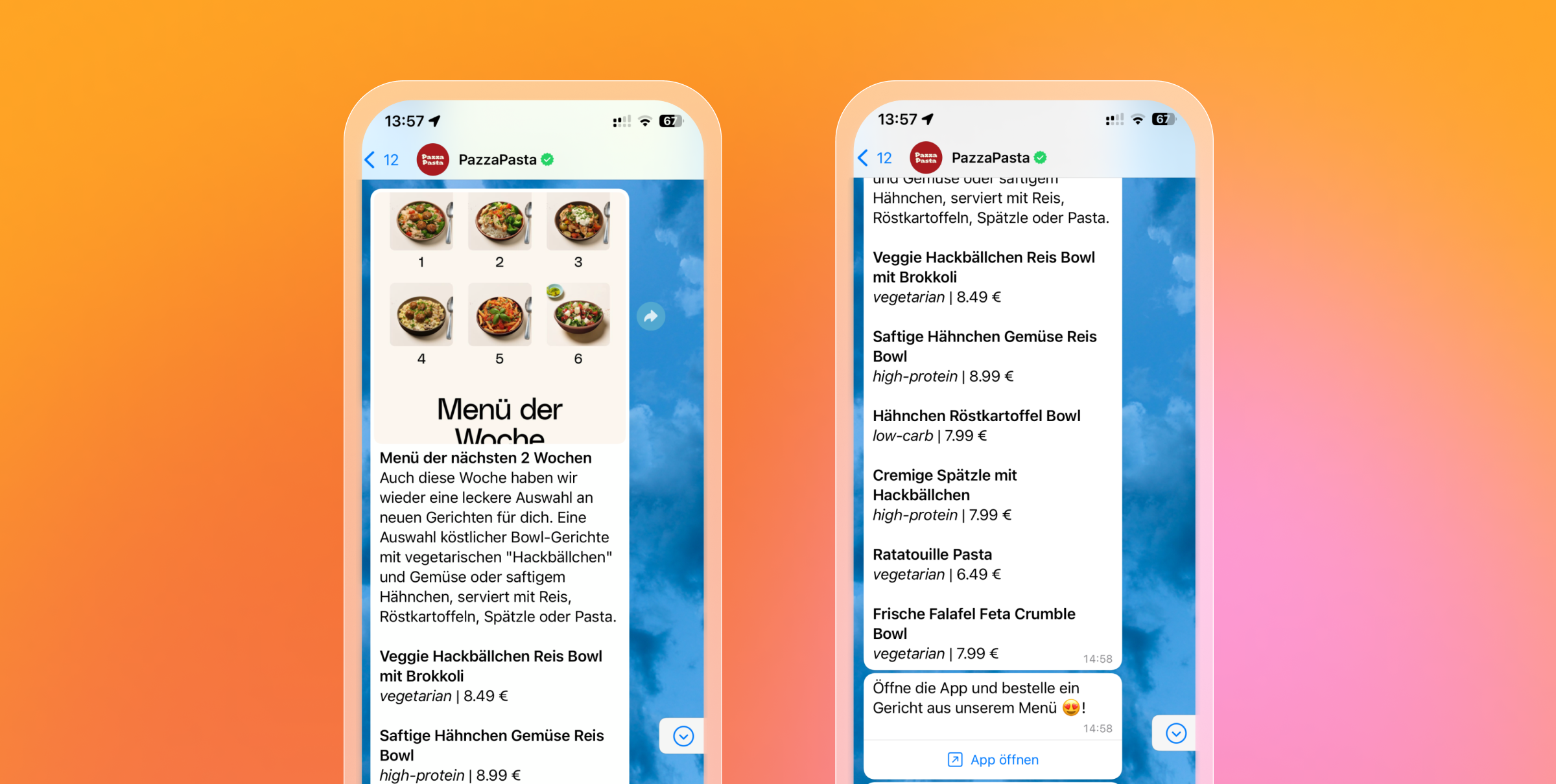
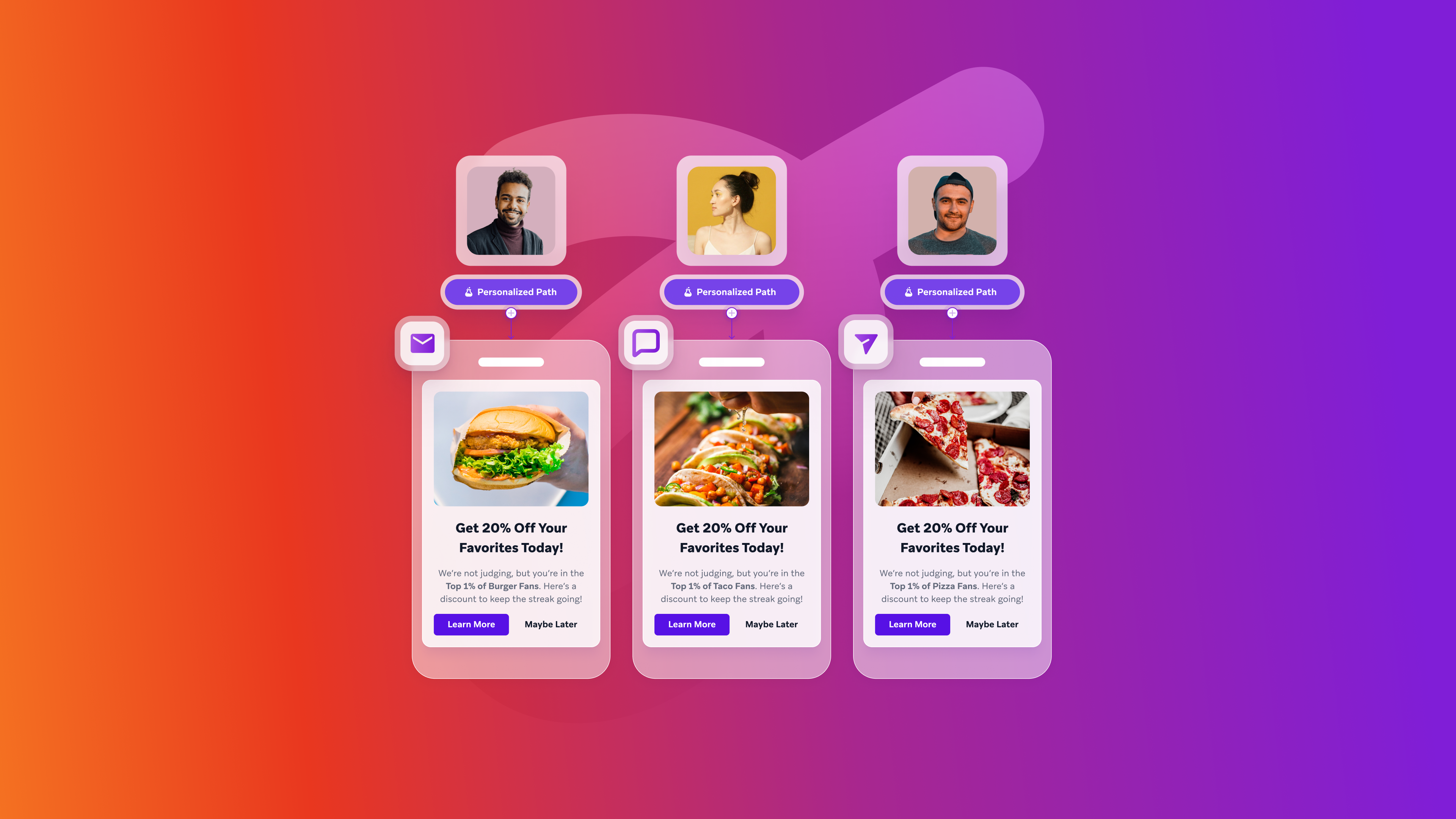
Solution: Using Braze Canvas, native WhatsApp integration, Braze Catalogs for dynamic content, and the OpenAI API for automated copy generation, Pazza Pasta launched fully automated weekly menu campaigns. They also became early adopters of AI Item Recommendations and Personalized Paths to deliver 1:1 personalized experiences at scale.
Results:
- 6x higher purchase rates on WhatsApp versus email for the weekly menu campaign
- 4.5x higher conversion rates on product announcements versus email
- 50% app open rate on their Black Friday WhatsApp campaign
- 12 hours of manual work saved every week through automation
3. 8fit gets fit for conversions with a 3.75X lift in purchase rates
8fit is a global health and fitness app offering personalized workouts, meal plans, and meditations, with 40 million downloads across six languages.
Features/tools used: Braze Predictive Suite (Predictive Purchases), AI-powered purchase likelihood scoring, cross-channel delivery (email, push, in-app)
Challenge: 8fit wanted to increase paid subscribers without offering blanket discounts to their entire user base, but had no way to identify which users were actually likely to convert.
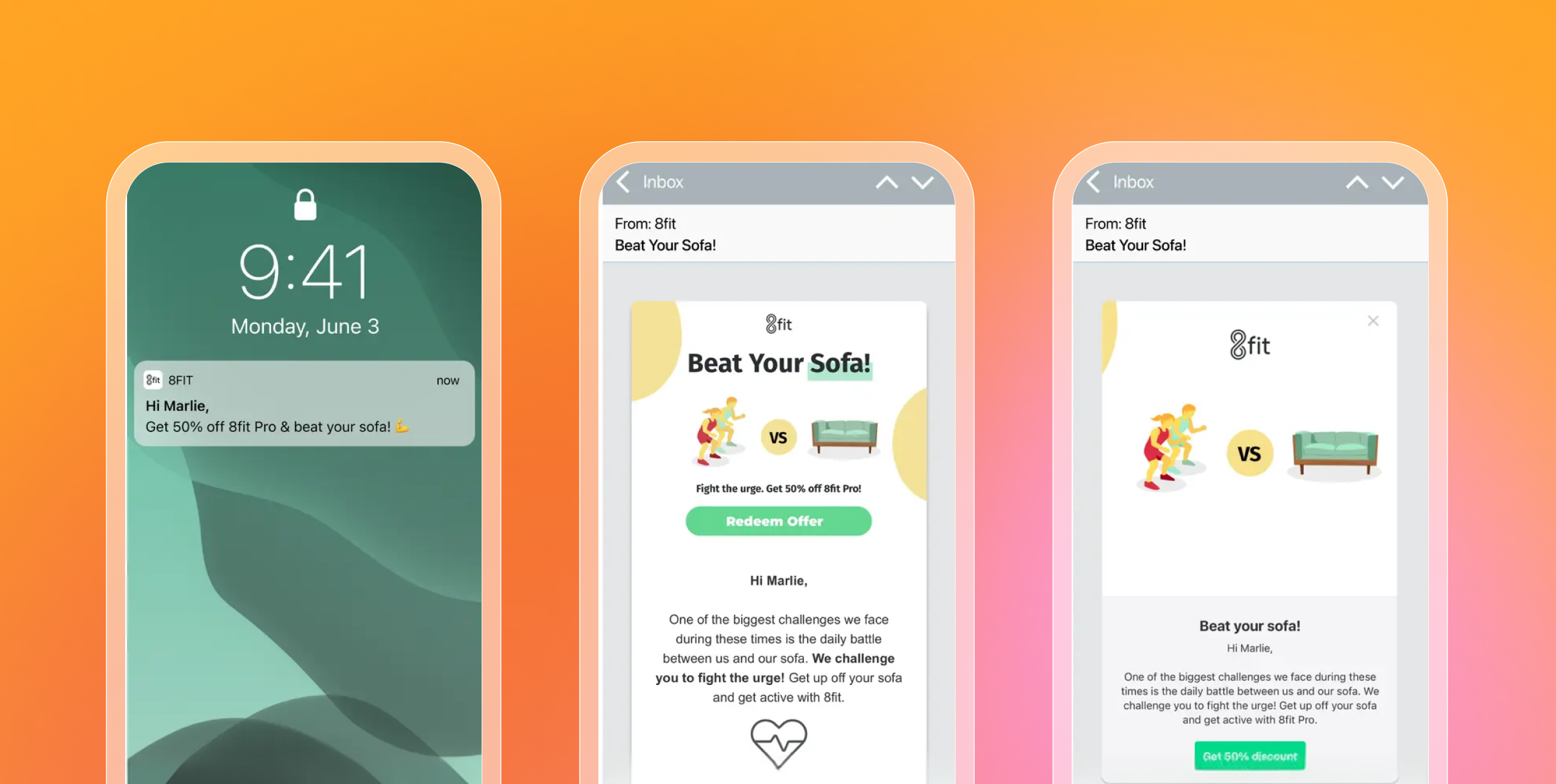
Solution: Using Braze Predictive Purchases, part of the Braze Predictive Suite, 8fit assigned every user a Purchase Likelihood Score from 0 to 100, then targeted tiered subscription offers across email, push, and in-app based on each user's score, saving bigger discounts for lower-intent users and smaller ones for those already inclined to convert.
Results:
- 3.75x higher conversions for high purchase likelihood users versus a randomly selected cohort of the same size
- 100,000 fewer emails sent weekly by excluding low-scoring users, with no negative impact on conversions
4. Luxury Escapes checks in to a 10% revenue lift with AI-powered segmentation
Luxury Escapes is one of the world's fastest-growing travel companies, selling exclusive holiday packages, tours, and hotel deals to over 9 million members across 30 countries.
Features/tools used: BrazeAI Agent Console™, behavioral signal-based segmentation, AI-powered cohort assignment
Challenge: Their welcome journey used fixed, session-count rules to sort new users into three cohorts. This system worked but couldn't weigh multiple behavioural signals simultaneously or adapt to the nuance of each individual user.
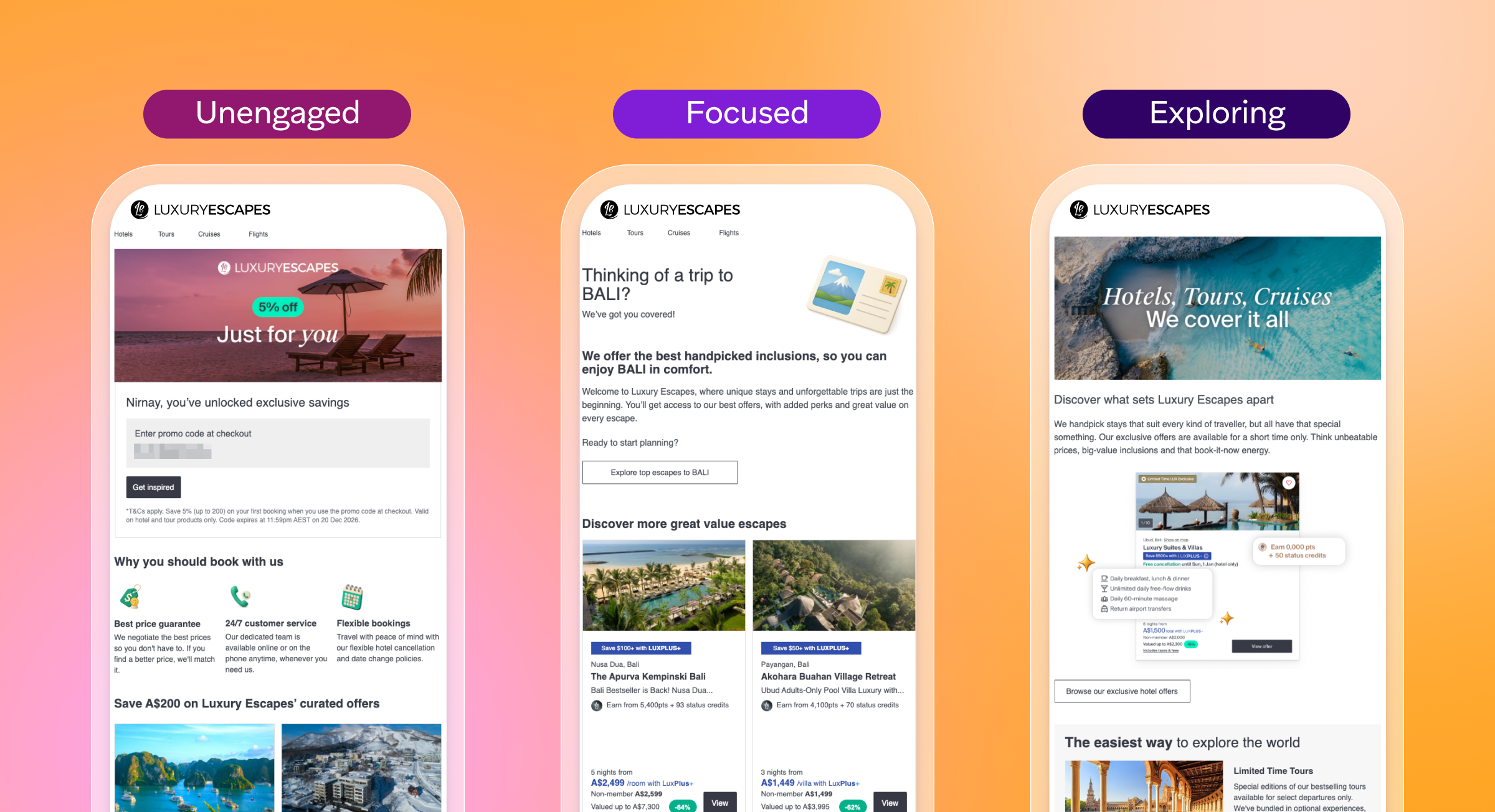
Solution: Luxury Escapes deployed BrazeAI Agent Console™ as a decisioning step within their welcome journey, replacing the hardcoded rules with an AI agent that evaluated ten distinct website behavioural signals to assign each new user to the right cohort, with no training data required.
Results:
- 10% lift in revenue per user versus the rule-based control group, driven entirely by conversion rate
- 7% increase in total transaction value
- 6% increase in purchase volume
5. Dayuse checks out of generic messaging, and into a 90% conversion rate uplift
Dayuse is a global hotel reseller operating in 30 countries, letting customers book hotel rooms by the hour for daytime use, (workspace, spa access, or rest), without an overnight stay.
Features/tools used: BrazeAI Agent Console™, Braze Canvas, AI-generated individualized content, multilingual personalization
Challenge: Re-engagement campaigns sent the same message structure to every user regardless of booking history, preferred language, or property type, making meaningful personalisation across 26 countries and multiple languages impossible to manage manually.
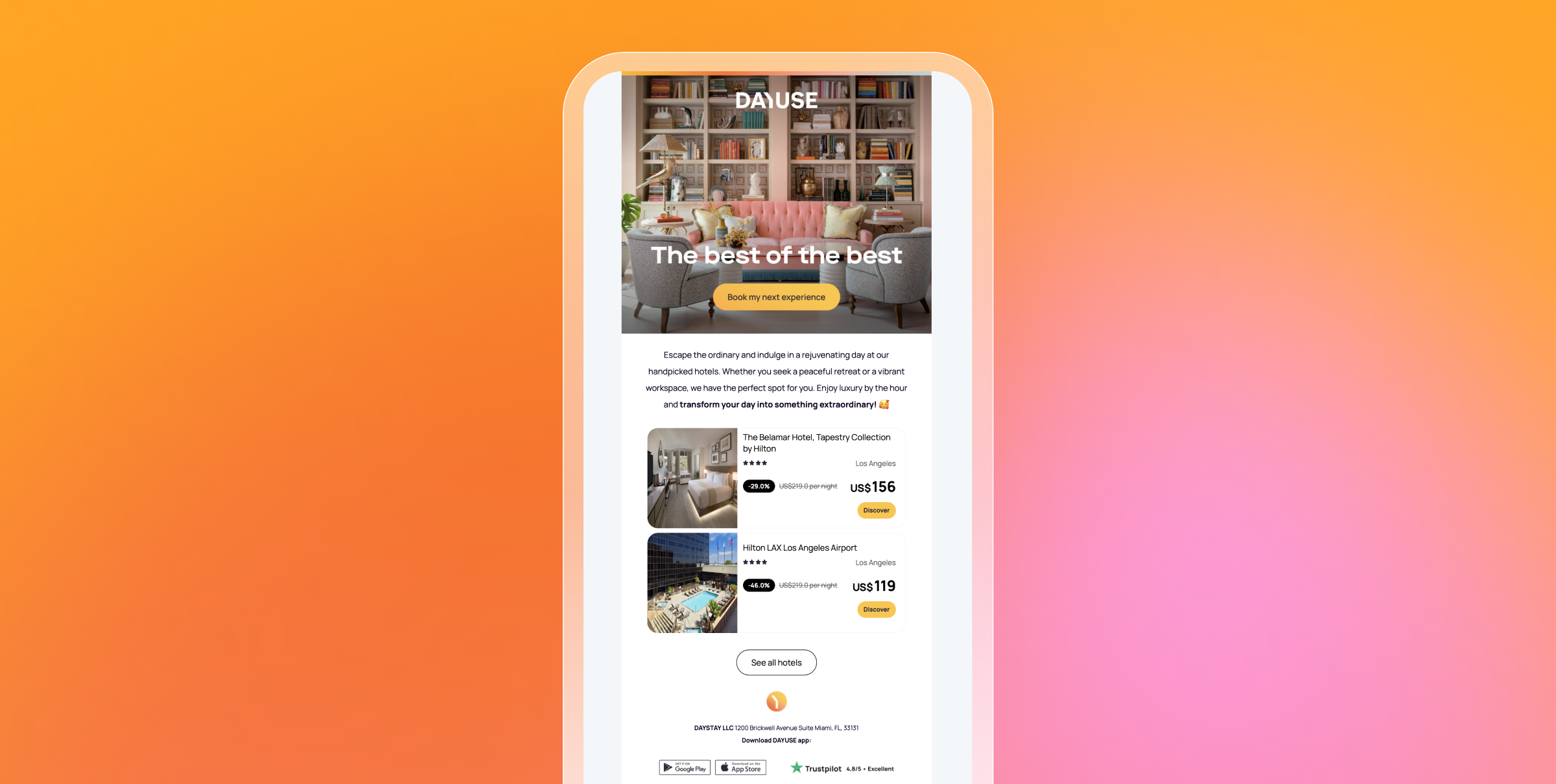
Solution: Dayuse adopted BrazeAI Agent Console™ embedded directly in Braze Canvas, replacing their previous external webhook setup. The agent draws on each user's wish-listed hotels, booking history, property preferences, and preferred language to generate individually tailored campaign content at scale, with full visibility into what the agent produces before it reaches a customer.

“Integrating BrazeAI Agent Console™ has done more than improve our operational efficiency; it directly impacted our conversion performance. Since transitioning to the native BrazeAI™ agent, we’ve observed an additional 23% uplift—a boost that is a direct result of the more sophisticated and seamless content personalization now available to us.”
Martin Juglair
CRM Specialist, DayuseResults:
- 90% increase in overall booking conversion rate
- 2x incremental revenue from their wish-list abandoned cart "favorite campaign"
- 23% additional uplift after migrating from their previous webhook setup to BrazeAI Agent Console™
6. Cleo welcomes members like it knows them—because now it does
Cleo is a global family care platform offered as an employee benefit, supporting members across every stage of the parenting and caregiving journey, from expecting parents through to those caring for aging relatives.
Features/tools used: BrazeAI Operator™, Liquid personalization, dynamic content blocks, multi-attribute conditional logic
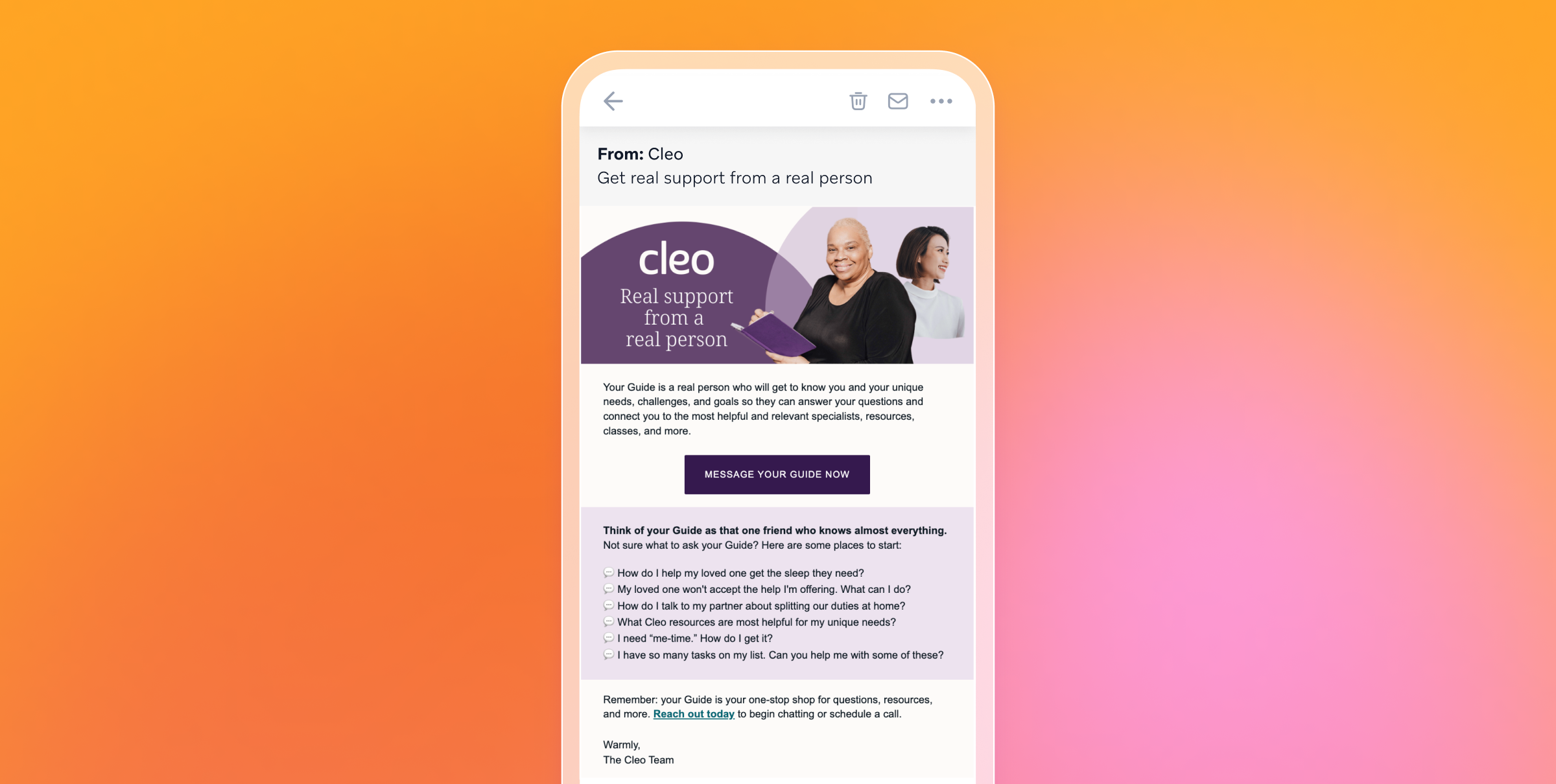
Challenge: Cleo's existing welcome series used deliberately vague messaging to avoid sending irrelevant content to its diverse member base. This was a workaround that limited personalisation and left an obvious opportunity on the table.

“At first, I tried standard LLMs, but they struggled to come up with usable code, much less achieve the complexity I was looking for. Operator, on the other hand, literally thought of things I hadn’t. I was able to achieve the deep level of personalization I was looking for—not only more easily and quickly, but even better than I imagined.”
Holly Jacobson
Lifecycle Marketing Manager, CleoSolution: Lifecycle marketing manager Holly Jacobson used BrazeAI Operator™ to write and debug the Liquid code powering a new personalized Quickstart welcome series, combining care recipient ages, package types, and life stage data to create content blocks tailored to each member's specific situation.
Results:
- 81% reduction in unsubscribes across the welcome series
- 97% drop in opt-outs on the first email
- 284% increase in app opens
- 124% lift in push notification engagement
- 178% increase in meaningful in-app behaviours within the first 30 days
7. Kayo Sports builds its Customer Cortex and scores a 105% cross-selling increase
Kayo Sports is Australia's largest sports streaming service, giving fans live and on-demand access to more than 50 sports and 30,000 hours of content across mobile, web, and TV.
Features/tools used: BrazeAI Decisioning Studio™, reinforcement learning models, Braze Canvas, Braze Currents, cross-channel delivery (email, SMS, push, in-app)
Challenge: Kayo's existing systems limited personalisation options and couldn't fully use their rich subscriber data to drive engagement and customer lifetime value, resulting in experiences that were more generic than the platform's data could support.
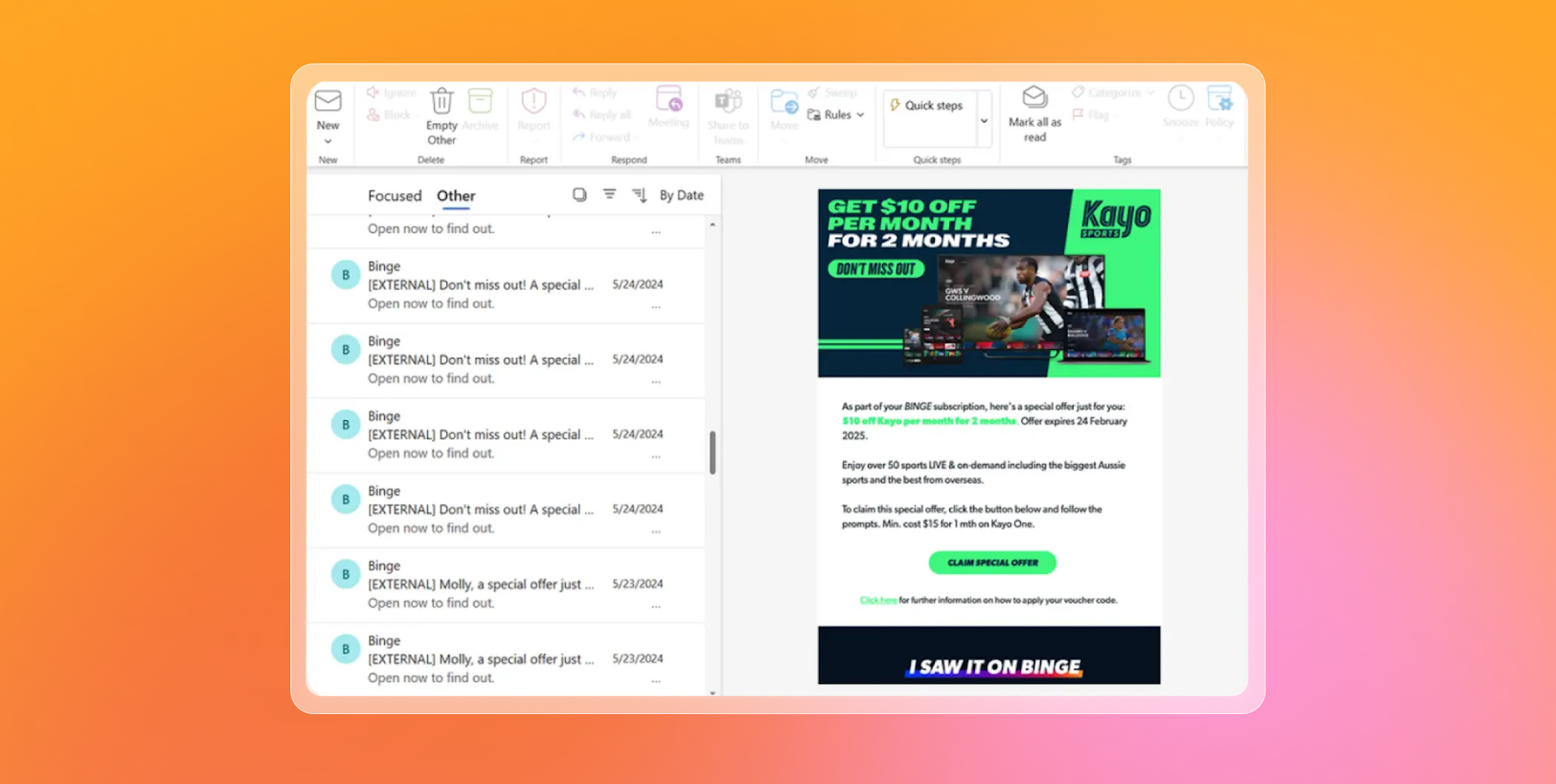
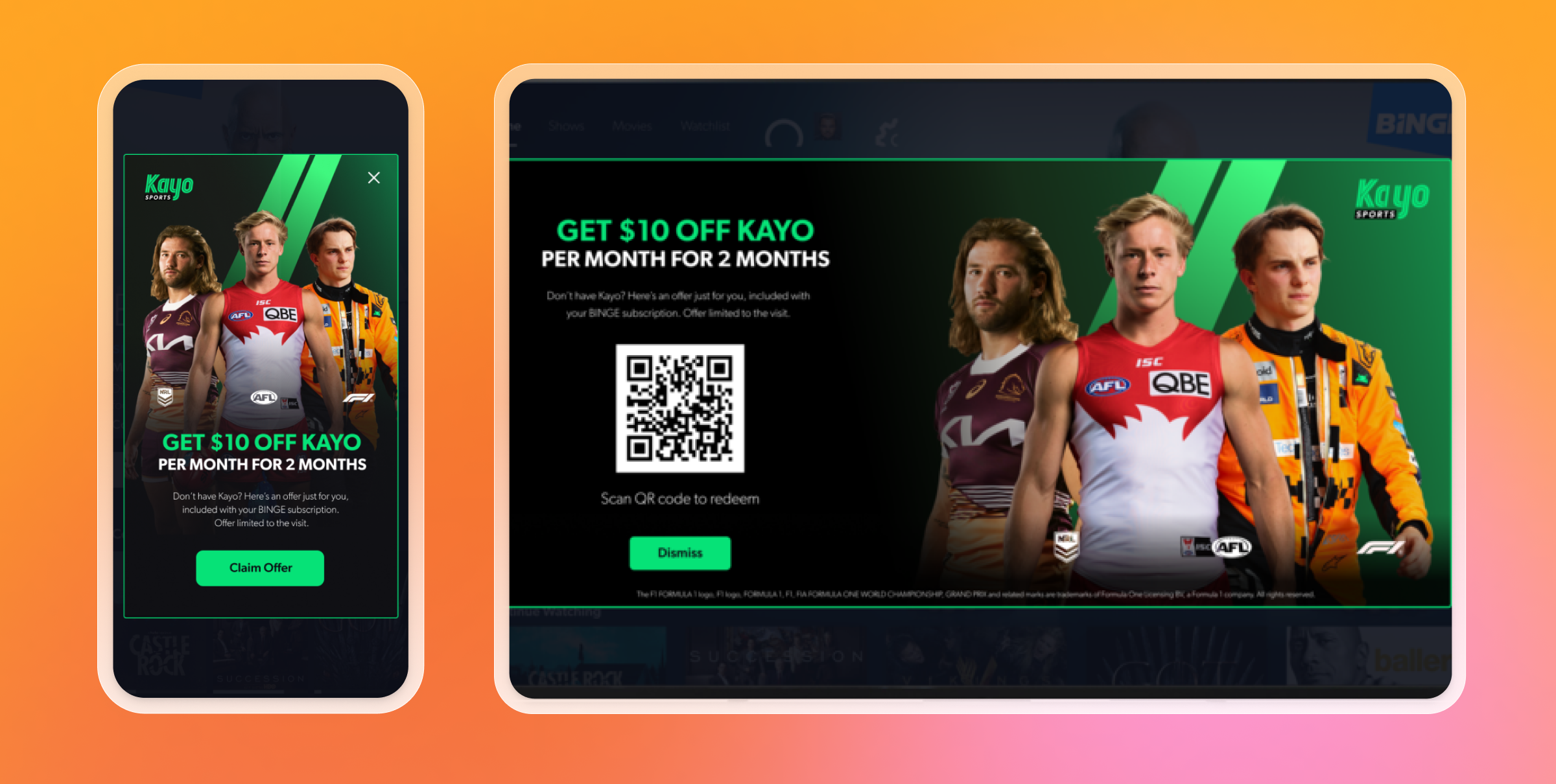
Solution: Kayo built a proprietary "Customer Cortex" powered by ten reinforcement learning models and BrazeAI Decisioning Studio™, determining the optimal message copy, offer, channel, timing, and frequency for each individual subscriber in an automated daily cycle. Recommendations were ingested into Braze and delivered across email, SMS, push, and in-app, scaling from 300 to 1.2 million personalized message variations.
Results:
- 14% increase in subscribers reactivating within 12 months of churning in FY24
- 8% increase in average annual occupancy
- 105% increase in cross-selling to BINGE, a companion streaming service
- All achieved while average subscription prices increased by 20%
AI marketing trends reshaping campaign strategy
The seven examples here point clearly the direction AI marketing trends are moving in. AI in marketing has changed from automating existing processes to enabling entirely new ones, and the pace of that change is accelerating.
Agentic AI moving from concept to practice
Agentic AI systems pursue goals autonomously, observing behavior, making decisions, and optimizing toward a stated objective without waiting for manual input. BrazeAI Agents are built on this principle, letting marketers set the strategy while intelligent systems handle execution in real time.
Machine learning personalization at scale
Machine learning personalization now determines content, offer, creative, and channel for each individual across every lifecycle stage, at a scale that manual approaches cannot match.
Cross-channel AI campaigns coordinating every channel
Cross-channel AI campaigns coordinate email, push, SMS, and in-app into one connected experience, using behavioral targeting signals from one channel to inform decisions on another. This is where marketing automation becomes powerful, running across the full customer journey.
Predictive decisioning and conversion optimization
Predictive decisioning allocates traffic dynamically toward stronger-performing variants while campaigns are still running, using campaign KPIs to drive what gets refined. This continuous approach to conversion optimization removes the lag between insight and action.
First-party data powering lifecycle campaigns
As privacy regulations increase, first-party data quality is becoming the primary factor in how well AI can personalize. Brands investing in loyalty programs, progressive profiling, and consent-driven data collection are building the foundation for personalization at scale across the full customer lifecycle.
Best practices for AI marketing campaigns
AI has huge benefits but you still need a strategy built around it. These four practices help you create an AI marketing campaign that retains the human touch and makes sure the tools you use bring you the right kind of attention from your customers.
Centralize customer data for actionable AI insights
Centralizing behavioral, transactional, and preference data into a unified customer profile gives AI the context it needs to make accurate, timely decisions. Braze ingests data in real time, keeping customer profiles current as new events come in so every AI decision is based on the latest available signal.
Use real-time marketing for segmentation and personalization
Real-time marketing closes the gap between a customer action and a brand response. When a customer browses without converting, opens a message without clicking, or returns to the app after going quiet, each of those moments carries intent, and acting on it immediately consistently outperforms waiting for the next scheduled campaign to catch it.
Setting up behavior-triggered campaigns across email, push, SMS, and in-app creates a responsive layer that fills the moments between planned campaigns with relevance. A customer experience that responds in real time feels attentive in a way that scheduled sends simply can't replicate.
Use AI optimization and AI-powered analytics for continuous testing and improvement
AI optimization is an ongoing process, not a one-time configuration. Campaigns should be set up to test, learn, and adjust continuously.
Automated experimentation through multivariate testing and AI decisioning lets you test multiple message variations simultaneously, pushing performance toward the strongest version in real time. This helps you build a body of evidence about what works for your audience.
Align AI campaigns with business KPIs
AI campaigns optimize toward whatever goal you set, so vague goals produce vague results. Defining specific, measurable KPIs like click-through rate, conversion rate, subscription renewal, and 30-day retention gives AI a clear target and gives your team a reliable way to know whether it's working.
Measuring success in AI marketing
Four dimensions give you the clearest picture of whether your AI campaigns are actually working.
Engagement metrics
Click-through rates, open rates, and in-app interaction rates are your earliest signal. They show how recipients are responding to messaging in real time and flag underperformance while you still have time to act.
Conversion and revenue impact
Conversion tells you whether campaigns are moving customers through the funnel, not just getting their attention. Track the full journey, from click to purchase, trial to subscription, first open to second session, to understand the true revenue impact.
Retention and churn reduction
Measuring how campaigns affect 30-, 60-, and 90-day retention shows whether AI is contributing to sustainable growth. Braze Predictive Churn flags customers showing early signs of disengagement so you can act before the relationship ends.
Tracking multi-channel AI performance and ROI
A customer might read an email, skip a push notification, and convert through an in-app message. Attribution models that account for these multi-touch journeys give a far more accurate picture of ROI than any single-channel view, and show you which channel combinations are doing the most work for each segment.
Final thoughts and takeaways
By this point you have a clear picture of how AI marketing campaigns work. The capabilities that connect planning to execution, the real-time signals that drive personalization, and the measurement frameworks that tell you whether any of it is moving the needle.
What the brand examples show, across every industry and use case, is that the results follow the foundations. AI enables smarter, faster, and more personalized campaigns when the data is clean, the goals are defined, and the system is set up to learn continuously. Predictive decisioning and real-time optimization drive measurable results, and integrating cross-channel orchestration tools maximizes engagement and ROI across every touchpoint.
Braze brings all of this together in one platform.
AI marketing campaign FAQs
How can AI plan and optimize marketing campaigns across multiple channels?
AI can plan and optimize marketing campaigns across multiple channels by analyzing real-time behavioral data to determine the best message, timing, and channel for each individual customer. It automates routing, content selection, and send timing, then continuously refines those decisions based on live engagement signals across email, push, SMS, and in-app.
What role does predictive decisioning play in AI marketing campaigns?
Predictive decisioning plays a central role in AI marketing campaigns by using machine learning to evaluate what message, offer, or channel is most likely to produce the desired outcome for each individual customer in real time. It moves campaign logic from broad audience rules to individual-level decisions that update continuously as new behavioral data comes in.
How does AI improve engagement analytics and campaign ROI?
AI improves engagement analytics and campaign ROI by connecting behavioral signals across channels into a single view of how customers interact with your campaigns. Teams can see which touchpoints drive conversion, where drop-off happens, and what to adjust, making analytics an active optimization tool rather than something you review after a campaign ends.
What are best practices for implementing AI-driven campaigns?
Best practices for implementing AI-driven campaigns include centralizing first-party data, defining clear KPIs, and setting up behavior-triggered messaging across channels. Using AI tools to test and optimize continuously, and connecting campaign goals directly to business outcomes, gives teams a foundation for results that build over time.
How do real-world brands use AI to enhance personalization and conversion?
Real-world brands use AI to enhance personalization and conversion by moving from broad segments to individual-level decisioning. Braze customer Pazza Pasta saw 6x higher purchase rates with AI-personalized WhatsApp campaigns and OneRoof achieved a 218% uplift in listing clicks through machine learning-powered dynamic content.
Related Tags
Be Absolutely Engaging.™
Sign up for regular updates from Braze.