5 min read
How Luxury Escapes deploys better segmentation with BrazeAI Agent Console™
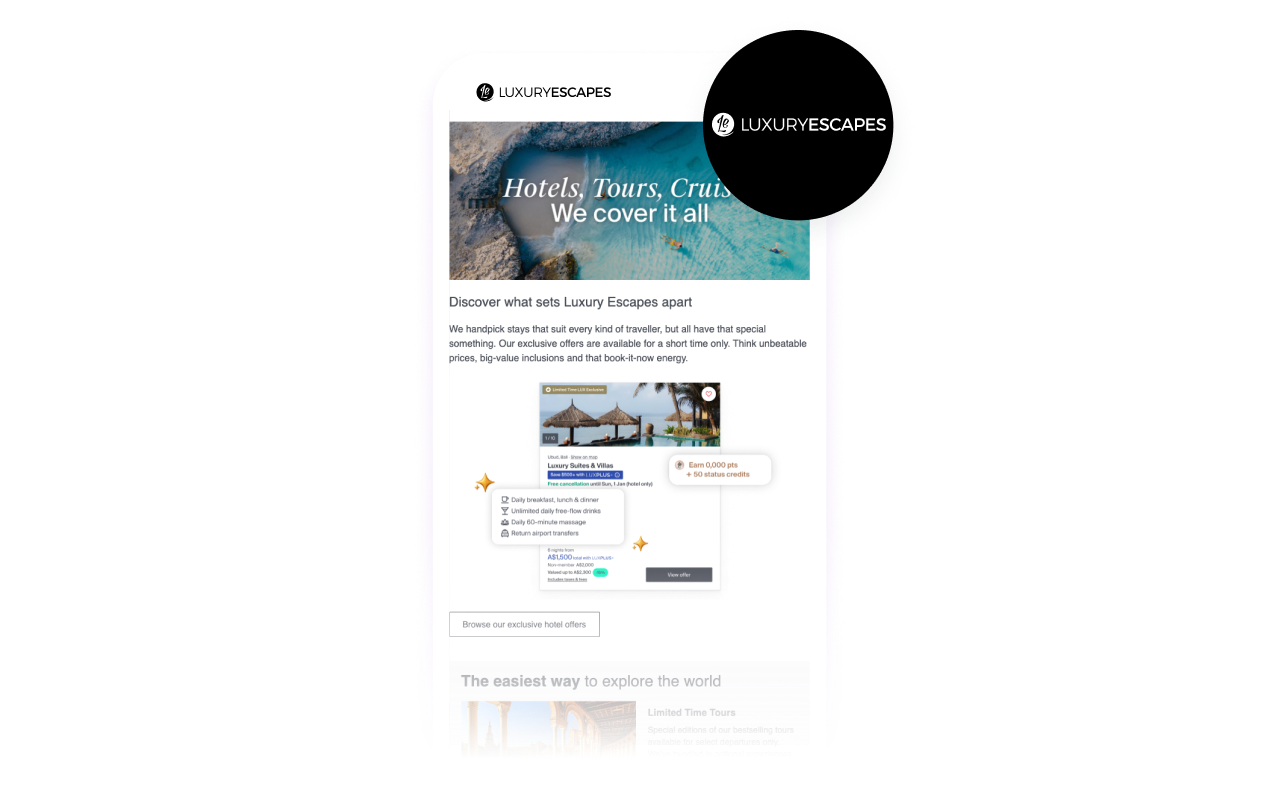
Luxury Escapes’ email segmentation used a rules-based approach that divided new users into three cohorts based on low, medium, and high engagement after signup to test the effectiveness of three different welcome emails. They saw good results, but wanted to push personalization further.
The team decided to deploy BrazeAI Agent Console™, replacing segmentation based solely on session count with a BrazeAI™ Agent that evaluated ten distinct website event signals to assign each new user to the right cohort.
The agent-based segmentation produced a 10% lift in revenue per user compared to the rule-based control group, driven entirely by conversion rate. It also drove a 7% increase in total transaction value and 6% increase in purchase volume.

INDUSTRY
PRODUCTS USED
BY THE METRICS
10%
Increase in revenue per user
7%
Increase in total transaction value
6%
Increase in purchase volume
Luxury Escapes sells exclusive travel offers to some of the world’s best escapes and is one of the world’s fastest-growing travel companies. Founded in Australia in 2013, the company believes that everyone should be able to travel in style, and the platform packages and sells holidays, tours, cruises, and hotels across 30 countries. Luxury Escapes has grown quickly—primarily serving Australia and emerging markets in the UK, Singapore, and Hong Kong—and boasts over 9 million global members. The platform operates similar to a virtual travel agency and offers flash-deals to entice travelers to take a trip and expand their horizons.
Nirnay Polaboina (Niru), Engineering Manager for the Customer Lifecycle team, has been with Luxury Escapes since 2021. His team owns the company’s martech stack end-to-end, which includes all integrations, data maintenance, and channel execution across email, SMS, push, and WhatsApp. The team’s goal, Niru shared, is to streamline processes for Luxury Escapes’ marketing team, and to make their experience more “drag and drop” so that they can push the boundaries of personalization.
Saying goodbye to the constraints of segmentation rules
Luxury Escapes takes a testing-first approach as it engages with new users. Previously, all new users received the same welcome email. In October 2025, the brand rolled out a new welcome journey more aligned to this strategy, with half of new users received a specific welcome email based on their placement within one of three cohorts. Based on session count after sign up, new users were considered as either “unengaged” (zero to one sessions), “explored” (one to three sessions), or “focused” (more than three sessions). Each cohort received a distinct email tailored to their stage in the discovery journey—from an introductory message with a promo code for the least engaged, to a destination-specific email drawing on search data for the most focused.
The experiment delivered a 12% increase in orders versus the previous “one-size-fits-all” welcome journey, which validated the segmentation approach. Still, the session-based thresholds were fixed, and the team had access to a much richer set of behavioral signals in Braze, but had no way to fold that data into the decisioning logic without rewriting the rules from scratch. Niru wondered: Could they replace rigid thresholds with something more adaptive, that could weigh multiple signals simultaneously and make smarter calls about where each user belonged?
Initially, Niru considered a traditional machine learning (ML) model, but they were working with a small window of behavorial signals and zero purchase history as the decisioning happens three days after account creation for users who have not yet made a purchase. ML models struggle here because there is no historical data train on, and building and maintaining a custom one takes significant data resources, which not every team has. Enter BrazeAI Agent Console™. The agent does not need training data—you give it the signals, explain what they mean, and it makes a nuanced decision straight away. It was the clear choice for Niru and team.
Traveling to a more nuanced welcome journey
The team deployed BrazeAI Agent Console™ as a decisioning step—not to generate content, but to evaluate each user’s aggregated website activity and assign them to the correct cohort. The agent received data from ten distinct website events: Signup success, screen views, page views, search count, product impressions, product clicks, and product view count, among others. Niru gave the agent instructions explaining what each of these events meant so the agent could understand what it represented and how it should factor into the classification.
Before launch, the team validated the agent’s distribution of customers into segments against the existing rule-based system. The results confirmed that the agent wasn’t putting all or most customers into a single segment, which helped to build the team’s confidence ahead of launch. One meaningful difference emerged: The agent routed fewer users to the “focused” cohort and more to “explored,” suggesting it was detecting behavioral nuance that the session-count threshold missed. Before launch, the team was concerned that the agent might route everyone to the “unengaged” cohort because that group gets a promo code. However, when they validated the decisioning flow, the agent actually sent fewer users to the promo cohort compared to the rules-based system. The agent was being more selective and only routing users who actually needed that nudge, and those users responded to it: More promo codes were redeemed when the agent selected the “unengaged” users versus when users were selected via the rules-based system.
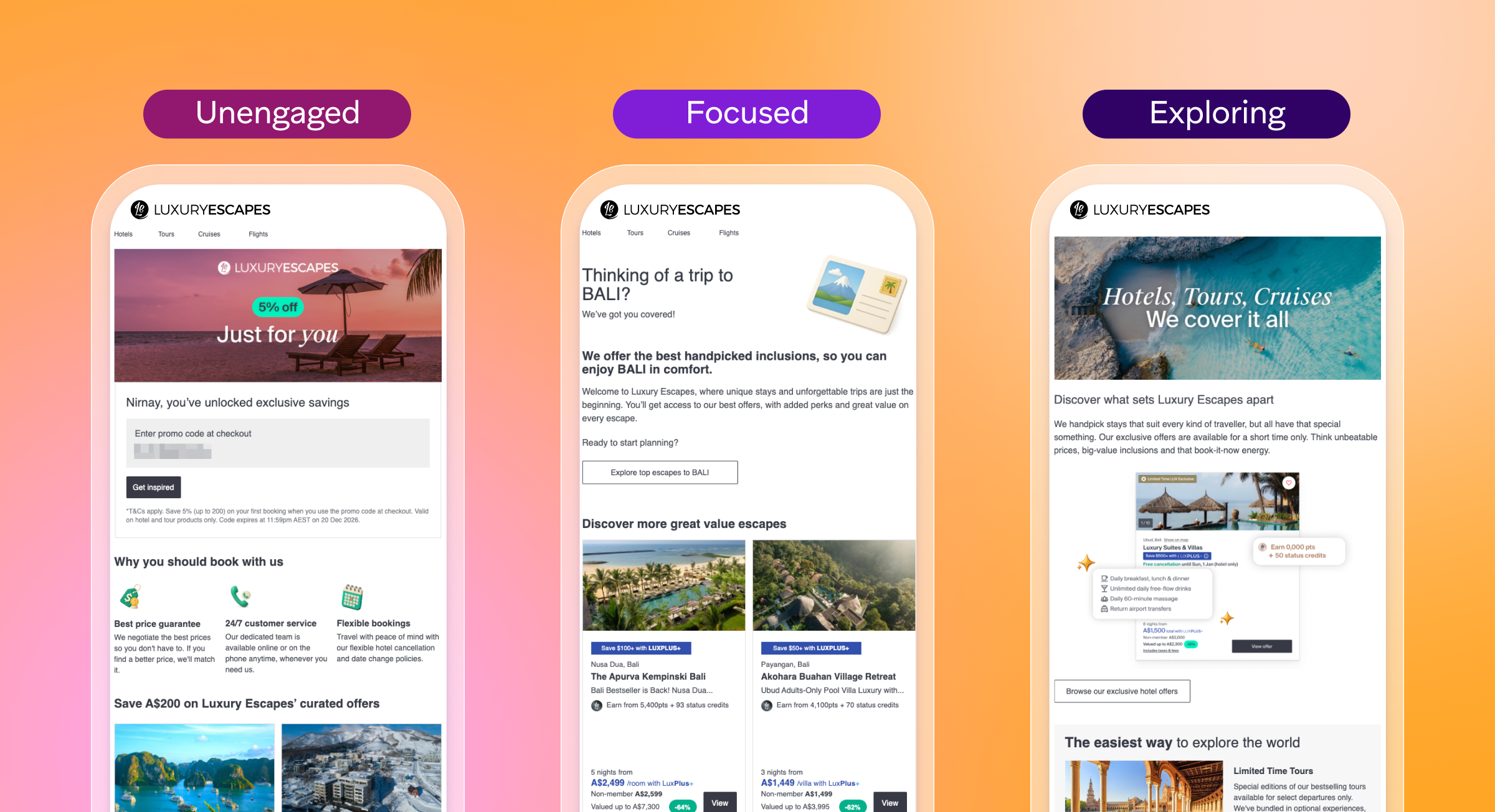
With that validation, Niru’s team structured a new A/B test. The treatment group received cohort assignments from the agent, while the control retained the original hardcoded rules. Both groups received the same emails once assigned to a cohort—the only difference was whether or not an agent made the assignment.
The results: Increase in transaction value, purchase volume, and revenue
The agent-based segmentation produced a 10% lift in revenue per user compared to the rule-based control group, driven entirely by conversion rate—not open rate or click metrics. It also drove a 7% increase in total transaction value and 6% increase in purchase volume. Testing confirmed that Luxury Escapes can rollout agent-based segmentation to 100% of new users as they move forward.
“The first question we asked was whether the agent would take the path of least resistance and default to promos. It did not. It was reading the user in a way our rules never could. So we ran the test and the results followed.”
Nirnay Polaboina
Engineering Manager, Luxury EscapesKey takeaways
- Agents can operationalize signals humans can’t manually process: The AI agent evaluated ten behavioral events simultaneously—something no static rule set could replicate.
- Test the decisioning layer independently: By testing the AI agent against the existing rule-based segmentation without changing other factors, Luxury Escapes was able to attribute the revenue lift to the agent’s classifications.
- Conversion rate is the real signal: Open and click-through rates were similar across both groups. Better segmentation doesn’t always lift engagement metrics, but can show up in purchases when you deliver the message most relevant to each person.
FEATURED TOPICS
Check out more Case Studies
 Case Study3 min read
How BookBeat cut days of cross-market reporting to minutes with the Braze MCP Server
 Case Study3 min read
Klover turned a testing plateau into its biggest open-rate wins with Braze Content Optimizer
 Case Study3 min read
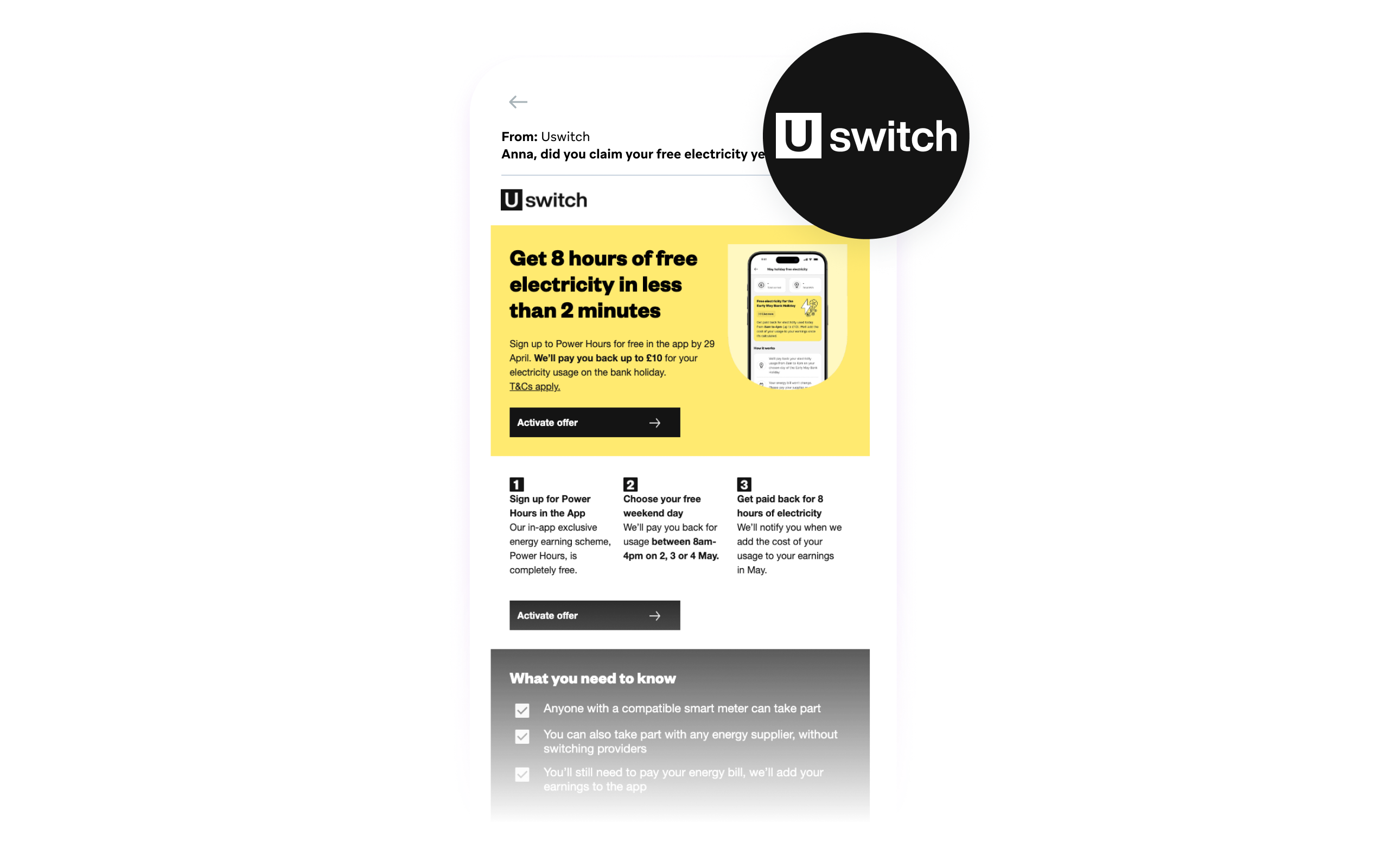
Uswitch turns AI-optimized subject lines and CTAs into a smarter path to smart meter connections