What is a customer engagement platform?
Published on January 21, 2026/Last edited on January 21, 2026/9 min read


Madison Tiemtoré
Content Marketing Lead, BrazeContents
According to the 2025 Global Customer Engagement Review, 39% of surveyed brands that missed their revenue goals used disconnected point solutions to send messages across channels. That's a real risk for teams that are struggling to deliver campaigns that feel personal and relevant across an ever-expanding range of channels.
Building credibility and impact has never been more important, and customer engagement platforms help teams respond to higher levels of customer expectation. Learning how to leverage AI and orchestration to get the most out of your tech stack is the best way to stay ahead of the curve.
Let's take a look at how your brand could move beyond outdated marketing and create the kind of best-of-breed solution that our mobile-first, real-time world now demands.
Customer engagement platform definition
A customer engagement platform (CEP) is software that supports real-time, cross-channel customer engagement, so teams can deliver relevant experiences that fit into their existing tech stack.
That means taking what customers do (and don’t do) and turning it into messaging and journeys that keep pace. A CEP typically supports orchestration across channels like email, web and mobile push, SMS, mobile inboxes, and in-app messages, from a single interface.
Is customer engagement software the same as a customer engagement platform?
Not exactly. “Customer engagement software” is describing a broad category, while a customer engagement platform is built specifically for real-time, cross-channel orchestration and messaging, from one place.
How a customer engagement platform compares to customer relationship management and marketing automation platforms
These tools often sit next to each other in a stack, but they solve different problems.
- CRMs are built to manage customer and account records, plus relationship workflows (often tied to sales and service). They’re great for tracking who someone is and what’s happened, but they’re not built to coordinate cross-channel messaging in real time.
- Marketing automation platforms are built to plan and run campaigns. They help teams automate communications through scheduled programs and rule-based journeys, but they can be harder to adapt on the fly as behavior changes across channels.
- Customer engagement platforms are built for orchestration. They connect customer data to action across channels, so teams can coordinate experiences and respond quickly to customer signals, without rebuilding their whole stack.
If your team uses a CDP, it can complement a CEP by unifying customer data. The CEP is where that data becomes orchestrated engagement across channels.
Why customer engagement platforms matter today
Disconnected experiences cost brands customers.
Customers want consistency across channels, which needs more than a human touch and yet they also want messaging that feels human, timely, and relevant to what they’re doing in the moment.
That changes what “engagement” looks like in practice. Instead of building a calendar of campaigns and hoping people line up with it, teams need engagement that adapts as customers browse, buy, pause, return, and change their minds. Customer engagement platforms support that continuous, responsive approach across channels, so experiences stay coherent even as behavior changes.
The core components of a CEP
Best-of-breed customer engagement platforms share a specific set of capabilities. A big part of that is customer data orchestration—getting the right customer context into the right place fast enough to act on it, and giving marketers a practical way to orchestrate what happens next.
Real-time data processing
It’s important that the platform is architected with stream processing technology, so data can be accessed within seconds as it flows into the system. That’s what supports acting on customer actions and behaviors as they happen, and turns testing into real-time personalization, across messages, channels, and journeys. Not all CEPs are built this way.
Audience segmentation
Stream processing supports segmentation based on user data and customer context that’s continuously updated in live customer profiles. That means precise, real-time audiences with no outdated lists or extra queries.
Cross-channel orchestration
A journey management tool lets marketers orchestrate campaigns across channels like email, web and mobile push, SMS, mobile inboxes, and in-app messages, all within a single user interface.
Testing and personalization
Multivariate campaign testing supports continuous optimization at the message, campaign, and strategy level. Pairing live customer profiles with interaction data also makes one-to-one and one-to-many personalization easier to run and scale.
Intuitive interface
An integrated and intuitive visual interface supports composing, personalizing, and orchestrating single- and cross-channel campaigns from one place, without constant toggling between systems.
Flexible platform integrations
A “no more custom integrations” approach comes from support for best-in-class partnerships across the stack, including tools across Business Intelligence, Customer Data Platforms, Attribution, and AI.
Data integrity
Best-in-breed CEPs use pseudonymized numbers, such a unique ID, to identifies each individual’s user profile to track actions and create audiences, instead of relying on directly identifiable data (such as email addresses).
Best-of-breed vs. legacy systems
Legacy engagement tools can make modern engagement feel harder than it needs to be. They were built for a different era of marketing, where speed mattered less, channels were fewer, and personalization could be handled with broad segments and scheduled sends.
A best-of-breed customer engagement platform is built for real-time behavior and cross-channel coordination. It’s designed to keep data, segmentation, journeys, and measurement moving at the pace customers move.
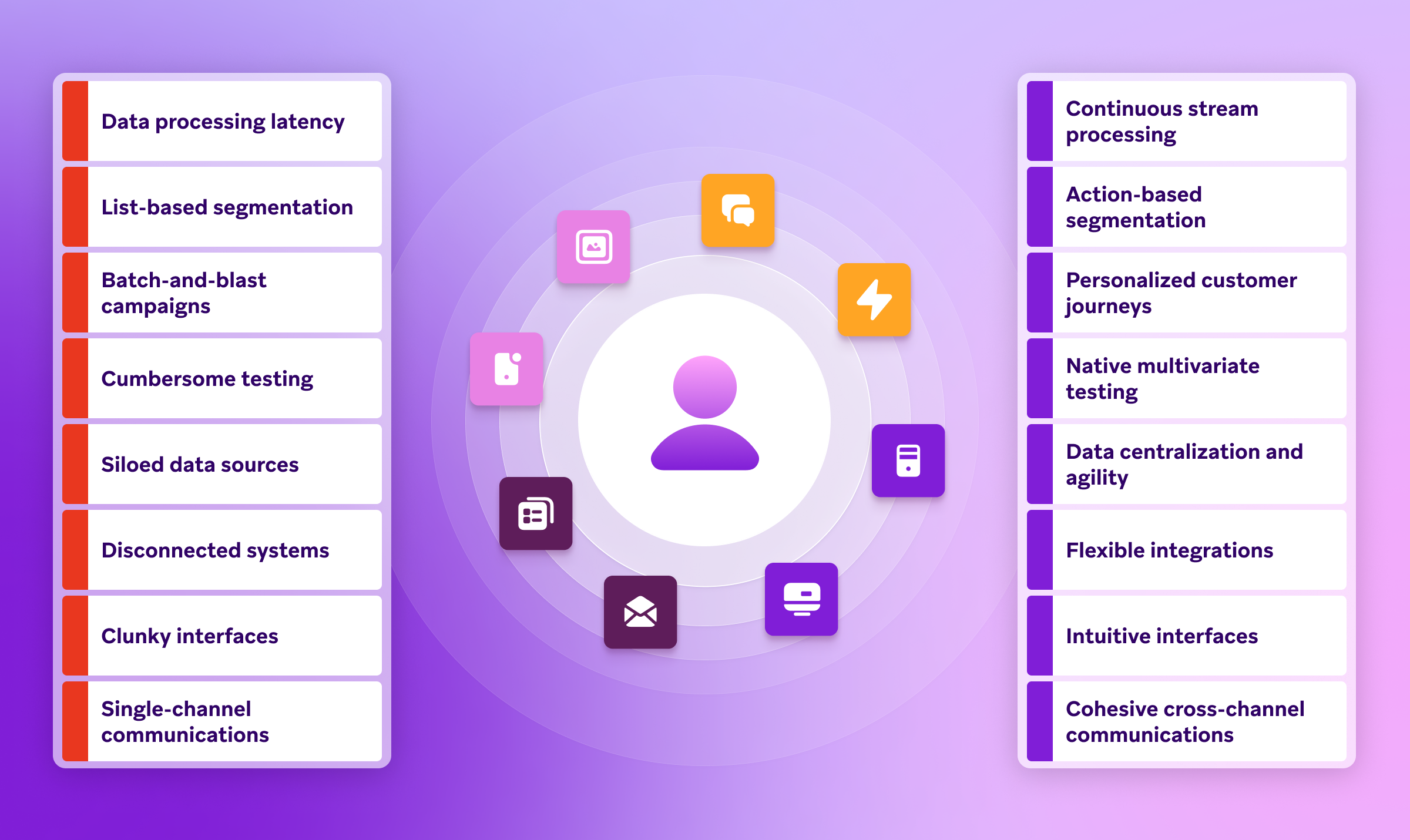
Legacy solutions
Legacy systems often come with:
- Data processing latency
- List-based segmentation
- Batch-and-blast campaigns
- Cumbersome testing
- Siloed data sources
- Disconnected systems
- Clunky interfaces
- Single-channel communications
Best-of-breed solutions
Best-of-breed platforms focus on capabilities like:
- Continuous stream processing
- Action-based segmentation
- Personalized customer journeys
- Native multivariate testing
- Data centralization and agility
- Flexible integrations
- Intuitive interfaces
- Cohesive cross-channel communications
Evaluating a customer engagement platform: Key criteria
A customer engagement platform can look great in a demo and still fail to hit the mark in real life. These questions help you pressure-test whether it will actually support real-time, cross-channel engagement as your stack, channels, and audiences grow.
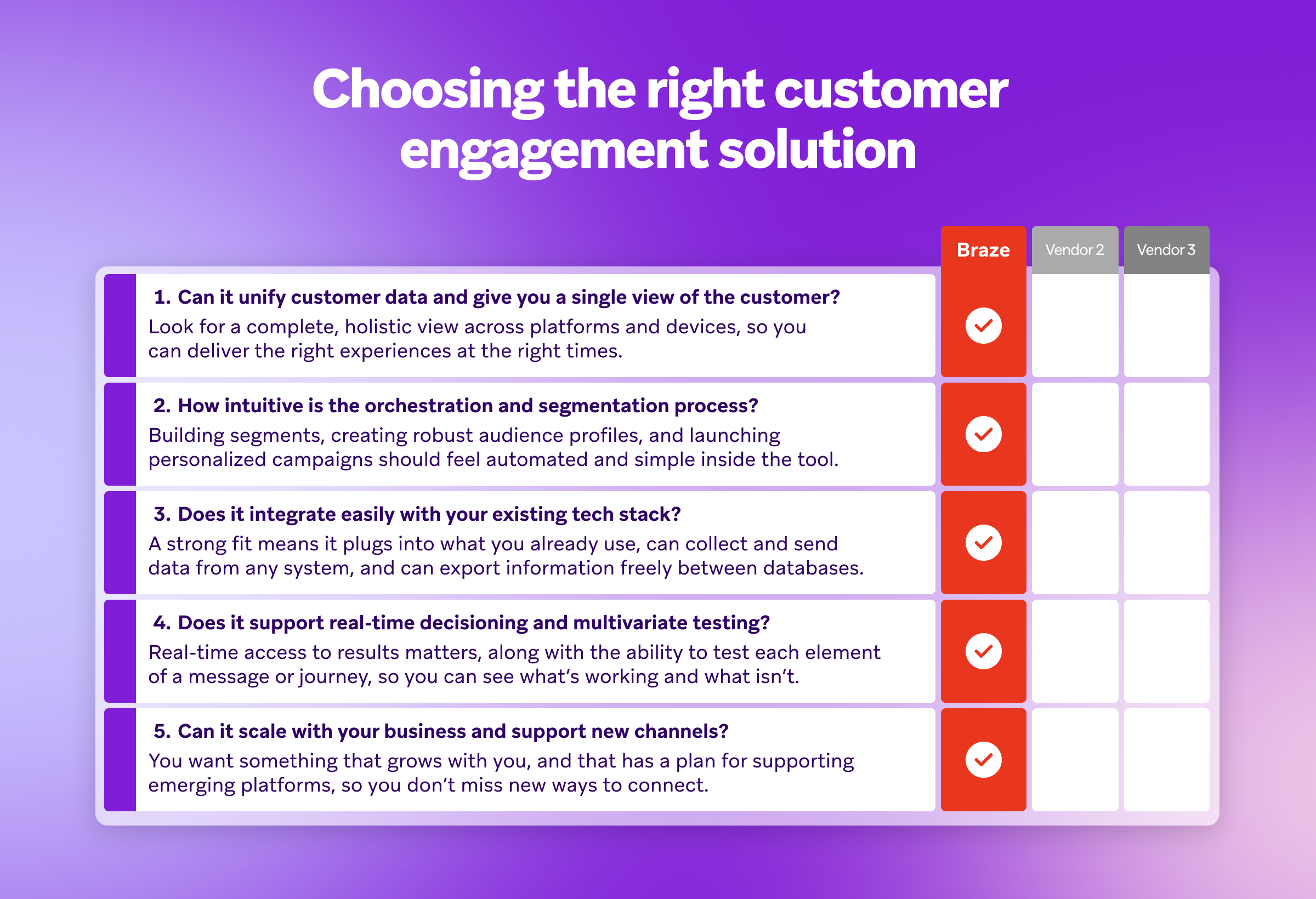
Choosing the right customer engagement solution
Start with the fundamentals:
- Can it unify customer data and give you a single view of the customer?Look for a complete, holistic view across platforms and devices, so you can deliver the right experiences at the right times.
- How intuitive is the orchestration and segmentation process?Building segments, creating robust audience profiles, and launching personalized campaigns should feel automated and simple inside the tool.
- Does it integrate easily with your existing tech stack?A strong fit means it plugs into what you already use, can collect and send data from any system, and can export information freely between databases.
- Does it support real-time decisioning and multivariate testing?Real-time access to results matters, along with the ability to test each element of a message or journey, so you can see what’s working and what isn’t.
- Can it scale with your business and support new channels?You want something that grows with you, and that has a plan for supporting emerging platforms, so you don’t miss new ways to connect.
A strong solution will provide best-in-class technology with intelligent AI-powered engagement and automation, enabling you to focus on improving the customer experience.
Does a customer engagement platform have the same capabilities as an omnichannel engagement platform?
Often, yes. In practice, many customer engagement platforms are built to support omnichannel engagement, and the terms get used interchangeably.
The difference is emphasis. An omnichannel engagement platform points directly to connected channels and continuity, where messages and context carry across touchpoints.
A customer engagement platform puts the focus on the overall customer experience and the outcomes you’re trying to drive, which may include omnichannel orchestration, and features like predictive analytics that help teams anticipate intent or risk signals and tailor journeys accordingly. It can also include other approaches that best fit what customers need in the moment.
Calculating value and ROI
Marketing technology buying decisions come down to perceived value. That’s why it helps to look past the surface costs on the price tag and ask what you’ll actually spend (in time, effort, and resources) for your customer experience optimization.
A practical way to assess that is to look at two things:
Explicit and implicit costs
The platform cost is only part of the picture. The bigger question is what sits beneath it, including the work required to get data flowing, campaigns live, and teams productive.
Expected time-to-value and potential results
Ask how quickly you can get to key capabilities, and what outcomes teams typically see once they’re there.
Here are some examples of the impact Braze has had on our customers’ strategies.
- 3X industry standard open rates for Overstock
- 58% increase in loyalty offer redemptions for e.l.f.
- 41% add to cart rate for Grove Collaborative
- 3X uplift in onboarding email open rates for happn
Beyond the platform: Why partnership matters
A customer engagement platform can have all the right features, but it still takes real support to get value out of it. The right partner helps you reduce initial time-to-value, get more out of the technology, and learn alongside a wider community of innovators.
A partnership with Braze shows up in practical ways across the lifecycle, including:
- Pre-sales supportDiscovery and strategic planning, personalized workshops, use case walkthrough demos, technical scoping, and ROI measures.
- Customer successA primary contact, ongoing business reviews, ongoing maturity support, plus long-term strategic planning and actionable recommendations.
- Data servicesData pipeline strategy, data training sessions, reporting requirements, and dashboards and reporting setup.
- Integrations and onboardingPlatform configuration support, best practices, personalized training, technical quality assurance, and go-live guidance.
- Deliverability servicesEmail onboarding, an IP warming plan, email best practices, personalized recommendations, and deliverability monitoring.
- Technical supportAward-winning technical support, a vast knowledge base, and live answers to product questions.
It’s also worth looking at the strength of the community around the platform. Braze has 300+ customer advocates and 1,600+ community members, which can make a real difference when you’re looking for references, advice, and proven approaches.
Key takeaways of customer engagement platforms
Choosing a customer engagement platform is a long-term decision. The best choice is the one that gives your team the speed to act on customer behavior, the flexibility to grow across channels, and the support to keep improving over time.
Here are the main points to keep in mind:
- Move beyond outdated marketing and data paradigmsModern engagement needs real-time data processing, responsive segmentation, and orchestration that can keep pace with customers across devices and channels.
- Choose a partner for the long haulThe platform matters, but so does the ecosystem around it. Look for strong support, services, and community that help you reach value faster and keep building.
- Ask the right questions upfrontFocus your evaluation on the practical realities: how data is unified, how easy orchestration is, how testing and decisioning work in real time, and how well the platform integrates with the rest of your stack.
Customer engagement platform FAQs
What is a customer engagement platform?
A customer engagement platform is software that supports real-time, cross-channel customer engagement, so teams can deliver relevant experiences that fit into their existing tech stack.
How does a customer engagement platform work?
A customer engagement platform works by processing customer data in real time, updating customer profiles and segments, and then orchestrating messaging and journeys across channels like email, mobile, web, and SMS from a single interface.
What channels can a customer engagement platform support?
Customer engagement platform channels commonly include email, web and mobile push, SMS, mobile inboxes, and in-app messages, so teams can coordinate experiences across the places customers actually engage.
What’s the difference between a customer engagement platform and a CRM?
The difference between a customer engagement platform and a CRM is that a CRM focuses on managing customer and account records and relationship workflows, while a CEP focuses on orchestrating cross-channel engagement and activating customer signals in real time.
What’s the difference between a customer engagement platform and marketing automation?
The difference between a customer engagement platform and marketing automation is that marketing automation tools typically focus on scheduled campaigns and rule-based programs, while a CEP is built to coordinate engagement across channels and adapt quickly to customer behavior.
What should you look for when evaluating a customer engagement platform?
When evaluating a customer engagement platform, look for unified customer data, intuitive orchestration and segmentation, easy integrations, real-time decisioning and multivariate testing, and the ability to scale as your business grows and new channels emerge.
How do you measure customer engagement platform ROI?
You measure customer engagement platform ROI by looking beyond license cost to include implementation effort, time-to-value, and the outcomes the platform helps you drive, such as improved engagement rates and faster activation of cross-channel campaigns.
Why does partnership matter when choosing a customer engagement platform?
Partnership matters when choosing a customer engagement platform because support, services, integrations help, and community access can reduce time-to-value and help teams keep improving their engagement strategy over the long term.
Can a customer engagement platform work with a CDP?
A customer engagement platform can work with a CDP because CDPs help unify and move customer data, while the CEP uses that data to orchestrate engagement across channels in real time.
Related Tags
Be Absolutely Engaging.™
Sign up for regular updates from Braze.
Related Content
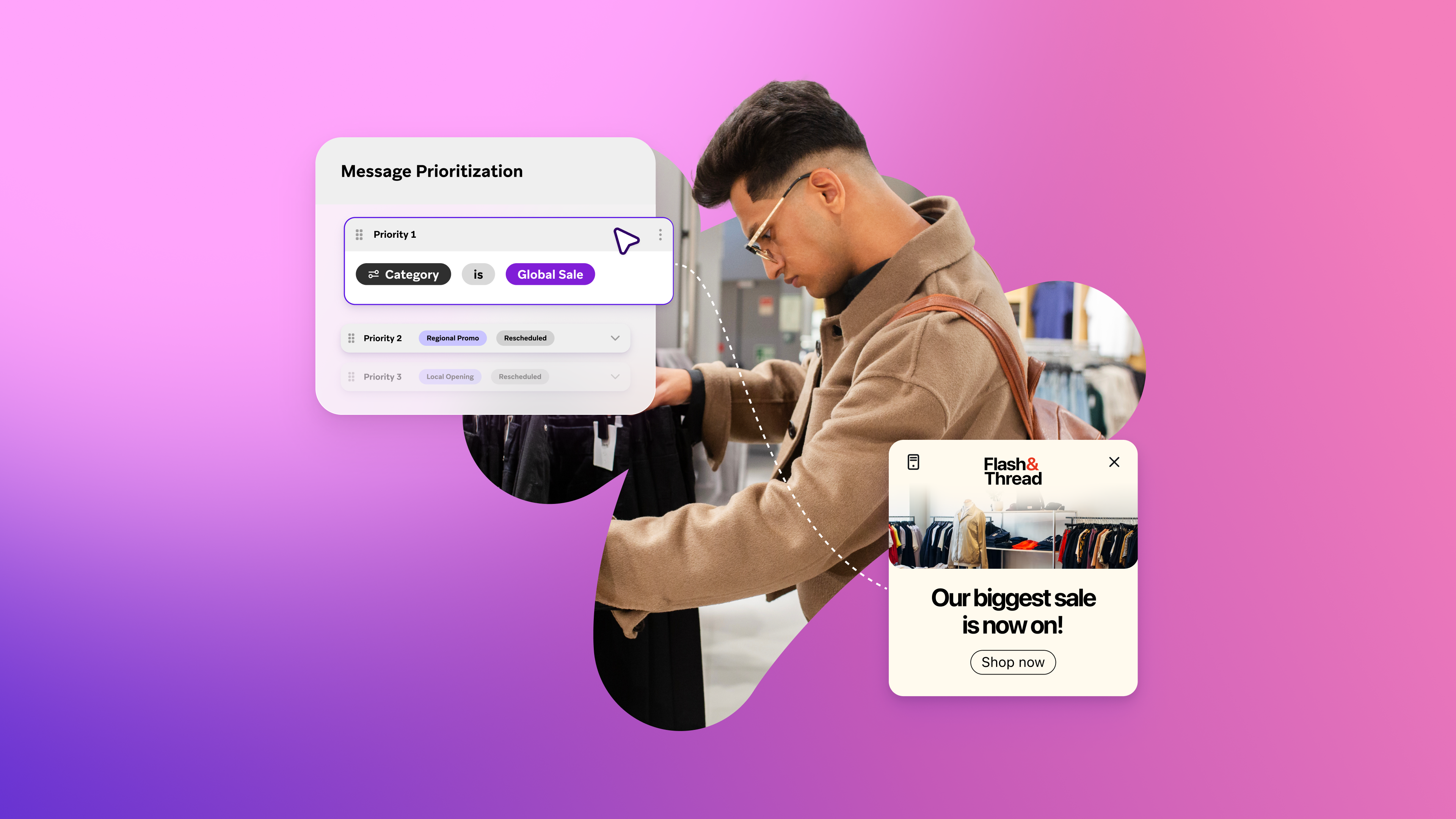 Article5 min read
Message Prioritization: Make your most important messages win
October 20, 2026 Article37 min read
SMS marketing examples: Use cases for B2C brands, by industry
October 19, 2026 Article11 min read
BrazeAI Operator™ Use Cases: How Marketers Launch Campaigns, Build Segments, And QA In Minutes
October 19, 2026