AI customer retention: Strategies, tactics, and mistakes to avoid
Published on March 04, 2026/Last edited on March 04, 2026/14 min read

Team Braze
Contents
Customers don’t want more messages. They want messages that make sense—based on what they’ve done, what they’ve asked for, and where they are in the customer lifecycle.
AI customer retention is using AI to help more customers stick around and come back—by spotting early signs someone might drop off, tailoring messages and experiences to what they care about, and choosing better moments to reach out.
This article breaks down what AI customer retention means, where it fits across the lifecycle, which tactics are worth trying first, and how to measure impact.
What is AI customer retention?
AI customer retention means using AI to help more customers stick around and come back. It does that by spotting early signs someone might drop off, tailoring messages and experiences to what they care about, and choosing better moments to reach out across the customer lifecycle.
For customer engagement teams, it’s about helping people get value sooner, keeping momentum going, and stepping in early when engagement starts to dip. AI can support real-time decisioning so journeys adapt to what customers actually do, instead of pushing everyone through the same sequence.
Why AI retention matters now
AI retention matters now because customer expectations for relevance are rising while tolerance for irrelevant automation is shrinking. Customers expect brands to remember context and keep messages relevant. They also have a low tolerance for automation that feels fake, pushy, or overly familiar.
AI retention has to balance those two realities—more relevance without more creepiness. Trust is the limiter and the differentiator. Teams that use real-time signals with clear permissioning, smart frequency limits, and a consistent brand voice as part of their customer engagement strategy can improve retention.
How AI improves retention across the entire customer journey
Retention starts long before someone looks “at risk.” If a customer never reaches value, gets stuck early, or doesn’t build a habit, churn is usually a matter of time.
AI helps by spotting the moments that shape whether someone sticks with you—then helping teams respond with the right experience across the right channel.
Here are the journey moments where AI can make the biggest difference:
- Onboarding and activation: pick up on early behaviors, then guide customers toward the actions that lead to success.
- Value realization: notice when someone stalls, then step in with in-product help, a reminder, or a route to support.
- Habit formation: adjust timing based on real engagement patterns, instead of sending on a fixed schedule.
- Lifecycle milestones: tailor journeys around renewals, replenishment cycles, changing usage, and shifting preferences.
- Churn prevention and win-back: prioritize who to reach and when, based on risk, propensity, and recency, with suppression to avoid adding noise.
As journeys spread across more channels, coordination matters as much as prediction—a churn score only helps when it leads to a timely experience that feels useful.
11 practical AI-driven retention strategies
If you’re trying to improve retention, you need ideas you can actually run. These tactics focus on the decisions that move the needle—who to avoid spamming, who needs help, what to send, and when to send it.
1. Predict churn risk and trigger proactive journeys
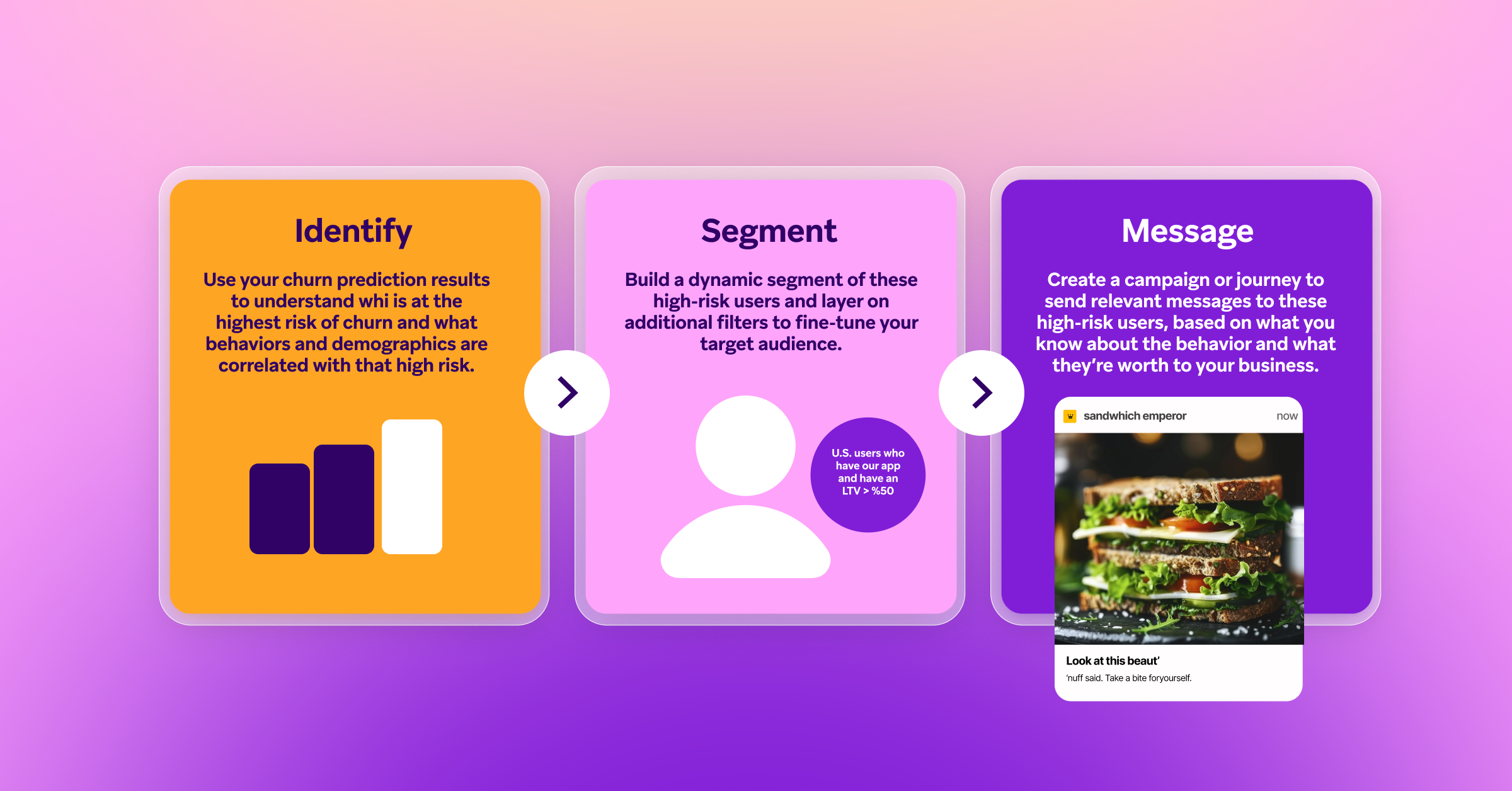
Use churn prediction signals to spot early risk, then start a journey that matches the likely blocker.
What to set up
- Track churn-risk signals such as usage decline, drop in message engagement, reduced purchase frequency, and support friction using first-party data
- Use those signals to move people into dynamic segments, then trigger proactive cross-channel journeys (email, push, in-app, and web) based on risk level
What to watch
- Suppression rules for customers already receiving a high volume of messages
- Success metrics tied to the journey goal (activation, repeat usage, renewal), rather than clicks alone
2. Optimize send timing and contact frequency using engagement signals
Timing and contact frequency are often quick wins. AI can use engagement patterns to adjust when you reach out and how often.
What to set up
- Use engagement signals (opens, clicks, sessions, purchases) to optimize send times by user
- Put frequency limits in place by channel, then align them across channels so customers do not get hit from multiple directions
What to watch
- Short-term spikes that skew timing, especially around promos
- Overlapping triggers across teams that create pile-ons
3. Personalize onboarding based on early behaviors
Early behaviors are strong predictors of long-term retention. AI can route customers into different onboarding paths based on what they do in the first session or week.
What to set up
- Define “early success” behaviors that indicate a customer is on track, based on your product’s first value moment
- Branch onboarding journeys based on in-app events and milestones, then tailor messaging and in-product guidance accordingly
What to watch
- Overly complex branching that is hard to maintain
- Messaging that assumes intent without giving customers preference controls
4. Use next best experience recommendations across channels
Next best experience recommendations help you choose which message, prompt, offer, or piece of education is most relevant right now, then deliver it across channels.
What to set up
- Define a library of eligible experiences (education modules, feature prompts, offers, content recommendations)
- Use real-time decisioning to select the next best experience based on context, propensity, recency, and prior exposure
What to watch
- Recommendations that feel disconnected from recent behavior
- Missing exclusions, such as recent complaints, refunds, preference changes, or low-intent signals
5. Run AI-assisted experimentation on subject lines, offers, and variants
AI can speed up experimentation by generating variants and helping you narrow what to test, then learning from outcomes.
What to set up
- Use AI to draft copy variants that follow your brand voice rules, then run structured A/B tests
- Use control groups to measure incremental lift, rather than relying only on top-line engagement
What to watch
- Moving faster than your measurement can support
- Testing too many variables at once, which makes results harder to interpret
6. Use dynamic segmentation and suppression to prevent fatigue
Dynamic segmentation updates in real time based on behavior. Suppression keeps your best journeys from turning into message overload.
What to set up
- Build behavioral segments around engagement level, recency, product usage, and lifecycle stage
- Add suppression rules that pause lower-priority messages when fatigue signals appear, or when intent is unclear
What to watch
- Suppression that is too strict, which can hide performance issues
- Static segments that never refresh, including long-lived “VIP” lists
7. Trigger in-the-moment interventions to unblock value
When customers get stuck, speed matters. In-app, push, and web interventions can remove friction while the customer is still engaged.
What to set up
- Trigger in-app messages when customers hesitate, hit errors, abandon key steps, or loop through help content
- Follow up with a coordinated push or email that connects to the same moment and offers a clear next step
What to watch
- Interrupting customers during high-intent tasks
- Reusing the same intervention for every blocker, which lowers relevance
8. Build loyalty and win-back journeys using propensity and recency
The right retention move depends on how recently someone engaged and how likely they are to return.
What to set up
- Create win-back tiers based on recency, prior value, and likelihood to re-engage
- Tailor incentives and content by tier, with escalating offers only for customers who need them
What to watch
- Training customers to wait for discounts
- Treating structural churn drivers (price, product fit, availability) like a messaging problem
9. Personalize content using first-party preferences
Personalization works best when preferences are explicit and respected. First-party data supports relevance without crossing lines.
What to set up
- Capture preferences through onboarding questions, in-app settings, content choices, and message interactions
- Personalize content blocks, recommendations, and education streams based on those preferences and recent behavior
What to watch
- Overly direct use of inferred data that can feel intrusive
- Preference data that never refreshes and becomes outdated
10. Build closed-loop learning into targeting rules
Closed-loop learning means outcomes feed back into future decisions, so journeys improve over time.
What to set up
- Feed outcomes such as conversion, repeat engagement, churn, and time-to-value back into segmentation and eligibility logic
- Review decision rules on a cadence tied to data volume and seasonality
What to watch
- Optimizing toward proxy metrics that do not map to retention
- Confusing short-term engagement with long-term value
11. Keep a human in the loop for sensitive retention moments
Some moments need judgment and empathy. Human review keeps AI helpful and protects brand authenticity.
What to set up
- Define scenarios that should route to a human, such as refunds, account access issues, regulated topics, and high-value customers at risk
- Add approval steps for offers and sensitive copy, and define escalation paths across marketing, product, support, and success
What to watch
- Bottlenecks that slow urgent intervention
- Unclear ownership that leads to inconsistent customer experiences
How to implement AI retention without over-automation
AI can help you move faster. Guardrails are what keep that speed from turning into noise.
Start by deciding how your retention journeys should behave across channels and teams—before you build more triggers.
Frequency and prioritization
Set contact limits by channel, then set a shared limit across channels. Add a simple priority order so if multiple messages are eligible, the most important one wins and the rest get delayed or suppressed.
Tone and brand voice
Write down a short set of rules AI has to follow—words to avoid, how direct you want to be, and which claims need review. Keep personalization grounded in customer actions and stated preferences, rather than guesswork.
Channel coordination
Define what each channel is for in your lifecycle marketing. Email can carry the longer story, in-app can unblock a step, push can nudge at the right moment, and web can reinforce the next action. The goal is one joined-up experience, not four separate campaigns.
Escalation paths
Map what happens after a customer needs help—where the handoff goes, who owns it, and how fast it needs a response. Define the route for common scenarios (billing issue, technical blocker, complaint), and set expectations for follow-up so customers don’t fall into a gap between teams.
When to route to a human
Document the moments that need judgment and empathy—high-value customers at risk, complaints, safety or regulatory issues, and any scenario where getting it wrong damages trust. Build those routes into your journeys so customers are not stuck in loops.
First-party data matters here, too. If you can’t explain why someone received a message, it’s hard to build trust, and it’s hard to troubleshoot what’s working.
Mistakes to avoid when using AI for customer retention
AI makes it easier to act on customer signals. It also makes it easier to create noise, lose trust, and drift away from your brand voice. These are the most common ways AI retention programs go off track, and what to do instead.
Over-messaging and spamming with AI
When AI makes it faster to build journeys, volume creeps up. Customers feel it quickly—more ignores, more opt-outs, and less engagement across every channel.
A better approach—cap frequency, set priorities, and suppress low-value touches when intent is unclear. Treat silence as information, not a cue to send again.
Treating AI as “just chatbots”
Chatbots can help with support, but retention is shaped by the whole journey—onboarding, in-product guidance, lifecycle nudges, and cross-channel follow-up.
A better approach—use AI to decide which experience a customer needs next, then deliver it through the right channel. Connect support moments back into your customer journey orchestration so the next message reflects what happened.
Replacing human judgment and empathy
Retention moments can involve frustration, confusion, billing issues, or high-stakes decisions. AI can help triage and personalize, but it shouldn’t be the only decision-maker when the situation is sensitive.
A better approach—keep humans involved for high-risk moments and define what “sensitive” means for your brand and audience. Build clear routing rules so customers reach a person before they hit a dead end.
Sounding inauthentic or chasing trends that don’t fit your brand voice
Customers can spot generic automation fast. They also notice when a brand suddenly starts copying a trend, a meme style, or a tone that doesn’t match the relationship.
A better approach—keep personalization grounded in customer context and stated preferences. Use brand voice rules and review flows for high-visibility messages, especially around retention and win-back.
Using AI outputs without measurement and iteration
AI doesn’t remove the need for measurement. Without control groups and clear outcomes, it’s easy to mistake activity for impact.
A better approach—measure incremental lift versus a control group where possible, then iterate based on retention outcomes like repeat usage, renewal, and churn rate, rather than engagement metrics alone.
AI customer retention use cases by lifecycle stage
AI retention gets easier to plan when you map it to lifecycle moments. A simple framework helps teams stay focused—signal → decision → journey → metric.
Onboarding
In onboarding, AI customer retention helps people reach their first real value milestone faster.
- Signal: Signup source, first-session behaviors, skipped steps, early feature usage
- Decision: Which onboarding path, content, and channel sequence fits this customer
- Journey: Guided in-app steps, triggered education, reminders, and preference capture
- Metric: Time-to-value, activation rate, onboarding completion, early retention
Activation
In activation, AI prioritizes the next best action that’s linked to long-term engagement.
- Signal: Repeat sessions, depth of usage, feature adoption, friction points
- Decision: Which action to prompt next, and when
- Journey: In-app prompts, push reminders, contextual email support, and help content
- Metric: Feature adoption, session frequency, activation milestone completion
Engagement
In engagement, AI helps with relevance, timing, and message selection across channels.
- Signal: Recency, preferences, content interaction, purchase or usage patterns
- Decision: Next best experience, channel choice, and message priority
- Journey: Personalized content, cross-channel journeys, dynamic suppression
- Metric: Engagement frequency, repeat usage, repeat purchase, LTV trend
Renewal and repurchase
At renewal or repurchase, AI helps identify the right intervention before a customer starts drifting.
- Signal: Usage decline, renewal window, price sensitivity, support signals
- Decision: Whether to educate, incentivize, escalate, or hold back
- Journey: Renewal education, plan guidance, reminders, targeted offers, and human routing
- Metric: Renewal rate, repurchase rate, expansion rate, retention rate
Churn prevention
For predictive churn prevention, AI identifies risk patterns early and triggers journeys that address the likely cause.
- Signal: Engagement drop-offs, repeated failures, negative sentiment, inactivity
- Decision: Which playbook fits the risk driver, and what to suppress
- Journey: Unblock flows, support routing, education, and win-back sequencing
- Metric: Churn rate, save rate, lift vs. control, reduced time-to-recovery
Win-back
In win-back, AI prioritizes customers most likely to return and tailors the experience based on recency and prior value.
- Signal: Time since last activity, prior value, last-touch outcomes, channel permissions
- Decision: Whether to re-engage, what to offer, and what channel to use
- Journey: Staged win-back, tailored incentives, preference refresh, and content reintroduction
- Metric: Reactivation rate, repeat engagement, incremental revenue, restored retention
How to measure AI-driven retention
AI-driven retention strategies should earn their place by changing customer behavior in ways that matter.
Start with a small set of core metrics, then add supporting diagnostics as needed:
- Retention rate and churn rate: Break these down by cohort and lifecycle stage so you can see where AI is helping, and where customers still drop.
- Repeat purchase or repeat usage: Proof customers are choosing to come back, not just opening messages.
- LTV: Longer-term value impact, especially when you compare groups exposed to AI-driven journeys with groups that aren’t.
- Time-to-value: A strong leading indicator. Customers who reach value faster tend to stick around longer.
- Engagement frequency: Useful when it maps to value, such as sessions, feature usage, purchases, or content consumption.
- Incremental lift vs. control: The cleanest way to separate correlation from causation. It tells you what changed because of the journey, not what would have happened anyway.
Where you can, use holdouts. If that’s not realistic, use stepped rollouts or matched cohorts so you can still estimate impact with credibility.
Will AI revolutionize customer retention?
AI will change customer retention because it helps teams make smarter decisions faster across the customer lifecycle. The gains won’t come from scaling for the sake of it. They’ll come from using AI to stay relevant, respect consent, and coordinate journeys across channels so customers get a consistent experience.
The brands that benefit most will treat AI like a system—solid first-party data, clear guardrails, and ownership for what happens when a customer is frustrated, confused, or at risk of leaving.
See how Braze helps teams use AI to improve retention with real-time decisioning and cross-channel journeys.
Customer retention FAQs
What is AI customer retention?
AI customer retention is using AI to help reduce churn and increase repeat engagement by spotting churn risk early, tailoring lifecycle experiences, and choosing better moments to reach out across channels.
How does AI improve customer retention rates?
AI improves customer retention rates by using behavioral and preference signals to pick more relevant messages and experiences, then triggering them at moments that support onboarding, activation, engagement, and renewal.
What are the best AI tactics to increase customer retention?
The best AI tactics to increase customer retention include predicting churn risk and triggering proactive journeys, selecting a next best experience across channels, using suppression to prevent fatigue, and feeding results back into targeting rules.
How can AI personalize retention journeys without feeling creepy?
AI can personalize retention journeys without feeling creepy by relying on first-party preferences, staying close to recent customer actions, and giving customers control over frequency, channels, and content.
What are the biggest mistakes to avoid when using AI for customer retention?
The biggest mistakes to avoid when using AI for customer retention include over-messaging, treating AI as “just chatbots,” removing human judgment from sensitive moments, chasing trends that don’t fit your brand voice, and skipping measurement and iteration.
Do you need predictive analytics to use AI for retention?
You do not need predictive analytics to use AI for retention. Many teams start with engagement signals, behavioral segmentation, and testing, then add churn prediction as their data and measurement mature.
How do you measure ROI from AI-driven retention?
You measure ROI from AI-driven retention by tying programs to outcomes like retention rate, churn rate, repeat purchase, LTV, and time-to-value, then validating impact with holdouts or other incremental lift methods.
Related Tags
Be Absolutely Engaging.™
Sign up for regular updates from Braze.