Hyper-personalization: What it is and how to deliver it at scale
Published on July 22, 2026/Last edited on July 22, 2026/18 min read

Team Braze
Contents
Hyper-personalization is the use of AI, real-time data, and machine learning to tailor content, offers, timing, and channel to each individual customer, adapting continuously as their behavior changes. It picks up where basic personalization stops. Inserting a first name or sending a segment a shared offer treats people as members of a group. Hyper-personalization treats them as individuals, with real-time adaptation that updates what they see in the moment rather than on a fixed schedule.
This higher level of relevance keeps people engaged, and it relies on two AI jobs working together. One generates the content. The other decides what, where and when, each person sees it.
TL;DR
- Hyper-personalization uses AI, real-time data, and machine learning to tailor content, offers, timing, and channel to each individual customer, adapting continuously as behavior changes rather than inserting a name or sorting people into segments.
- It sits at the far end of a spectrum that runs from segmentation to basic personalization, differing on three fronts: how much data it uses, how precisely it targets the individual, and how often it updates.
- It works as a continuous loop, unifying first-party and contextual data into one profile, using machine learning to decide what each person gets, delivering in real time, then learning from the outcome to sharpen the next decision.
- It relies on two AI jobs working together: generative AI builds a library of on-brand content variants, and AI decisioning selects the variant, channel, and timing for each individual based on observed outcomes.
- Real brands run it across every channel and industry, from Grove Collaborative's browse-triggered email to foodora's per-user send times, and building it starts with a unified data foundation before layering decisioning on top.
What is hyper-personalization?
Hyper-personalization is the use of advanced data and AI to tailor experiences to each individual customer with a high degree of precision, updating in real time as their behavior changes.
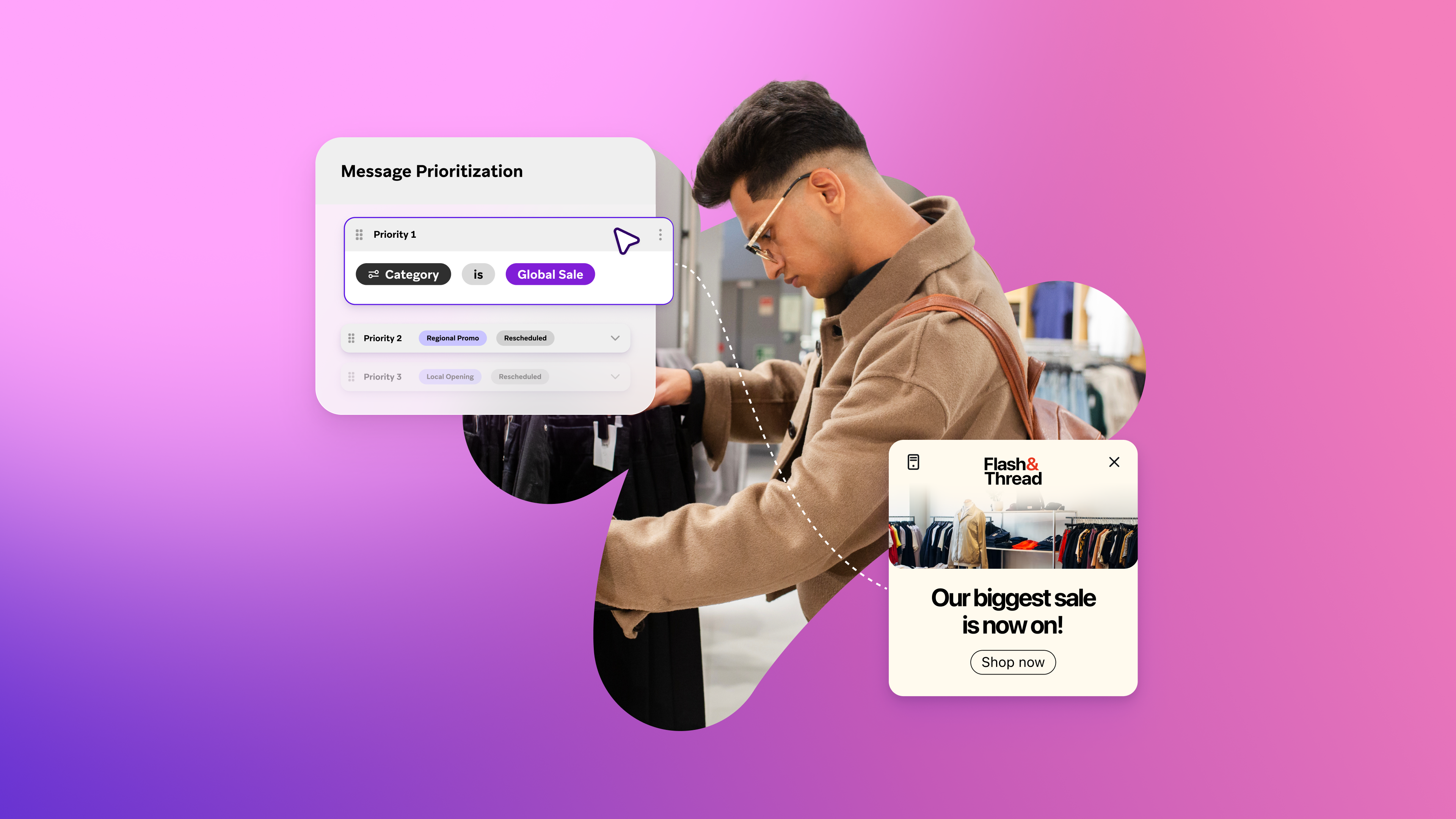
For example, a clothing retailer's app might show a shopper waterproof coats and umbrellas when it's raining where they are, alongside styles they browsed earlier, rather than the one seasonal banner their whole segment sees.
Hyper-personalization has three ingredients that help make the personalization “hyper”, rather than ordinary.
- Breadth of data. Hyper-personalization draws on behavioral data (clicks, purchases, sessions), contextual signals (location, device, time of day), and first-party data collected directly from the customer, brought together into a single view of the person.
- Real-time processing. Instead of a rule someone set once, AI and machine learning models process new behavior as it arrives and update their understanding of the customer accordingly.
- Individual-level delivery. Delivery that adapts per individual rather than per segment. Two people in the same audience can receive different messages, on different channels, at different moments, because the system is responding to each of them separately.
Hyper-personalization vs. personalization vs. segmentation: what is the difference?
The difference between AI hyper-personalization, personalization, and segmentation is down to how much data each one uses, how precisely it targets, and how often it updates.
- Segmentation groups customers into buckets based on shared traits like age, location, or purchase history, then sends each group a message built for that group. It's the foundation most customer segmentation and personalization work is built on.
- Personalization adjusts a message for the individual using simple known data, like inserting a first name or referencing a recent purchase. The content changes, but it's set when the message is built.
- Hyper-personalization tailors each interaction to the individual using real-time AI, drawing on behavioral, contextual, and first-party data, and keeps updating what the person sees as their behavior changes.
The lines that divide these three are data depth, timing, and precision. Segmentation works from a handful of broad attributes, while hyper-personalization works from a live blend of behavioral, contextual, and first-party signals. Segmentation and basic personalization are fixed once the campaign is built, while hyper-personalization updates in the moment. And segmentation speaks to a group, while hyper-personalization speaks to the individual.
These three sit on a continuum, not in separate boxes. You don't have to jump straight to hyper-personalization. Most teams start with the data they already have, get their segmentation sharp, add personalization, and move toward real-time, individual-level delivery as their data foundation matures. Push too far ahead of your data and the work gets hard to manage by hand, and that’s the challenge behind personalization at scale.
What lets hyper-personalization update in the moment is the machinery underneath it.
How hyper-personalization works: Data, AI, and real-time delivery
Hyper-personalization runs as a continuous loop. It pulls each person's data into one profile, uses machine learning to read what they want, delivers the right message in the moment, then learns from what they do next.
The real-time element is what separates it from a scheduled campaign. A scheduled send goes to a whole list at a fixed time, whatever those people are doing. Hyper-personalization reacts to behavior as it happens, so what someone did moments ago changes what they see next.
The loop runs in four stages.
1. The unified data foundation
It starts by bringing a customer's data into a single profile, so the system sees one person rather than scattered fragments.
That usually means a customer data platform that unifies first-party data like clicks, purchases, and app sessions with real-time context like location, device, and time of day. Behavioral data from every channel sits in one place, ready for the models to read.
2. The intelligence layer
Machine learning models read that unified data to predict what each person is likely to want, then decide what to do about it. This is where individual-level decisioning happens.
The prediction side estimates intent, like purchase likelihood or churn risk, and updates as new behavior arrives. The decisioning side picks the next action for that specific person, rather than applying one rule to a whole segment.
3. The real-time personalization delivery layer
Delivery reaches the customer in the moment, on the channel they're most likely to engage with. This is real-time personalization at work.
Real-time triggers respond to live behavior like a browse or an abandoned cart, so the message lands while intent is fresh. Predictive send-time picks the hour each individual is most likely to open. And dynamic content swaps the images, copy, or offers inside a single template to fit the person receiving it, keeping contextual relevance high wherever the person shows up.
4. The feedback loop
Every interaction produces an outcome, and that outcome feeds back into the models so the future decisions are improved.
This is what keeps the system from going stale. Real-time data processing turns each open, click, or purchase into training for the next decision, so the personalization gets more accurate the longer someone engages.
Generative AI vs. AI decisioning in hyper-personalization
The lines between generative AI and AI decisioning sometimes get blurred, so let's be clear. Generative AI writes the content, and AI decisioning chooses which piece of it reaches each person, on which channel, at what time. Hyper-personalization runs on both.
How generative AI builds a content library
Generative AI takes one idea and returns a wide set of on-brand variants, from subject lines and body copy to images and offers.
Generative tools help create on-brand assets, so a team can widen its pool of content or better personalize to different audiences. This gives the system a deep bank of dynamic content to draw from.
How AI decisioning selects for each individual
AI decisioning chooses which variant reaches each person, on which channel, at what time, judged on the outcomes it observes. This is action optimization, working across all of those dimensions at once instead of settling any one in isolation.
It runs on reinforcement learning-based action selection, weighing channel, message, timing, and frequency together for each customer and sharpening those choices as new outcomes arrive. Individual-level decisioning like this works from the single person rather than the broad segment they sit in.
Why both are required for true AI hyper-personalization
Generation and decisioning only add up to hyper-personalization when they run together. One creates the range of messages, the other works out who should see which.
BrazeAI Decisioning Studio™ fills the decisioning role, making 1:1 personalization decisions that optimize any business KPI, so the variants a team generates reach each customer through the choice most likely to land.
Hyper-personalization examples across channels and industries
Hyper-personalization looks different in every inbox, app, and feed. Here are nine examples, from browse-triggered email to send times tuned per individual, each showing the signal that sets it off and the result it drove.
1. Browse-triggered email with dynamic product blocks
Use case: Grove Collaborative, a sustainable consumer goods retailer, used real-time triggers and dynamic content to turn abandoned browses into timely email.
Signal: A browse, then an exit, without buying.
Individual-level adaptation: The email features the exact item that shopper viewed.
How they did it: A browse-abandon event from the shopper's session, captured through a Shopify integration, triggers an email whose product block is built around the exact item that person just viewed, so no two shoppers get the same follow-up.
Results: A 10% checkout rate and 41% add-to-cart rate, with the campaign's 3% click-through rate among the highest in Grove's triggered email program.
2. Real-time restock alerts by product interest
Use case: Bazaar, Pakistan's leading e-commerce and quick-commerce app, used real-time triggers with push to tell shoppers the moment a wanted item came back in stock.
Signal: A wanted item comes back in stock.
Individual-level adaptation: Only shoppers who opted in for that product get the alert.
How they did it: Live inventory data is matched to each shopper's opt-in for a specific out-of-stock product, so a restock push with the product name filled in per person reaches only the people who asked about that item.
Results: A 29% increase in open rates, a 26% increase in orders, and a 21% increase in revenue.
For a deeper set of retail examples, the guide to personalization in retail covers the industry in full.
3. In-app content matched to lifestage
Use case: Legal & General, a UK-based financial services and pensions group, used dynamic content in its app to match financial guidance to each customer's situation.
Signal: The customer's lifestage and product holdings.
Individual-level adaptation: Each person sees a different content card from the library.
How they did it: A customer's lifestage and product holdings, kept current by live profile data streamed in, decide which Content Cards appear in the pension app, drawing a per-person block from a defined content library.
Results: A 30% increase in engagement versus previous email capabilities, and a 220% rise in meaningful actions from email activity.
4. Real-time eligibility offers in-app
Use case: Simplii Financial, a Canadian digital bank serving roughly two million customers, used real-time data to show a credit card offer only to customers who qualified at that moment.
Signal: Live account eligibility at the moment of opening.
Individual-level adaptation: The offer shows only to customers who qualify right then.
How they did it: Live eligibility and account data are read as the message opens, so an in-app offer populated with the customer's own details appears only for eligible people and stays hidden from everyone else.
Results: A rise in conversions, with campaign build time cut to two weeks or less.
5. Year-in-review email built per subscriber
Use case: Peacock, NBCUniversal's streaming service, used dynamic content blocks over email to build a year-in-review unique to each subscriber.
Signal: The subscriber's own viewing history.
Individual-level adaptation: Each recap is built from that person's watch patterns.
How they did it: Each subscriber's viewing patterns, like their most-streamed month, day, and genres, feed a set of per-person content blocks, so every recipient's recap email is structurally different.
Results: A 20% reduction in churn, a 6% lift in free-to-paid upgrades, and a two-point lift in return rate.
6. Opt-in reminders timed to each viewer
Use case: Max, the on-demand streaming service formerly known as HBO Max, used a real-time trigger with push to remind viewers about a premiere they saved.
Signal: A "remind me" tap on a specific premiere.
Individual-level adaptation: The push fires at each viewer's chosen premiere time.
How they did it: An explicit "remind me" opt-in against a specific title sets up a push that fires at a different moment per person, timed to whichever premiere they chose.
Results: An 18% increase in viewers for weekly premieres, alongside a 13% decrease in churn.
7. AI-generated copy from booking history
Use case: Dayuse, a daytime hotel booking service operating across dozens of countries, used AI agents to generate email copy tailored to each traveler.
Signal: The traveler's booking history and language.
Individual-level adaptation: The copy is written for that person, in their language.
How they did it: A customer's wish-listed hotels, booking history, and preferred language feed an AI agent that writes copy for that person and serves it in their own language, rather than sending one version by country.
Results: A 90% increase in overall booking conversion rate, a 2X lift in incremental revenue from the wish-list campaign, and a 23% uplift after moving to BrazeAI Agent Console™.
8. Cross-channel recovery by drop-off point
Use case: BlaBlaCar, a carpooling and travel marketplace with more than 100 million members, used real-time triggers across email, push, and Content Cards to recover abandoned bookings.
Signal: Where the member abandoned the booking.
Individual-level adaptation: Each person gets a different recovery journey from that point.
How they did it: The exact point where a member drops out of the booking flow decides their next steps, routing each person through a different sequence of messages based on their last action.
Results: A 30% increase in bookings and a 48% uplift in click rate.
9. Send times tuned to each person
Use case: foodora, a food and quick-commerce delivery service across more than 700 European cities, used AI-driven send-time optimization to reach each user when they tend to engage.
Signal: The user's own engagement history.
Individual-level adaptation: Each user gets their own send time.
How they did it: Each user's personal engagement history sets their own send window, so one campaign lands at different times for different people rather than on a single blanket schedule.
Results: A 41% conversion rate from messages sent, with a 26% reduction in unsubscribe rate using Intelligent Timing.
Benefits and challenges of hyper-personalization
Hyper-personalization can raise engagement and trim wasted spend, but the data, privacy, and scale work comes first. These challenges are solvable with the right data foundation and guardrails.
What are the benefits of hyper-personalization marketing?
Nearly all of it traces back to relevance. When a message actually fits the person, they open it, they act on it, and they come back, and those are the numbers most marketers are judged on.
Here are the gains you’re likely to see:
- Higher engagement. A message tied to what someone's doing right now gets more opens and clicks than the same thing sent to everybody.
- Stronger conversion. The right offer at a moment someone's already interested converts better than the same offer on a fixed schedule.
- Deeper loyalty. Be useful often enough and people feel like you get them, so they stay longer.
- Leaner spend. You can hold the discount back from someone who was going to buy anyway and use it only where it changes their mind. Less budget wasted.
- A cleaner experience. Fewer messages that miss, more that are worth opening.
This can take time, because the system learns each person as it goes and gets sharper over a few months, so results will be better then, than on day one.
What are the challenges of hyper-personalization?
Data, compliance, and scale are where teams can get stuck.
These issues are common:
- Data silos. Behavior in one tool, profiles in another, context somewhere else, and nothing sees the whole person. You slide back to segment-level messaging. One profile has to come first.
- Privacy and compliance. Using detailed behavioral data means meeting rules like the GDPR and the CCPA, so real consent, a straight answer about what you collect, and an easy way out when someone wants it.
- Over-personalization. There's a point where accurate tips into creepy, and once you cross it you lose people. Stick to signals someone would expect you to act on and you stay on the right side of it.
- Scale. Deciding in real time for millions of people is a lot of work, and quality drops if the system underneath can't handle the volume.
How do you address the challenges of hyper-personalization?
A unified profile pulls first-party and contextual data into one view, so the silo problem goes away and the system reads a whole person rather than fragments. That same single view is what lets decisioning run in real time across millions of customers without quality dropping off.
Clear consent practices are needed too. When people know what you collect and can opt out easily, you meet privacy rules like the GDPR and the CCPA, and you stay well short of the over-personalization line, because you're acting on data people agreed to share. Get the profile and the consent right early, and the rest of a hyper-personalization strategy has something solid to build on.
How to build a hyper-personalization strategy with Braze
Building a hyper-personalization strategy is easier with a framework. This one has six steps: unify your data, define your KPIs, build a content library, decide what each person gets, orchestrate across channels, and measure. Together they add up to a working personalization engine, and it starts with the data, since everything after it needs one view of the customer.
Step 1: Unify your data into one customer profile
Bring first-party and contextual data into a single profile, so every later decision reads a whole person rather than fragments. This is the foundation the rest of the strategy sits on.
The Braze Data Platform ingests behavioral, profile, and contextual data from across your channels and holds it as one live customer profile. With BrazeAI™, you can go beyond segments to deliver true 1:1 relevance at scale, as the profile updates in real time.
Step 2: Define the outcomes and KPIs that matter
Decide what you're optimizing for before you automate anything, whether that's conversions, retention, revenue per user, or something else. The metric you pick is what the decisioning layer will learn to move.
This step is strategic rather than technical, and it's worth doing carefully. A clear KPI gives the system a target to optimize against, and it's how you'll later tell whether your AI marketing personalization is actually working.
Step 3: Build a content library with generative tools
Create a set of on-brand content variants for the decisioning layer to choose from. Generative AI produces the range, subject lines, copy, images, and offers, while keeping everything within brand guidelines.
Creative Studio builds and manages that library, with AI-generated copy checked against your brand rules and content blocks reused across channels. The wider the library, the more the decisioning layer has to match to each individual.
Step 4: Decide what each individual receives
Use decisioning to select the variant, channel, and timing for each person, based on the outcomes it observes. This is action optimization, choosing across all those dimensions at once rather than picking a single product.
BrazeAI Decisioning Studio™ makes 1:1 decisions that optimize any business KPI, using reinforcement learning-based action selection to weigh message, channel, timing, and frequency together for each customer. It's the counterpart to generation, where Creative Studio supplies the options and Decisioning Studio chooses among them per person.
Step 5: Orchestrate across every channel
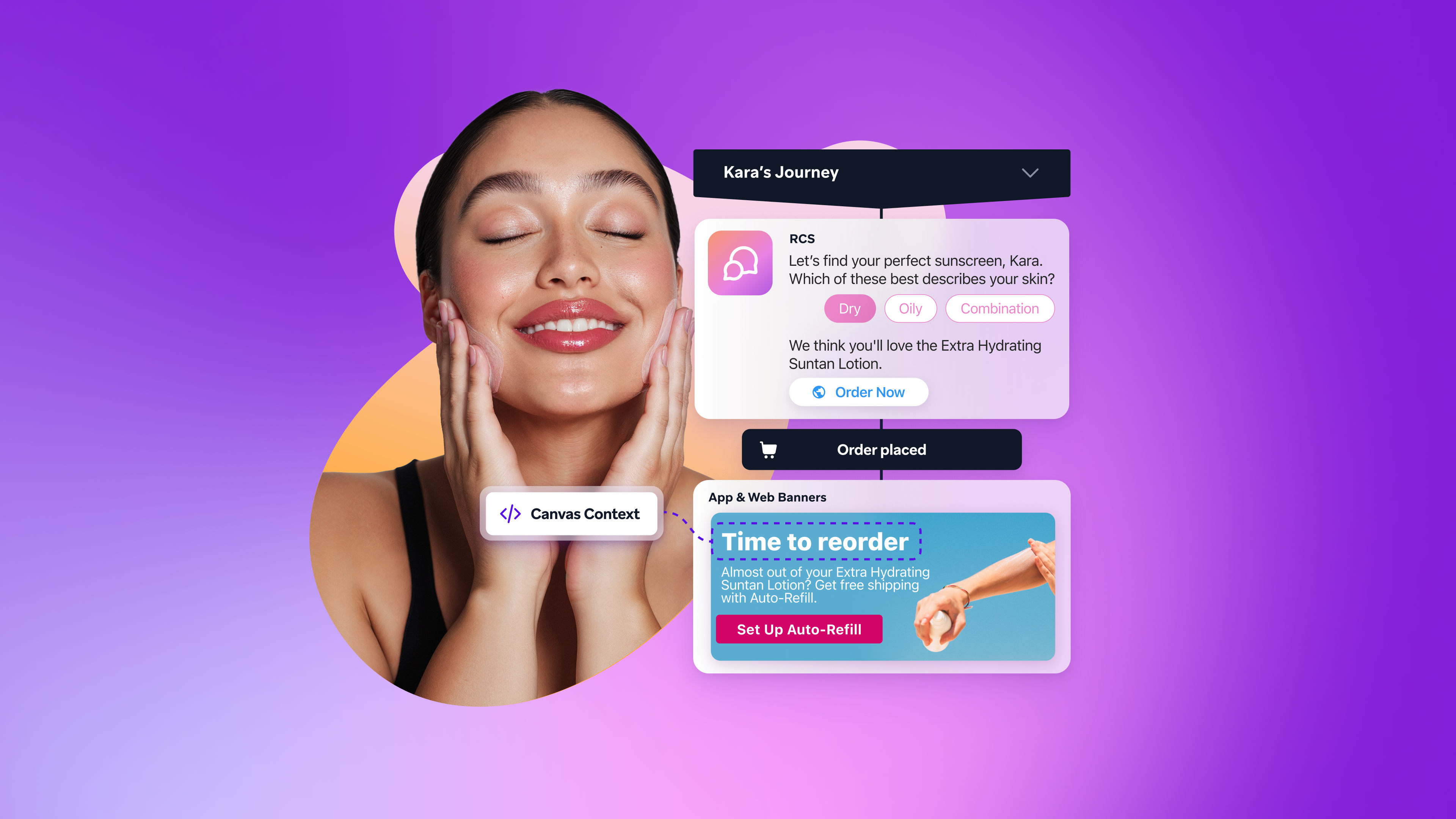
Coordinate delivery so each customer's messages stay consistent from one channel to the next. Cross-channel orchestration keeps email, push, in-app, SMS, and web working from the same profile rather than firing independently.
Braze runs this orchestration from the single customer view, so a decision made about someone carries across whichever channel they show up on. One profile and one decisioning layer feed every channel, which keeps the experience coherent instead of fragmented.
Step 6: Measure and feed outcomes back
Track how each interaction performed against your KPI, and let those outcomes retrain the decisioning layer. Every open, click, and conversion sharpens the next decision.
BrazeAI™ measures uplift against a control group, so you can see the impact of the personalization rather than assume it. Because outcomes feed back automatically, the strategy keeps adjusting to new behavior without a manual rebuild each time markets or customers change.
Hyper-personalization FAQs
What is hyper-personalization?
Hyper-personalization uses AI, real-time data, and machine learning to tailor content, offers, timing, and channel to each individual customer. It builds on basic personalization by adapting continuously to live behavior and context, rather than inserting a name or sorting customers into broad segments.
How is hyper-personalization different from personalization?
Basic personalization uses simple data like a first name or segment to adjust messages. Hyper-personalization analyzes real-time behavioral and contextual data with AI to tailor each interaction to the individual and update it continuously, making experiences far more specific, timely, and relevant.
What data does hyper-personalization use?
Hyper-personalization draws on first-party behavioral data (clicks, purchases, sessions), profile attributes, and real-time context such as location, device, and time. Unified in one customer profile, this data lets AI models predict intent and choose the most relevant content and timing for each person.
How does AI enable hyper-personalization?
AI does two jobs: generative AI creates a library of on-brand content variants, and decisioning models select which variant, channel, and send time each individual receives based on observed outcomes. Machine learning updates these choices continuously as new behavior arrives, keeping every interaction relevant.
What are examples of hyper-personalization?
Examples include product recommendations chosen from live browsing behavior, send-time optimized per individual, app messages that adapt to location or weather, and retention offers triggered by early churn signals. The common thread is real-time, individual-level adaptation rather than one-size-fits-segment messaging.
Related Tags
Be Absolutely Engaging.™
Sign up for regular updates from Braze.