Email deliverability in Canada: Everything marketers need to know
Published on May 19, 2026/Last edited on May 19, 2026/7 min read


Ess Adjekum
Email Deliverability Consultant, BrazeContents
Navigating the email deliverability landscape in Canada can be challenging due to the unique structure of the country’s inbox providers. Whether you are an experienced sender or an email novice, understanding this landscape is crucial for achieving the impressive 38:1 ROI that email marketing can offer. But to really tap into the full impact of email marketing, emails must actually reach the inbox.
To be successfully delivered, emails must pass through spam filters and avoid issues such as hard bounces, throttling delays, or soft bounces that leave them in limbo.
In this article, we’ll explore the intersection of global standards and regional requirements, and offer email deliverability tips on how to successfully navigate the top inbox providers in Canada.
Top inbox providers
Assessing the email terrain in Canada is the first step towards achieving healthy deliverability. For senders to a Canadian audience, this means knowing who the major players are in terms of inbox market share, and using this data as a roadmap for deliverability strategies.
Globally and regionally within Canada there are different inbox providers that act as gatekeepers for consumers. When people sign up for an email address, they are given a layer of protection by these providers who filter incoming emails that could be seen as spam or detect threats like phishing scams and reject them on behalf of the end user. Successfully navigating these providers' filters is critical in driving healthy email performance.
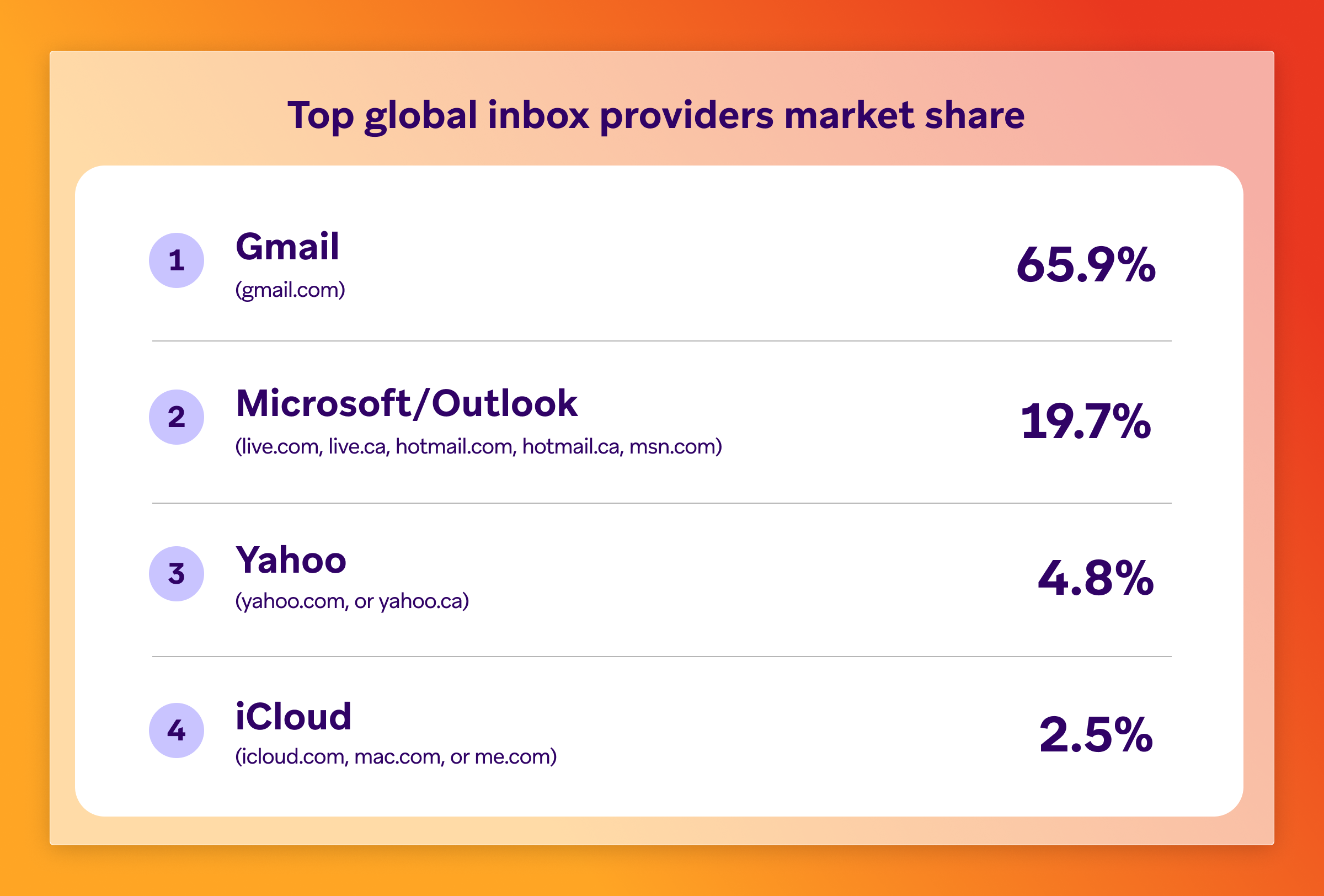
Looking at the top inbox providers for Canadian customers of Braze, the major players are Gmail, Microsoft, Yahoo and Apple who dominate with a combined market share of 93.09%. For senders, this signals that the key to deliverability within Canada is to approach deliverability with global standards rather than a Canadian-specific approach.
Top Canadian inbox providers
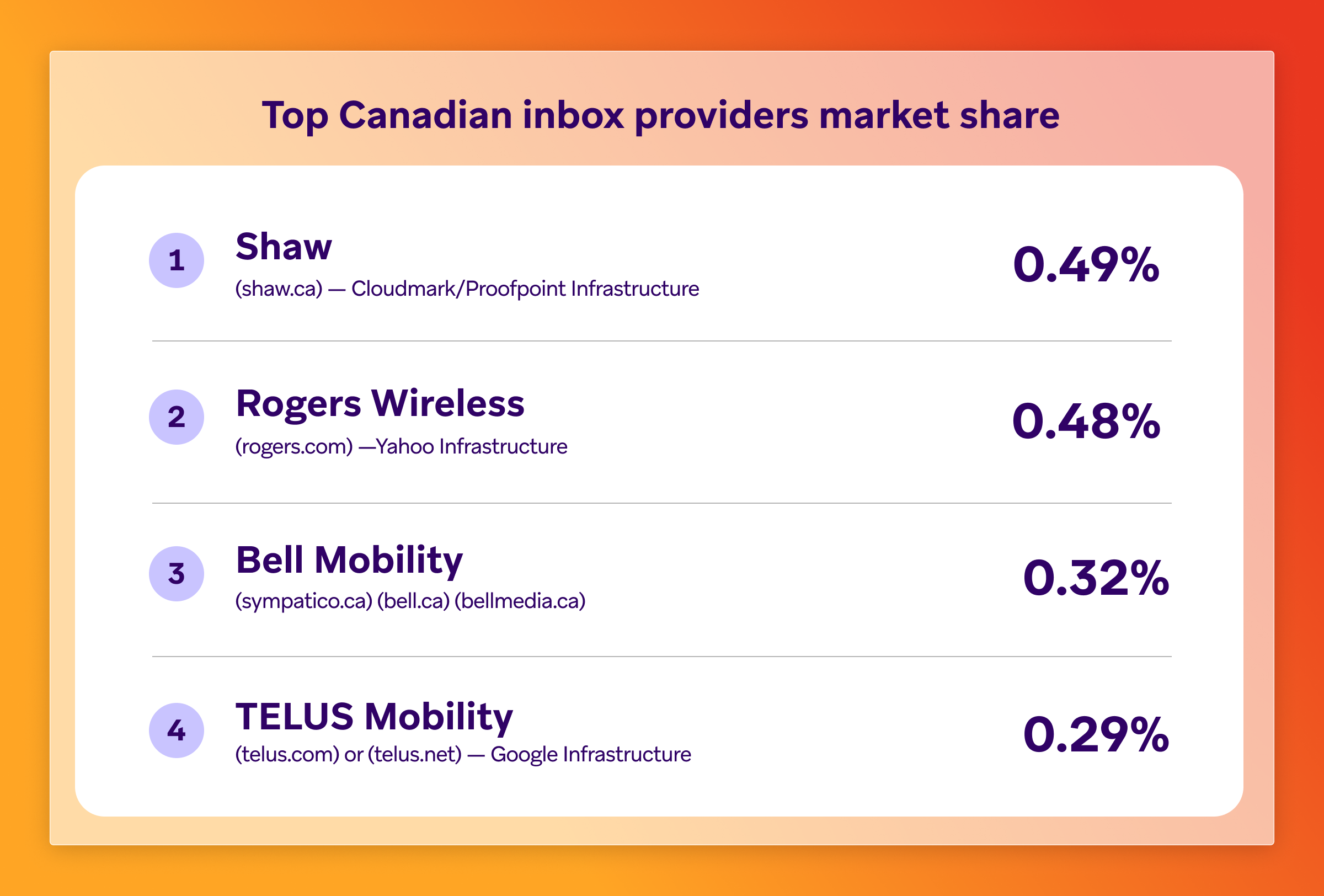
For Canadian Braze customers, domestic providers account for 1.58% of the audience share. While these companies are household names within Canada and primary providers of internet/telecommunications services, they are not the primary gatekeepers of inboxes in Canada due to leveraging the infrastructure of top global providers.
Typically, regional inbox providers come into play when they provide a telecom service for their consumers bundled with a unique email address. Consumers will then continue using the email address hosted by their trusted provider.
Regional providers in Canada
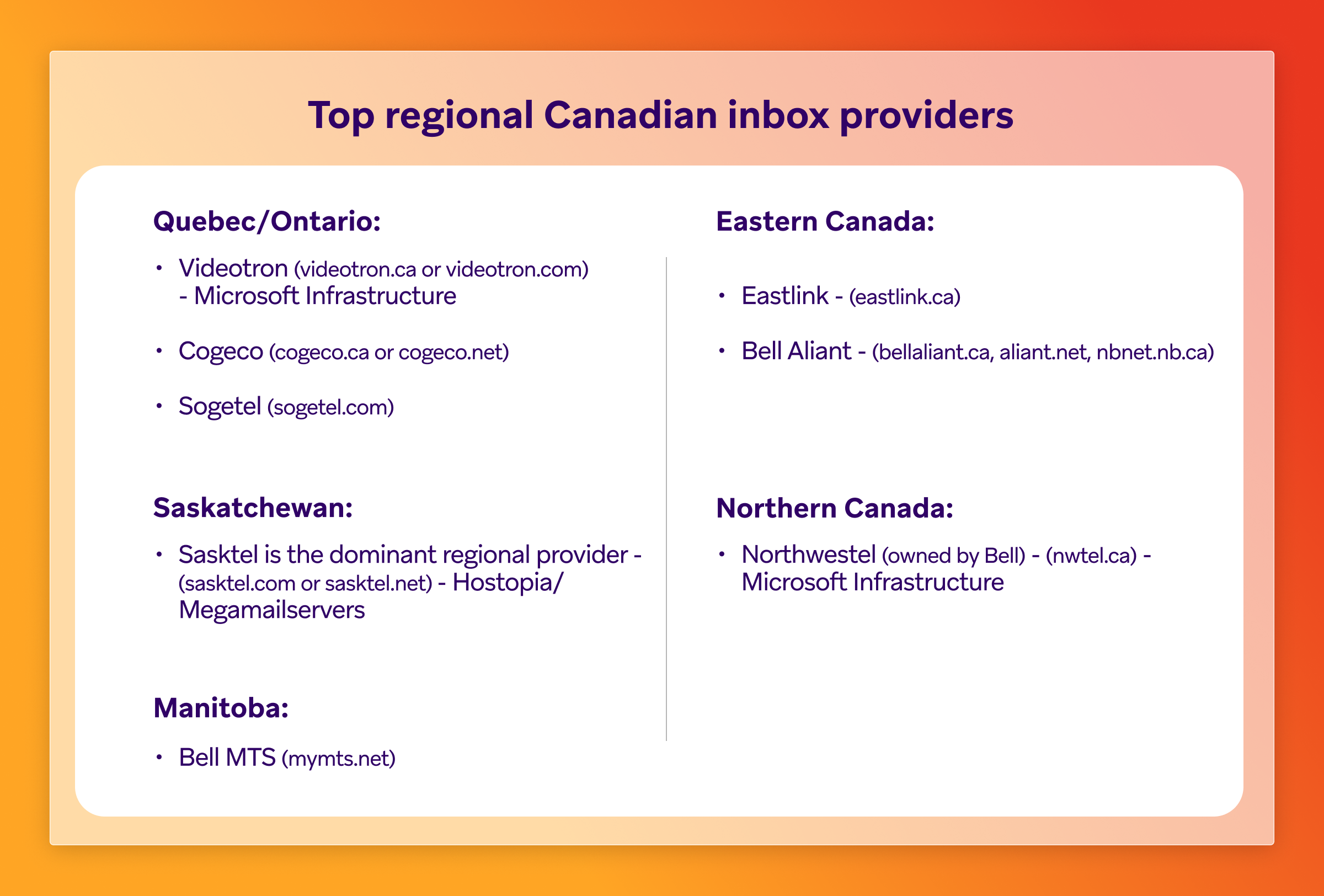
In recent years, many of these regional Canadian inbox providers have migrated users over to top mailbox providers like Gmail, Microsoft, and Yahoo. These global providers handle the heavy lifting of threat detection and spam filtering. Companies like Rogers offload their security and filtering to the top inbox providers, in this case, Yahoo; Shaw with Cloudmark/Proofpoint, and Telus with Google. This is good news for senders, because it means that if you can maintain a good reputation with the top global providers, your chances of a good reputation with the smaller ones across Canadian provinces are extremely high.
Canada’s approach to email ISPs also includes provincial providers that operate under the security infrastructure of domestic or global providers. This includes Videotron and Cogeco in Quebec and Ontario, Sasktel in Saskatchewan, Bell MTS in Manitoba and Eastlink in The Maritimes of Eastern Canada.
One thing to note is that every inbox provider has different technical limits, while larger platforms can often handle larger amounts of email at one time, smaller or regional providers might need to receive mail more slowly to keep their systems running smoothly and rate limiting is a great option if it seems that smaller inbox providers are throttling your emails.
A starting strategy to help comply with deliverability standards for major providers is enabling tools like Microsoft SNDS and Google Postmaster so that you can monitor your metrics in the Braze Deliverability Center. This will allow you to view your domains by IP reputation and view any delivery errors you may receive. Some errors, like a mailbox being full, are quick fixes that can signal issues with list quality and may require you to implement segmentation criteria, while other errors might signal more complex issues with your IP reputation and require mitigation.
The role of email authentication
Another important aspect of email deliverability within Canada is email authentication. The leading global providers require all bulk senders to have SPF, DKIM, and DMARC fully configured.
- Sender Policy Framework (SPF) - A DNS record that lists the specific IP addresses authorized to send emails on behalf of your domain
- DomainKeys Identified Mail (DKIM) - The digital signature attached to your emails that allows recipients to verify that the content hasn't been tampered with once sent.
- Domain-based Message Authentication, Reporting, and Conformance (DMARC) - A policy that tells mailbox providers how to handle emails that fail SPF or DKIM checks, providing instructions to either do nothing, quarantine, or reject the message.
Proper authentication signals that senders are legitimate, reducing the risk of your mail being flagged as a security threat or spam. Without this verification, even the most relevant, timely and desired emails will end up in the spam folder or blocked.
Adopting these authentication standards is not just a best practice but a requirement to see your communications recognized as trusted and successfully delivered to your Canadian audience.
Does good deliverability in Canada require a regional approach?
Rather than simply following a regional approach, landing in Canadian inboxes requires a strict adherence to CASL regulations alongside the technical authentication standards mandated by the major inbox providers, and best practices with email deliverability standards.
To align with CASL requirements, senders should adopt the following practices:
1. Obtain consent: Senders must have consent from the recipient before sending a message. The recipient must take action to opt-in (pre-checked boxes or assuming consent through inaction are not allowed)
We recommend implementing a double opt-in. Not only does this provide you with explicit consent, but it also helps to reduce the chances of typos and misspelled email addresses, which can impact your future sends and deliverability.
2. Provide identification information: Emails must clearly identify the sender or business, and they must also include a valid mailing address along with at least one additional contact method, such as a telephone number with voice messaging, an email address, or a web address.
A great option for implementing this is creating an attractive custom footer in your email template where this information is readily available to the recipient.
3. Provide an option for unsubscribes: Emails and messages must include a simple, quick, and easily accessible way for recipients to opt out of future communications.
It should be easy for recipients to find the unsubscribe link, and they should not have to look for it within your email or message, otherwise you may find that recipients will mark you as spam just to stop hearing from you.
Conclusion
By consistently applying these deliverability, authentication and CASL standards, you move beyond a regional focus to a strategy that helps secure high deliverability across the board.
A proactive approach to deliverability not only protects your sender reputation but also helps your content consistently reach your audience, regardless of their mailbox provider. Ultimately, this three-way approach is a reliable path to Canadian inboxes and is likely to result in high deliverability regardless if it is a large international or small regional provider.
Key takeaways:
- The Canadian inbox provider landscape is dominated by global players with Gmail, Microsoft, Yahoo and iCloud making up 93.09% of the market.
- Domestic Canadian providers like Shaw, Rogers Wireless, Bell Mobility and Telus represent less than 2% of the market share.
- Many regional Canadian providers do not manage their own security infrastructure, but rather they offload it to global providers.
- In Canada, maintaining a good reputation with major global providers typically results in a good reputation with the small regional providers.
- Smaller regional providers may require slower email delivery via rate limiting to prevent system strain or throttling.
- Instead of a regional technical approach, deliverability success in Canada relies on strict adherence to CASL compliance.
Be Absolutely Engaging.™
Sign up for regular updates from Braze.