Customer experience strategy: How to design end-to-end engagement across channels
Published on April 23, 2026/Last edited on April 23, 2026/12 min read

Madison Tiemtoré
Content Marketing Lead, BrazeContents
We live in a highly connected society. Customers move between apps, emails, messaging platforms and physical stores or events throughout their day, and they expect the experience to move with them. A deliberate customer experience strategy connects every channel, every lifecycle stage, and every data point into an omnichannel experience that feels coherent from the customer's side.
When a message arrives at the right moment, channel, and with the right level of personalisation, it builds the kind of trust that translates into retention, deeper engagement, and long-term revenue.
Here, you'll find a practical guide to building a customer experience (CX) strategy that delivers, covering the key elements, the types of initiatives that drive results, and how AI personalization, lifecycle insights, and real-time orchestration bring it all together.
TL;DR
- A customer experience strategy defines how a brand interacts with customers from first awareness through to long-term loyalty, aligning customer needs with business objectives
- Strong CX strategy relies on three foundations: behavioral data, lifecycle insights, and cross-functional alignment
- Key initiatives span onboarding, retention, upsell, feedback, behavioral triggers, and contextual engagement, each targeting a specific moment in the customer lifecycle
- Platforms like Braze operationalize CX strategy through AI-driven personalization, real-time cross-channel messaging, and journey orchestration via Canvas
Key takeaways
- A CX strategy connects behavioral data, lifecycle insights, and cross-channel orchestration into a framework that produces measurable retention and revenue outcomes
- Personalization, when powered by AI and real-time data, allows brands to move beyond broad segments and communicate with customers as individuals at every stage of the journey
- The most effective CX programs treat the customer journey as a single, continuous experience, coordinating messaging across channels rather than managing each one in isolation
What is a customer experience strategy?
A customer experience (CX) strategy defines how a brand interacts with customers at every stage of the relationship, from first awareness through to long-term loyalty. It aligns customer needs with business objectives, creating a framework for delivering consistent, relevant, and connected interactions across every channel and touchpoint.
A good customer experience strategy is important because it's one of the clearest drivers of retention, revenue, and long-term loyalty. Research from Bain & Company, shows that a 5% increase in customer retention can increase profits by up to 95%. Three things need to be included to make that possible:
- Behavioral data, which captures how customers actually interact with a brand across channels and over time
- Lifecycle insights, which reflect where someone is in their relationship with you and what they're likely to need next
- Cross-functional alignment, which makes sure that marketing, product, and support teams are working from the same understanding of the customer
CX design: the key elements of a strong CX strategy
An effective CX strategy is the product of several interconnected elements, each one informing the others, and the strength of the whole depends on how well they work together.
Customer journey strategy: mapping touchpoints
A customer journey strategy involves journey mapping. This is the process of documenting every touchpoint a customer has with a brand, from discovery and sign-up through to repeat purchase and referral, and identifying where friction or disengagement occurs. Maps capture what customers expect at each stage and where reality falls short of that expectation, keeping pace with how customer behavior continuously evolves.
AI personalization in CX
AI-driven personalization uses behavioral data, purchase history, and predictive modeling to tailor content, timing, and channel selection for each individual customer. At scale, this means every touchpoint can reflect where someone actually is in their relationship with a brand, what they've responded to before, and what they're most likely to need next. Understanding predictive customer behavior gives brands the ability to act on anticipated actions rather than waiting for a milestone to be reached.
Cross-channel orchestration and real-time engagement
Someone might browse a product on mobile, receive an email follow-up, and convert through a push notification. Each of those touchpoints needs to be informed by the same understanding of that customer. Cross-channel orchestration coordinates messaging, timing, and content across channels so each interaction builds on the last. Real-time engagement adds responsiveness, with triggered notifications based on specific behaviors or events arriving at the moment they're most relevant.
Customer lifecycle management
Every customer moves through distinct stages: acquisition, onboarding, growth, retention, and sometimes re-engagement. A CX strategy needs to account for where someone actually is in that journey, because the messaging, content, and cadence that works at one stage will often miss the mark at another. Feedback loops, whether through surveys, behavioral signals, or support interactions, keep that picture accurate over time.
Metrics to measure CX success
Measuring CX means looking at both leading indicators that signal future behavior and lagging indicators that reflect outcomes already achieved. Tracking the right combination drives ongoing customer experience improvement, giving teams the data they need to adjust and optimise at every stage. The most commonly tracked include:
- Net Promoter Score (NPS): a measure of how likely customers are to recommend a brand, useful for gauging overall loyalty and sentiment
- Customer retention rate: the percentage of customers who stay over a given period, directly tied to revenue stability
- Engagement rates: opens, clicks, session frequency, and feature usage that show how actively customers are interacting
- Customer lifetime value (CLV): the total revenue a customer generates over the course of their relationship with a brand
- Customer satisfaction score (CSAT): a direct measure of satisfaction at specific touchpoints
Types of CX initiatives and campaigns
A CX strategy sets the direction, but it's the individual initiatives and cross-channel campaigns that do the actual work. Each one targets a specific moment in the customer lifecycle, and the most effective programs run several in parallel, coordinated around where different customers actually are.
Initiative | Purpose | Example |
|---|---|---|
Onboarding experiences | Help new customers find value quickly and build lasting habits | Welcome email series, in-app walkthrough, first-action push notification |
Retention and loyalty campaigns | Reward engagement and re-engage customers who are starting to drift | Lifecycle-based messaging tailored to how long a customer has been active |
Upsell and cross-sell campaigns | Introduce relevant upgrades or complementary features at the right moment | Triggered offer following a completed action or usage milestone |
Feedback and survey-driven personalization | Capture preferences and friction points that behavioral data alone can't reveal | Post-purchase survey, in-app NPS campaign |
Behavioral-triggered notifications | Respond to real-time customer behavior with relevant, timely messaging | Abandoned cart reminder, lapsed session re-engagement |
Contextual engagement | Factor in location, time, or device to add relevance to outreach | Lunchtime push from a restaurant brand, pre-trip reminders from a travel app |
Onboarding experiences
How a customer experiences a product in the early stages shapes whether they stay with it. Customers who find value quickly are more likely to build a habit around a product. A strong onboarding experience typically spans multiple channels: an in-app walkthrough, a welcome email series, and a push notification marking a first completed action. The sequencing matters as much as the content itself.
Retention strategy and loyalty campaigns
Loyalty programs and retention campaigns reward consistent engagement, re-engage customers who are starting to drift, and give long-term customers a reason to feel recognised. The most effective retention strategy is built on lifecycle data. A customer who joined 90 days ago needs a different conversation than one who has been active for two years.
Upsell and cross-sell campaigns
Upsell and cross-sell opportunities are most effective when they're tied to specific customer behavior, for example a completed action or a pattern of engagement with a related feature. Relevance is what separates a message that feels helpful from one that feels opportunistic.
Feedback and survey-driven personalization
Direct feedback is one of the richest inputs a CX team has access to. Post-purchase surveys, in-app ratings, and NPS campaigns capture preferences and friction points that behavioral data alone can't fully reveal. When customers can see that their input has shaped their experience, it builds a stronger sense of trust.
Behavioral-triggered notifications
Triggered messaging based on real-time customer behavior, whether an abandoned cart or a lapsed session, is one of the most effective tools in a CX strategy. Real-time notifications give brands the ability to respond at the moment a signal occurs, and the closer a message is to the moment that triggered it, the more relevant it tends to be.
Contextual engagement strategy
Location, time of day, and device type can all shape how a customer receives a message. A lunchtime push from a restaurant brand, or a travel app surfacing reminders before a booked trip, gives a well-timed message a quality that broader campaigns rarely achieve.
Braze solutions for customer experience strategy
Braze is built to operationalize CX strategy across every channel, at every lifecycle stage. The platform gives marketing teams the infrastructure to turn strategy into execution, without the complexity of managing multiple disconnected tools.
Cross-channel orchestration with Canvas
Canvas is the Braze journey orchestration tool, a visual canvas for building multi-step, cross-channel and omnichannel CX journeys. Teams can design experiences that move customers through different paths based on their behavior, preferences, and lifecycle stage. Canvas coordinates push, email, SMS, and in-app messages within a single workflow, giving brands the ability to deliver omnichannel CX without managing each channel in isolation.
Personalization at scale with BrazeAI™
BrazeAI™ allows you to take advantage of predictive churn detection, intelligent send-time optimization, and content personalization at the individual level when building your campaigns. Marketers can use it to anticipate which channels a customer prefers, what content is most likely to drive action, and when to send, without needing a dedicated data science team to get there.
Real-time messaging across push, SMS, in-app, and email
Braze supports real-time messaging across the full channel stack. Campaigns can be triggered by customer actions the moment they happen, whether that's completing a purchase, abandoning a cart, or hitting a usage milestone. Every trigger point in the customer journey becomes an opportunity to deliver something relevant and timely.
Customer journey analytics and CX optimization
The reporting and analytics tools within Braze give marketers visibility into how campaigns perform across the lifecycle, from conversion rates and retention impact through to engagement by channel. CX optimization is an ongoing process, and the ability to measure, test, and adjust as customer behavior evolves is what keeps a strategy from going stale.
Case studies and real-life customer examples
Three brands, three different challenges, one common thread: a deliberate approach to customer experience that produced measurable results. Each of the following examples reflects a different aspect of CX strategy in action, from email efficiency and operational improvement through to engagement and retention.
DraftKings kicks email inefficiency into touch
DraftKings is a leader in sports entertainment, offering sports betting, fantasy sports, and digital casino games to millions of fans across the U.S. and beyond. Connecting fans to the thrill of the game is central to the brand, which makes the quality of every customer touchpoint a competitive priority.
The challenge
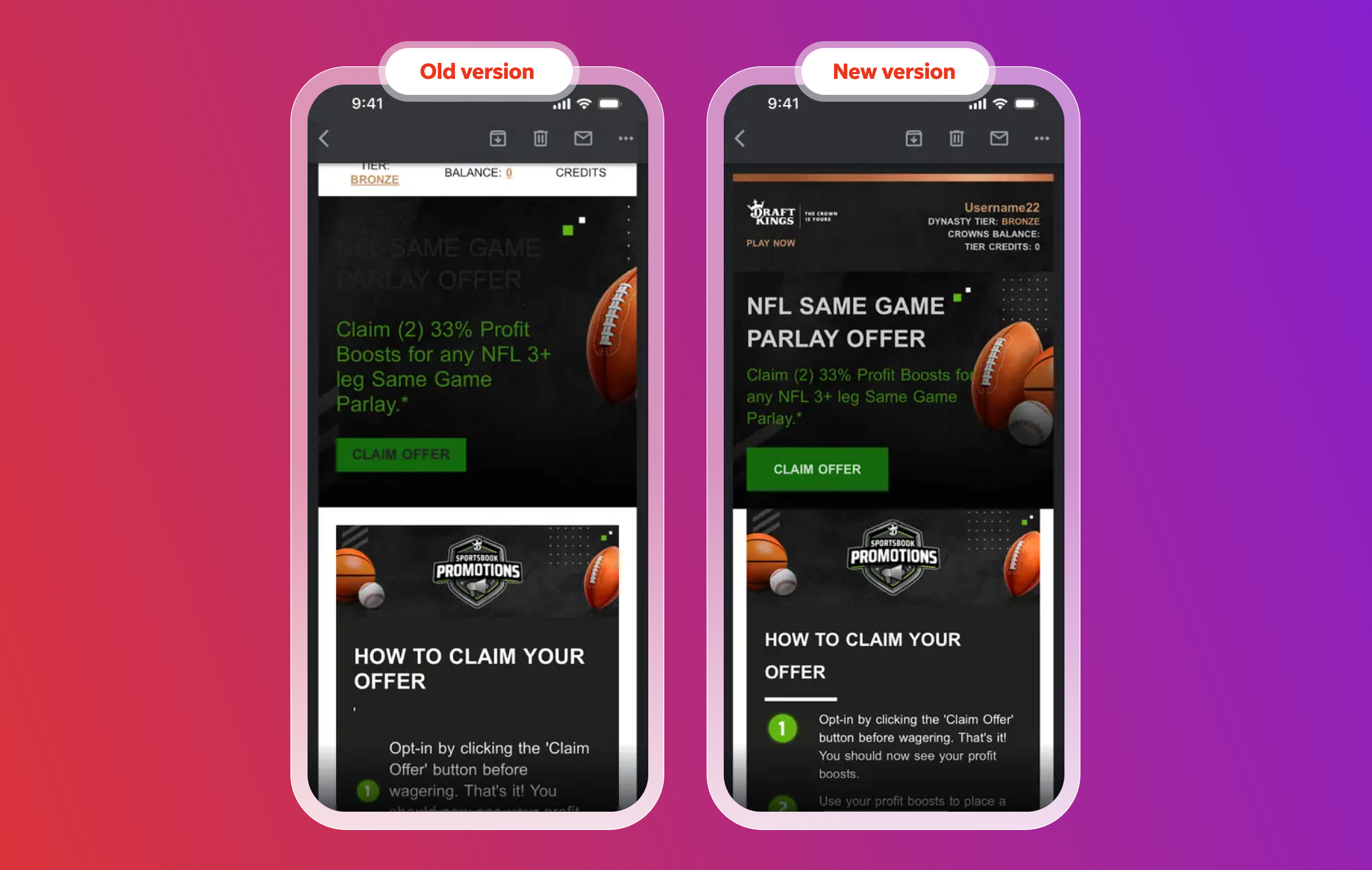
Email communications weren't keeping pace with that standard, particularly around dark mode and mobile display. Building templates that performed well across both required significant time and external HTML resource, which was slowing down the team and affecting the consistency of the player experience.
The strategy
DraftKings worked with Braze Email Creative Services to rebuild its email templates from the ground up, with a focus on dark mode compatibility, mobile optimization, and a drag-and-drop build process that reduced reliance on external contractors. The goal was a more efficient production cycle without sacrificing quality.
The wins
- Marked improvement in email open rates and click-through rates
- Streamlined email creation and deployment process, freeing the team to focus on strategic initiatives and content
- 4 to 5 hours saved per week per campaign creator
Stori sends financial friction packing with WhatsApp
Stori is a fintech company on a mission to expand financial inclusion across Latin America, offering digital credit and banking solutions to communities underserved by traditional banks. With a 99% credit acceptance rate, putting the customer experience at the center of every interaction is their business model.
The challenge
Several of Stori's core customer processes, including updating a home address or accessing account information like balances and payment due dates, were cumbersome to complete. Customers were dropping off at exactly the moments that mattered most, creating friction in the relationship and putting retention at risk.
The strategy
Using Braze Canvas and WhatsApp, Stori built two targeted campaigns to tackle the problem directly. The first allowed customers to update their address with a single reply within a WhatsApp message, removing the need to navigate an in-app process. The second transformed a payment reminder into an interactive chatbot experience, using personalized greetings, quick replies, and A/B testing to strike the right tone and maximize response rates.
The wins
- 3x higher response rate on WhatsApp compared to push notification
- 26% higher conversion rate for address updates compared to the in-app process
- Payment reminder reframed as an engaging, two-way conversation rather than a transactional alert
- Streamlined operations and improved overall efficiency of customer communications
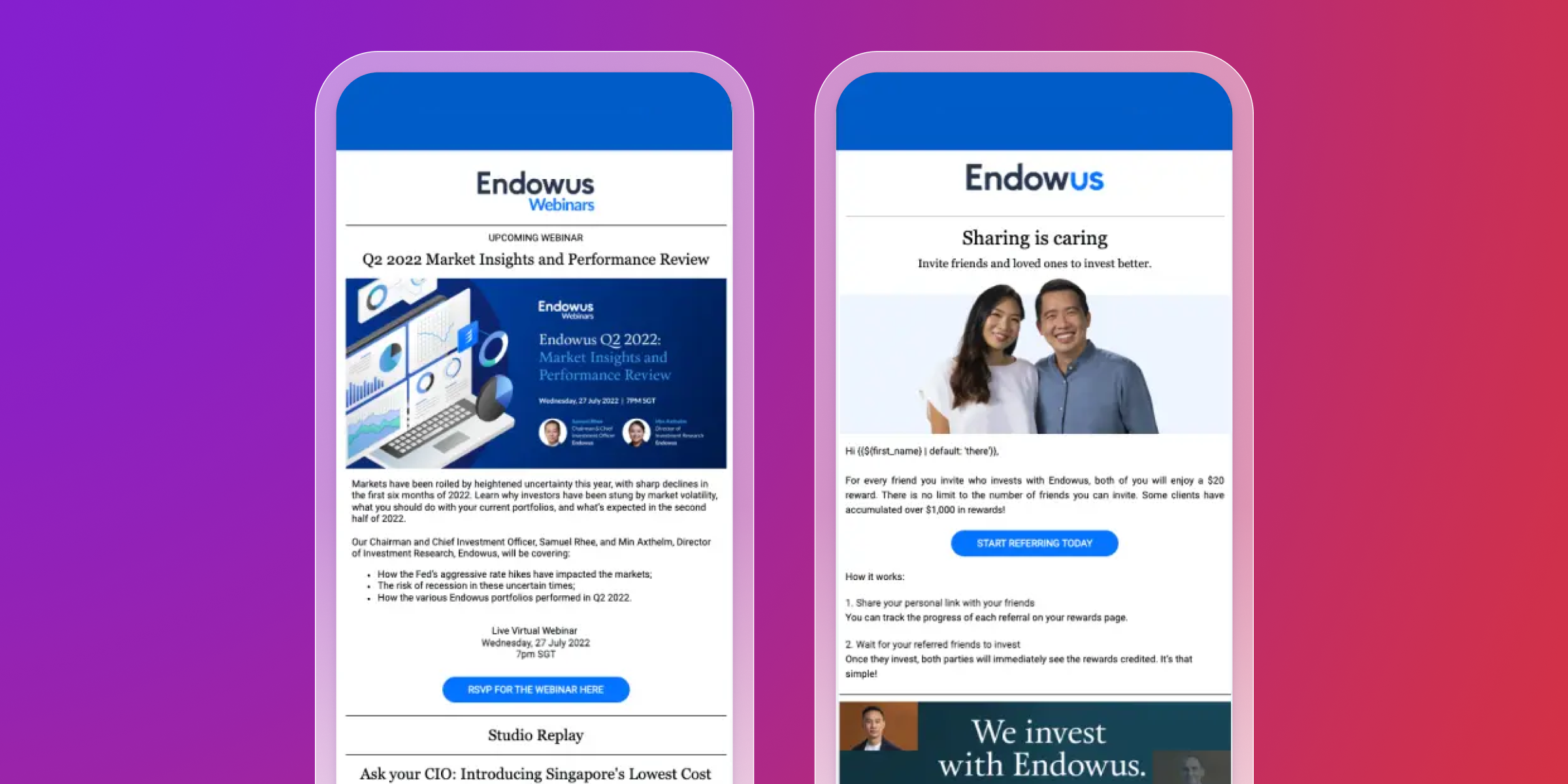
Endowus' customer journeys pay dividends
Endowus is a Singapore-based digital wealth platform on a mission to make conflict-free, institutional-grade investing accessible to everyone. Built on a fee-only model with no commissions, it gives retail investors access to expert advice and best-in-class funds at low, transparent costs across cash savings, public pension funds, and supplementary retirement schemes.
The challenge
With a lean marketing team and a rapidly growing user base, Endowus needed a way to automate and personalise cross-channel customer journeys without putting pressure on engineering resources. Messaging across the onboarding journey and beyond was inconsistent, and the team lacked the tools to test and iterate quickly enough to keep pace with growth.
The strategy
Using Braze Canvas, Endowus built automated journeys triggered by both customer actions and time. When a user moved from one onboarding stage to the next, a relevant prompt followed automatically. After a customer's first investment, an NPS survey went out within the first week, with follow-up surveys triggered at intervals over subsequent months and years. The team also introduced frequency capping to prevent over-messaging, and segmented audiences by attributes including referral source, event attendance, and investment behavior.
The wins
- 30% increase in email open rates
- Significantly reduced time to execute campaigns, freeing the team to focus on strategy and experimentation
- More personalised customer journeys built and iterated without reliance on technical resource
Final thoughts and takeaways
Understanding your customer and connecting data and channels brings together all the elements for a positive and engaging customer experience that drives measurable business outcomes.
Personalization brings the human touch, orchestration keeps everything connected and coherent, and data-driven insights give the experience relevancy. As customer expectations continue to rise, the margin for delivering generic, disconnected experiences shrinks with them.
As the case studies show, measurable improvement follows when brands stop treating channels as separate conversations and start treating the customer journey as a single, continuous one.
Customer experience strategy FAQs
What is a customer experience strategy, and why is it important for businesses?
A customer experience strategy defines how a brand interacts with customers at every stage of the relationship, from first awareness through to long-term loyalty. It matters because it directly influences retention, engagement, and revenue.
How can companies design end-to-end customer experiences across multiple channels?
Designing end-to-end customer experiences starts with mapping the full customer journey and identifying key touchpoints. From there, cross-channel orchestration tools coordinate messaging across email, push, SMS, and in-app, so each interaction builds on the last, regardless of where or how a customer engages.
How does AI personalization enhance the customer experience?
AI personalization uses behavioral data and predictive modeling to tailor content, timing, and channel selection for individual customers. Rather than relying on broad segments, it allows brands to deliver messages that reflect where each person is in their journey and what they're most likely to respond to at that moment.
Which metrics should marketers track to measure CX success?
The most important CX metrics include Net Promoter Score (NPS) for loyalty and sentiment, customer retention rate for relationship health, engagement rates such as opens and session frequency for behavioral signals, and customer lifetime value (CLV) for long-term revenue impact. Tracking a combination gives the fullest picture.
How can brands use real-time orchestration to improve engagement and retention?
Real-time orchestration allows brands to trigger relevant messages based on live customer behavior, for example an abandoned cart or a period of inactivity. Responding to these signals in the moment rather than on a fixed schedule improves relevancy, which in turn drives both short-term conversion and long-term retention.
Related Tags
Be Absolutely Engaging.™
Sign up for regular updates from Braze.