AI email marketing: How to use AI to run smarter email programs
Published on July 16, 2026/Last edited on July 29, 2026/13 min read

Team Braze
BrazeContents
AI email marketing uses AI to help create email content, personalize messaging, and decide targeting based on observed customer behavior rather than manual rules. The use cases run from content variants to send time to individual decisioning, and they work best when email is part of a cross-channel strategy and not run on a standalone tool.
TL;DR
- AI email marketing uses AI to decide and create what an email says, when it sends, and who receives it, based on how customers behave rather than fixed rules.
- It splits into two capabilities that get bundled together: generative AI that writes the content, and AI-driven optimization that handles send time, audience, and message selection.
- The main use cases are generating and testing content variants, optimizing send time, segmenting by live behavior, selecting the next best message, and protecting deliverability.
- AI email tools fall into three groups: platform AI built into an ESP, specialist writing tools that bolt on, and cross-channel platforms where email is one AI-driven channel among several.
- Running AI email inside a cross-channel platform like Braze lets decisions draw on one customer profile across email, push, and SMS, instead of optimizing email in isolation.
What is AI email marketing?
AI email marketing is the use of artificial intelligence to write email content and decide when, how, and to whom it is sent, based on what customers do rather than rules a marketer sets in advance. The AI reads behavior, opens, clicks, purchases, and time spent in an app, then uses those signals to shape both the message and the send. The information gathered here is raw material.
Within that are two categories:
- Generative AI for email produces the words and the creative. It drafts subject lines, body copy, and on-brand variants at a volume no individual writer could match.
- AI-driven optimization handles the delivery decisions. It runs send time optimization, audience selection, and individual-level decisioning, choosing what reaches each person based on how they behaved before.
How is AI email marketing different from email marketing automation?
Rules-based email marketing automation runs fixed if-then logic that a marketer builds once and the system repeats the same way every time.
In comparison, AI decides what to do from behavior as it happens, so the logic keeps updating instead of staying frozen.
For example, you could set a standard automation to send a follow-up to everyone who opened your first email, three days later, no matter what. An AI-driven version weighs how each person engaged and, based on all the data it holds about that person, chooses what to send and when, even if that means not sending anything at all.
How to use AI in email marketing
You use AI in email marketing for five jobs: making the content, timing the send, building the audience, choosing the message, and protecting the inbox. Each one swaps manual setup for a decision pulled from how customers behave. Here’s five concrete examples of what that could look like.
Use case #1: Generate and test more content variants without manual creation
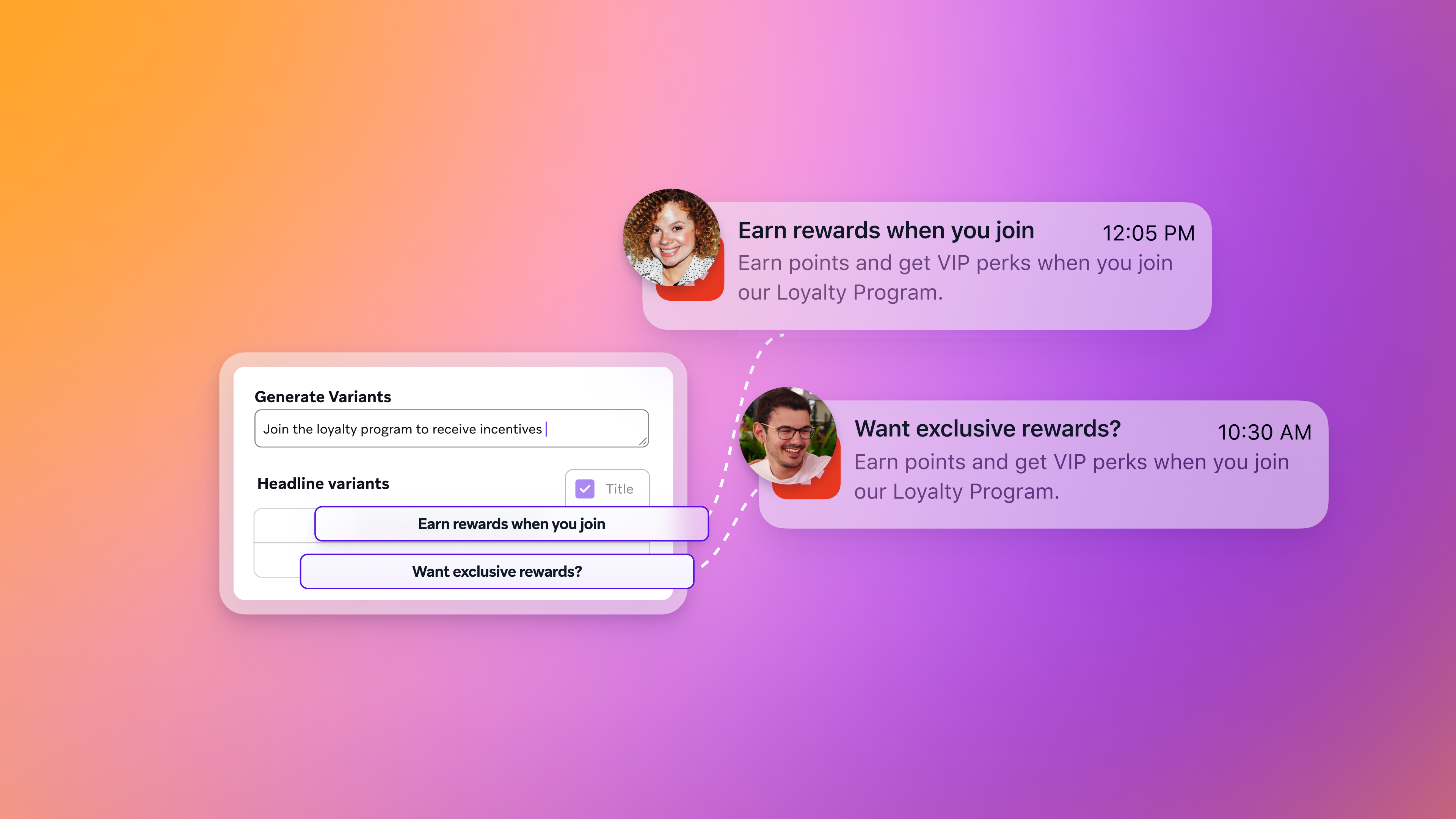
AI generates and tests email content by producing many versions at once and learning which land with which readers, so you are not building each one by hand.
What it does: Automatically generates personalized message variants from user data at scale, removing the need to manually build each version
Best for: Brands with large audiences and high personalization ambitions but small teams
What it controls: Content variables, personalization attributes, creative combinations
How to measure lift: Engagement rate and conversion per variant vs. manually created control
Use case #2: Optimize send time per individual based on engagement patterns
AI times the send by learning when each person is most likely to engage and delivering then, rather than picking one broadcast moment for everyone.
What it does: Learns when each individual user is most likely to engage and sends at that moment rather than a fixed broadcast time
Best for: Any high-volume messaging program where timing drives open and click rates
What it controls: Send window per user, cadence spacing
How to measure lift: Open rate, click rate, and conversion vs. fixed-time sends
Use case #3: Segment by behavior automatically rather than maintaining static lists
AI segments the audience by reading live behavior and moving people in and out of groups as they act, so no one is hand-maintaining lists.
What it does: Continuously evaluates live user behavior to add and remove users from segments in real time, replacing manually maintained lists
Best for: Brands with fast-moving customer behavior and frequent campaign refreshes
What it controls: Segment membership, entry and exit criteria, audience eligibility
How to measure lift: Campaign relevance scores, unsubscribe rate, and conversion vs. static list campaigns
Use case #4: Select the next best message for each subscriber using decisioning
AI chooses the next message by weighing the options available and picking the one most likely to hit your goal for that individual, in that moment.
What it does: Evaluates available message options and selects the one most likely to drive the target outcome for each individual at each moment
Best for: Programs running multiple message types, offers, or journeys simultaneously
What it controls: Message selection, offer type, channel, timing, cadence
How to measure lift: Conversion rate and revenue per user vs. rule-based message selection
Use case #5: Improve email deliverability and list hygiene with AI-assisted monitoring
AI protects the inbox by watching engagement and sender reputation signals, then flagging risky addresses and list actions before they hurt performance.
What it does: Monitors engagement signals and sender reputation data to identify inactive addresses, flag deliverability risks, and recommend list actions before problems affect performance
Best for: High-volume email programs migrating platforms or scaling to new audiences
What it controls: Send volume, list suppression, IP warmup pacing, engagement thresholds
How to measure lift: Deliverability rate, bounce rate, and inbox placement vs. pre-implementation baseline
Generative AI vs AI decisioning in email
Generative AI and AI decisioning are two different types of AI doing two different jobs. One creates or generates the email. The other decides which version each person receives.
Generative AI for email creates content. Give it a brief and your brand rules and it drafts subject lines, body copy, and creative variants. Volume and range are what it is good at, meaning enterprise-level companies in particular benefit from producing personalized email content at scale.
AI decisioning selects. It weighs the available options against everything known about a person, picks the one most likely to hit your goal, and learns from the result to sharpen the next choice. AI decisioning is the step beyond next best action. Rather than predicting a single best product or offer and stopping there, it drives the next best experience, by choosing across message, creative, channel, timing, and frequency together, for each individual. It runs on your first-party data and the outcomes it observes, and keeps adapting as behavior changes.
The two categories work together, with generation supplying the range of content, and decisioning matching each piece to the person most likely to respond, for 1:1 personalization. This combination lifts the whole send from beginning to end, rather than one part of it.
Best AI email marketing tools and platforms
The AI email marketing tools on the market fall into three groups:
- Platform AI: email platforms with AI built in, like Mailchimp, Klaviyo, HubSpot, and Salesforce Marketing Cloud
- Specialist AI: standalone writing and copy tools that bolt onto your existing email service provider (ESP)
- Cross-channel AI: platforms like Iterable, MoEngage, and Braze, where AI email is one channel inside decisioning and orchestration
Which group fits depends on whether you want AI for the email itself or AI across the whole customer journey. This is a light-touch rundown rather than a full ranking, so for a side-by-side of the major options, the best email marketing platforms brief goes deeper.
Platform AI built into email tools
Platform AI is the intelligence built into an email platform you already send from. It usually covers content drafting, subject line suggestions, and send time optimization inside that platform's own channels. The appeal is that it is already there next to your campaigns. The trade-off is scope, since the AI tends to see only the data and channels living in that one tool.
Platform | Overview | Email capability | Best for | Differentiator |
|---|---|---|---|---|
Mailchimp | A widely used email and marketing platform aimed at small and mid-sized businesses, with AI layered into a familiar campaign builder. | Content and subject line generation, send time suggestions, and template assistance inside Mailchimp's own sending tools. Scheduled resends for those who don’t open and pushing to SMS if the email hasn’t been opened. | Small teams that want approachable, built-in AI | Ease of entry for businesses taking their first step into AI-assisted email. |
Klaviyo | An email and SMS platform built for ecommerce, with AI tuned to store and purchase data. | Subject line generation, send time prediction, and product recommendations drawn from shopping behavior. | Online retailers that want AI working off their store data. | Broad ecommerce integrations, especially with Shopify. |
HubSpot | A CRM-led platform where email AI sits alongside sales and service data in one record. | AI drafting, subject line suggestions, and send time optimization tied to CRM segmentation. | Teams that already run on HubSpot's CRM and want email to draw from it. | Email AI informed by the same CRM record as sales and service. |
Salesforce Marketing Cloud | An enterprise marketing platform with Einstein AI spanning content and decisioning across its channels. | Einstein content generation, send time optimization, and engagement scoring inside Marketing Cloud. | Large organizations with the resources for enterprise setup. | Sits at the stronger end of this group, though that depth comes with cost and configuration smaller teams may not want. |
Mailchimp
Overview: A widely used email and marketing platform aimed at small and mid-sized businesses, with AI layered into a familiar campaign builder.
Email capability: Content and subject line generation, send time suggestions, and template assistance inside Mailchimp's own sending tools.
Best for: Small teams that want approachable, built-in AI without a heavy setup.
Differentiator: Ease of entry for businesses taking their first step into AI-assisted email.
Klaviyo
Overview: An email and SMS platform built for ecommerce, with AI tuned to store and purchase data.
Email capability: Subject line generation, send time prediction, and product recommendations drawn from shopping behavior.
Best for: Online retailers that want AI working off their store data.
Differentiator: Broad ecommerce integrations, especially with Shopify.
HubSpot
Overview: A CRM-led platform where email AI sits alongside sales and service data in one record.
Email capability: AI drafting, subject line suggestions, and send time optimization tied to CRM segmentation.
Best for: Teams that already run on HubSpot's CRM and want email to draw from it.
Differentiator: Email AI informed by the same CRM record as sales and service.
Salesforce Marketing Cloud
Overview: An enterprise marketing platform with Einstein AI spanning content and decisioning across its channels.
Email capability: Einstein content generation, send time optimization, and engagement scoring inside Marketing Cloud.
Best for: Large organizations with the resources for enterprise setup.
Differentiator: Sits at the stronger end of this group, though that depth comes with cost and configuration smaller teams may not want.
Specialist AI writing tools that bolt on
Specialist AI tools are dedicated writing and copy generators you connect to whatever ESP you already use. They are quick at producing subject lines, body copy, and creative at volume. What they do not do is decide who gets which version or when. They generate, your ESP sends, and the two do not share a brain, so the copy is not informed by the same behavioral data driving your sends.
Jasper
Overview: An AI writing platform built for marketing teams, with brand voice controls and campaign templates.
Email capability: Drafts subject lines, body copy, and variants you then move into your ESP to send.
Best for: Teams that want on-brand copy at volume and already have a sending tool they like.
Differentiator: Brand voice controls that keep generated copy consistent.
Copy.ai
Overview: A copy generation tool covering email alongside other marketing formats.
Email capability: Generates subject lines and body copy from prompts, exported to your ESP.
Best for: Marketers who want fast first drafts across formats, not just email.
Differentiator: Breadth across formats rather than email-specific depth.
Cross-channel AI for email marketing
For the best email marketing practices, cross-channel platforms allow for AI usages across email, push, SMS, in-app, an dother channels. Email is working together withe all the channels inside the platform, rather than a standalone tool with its own separate silo. That way, messages can reflect and target how a customer changes and moves from one change to the next.
Platform | Overview | Email capability | Best for | Differentiator |
|---|---|---|---|---|
Braze | Runs on real-time first-party data, with orchestration, cross-channel delivery, and AI in one system. | Behavior-triggered sends, live recommendations, and AMP for email, backed by deliverability support. | Enterprise and high-growth brands running cross-channel lifecycle programs. | Individual-level decisioning via reinforcement learning, plus generative copy and images. |
Iterable | Coordinates email, SMS, push, in-app, and web from a unified profile, with an AI layer called Nova. | Send time, channel, and frequency optimization, Copy Assist for content, and Brand Affinity scoring. | Consumer and ecommerce brands wanting cross-channel reach | Brand Affinity scoring that labels each user by sentiment. |
MoEngage | An insights-led engagement platform for consumer brands, built around an AI engine called Merlin. | Best Time to Send, Merlin Copywriter, AMP for email, and 1:1 product recommendations. | Brands engaging across email, push, SMS, and web. | Auto-routes traffic to the best-performing content variant. |
Braze
Overview: A customer engagement platform that runs on real-time first-party data, with journey orchestration, cross-channel delivery, and AI in one system. Consumer brands run it at scale across retail and ecommerce, financial services, media, and travel.
Email capability: Trigger email sends from real-time behavior, drop live product and content recommendations into each message, and build interactive in-inbox experiences with AMP for email, backed by deliverability support like IP warming.
Best for: Enterprise and high-growth consumer brands running cross-channel lifecycle programs that need personalization at the level of the individual customer.
Differentiator: Individual-level decisioning through BrazeAI Decisioning Studio™, which uses reinforcement learning to choose the channel, timing, message, creative, and offer for each person. Meanwhile, BrazeAI Operator™ handles generative work like copy and image variants and BrazeAI Agent Console™ powers custom agents capable of supporting conversational experiences, automated message QA, and more.
Iterable
Overview: A cross-channel platform that coordinates email, SMS, push, in-app, and web from a unified customer profile, with an AI layer called Nova.
Email capability: Send time, channel, and frequency optimization, Copy Assist for subject lines and body copy, and Brand Affinity scoring that adjusts messaging by engagement level.
Best for: Consumer and ecommerce brands that want cross-channel sophistication and have the data setup to support it.
Differentiator: Brand Affinity scoring that labels each user by sentiment for use across journeys.
MoEngage
Overview: An insights-led cross-channel engagement platform for consumer brands, built around an AI engine called Merlin, formerly Sherpa.
Email capability: Best Time to Send delivery, Merlin Copywriter for subject lines and body copy, AMP for email, and 1:1 product recommendations, all inside its Flows journey builder.
Best for: Mobile-first consumer brands running engagement across email, push, SMS, and web.
Differentiator: Content optimization that routes traffic to the best-performing variant automatically.
How Braze uses AI across the email lifecycle
Braze applies AI at every stage of the customer journey, moving from email lifecycle automation to sophisticated AI decisioning. All of it runs from the same first-party data and the same live customer profile, so a decision made at one stage carries into the next.
Generate content variants with BrazeAI™
BrazeAI™ handles the generative work, drafting copy and image variants so a team can produce many versions of an email instead of writing each one by hand. Because the variants live in the same system that sends them, they are ready to be tested and assigned automatically rather than exported to another tool first.
Optimize delivery with send time and channel optimization
Braze decides when and where each message lands, not just what each message says. Send time optimization learns the hour each individual tends to engage and delivers then, while channel optimization weighs whether email is the right place to reach that person at all, or whether a push would work better. Both calls draw on the same profile, so timing and channel reinforce each other rather than working from separate silos.
Select the next best message with BrazeAI Decisioning Studio™
BrazeAI Decisioning Studio™ chooses the next best message for each individual, using reinforcement learning to weigh message, creative, offer, channel, timing, and frequency together, then learning from what each person does next.
It’s a step beyond next best action, optimizing every dimension at once to discover the next best experience for each individual.
How does AI email personalization work in Braze?
Tailoring emails to the individual in Braze can be done using AI-assisted personalization, which makes every part of a message feel relevant to the person receiving it. The image, the offer, the subject line, and the send time all change from one customer to the next, drawn from each profile rather than the segment.
Why cross-channel beats optimizing email in isolation
Running AI email inside a cross-channel platform means email is never deciding on its own. The model picking the next email can see that a customer just got a push, opened the app, or abandoned a cart, so it can hold the email, change it, or hand off to another channel. With a standalone email, AI sees only email, which is how a customer can end up with three disconnected or repeated messages from the same brand in a day.
AI email marketing FAQs
What is AI email marketing?
AI email marketing is the use of AI to write email content and decide when, how, and to whom each message is sent, based on what customers actually do rather than fixed rules. It covers two things: generative AI that creates the content, and AI-driven optimization that handles timing, audience, and message selection per person.
How do you use AI in email marketing?
You use AI in email marketing for five main jobs: generating and testing content variants, optimizing send time per individual, segmenting by live behavior, selecting the next best message through decisioning, and protecting deliverability with AI-assisted monitoring. Each one replaces manual setup with a decision pulled from how each customer behaves.
What is the difference between generative AI and AI optimization in email?
Generative AI creates the email, drafting subject lines, body copy, and creative variants at volume. AI optimization decides what happens with them, choosing the send time, the audience, and the message each person receives. One produces the range of options. The other selects which option goes to whom.
What can AI do for email marketing that automation cannot?
Automation repeats fixed if-then logic a marketer builds once. AI decides from behavior as it happens, so the logic updates itself. It can weigh how each person engaged, choose the message and timing for them individually, and hold a send entirely, rather than treating everyone in a flow the same way.
Which email platforms have the best AI?
The best AI depends on what you need. Platforms with built-in AI like Mailchimp, Klaviyo, and Salesforce Marketing Cloud suit single-channel email. Cross-channel platforms like Iterable, MoEngage, and Braze go further, making AI decisions across email, push, SMS, and more from one customer profile.
Related Tags
Be Absolutely Engaging.™
Sign up for regular updates from Braze.
Related Content
 Article16 min read
Congratulations to the Forge 2026 Torchie Awards winners
September 29, 2026 Article6 min read
Bring 1:1 decisioning to every marketing journey with BrazeAI Decisioning Studio™ Go
September 28, 2026 Article12 min read
Made for this: How Braze is providing new ways to build, support, and extend your campaigns
September 28, 2026