Explore vs. exploit: The safe bet for AI decisioning isn’t always the right one
Published on March 27, 2026/Last edited on March 27, 2026/7 min read


Michael Eldridge
Head of AI Decisioning Deployment, BrazeContents
In marketing, business, and life, the grass isn’t always greener on the other side. Sometimes, the best thing to do is to keep on doing what you’ve already been doing.
But how do you know whether you should stay the course or try something new? To answer this exact question, marketing teams at leading brands are turning to a fast-growing type of artificial intelligence (AI) called AI decisioning.
Using a type of machine learning called reinforcement learning, AI decisioning helps businesses quantify the trade-offs of sticking with what’s been working versus testing out new strategies, allowing agents to continue exploring new options to quickly adapt to dynamic environments. The driving force behind AI decisioning, reinforcement learning lets brands see whether the best move is to explore what’s out there or exploit (that is, squeeze every last drop of juice out of) a current plan of action.
The tradeoffs of exploring new strategies vs. exploiting effective strategies in marketing
Once a marketing team runs a successful test or sees something working well, they sometimes stop testing or iterating to make their campaigns better.This could lead to waning results as campaigns continue. On the other hand, marketing teams that spend all their time exploring what else might be out there are likely missing out on potential gains that they could be seeing from strategies that are already working.
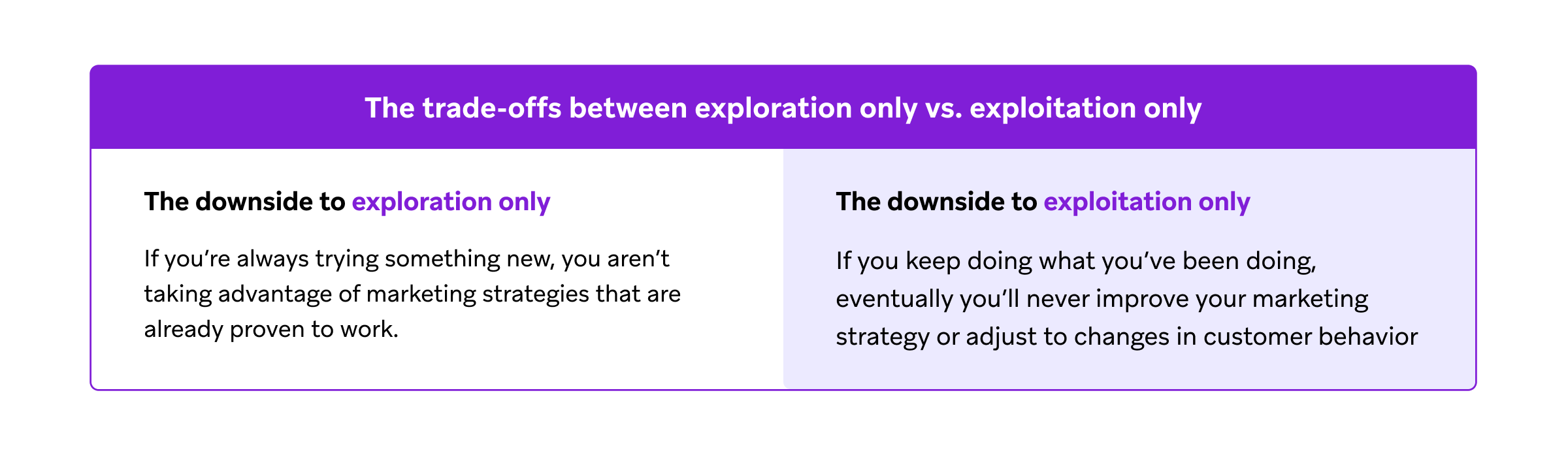
The reality is, you want a balanced situation and that balance depends on your goals. Some level of exploration is usually a strategic complement to marketing campaigns that are delivering desired outcomes, but finding the right mix is the key challenge—and opportunity.
Understanding how AI decisioning’s explore-vs.-exploit experimentation works
To get a clear picture of how AI decisioning helps businesses test out the pros and cons of a current strategy versus other potential options, let’s walk through a classic example of explore-versus-exploit in action, a multi-armed bandit problem.
Here’s the scenario: You’re in Vegas in a room with 100 slot machines (known as one-armed bandits), you’ve got 100 tokens, and your goal is to make as much money as possible. The question is, how should you distribute your tokens?
The machines pay out at different rates or probabilities. With one, you might get lucky 90% of the time and another you might get lucky only 20% of the time—but on average you can expect to win more than you’ll lose.
Your task? To find the one that pays out the best and play it as much as possible. At what point is it safe to say you’ve found a machine that’s paying you often enough that it’s no longer worth trying other machines?
Just because a machine pays out the first time you play, it doesn’t mean that it’s the best machine. You could have just gotten lucky. You have to feed it more tokens to get a good sense of how likely it is to pay out over time.
That’s how AI decisioning works as well. Our team at Braze has figured out the sweet spot for balancing testing and learning versus sticking with what’s working.
Here’s the right balance: Our AI decisioning platform, the BrazeAI Decisioning Studio™, uses what's called an epsilon-greedy algorithm, using something like a 95%-5% split between exploitation versus exploration. In other words, the system will send out campaigns that are leveraging the current best option 95% of the time—and the other 5% of the time, the system will experiment by randomly selecting other test campaign options.
Over time, our forward-deployed engineers and AI experts will further fine-tune the amount of exploration our custom AI decisioning system does based on what’s appropriate for a given brand, their goals, and their performance.
3 marketing use cases for using explore vs. exploit testing with AI decisioning
Major brands across entertainment, travel and hospitality, financial services, and more use our reinforcement learning-powered AI decisioning model to make smarter decisions. Here are the three top use cases that the marketing teams we work with pursue in order to see the impacts of explore vs. exploit in action.
1. When updating marketing promotions
Certain types of companies, such as retailers and quick service food brands, change their promotional offers frequently, sometimes as often as every week or two. Others, such as financial services providers, energy companies, and telecommunications brands, tend to update their promotions less often throughout the year. Regardless of how often these changes are being made, AI decisioning can be set up to balance exploring new promotions versus exploiting existing strategies.
In the beginning of a new promotional rollout, our AI model is calibrated to show the new promotion variant more frequently than older options while the system is in a learning phase, gathering insights about how the fresh offer is performing. Over time, as it learns, the system will either detect signals that a new offer is delivering desired results or not, and it will begin to show that offer more often and double down on that strategy or dial back accordingly.
2. To understand the impacts of seasonality and changing behavior
AI decisioning can help brands understand how various factors impact the performance of a given promotion. For instance, for a streaming platform, a discount may not be as effective when a new season of a popular show has just been released—after all, fans are likely coming back to the service organically to tune in—but the financial incentive might start making an impact after the new season has been available to steam for some time.
3. Running always-on controlled trials
For marketing teams that want to continuously test and learn, AI decisioning can be used to balance exploration versus exploitation all the time by using it to run mini random controlled trials continuously in the background.
For instance, let’s say you have a campaign that you think really resonates with loyal customers. You can use AI decisioning to send this campaign to your loyal cohort 95% of the time and then the other 5% of the time you can test it out across a collection of other segments. This will allow you to measure the effectiveness of the loyalty campaign on loyal users versus other segments.
This same kind of testing can be applied to evaluate the impact of a variety of different dimensions, such as frequency, time of day, creative, and more.
AI decisioning is reshaping how brands think about—and run—promotions, for the better
Traditionally, marketing teams have rolled out new promotions using the same approach they always have, changing them up weekly, monthly, semi-annually, or annually based on what’s typical for their industry and type of business.
AI decisioning allows brands to take a modern, algorithmic, and data-driven approach and ask (and answer) the question: Do we need to change these promotions yet or is what we’re doing working?
By using this type of machine learning, brands are forced to slow down—and gather learnings over a minimum of a couple of weeks to a month to capture meaningful data and draw conclusions. It gives teams time to learn how promotions are actually working so that more intelligent strategic decisions can be made going forward.
To see how our AI decisioning helps companies find the ideal balance of exploration versus exploitation, learn more about the BrazeAI Decisioning Studio™.
Be Absolutely Engaging.™
Sign up for regular updates from Braze.