Push vs pull marketing strategy: How to balance direct and inbound approaches
Published on April 28, 2026/Last edited on April 28, 2026/16 min read


Team Braze
Contents
A customer finds a brand through a Google search, reads a blog post, downloads a guide, gets an email a week later, receives a push notification on the day of a sale, and converts. Each of those touchpoints belongs to a different part of the same strategy.
Push vs pull strategy marketing maps this territory. Push channels reach customers directly, through email, paid advertising, and direct messaging, regardless of whether they're actively looking. Pull channels create the conditions for customers to arrive on their own terms, through content, organic search, and in-app experiences that reward engagement and build trust. The two approaches serve different moments in the same journey.
Understanding where each fits, and how AI and marketing automation can coordinate them in real time, is how a collection of campaigns becomes a strategy that builds over time.
TL;DR
- Push marketing uses outbound channels such as email, push notifications, and paid advertising to reach customers directly and drive immediate action
- Pull marketing attracts customers through content, SEO, and in-app experiences, building familiarity and trust over time
- Used together, push and pull produce stronger results than either delivers alone, with each approach doing the work the other cannot
- AI and marketing automation make it possible to coordinate push and pull in real time, triggering the right message on the right channel based on what a customer has actually done
- Holistic measurement, through multi-touch attribution and metrics like retention rate and customer lifetime value, is the only way to understand the true contribution of both strategies
Key takeaways
- Push tactics work best for high-urgency, time-sensitive moments. Pull tactics build sustained engagement and loyalty over time
- Integrating push and pull across the full customer journey produces compounding returns that single-channel approaches cannot replicate
- AI decisioning and marketing automation allow real-time coordination of push and pull channels without a marketer having to orchestrate every individual interaction
- Last-click attribution undervalues pull channels. Holistic measurement requires understanding the full contribution of every touchpoint across the journey
What is push vs pull marketing?
Push marketing sends messages directly to customers through outbound channels such as email or push notifications. The customer doesn't need to be looking for the brand. The message finds them. It’s built for immediacy, covering promotional offers, re-engagement nudges, and time-sensitive announcements.
Pull marketing works the other way round. Customers arrive through valuable and interesting content they've actively sought out. It’s a customer-centric approach that earns attention rather than interrupting it, and builds familiarity and trust that brings customers back without being prompted.
A customer engagement strategy that relies on only push or pull marketing is leaving revenue and valuable opportunities on the table.
Inbound vs outbound marketing
Inbound and outbound marketing mean the same thing as pull and push. The terms are interchangeable.
Outbound and push both describe reaching customers directly, regardless of whether they're currently thinking about the brand.
Inbound and pull both describe creating the conditions for customers to arrive on their own terms.
Push marketing strategy basics
Push marketing is any outbound channel that puts a message in front of a customer without waiting for them to come looking. It creates moments of contact that wouldn't have happened otherwise and it works across the full customer journey.
At the awareness stage, paid ads introduce a brand to people searching relevant keywords. As interest develops, personalized email campaigns reach customers who have visited a website or engaged with specific products. Further along, retargeting ads and time-sensitive promotions reach people who have shown clear intent, such as adding items to a cart without completing a purchase.
Push marketing channels and when to use them
Paid advertising reaches customers based on keywords, browsing behavior, or audience criteria. Retargeting campaigns reconnect with people who have already shown interest, making the message more relevant by design.
Email marketing delivers promotional content directly to inboxes, timed around product releases, events, or behavioral triggers. Automated sequences can surface relevant products or offers based on what a customer has already browsed or purchased.
SMS and direct messaging suit time-sensitive communications such as flash sales or order updates, where immediacy is the objective.
Advantages
- Enables proactive outreach to customers who aren't actively looking
- Generates quick results for time-sensitive promotions and product launches
- Provides precise control of when and to whom messages are delivered
- Allows targeting based on behavior, intent, or audience segment
Disadvantages
- Risks feeling intrusive if frequency or relevance is misjudged
- Requires ongoing investment, particularly for paid channels
- Less effective for building long-term loyalty without pull channels alongside it
- Results depend heavily on the accuracy of targeting and segmentation
Pull marketing strategy basics
Pull marketing attracts customers through content, organic search, and in-app experiences they've chosen to engage with. A customer who arrives through a search result or a piece of content they sought out has already demonstrated interest before the brand has said a word, making the subsequent relationship more likely to stick.
Pull channels tend to take longer to show results, but they keep working long after the initial effort. A well-optimized article can generate organic traffic for months after publication, for example, while an in-app experience keeps customers engaged each time they return.
Pull marketing channels and when to use them
Content marketing meets customers at the moment they're looking for answers. Blog posts, guides, original research, and interactive campaigns such as assessments or quizzes position a brand as a useful resource in its category. Content that addresses specific questions from a clearly defined audience builds authority over time, which strengthens organic rankings and brings in more relevant traffic. This is also where thought leadership develops: brands that consistently produce expert, original content become recognized voices in their category, which attracts customers who are already predisposed to trust them.
SEO makes content marketing work at scale. Ranking well for terms customers are actively searching means the brand is present at exactly the moment someone is looking for what it offers, creating a compounding return as more content earns rankings. Conversion optimization at those moments, through clear calls to action and relevant landing pages, connects organic traffic directly to measurable outcomes.
Organic social media builds a pull ecosystem when used to share genuinely useful content and engage authentically with a community. An audience that arrives through organic social has chosen to follow the brand, which means a higher baseline of interest than a paid audience.
In-app messaging and Content Cards serve customers who are already engaged with a product, deepening the experience each time they open the app on their own initiative.
Advantages
- Builds long-term brand loyalty and trust
- Generates compounding returns as content earns rankings and organic traffic grows
- Reaches customers at the moment of active interest
- Lower ongoing cost than paid channels once content is established
Disadvantages
- Results take time, making pull a slower route to initial awareness
- Requires consistent output to maintain organic presence and audience engagement
- Harder to attribute individual conversions to specific content pieces
- Less suited to time-sensitive moments that need immediate reach
Integrating push and pull strategies
Push and pull channels produce stronger results when they're designed to work together. Push creates the moment of contact through an email, a notification, or a paid ad. Pull sustains what follows through content, organic search, and in-app experiences that give customers a reason to stay engaged.
The challenge for most brands is that push and pull are often managed by different teams with different tools and different definitions of success. When that happens, a customer might receive a promotional email and arrive at an app that has no awareness of what they were just sent. The experience fragments, and the opportunity is lost.
Integrating both means connecting them for customer journey alignment, and each touchpoint builds on the last.
Cross-channel messaging: where push and pull come together
Cross-channel messaging is how push and pull become a single connected strategy. Cross-channel coordination maps each channel and piece of content to a specific role in the customer journey, so that promotions and content are aligned rather than operating independently. According to the Cross-Channel Difference report, cross-channel messaging can produce engagement rates as much as 844% higher than no messaging at all.
Push channels handle the outreach. An email re-engages a lapsed customer, a notification announces a sale, and a retargeting ad brings someone back to a product they viewed. Pull channels handle what happens when the customer arrives, from the in-app message that provides context to the content that answers their questions and deepens the experience. When those two things are aligned, a customer who receives a promotional push message arrives at a pull experience that reflects exactly what they were just sent.
How marketing automation makes timing and targeting smarter
Marketing automation replaces fixed send schedules with behavioral triggers, so messages go out based on what a customer has actually done. For push and pull to work together, they need to connect to each other in real time. A push notification that drives a customer into an app should be followed by a pull experience that's aware of what triggered the visit. With automation, that connection happens without a marketer having to orchestrate every individual interaction.
Journey orchestration tools allow marketers to map these transitions visually, building flows that adapt based on how each customer responds.
AI marketing optimization for smarter decisions across the funnel
AI takes automation further by evaluating multiple signals at once to determine the best channel, message, and timing for each customer. A rules-based system might send an email after three days of inactivity. An AI-driven system considers a customer's full behavioral history, channel preferences, and predicted likelihood to respond before making that decision. This makes real-time personalization achievable across a large customer base without requiring a manual decision for every individual.
Balancing paid vs organic strategy across push and pull
Paid and organic channels map closely to push and pull. Paid produces results quickly and can be scaled immediately. Organic compounds over time and keeps working after spend stops. Used together, they address both the short-term need for conversions and the longer-term work of building an engaged customer base.
The balance between them tends to shift as a brand grows. Early on, paid push builds the awareness and customer base that organic pull then works on. As content, SEO, and community develop, organic can carry more of the load, reducing dependence on paid to drive every new acquisition.
Examples of push and pull in action
The following examples show how push and pull work across three different brands and challenges. One rebuilt customer trust by reaching out personally to every customer who'd ever had a bad experience. Another replaced paid re-acquisition with a pull-driven restock strategy that let customers signal their own intent. A third ran both approaches simultaneously to retain loyalty through its biggest product change in years.
1. KFC Spain: a side of free fries, a helping of record-breaking sales
KFC Spain has built its reputation on bold creative marketing and exceptional fried chicken. The brand has consistently pushed creative limits in Spain, known for its tongue-in-cheek voice and willingness to take risks. One product, however, had become a liability: its french fries, which years of customer reviews and social media had established as the weakest part of the KFC experience.
The challenge
When KFC Spain reformulated its fries recipe, it faced a problem that a standard product launch campaign couldn't solve. The customers most likely to dismiss the new fries were exactly the ones who'd been disappointed by the old ones. A generic "new and improved" message wouldn't rebuild trust. Something more direct was needed.
The strategy
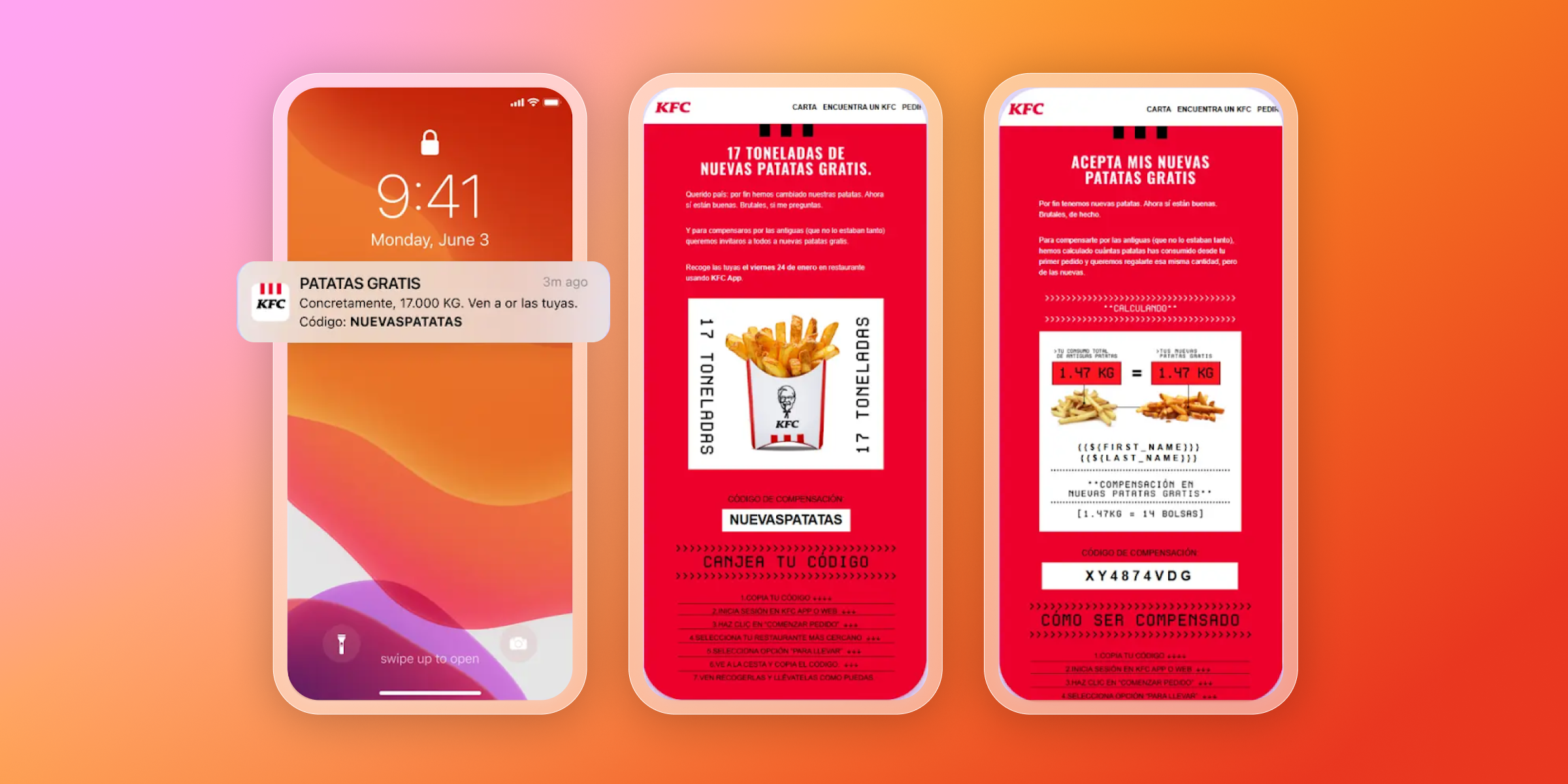
KFC Spain used Braze to analyze years of CRM and purchase history to identify every customer who had ever ordered the old fries. From that data, it built the "Fries Compensation" campaign: personalized emails, push notifications, and in-app messages sent to each identified customer, acknowledging their experience and compensating them with the exact number of free fries they'd previously purchased. A single marketing team member executed the entire segmentation in Braze.
The pull dimension came from social media, where KFC publicly replied to old Google Reviews and displayed real customer complaints on billboards, personally inviting critics to try the new recipe for free.
The wins
- 95% email open rate, KFC's highest-performing CRM campaign ever
- 679% increase in app downloads
- 233% increase in daily active users
- 20X increase in daily orders on launch day
- 42M impressions and 1.3M social interactions
- Highest-ever daily app sales, despite giving away 17 tons of fries for free
2. Bazaar's "notify me" button turns out-of-stock into 21% more revenue
Bazaar is Pakistan's leading e-commerce and fintech company, founded in 2020. The app offers next-day delivery of essential goods at wholesale prices and has since expanded into bookkeeping, procurement, and distribution services.
The challenge
When products went out of stock on the Bazaar app, customers had to either shop elsewhere or keep checking back manually. Neither outcome was good for retention, and the brand had become increasingly reliant on paid advertising to bring lapsed customers back. The existing CRM platform couldn't support the real-time data processing or out-of-app messaging capabilities needed to fix it.
The strategy
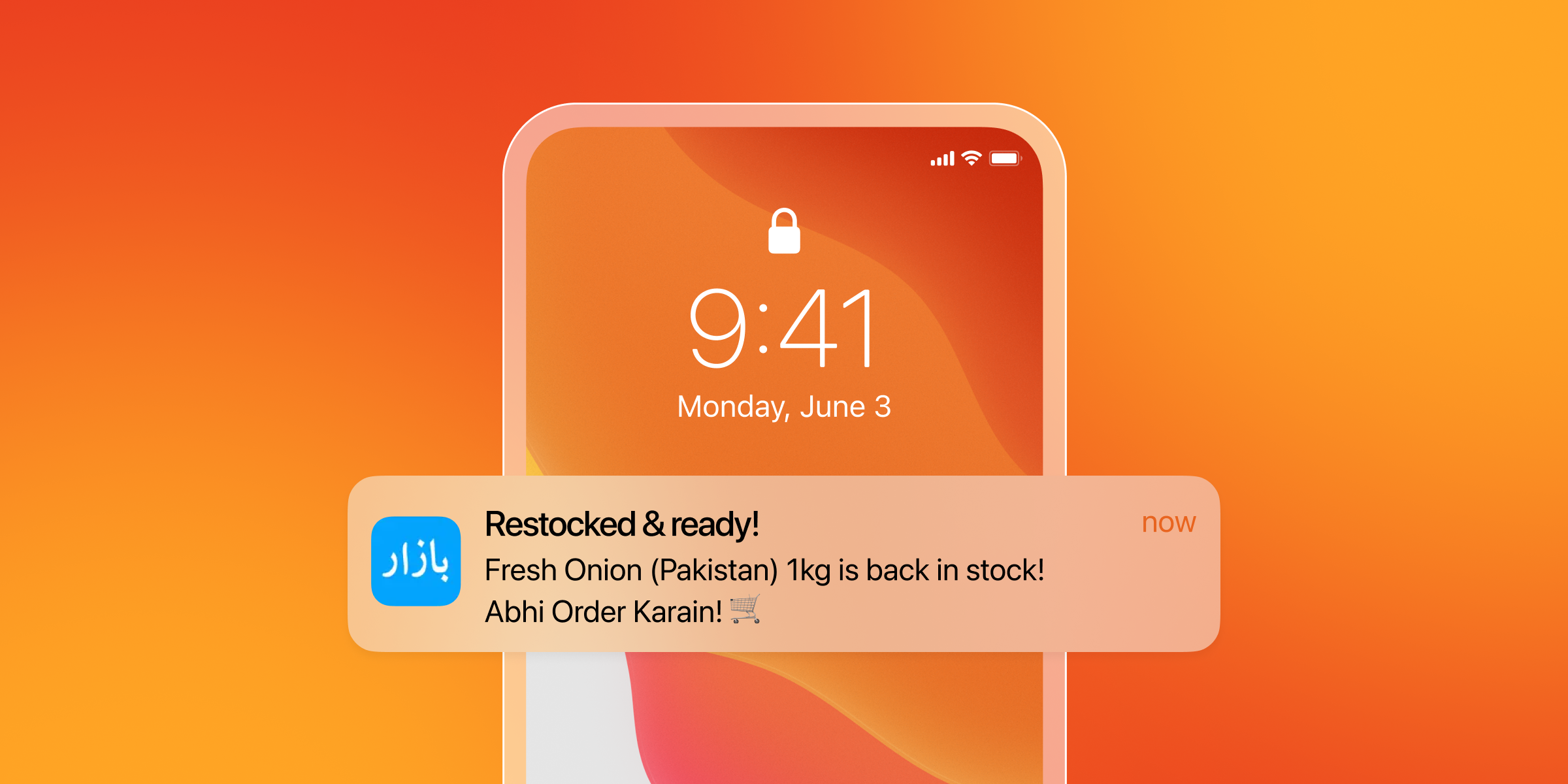
Bazaar built a restock alert campaign on a pull-first mechanic. When a customer encountered an out-of-stock product, they could tap a "Notify Me" button to opt into an alert at the moment of highest interest.
Braze Canvas then monitored live inventory data and triggered a personalized push notification the moment the item was restocked, using product-specific details and a clear call to action. Multiple message variants were tested across tone and copy style, with the best-performing versions automatically scaled to the majority of users. The entire Braze build took two days.
The wins
- 29% increase in open rates
- 26% increase in orders
- 21% increase in revenue
- 12% increase in total conversions
- 9% increase in one-day conversion across the funnel
- Reduced dependence on paid re-acquisition, with first-party data-driven organic engagement proving more cost-effective than paid channels for returning customers
3. Panera Bread proves loyalty is never half-baked with a 5% retention lift
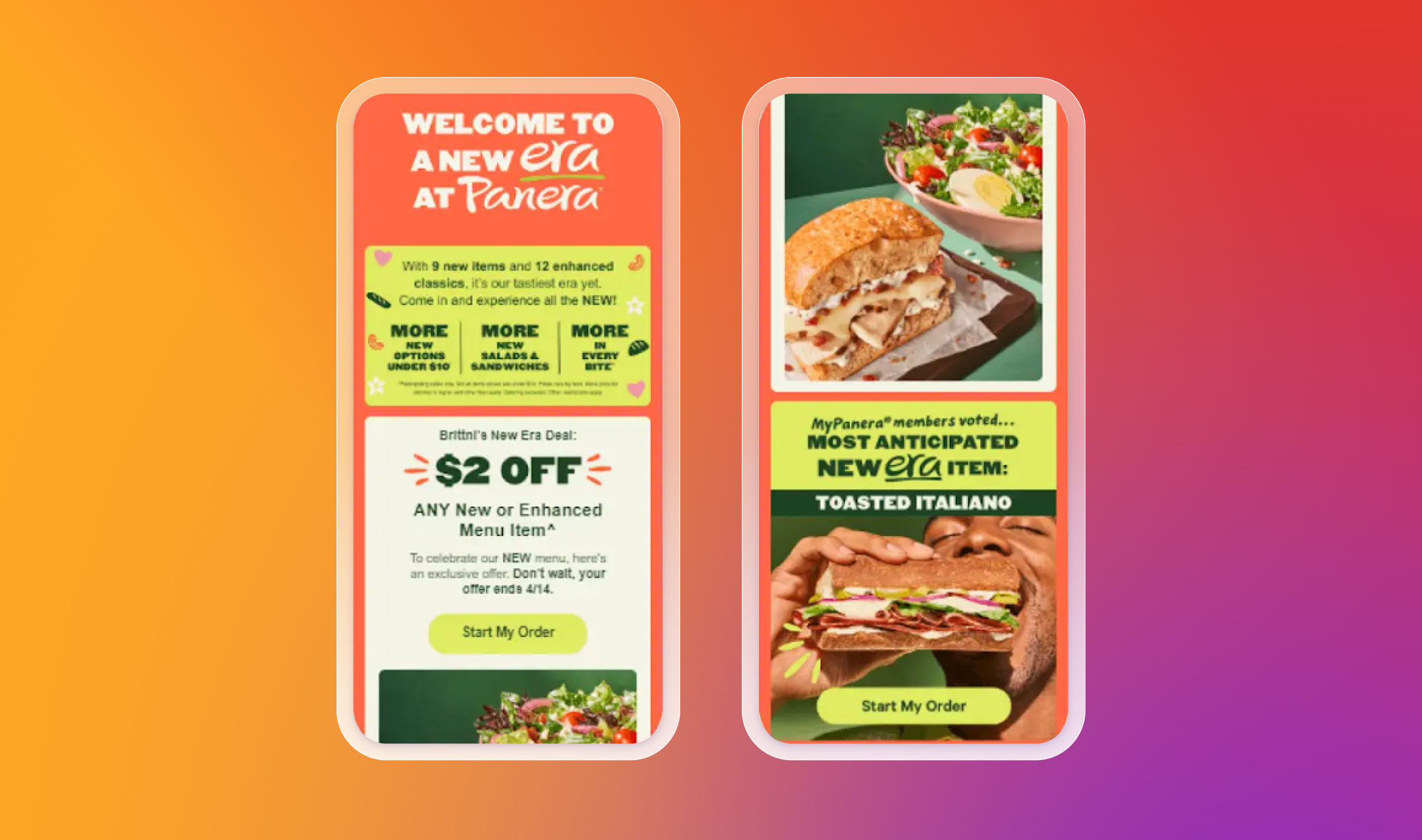
Panera Bread is a leading fast casual restaurant with over 2,200 locations across North America, known for its soups, salads, sandwiches, and baked goods. In April 2024, it launched the largest menu transformation in its history, updating more than 20 items and introducing nine new additions.
The challenge
A menu overhaul of that scale carried a real risk of losing customers who had built habits around specific items. Panera needed to retain guests who might disengage during the transition, reward its most loyal customers, and reactivate lapsed guests, all while communicating significant change without creating confusion.
The strategy
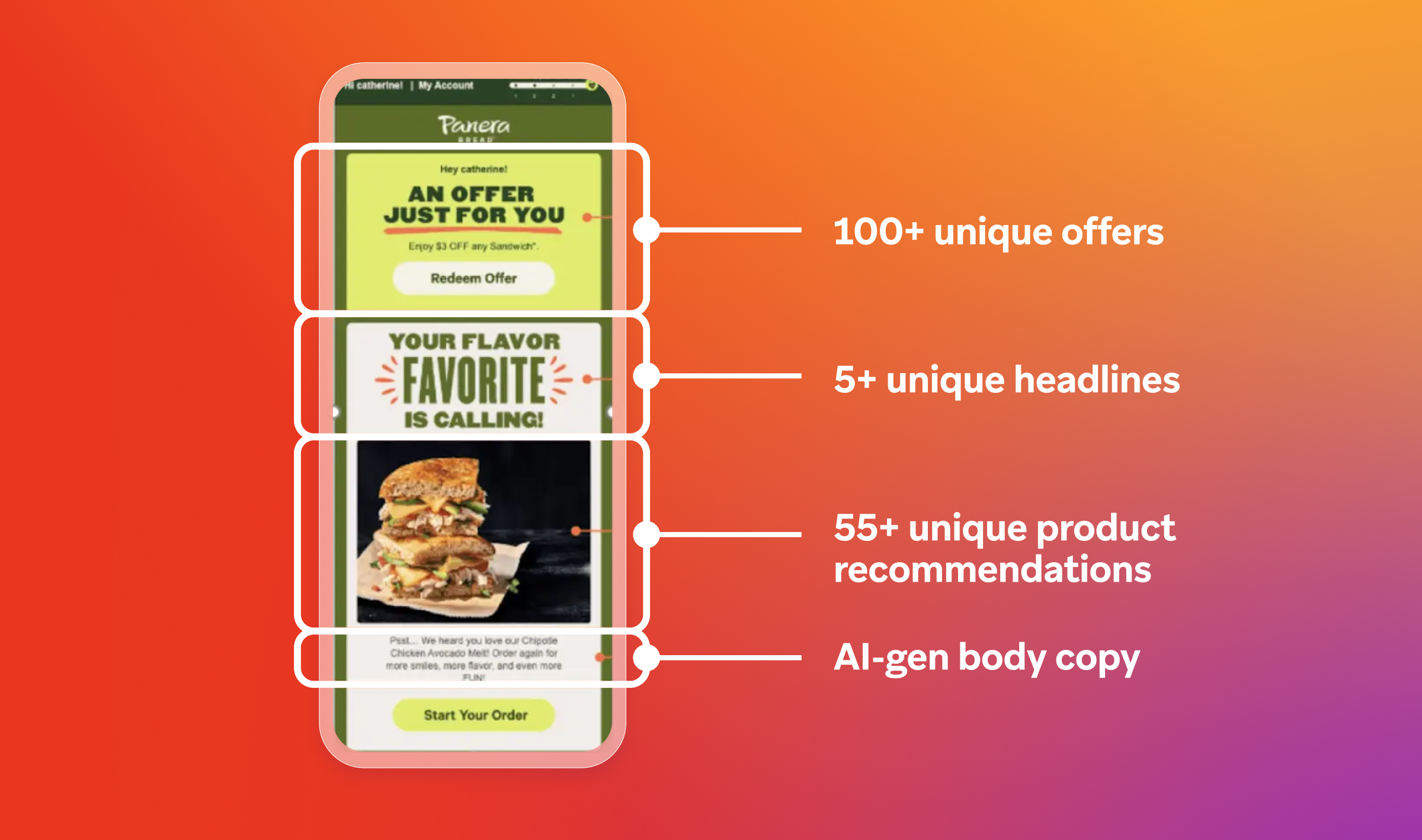
Panera ran push and pull mechanics simultaneously through Braze Canvas. An AI-powered decision engine identified guests at risk of lapsing, then deployed personalized emails, push notifications, in-app messages, and Content Cards across more than 4,000 unique content combinations based on individual purchase history. Guests who browsed new menu categories without completing a purchase received triggered follow-up messages with targeted offers.
On the pull side, MyPanera loyalty members were invited before launch to vote on their most-anticipated new item. The behavioral data from that campaign, generated by customers choosing to participate, then shaped the personalized offers sent after launch.
The wins
- 5% retention lift among at-risk guests
- 2X increase in loyalty offer redemptions
- 2X increase in purchase conversions from abandoned order follow-ups
- Over 400,000 votes collected in the pre-launch campaign
- 50+ hours of manual work saved through automated content creation and streamlined campaign management
Measuring push and pull marketing success
- KPIs for push: click-through rates, conversions, ad performance
- KPIs for pull: organic traffic, content engagement, lead generation
- Integrating analytics for holistic ROI and performance tracking
Push and pull strategies are measured differently, and looking at them separately gives an incomplete picture. Push metrics don't show how pull channels built the audience that responded to those messages. Pull metrics don't show how much of that organic traffic arrived because a push campaign created the initial moment of contact. Tracking both together connects marketing activity to actual business outcomes.
Push KPIs to track
- Click-through rate: The proportion of messages across email, push notifications, and SMS that generate a click
- Conversion rate: The proportion of recipients who complete the intended action after receiving a message
- Delivery and open rates: For email, an indicator of whether messages are reaching inboxes and earning attention
- Cost per acquisition and return on ad spend: The primary efficiency measures for paid advertising
- Opt-out and unsubscribe rates: Usually the first signal that frequency or relevance has slipped, before it shows up in conversion data
- Retention rate and customer lifetime value: Longer-term measures of whether push activity is building lasting relationships rather than just immediate responses
Pull KPIs to track
- Organic traffic volume: The primary indicator of SEO and content marketing performance
- Search rankings: A forward-looking measure of organic visibility for target keywords
- Content engagement: Time on page, scroll depth, and social shares show whether content is holding interest
- Lead generation from organic sources: Content downloads and form completions connect pull activity to commercial outcomes
- Session depth: The number of pages visited in a single session, indicating how well pull content sustains engagement once someone arrives
Multi-touch attribution: seeing the full picture
A customer who converts after receiving a push notification may have spent weeks reading blog content and browsing organic search results first. Giving all the credit to the push notification, as a last-click model would, makes pull channels invisible in the data even when they did most of the relationship-building work.
Multi-touch attribution distributes credit across every touchpoint that contributed to a conversion. Cohort analysis adds another layer: comparing the long-term behavior of customers who arrived through organic channels against those acquired through push often reveals differences in retention and lifetime value that campaign-level reporting alone would never show.
Campaign orchestration tools that bring push and pull data into a single platform make this kind of measurement achievable. A fragmented reporting stack, where email, paid, and organic channels all report separately, makes it almost impossible to see the customer journey as a whole. When push and pull data sit in the same platform, it becomes possible to calculate ROI across the full customer journey rather than attributing it to whichever channel happened to close the conversion.
Final thoughts and takeaways
Push and pull marketing aren't competing priorities. Push creates the moments of contact that bring customers in. Pull creates the experiences that keep them coming back. A strategy built around both, with each channel mapped to the right moment in the customer journey, produces results that neither approach generates alone.
The brands seeing the strongest results are the ones treating customer data as the connective tissue between push and pull, using behavioral signals to decide when to reach out, what to say, and which experience to deliver when a customer arrives.
Measurement is where many combined strategies fall short. Tracking push and pull in separate reporting stacks makes it impossible to see the full customer journey, which means crediting the wrong channels and under-investing in the ones doing the most work.
Push vs pull marketing FAQs
What is push vs pull marketing strategy, and why is it important for businesses?
Push vs pull marketing are complementary approaches. Push marketing uses outbound channels like email, push notifications, and paid advertising to reach customers directly. Pull marketing uses content, SEO, and in-app experiences to attract them organically. It matters because each approach serves a different role in the customer journey, and together they produce stronger engagement than either strategy can deliver alone.
How can brands decide when to use push versus pull tactics?
Brands can decide between push and pull tactics by considering where the customer is in their journey and what outcome is needed. Push tactics are most effective for time-sensitive moments where they need to reach customers outside of owned channels. Pull tactics are most effective for building awareness and nurturing long-term loyalty.
How can push and pull strategies be integrated for cross-channel marketing success?
Push and pull strategies integrate most effectively when mapped to the full customer journey. Push channels driving direct outreach, and pull channels sustaining organic engagement across touchpoints. Marketing automation and journey orchestration tools make this coordination scalable across any channel mix, without requiring manual management of every customer interaction.
What role does automation and AI play in optimizing push and pull campaigns?
Marketing automation enables brands to trigger push and pull messages based on real customer behavior rather than fixed schedules, which increases relevance and reduces the risk of message fatigue. AI optimization evaluates multiple behavioral signals simultaneously to determine the best channel, timing, and content for each customer. Together, they make real-time personalization at scale achievable and continuously improve campaign performance.
How do marketers measure ROI and engagement for combined push and pull strategies?
Measuring the effectiveness of combined push and pull strategies requires tracking KPIs across both approaches. Multi-touch attribution models are important for understanding how both types of touchpoint contribute to a single conversion. Long-term metrics like customer lifetime value and retention rate capture the compounding value that pull channels in particular generate over time.
Related Tags
Be Absolutely Engaging.™
Sign up for regular updates from Braze.