Marketing funnel automation: From awareness To retention
Published on April 23, 2026/Last edited on April 23, 2026/12 min read

Sally Wills
Senior Content Strategy Manager, BrazeContents
Scaling customer engagement without scaling headcount is one of the central challenges of modern marketing. The volume of decisions required to run a funnel effectively, who receives what message, on which channel, at which moment, quickly outpaces what any team can manage manually.
By connecting customer data to automated workflows, marketing funnel automation replaces repetitive manual tasks with real-time responses to actual customer behavior across every stage of the journey from awareness to retention. An AI-driven funnel takes this further, making faster lead qualification, more relevant communication, and higher conversion rates possible without a proportional increase in resource.
AI is adding more fuel and changing the scope of what automated funnels can do. Smarter targeting, real-time personalization, and decisioning that improves with every interaction mean that automation is becoming a competitive necessity for brands serious about customer engagement.
This guide covers how marketing funnel automation works, how to build one that performs and what it can do at each stage of the funnel.
TL;DR
- Marketing funnel automation uses software to manage and move customers through every stage of the buying journey automatically, replacing manual tasks with workflows triggered by real behavior.
- Automation improves efficiency, engagement, and conversions across TOFU, MOFU, and BOFU stages, with each stage feeding data into the next.
- AI takes funnel automation further, enabling real-time personalization, predictive lead scoring, and 1:1 decisioning that adapts continuously without manual testing.
- Choosing the right tools matters: look for platforms with unified customer data, cross-channel messaging, behavioral triggers, and clean integrations across your existing stack.
Key takeaways
- The most effective automated funnels treat each stage as part of a connected system, where data from one stage actively improves performance in the next.
- Speed to lead matters. Automation removes the delay between a customer taking an action and receiving a relevant response, protecting high-intent moments from slow follow-up.
- Personalization at scale is only possible when behavioral triggers and dynamic segmentation are working together in real time, not against static lists.
- AI decisioning represents a meaningful step beyond AI-powered automation, making 1:1 decisions across message, channel, timing, and offer simultaneously for every individual.
- Tool selection is a strategic decision. Unified data, cross-channel capability, and clean integrations determine how far automation can actually reach across the funnel.
What is marketing funnel automation?
Marketing funnel automation is the use of software to automatically manage and move potential customers through every stage of the buying journey, from awareness through to post-purchase retention, without manual intervention. By replacing repetitive tasks with automated workflows triggered by real customer behavior, it improves efficiency, drives engagement, and increases conversions at every stage of the funnel.
The funnel breaks into three stages, which automation streamlines.
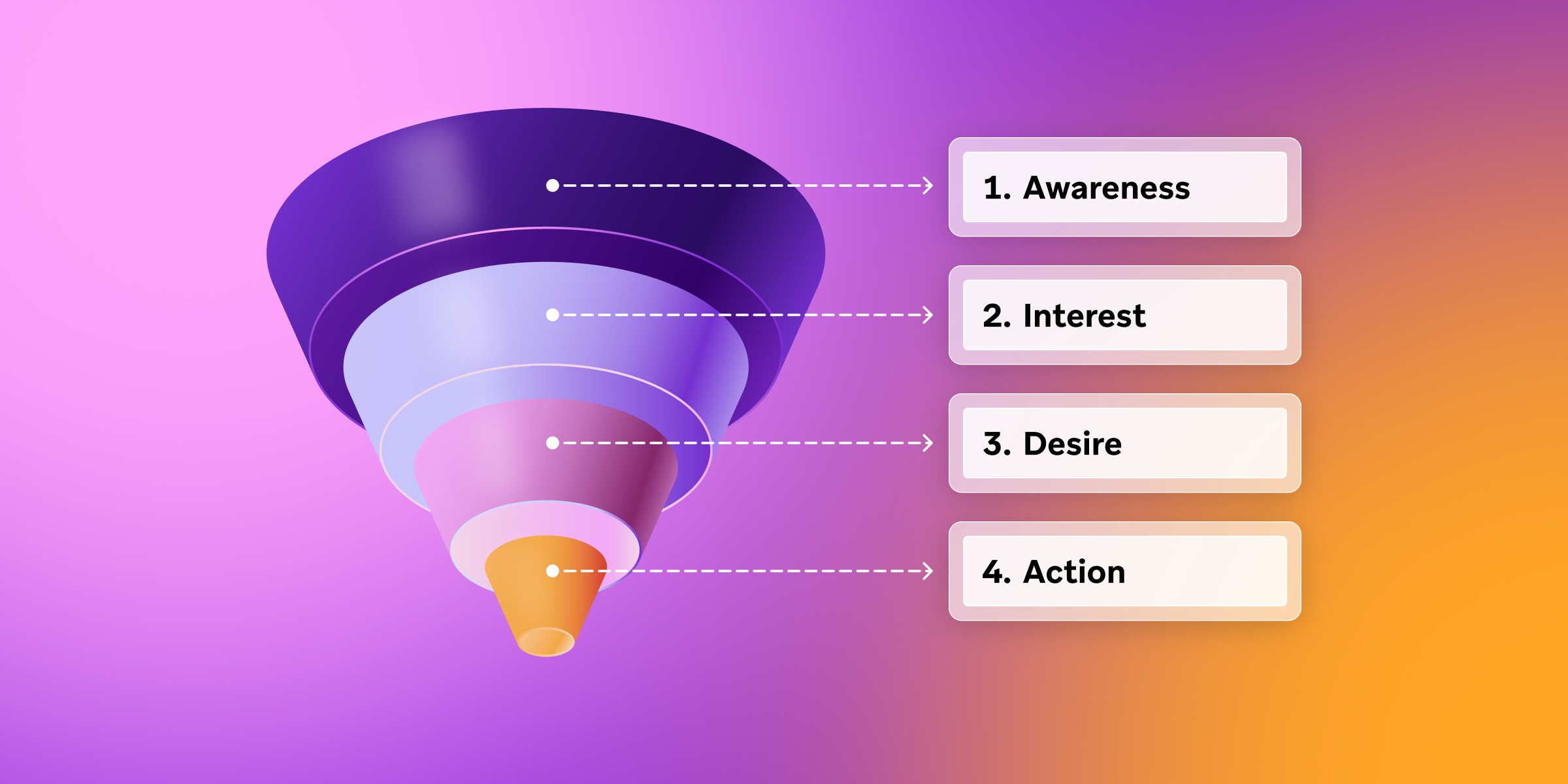
TOFU automation: capturing attention at scale
TOFU stands for top of funnel, where potential customers first encounter a brand. Automation here handles lead capture from paid social ads, content downloads, and sign-up forms, routing new contacts into a central system in real time and triggering an immediate response so no new lead goes cold.
Getting someone into the funnel is only the beginning. What happens next determines whether they stay engaged or drop off.
MOFU automation: nurturing interest into intent
MOFU, the middle of the funnel, is where prospects know a brand exists but haven't committed yet. Automated email sequences, lead scoring, and behavioral triggers work together here to keep prospects moving and surface the ones showing the strongest buying intent.
Once a prospect has shown enough intent, the funnel shifts into its final stage.
BOFU automation: closing the loop on conversion
BOFU, the bottom of the funnel, is where high-intent prospects need a well-timed prompt to convert. Retargeting campaigns, personalized offers, and triggered follow-up sequences all run automatically based on specific behaviors, with timing and relevance doing as much work as the message itself.
Key benefits of marketing funnel automation
Automation addresses the challenges at each funnel stage in ways that show up directly in marketing ROI. These are the benefits teams see when it runs across the full journey:
Automated lead capture and qualification. Contact information collected from forms, ads, and content downloads is captured instantly and routed into the right workflow without manual handling. Behavioral data runs in the background to determine which leads are ready for direct outreach and which need more nurturing, so teams focus effort where it counts most.
Personalized email and messaging sequences. Triggered by specific customer actions, not a fixed send schedule, automated emails reach a prospect when the content is relevant to where they are in their journey. Timing and relevance working together turn a message into a response.
Content-driven nurturing across channels. Automation keeps a brand present across longer buying cycles without requiring constant manual effort. Each touchpoint adapts based on what a prospect has already engaged with, so communication stays relevant as they move through the funnel.
Retargeting across web, social, and mobile platforms. Prospects who leave without converting can be reached with relevant messages wherever they go next. According to the 2024 Global Customer Engagement Review, messaging customers across a combination of channels results in 25% more purchases per user than out-of-product channels alone.
Real-time analytics and optimization. Campaign automation tracks performance continuously, making open rates, click-through rates, and conversion data available as campaigns run, not after them. Teams can identify what's working and adjust without waiting for a post-campaign report.
Speed to lead. The faster a brand responds to a new lead, the more likely that lead is to engage. Automation removes the delay between a prospect taking an action and receiving a relevant response, so high-intent moments aren't lost to slow follow-up.
Scalability without added overhead. Manual processes have a natural limit. At some point, volume outpaces the team managing it. Automation handles increasing lead volumes and more complex customer journeys without requiring proportional increases in resource.
How to build an automated marketing funnel
Getting the funnel right starts with strategy, not software. The decisions made before anyone logs into a platform shape everything the automation is built around: who the customer is, what they need at each stage, and what signals readiness to move forward.
1. Map the customer journey from awareness to retention
Every stage a customer moves through needs to be defined before automation can be built around it. Identify what customers need at each point and what action signals readiness to move to the next stage. Automation built without this foundation tends to fire at the wrong moments.
2. Select tools that integrate with existing systems
A customer engagement platform, CRM, and analytics tools need to share data in real time so every automated action is based on a complete, current picture of the customer. Data centralization consolidates customer information from multiple sources into a single system, giving every workflow a consistent foundation to draw from.
3. Lead nurturing automation: capturing and segmenting leads effectively
Automated systems tag customers as they enter the funnel, based on source, behavior, and engagement level. Dynamic segmentation groups customers based on real-time data, so relevant content reaches the right people without manual intervention.
Nurturing sequences that adapt based on behavioral signals outperform those running on fixed timelines. A customer who downloads a case study moves into a different flow than one who only visited the homepage, and each path delivers content matched to where they are in their decision.
4. Create automated email and messaging sequences
Automated sequences can be built for each stage of the journey once segments have been defined. Campaign automation means each sequence responds to what a customer has done. A customer who opens three emails and visits the pricing page warrants a different next message than one who engaged once and has since gone quiet.
5. Implement dynamic retargeting campaigns
Customers who leave the funnel without converting can be brought back with relevant, timely messages across paid social, display, and mobile channels. Triggered by specific customer actions, not a fixed send schedule, personalized messaging reaches a customer when the content is relevant to where they are in their journey. Timing and relevance working together turn a message into a response.
6. Monitor performance and optimize continuously
Open rates, click-through rates, conversion rates, and drop-off points all feed back into the system as signals for improvement. Reviewing this data regularly and adjusting sequences, timing, and content keeps the funnel performing as customer behavior evolves.
AI and personalization in marketing funnel automation
AI-driven automation learns, adapts, and makes decisions based on patterns in customer behavior that no manual process could track at scale. Applied to personalization, it means every customer interaction can be tailored in real time, based on what that individual has done, not what their segment looked like six months ago. Here are the capabilities where AI is having the most direct impact on funnel performance:
AI marketing automation: smarter decisions at every stage
AI marketing automation evaluates behavioral signals, engagement history, and predictive indicators to determine what should happen next and when. In an AI-driven funnel, a customer receives the next message because the signals say it's the right moment, not because a timer ran out.
According to the 2026 Global Customer Engagement Review, top-performing brands are 30% more likely to use AI to anticipate purchase intent, allowing them to act on demand in real time.
Funnel optimization: using data to continuously improve performance
AI models analyze engagement patterns across the funnel in real time, identifying where customers are dropping off, which sequences are underperforming, and where timing adjustments would improve conversion rates.
Send-time optimization is one of the most immediate applications. AI determines the moment each individual customer is most likely to engage and delivers the message at that point, not at a time chosen for the whole segment.
Conversion automation: turning intent signals into action
Conversion automation uses AI to identify the behavioral signals that indicate a customer is close to making a decision and triggers the right response automatically. For example, a customer who has visited a product page multiple times, engaged with a comparison email, and started a free trial is exhibiting a distinct pattern that AI recognizes and acts on.
This precision removes the guesswork from conversion-stage messaging. Customers receive relevant prompts at the right moment, and teams don't need to manually identify and act on every high-intent signal across a large audience.
Cross-channel marketing automation: meeting customers where they are
Cross-channel marketing automation coordinates messaging across email, push notifications, SMS, in-app messages, and paid channels so the customer experience feels connected, not fragmented. Personalized messaging delivered through the right channel at the right time is what cross-channel automation makes possible at scale, with AI determining which channel each individual customer is most likely to respond to.
Tools and integrations for funnel automation
The right marketing technology stack doesn't need to be large. What matters is that every tool in it serves a clear purpose and shares data freely with the others. Here's what to pay attention to when evaluating platforms for funnel automation.
Capability | What to look for |
|---|---|
Unified customer data layer | Real-time data ingestion from multiple sources into a single customer view |
Cross-channel messaging | Email, SMS, push, in-app, and paid channels managed from one platform |
Behavioral triggers and dynamic segmentation | Sequences that fire on real actions, with segments that update automatically |
AI-powered automation and AI decisioning | AI automation for send-time and personalization; AI decisioning for 1:1 decisions across all variables simultaneously |
Analytics and attribution | Real-time performance data at every funnel stage with accurate conversion attribution and clear marketing ROI visibility |
System integrations | Clean API connections to CRM, data warehouse, paid media, and analytics tools |
A unified customer data layer
Platforms that ingest data from multiple sources in real time and make it immediately available to trigger automated actions are the ones to prioritize. Without a single, centralized view of the customer, workflows operate on incomplete information and personalization breaks down quickly.
Cross-channel messaging capability
A funnel automation tool should be able to reach customers across email, SMS, push notifications, in-app messages, and paid channels from a single platform. Managing these channels separately creates inconsistent experiences and makes coordinated automation difficult to execute.
Behavioral triggers and dynamic segmentation
The tools that matter here respond to what customers do in real time, not just who they are on a static list. Behavioral triggers fire sequences based on specific actions, and dynamic segmentation updates automatically as customer behavior changes.
AI-powered automation and AI decisioning: knowing the difference
Most platforms now offer some form of AI-powered automation. This typically covers things like send-time optimization, predictive lead scoring, and content personalization based on behavioral patterns. These are genuinely useful capabilities and a significant step forward from rules-based automation alone.
AI decisioning is a different and more advanced capability. Built on reinforcement learning, it goes beyond predicting what a customer might do and instead makes 1:1 decisions for every individual simultaneously, across message, channel, timing, offer, creative, and frequency. A predictive model tells you a customer has a high probability of churning. An AI decisioning agent decides what to do about it for that specific person, tests different approaches, and updates its logic based on what actually drives the outcome you care about. It doesn't rely on segments or manual A/B testing. It learns continuously.
Understanding these subtle differences when evaluating AI capabilities will help you see how far you can go with your customer engagement and marketing efforts, and which platform best meets your current and future growth plans.
Analytics and attribution
The best analytics capabilities make it straightforward to measure marketing ROI performance at every stage, attribute conversions accurately, and identify where customers are dropping off. Funnel automation generates a large volume of data, and the platforms that make that data actionable in real time are worth the investment.
Integration with existing systems
No automation platform operates in isolation. Platforms that connect cleanly with CRM systems, data warehouses, paid media platforms, and analytics tools through well-documented APIs give every workflow a more complete and current foundation to draw from.
Final thoughts and takeaways
Marketing funnel automation improves efficiency, engagement, and conversions across every stage of the customer journey. It works best when it runs as a connected system, not a collection of independent tools, because each stage produces data that feeds the next decision, sharpens the next sequence, and improves the next message.
AI and real-time orchestration take this further, enabling smarter, more personalized campaigns that adapt to individual behavior without manual intervention. Integrations across tools and platforms amplify all of it, giving every automated workflow a more complete and current foundation to act on.
Teams that build connected, intelligent funnels tend to find the same thing: the better the data, the smarter the automation, and the smarter the automation, the stronger the results.
Marketing funnel automation FAQs
What is marketing funnel automation, and why is it important for businesses?
Marketing funnel automation is the use of software to automatically manage and move potential customers through every stage of the buying journey, from awareness through to post-purchase retention, without manual intervention. It matters because it replaces time-consuming manual processes with automated workflows that respond to real customer behavior, improving efficiency, engagement, and conversions at scale.
How can automation streamline the customer journey from awareness to retention?
Automation streamlines the customer journey from awareness to retention by triggering the right communication at each stage based on what a customer actually does. At the top of the funnel it captures and qualifies leads automatically. In the middle it nurtures prospects with relevant sequences. At the bottom it converts high-intent signals into action, and post-purchase it keeps customers engaged through targeted retention flows.
What types of tasks can be automated within marketing funnels?
Marketing funnels can automate lead capture and qualification, email and messaging sequences, dynamic audience segmentation, lead scoring, retargeting campaigns, send-time optimization, A/B testing, and post-purchase retention flows. The most effective automated funnels connect these tasks across a single platform so data from one stage informs the next.
How does AI enhance marketing funnel automation for personalization and engagement?
AI enhances marketing funnel automation by moving beyond fixed rules and static segments to make real-time decisions based on individual customer behavior. It optimizes send times, predicts intent, and personalizes content at scale. More advanced AI decisioning uses reinforcement learning to make 1:1 decisions across message, channel, timing, and offer simultaneously, continuously improving without manual testing.
Related Tags
Be Absolutely Engaging.™
Sign up for regular updates from Braze.
Related Content
 Article16 min read
Congratulations to the Forge 2026 Torchie Awards winners
September 29, 2026 Article6 min read
Bring 1:1 decisioning to every marketing journey with BrazeAI Decisioning Studio™ Go
September 28, 2026 Article12 min read
Made for this: How Braze is providing new ways to build, support, and extend your campaigns
September 28, 2026