Demographic segmentation: How to do It, examples and best practices
Published on January 30, 2026/Last edited on February 04, 2026/14 min read

Team Braze
Contents
So you want to try segmentation. Chances are, you start with demographic segmentation. It’s a simple first step and easy to understand and explain across the business. But beyond that gateway is powerful data you can use to enhance your segmentation strategy. Combined with behavioral and lifecycle signals, demographic segmentation turns into a more complete and effective part of your lifecycle orchestration.
Let’s find out how you can stay ahead of the curve in 2026 and successfully roll out demographic segmentation for engaging, cross-channel customer experiences.
Here’s a quick summary:
- Demographic segmentation groups audiences by measurable traits like age, role, income, household status, or language.
- On its own, demographic data can be too broad, so results improve when it’s combined with behavioral and lifecycle signals.
- In 2026, effective demographic segmentation is dynamic, privacy-aware, and activated across channels to stay relevant over time.
What is demographic segmentation?
Demographic segmentation is the practice of grouping audiences by measurable traits—such as age, income, occupation, education level, or household status—so you can tailor messaging, offers, and experiences.
As these traits are facts, (not based on emotions or opinions), they’re often used as a starting point because they’re concrete, provable information.
Why demographic market segmentation matters
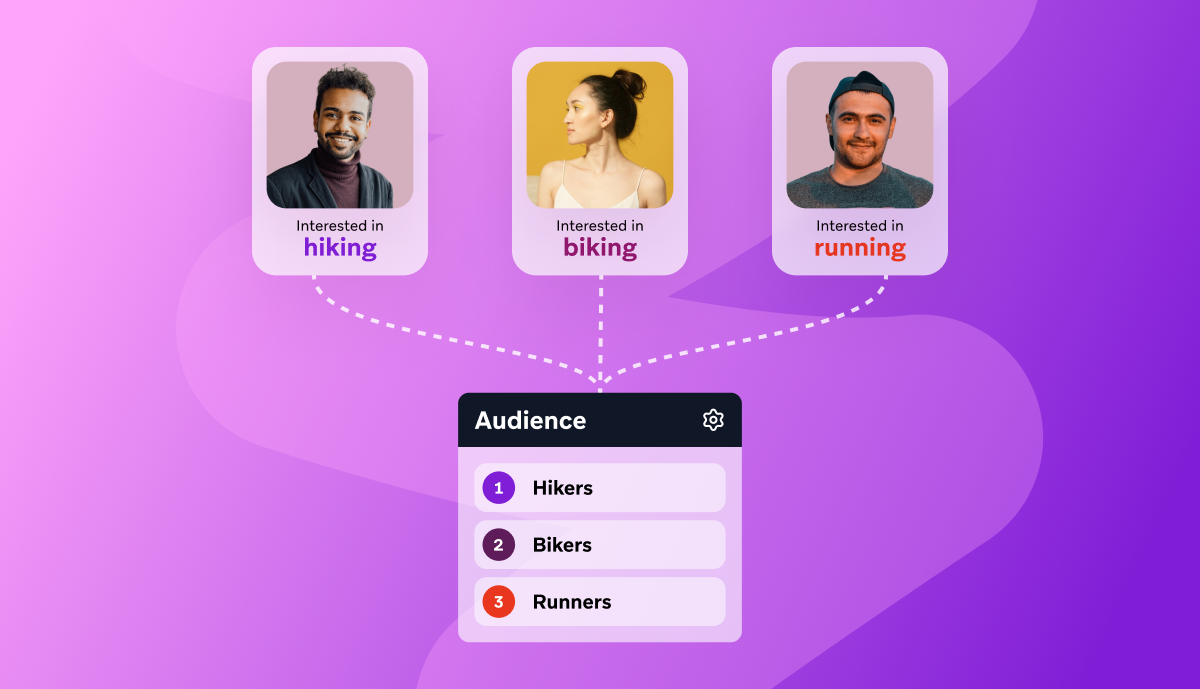
If you want your messaging to resonate, engage and convert, then you need to get specific with your audience. A one-size-fits-all approach isn’t going to work. When you can give the customer something they can relate to, and show that you understand their real world, then you make more of a connection with them.
More relevant messaging and offers
Demographic traits like life stage, role, household status, and language can shape what people care about and what they can act on. That makes it easier to write messaging angles, choose incentives, and personalize content without guessing.
Less wasted spend
Broad targeting burns budget on people who were never a fit. Demographic market segmentation narrows the audience, so promos, discounts, and paid spend go to segments with a higher likelihood of responding, which also cuts down on message fatigue.
Higher conversion potential
Conversion improves when the offer fits the customer’s context. Demographic customer segmentation helps you align pricing, bundles, and value props to different segments, then use first-party data to validate intent before you push harder.
Better customer experience and retention
Customers stick around when the experience feels coherent across the customer journey. Demographic segmentation supports smarter onboarding, more relevant recommendations, and lifecycle marketing that adapts over time, which can lift engagement and retention.
Advantages and disadvantages of demographic segmentation
Demographic segmentation is easy to start, but it has clear limits. Knowing where it shines (and where it falls short) makes it easier to build segments that hold up over time.
Here’s a quick look at the good and the bad:
Pros
- Easy to collect: Often available through signup, profiles, and preference centers.
- Cost-effective: Lower lift than deeper behavioral analysis or psychographic research.
- Simple to implement: Clear rules make segments easy to build, explain, and use.
- Scales cleanly: The approach works the same across small and large audiences.
Cons
- Can be too broad: Shared traits don’t always translate into shared preferences.
- People don’t fit neatly into buckets: Demographics rarely capture intent, urgency, or constraints.
- Attributes change: Roles, income, and household status can change quickly, which makes static segments inaccurate.
- Missing motivation: Demographics alone don’t explain why someone buys or when they’re ready to act, so results improve when you pair them with behavioral and lifecycle signals.
The 7 types of demographic segmentation (with examples)
The 7 most common types of demographic variables you can track, are popular because they cover universal traits. Here’s how they work and examples of what using each one can look like.
1. Age and life stage
Age and life stage segmentation helps align messages to what people are likely dealing with right now, which makes onboarding, offers, and education feel more relevant.
It’s most useful in categories where needs, budgets, or routines change across stages, because you can adjust message angle and timing without rebuilding the whole journey.
Example A: A telecom brand promotes a “share data with housemates” plan to students via push, and “family plan and shared data” upgrades, framed around managing multiple devices and household usage for new parents.Example B: A bank routes new graduates into a “first paycheck” onboarding series, while older customers see retirement planning tools and appointment prompts in-app.
2. Gender
Gender segmentation can support personalization in categories where fit, sizing, or product design differs, and where customers choose how they want to be addressed.
It works best when customers control the field and it’s paired with preference data (sizes, categories, style, or goals) so targeting reflects what people actually want.
Example A: A fashion retailer captures pronouns and saved sizes in a preference center, then triggers a “back in stock in your size” push for wish-listed items.Example B: A footwear brand uses customer-selected fit preferences (wide, standard, narrow) and style categories to personalize email product edits and in-app recommendations.
3. Income and purchasing power
Income and purchasing power segmentation helps align price points, bundles, and incentives to what different groups are likely to consider.
It’s most useful when you can anchor segments in first-party data patterns like average order value, discount usage, and repeat purchase rate, so targeting reflects buying behavior, not guesswork.
Example A: A home goods brand sends “bundle and save” offers to discount-heavy buyers, and early access to new collections to high-spend shoppers.Example B: A grocery delivery service highlights “under £25” meal plans and budget-friendly swaps for price-sensitive segments, while higher-spend segments see premium add-ons and seasonal specials.
4. Occupation and industry
Occupation and industry segmentation is especially useful in B2B because it maps to responsibilities and next steps, which can make onboarding and nurture far more relevant.
It’s most useful when your product has different users inside the same account, since admins, daily users, and stakeholders need different messages and milestones.
Example A: A SaaS platform sends admins a setup checklist and permissions guidance by email, while end users see an in-product prompt to build their first workflow.Example B: A payments provider runs separate nurture tracks for ecommerce and subscription brands, sending ecommerce teams chargeback content and subscription businesses guidance on recovery and retries.
5. Language
Language segmentation makes messaging easier to follow by keeping copy consistent in the customer’s preferred language.
It’s most useful when language preference applies across touchpoints, so email, push, in-app messages, and support content stay consistent for the customer.
Example A: A travel app sends booking confirmations and check-in reminders in the customer’s preferred language across email and push.Example B: A global retailer localizes order updates and returns instructions, then mirrors the same language inside app help modules.
6. Education level
Education level segmentation can help you judge how much explanation and guidance customers need, especially for complex products.
It’s most useful for onboarding and high-consideration journeys, where the right level of explanation can reduce drop-off and build confidence.
Example A: An investing app sends first-timers a short email series explaining key terms, while experienced users get a product comparison guide and advanced features content.Example B: A mortgage lender tailors its quote journey, showing plain-language explainers and glossaries for new buyers, and faster comparison flows for experienced customers.
7. Marital or household status
Household status can shape things like quantity, pack size, and reorder reminders, because people buy differently depending on who they’re buying for.
It’s most useful when it’s paired with behavioral signals like basket size and reorder patterns, so household-based assumptions don’t take over the strategy.
Example A: A meal-kit brand recommends smaller boxes and “solo lunch” recipes for one-person households, and school-night bundles for families.Example B: A wireless provider promotes multi-line discounts and shared billing to households, while solo customers see flexible month-to-month plans and device upgrade offers.
Demographic segmentation examples (by industry)
Different industries use demographic segmentation in various ways, because buying cycles, channel mix, and available signals are changeable.
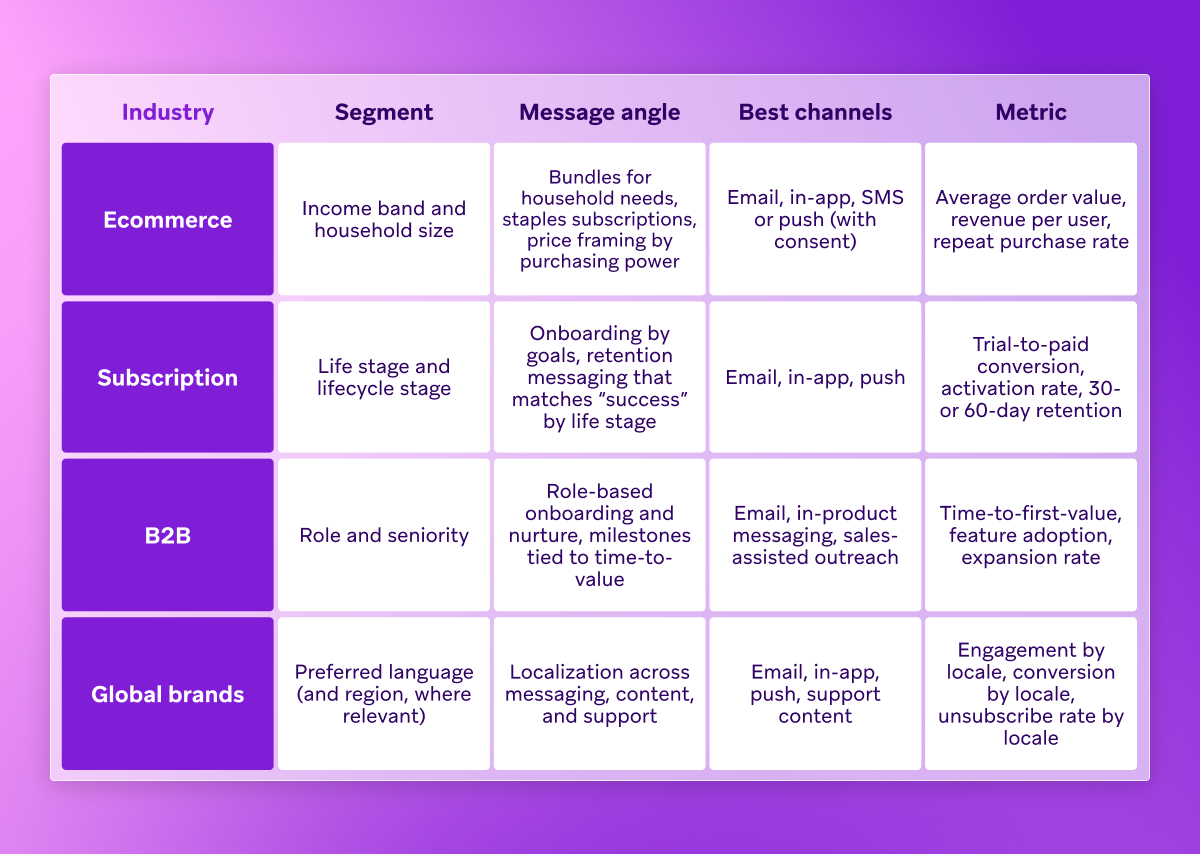
eCommerce
Segment: Income band and household size.
Message angle: Household-friendly bundles, “subscribe and save” prompts for staples, and price framing that matches purchasing power.
Best channels: Email for bundle discovery and offers, in-app for personalized shelves and reorder prompts, SMS or push for time-sensitive promos, where consent allows.
Metric: Average order value, revenue per user, repeat purchase rate.
Subscription
Segment: Life stage paired with lifecycle stage (trial, new, active, at-risk).
Message angle: Onboarding content that matches the customer’s goals, plus retention messaging that reflects what “success” looks like in that life stage.
Best channels: Email for education sequences, in-app for contextual tips tied to key actions, push for reminders and streak nudges.
Metric: Trial-to-paid conversion, activation rate, retention at 30 or 60 days.
B2B
Segment: Role and seniority (admin, practitioner, stakeholder).
Message angle: Role-based onboarding and nurture, with milestones that match responsibilities and time-to-value for each segment.
Best channels: Email for setup guidance and enablement, in-product messaging for prompts at the moment of need, sales-assisted outreach for high-intent accounts.
Metric: Time-to-first-value, feature adoption, expansion rate
Global brands
Segment: Preferred language (and region for timing and support, where relevant).
Message angle: Localized messaging, content, and support experiences that stay consistent across touchpoints.
Best channels: Email and in-app for consistent localization, push for reminders and updates in the right language, support content matched to the same preference.
Metric: Engagement rate by locale, conversion rate by locale, unsubscribe rate by locale.
How to do demographic segmentation (step by step)
Here are the steps you need to start using demographic segmentation in your journey orchestration:
1. Gather demographic data
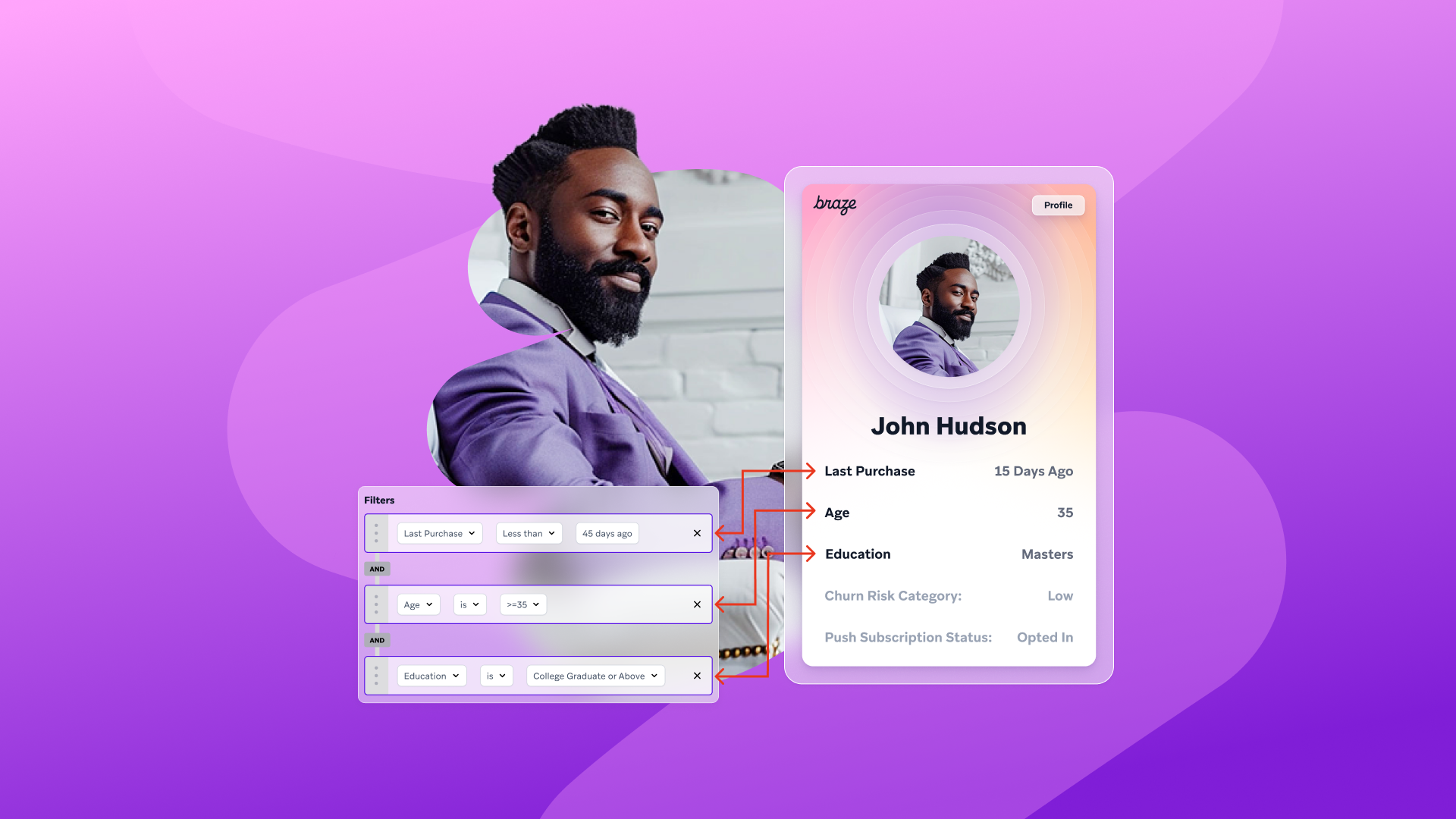
Collect the minimum you need, then pair it with first-party data like purchase history, product usage, and channel engagement. Skip fields that won’t change messaging, timing, or measurement.
Common collection points include:
- Signup and onboarding forms
- Account profiles and settings
- Preference centers and surveys
- Newsletter signups
- Loyalty and membership programs
2. Choose segments tied to a business goal
Start with the outcome, then define the segment. Such as:
- Reduce churn: household status plus recent engagement drop
- Increase AOV: purchasing power tier plus category interest
- Improve onboarding: role plus first-week actions
For example, if churn is creeping up, household status can be a useful demographic lens because it often correlates with how people shop and what they consider “value.” Pair that with an engagement signal—like fewer app sessions this week, no email clicks in 30 days, or a missed reorder window—and you have a clear moment to act.
A grocery delivery brand might treat a missed weekly order as the trigger, then tailor the message by household segment. One-person households could get quick “dinners for one” bundles and flexible delivery slots. Families could see school-night bundles, multi-buy savings, or a reminder to reorder staples.
3. Build segments in a segmentation tool
Turn the segment into simple rules teams can maintain:
- One demographic variable
- One behavioral or lifecycle signal
- Guardrails like suppression, exclusions, and frequency caps
4. Activate segments cross channels and journeys
Use segments for entry rules, branching, and personalization across cross-channel messaging. Let the segment influence message angle, offer, timing, and channel.
5. Test and iterate
Validate impact with experiments and use the resulting data to refine segment logic. A control group gives you a baseline, so you can see how much the segment actually moved the metric.
How to collect demographic data responsibly
Demographic data can make segmentation sharper, but it also comes with higher expectations from customers and regulators. A trust-first approach keeps you on the right side of privacy requirements like GDPR in the UK and EU and CPRA in the U.S., while improving the quality of the data you collect.
Consent and transparency
Demographic data collection should be clear, optional where appropriate, and easy to understand. Tell people what you’re asking for, why you’re asking, and what will change in their experience as a result.
Good patterns include:
- Plain-language explanations next to the field
- A link to preferences and privacy settings
- The ability to edit or remove details later
Collect only what you will actually use
Every extra field adds friction to signup and increases risk. Keep forms short, and only collect demographic attributes that directly support messaging, personalization, measurement, or customer support.
A simple internal check—if a field won’t change what you send, when you send it, or what you measure, skip it.
Preference capture where possible (zero-party data)
For sensitive attributes and identity-related fields, direct preference capture is often the cleanest option. Zero-party data comes from what customers explicitly share, like preferred language, content interests, fit preferences, or communication choices.
Use low-friction moments to capture it:
- Preference centers and profile settings
- Onboarding questions with clear value (“help us tailor your experience”)
- Surveys that focus on usefulness, not curiosity
Trust-first collection also supports better segmentation over time, because self-reported fields tend to be more accurate and easier to maintain than inferred guesses.
Demographic vs behavioral vs psychographic segmentation
These segmentation types answer different questions, and in 2026, the strongest strategies layer them.
- Demographic segmentation: Who someone is. Measurable traits like age, household status, role, income band, or language.
- Behavioral segmentation: What someone does. Purchases, browsing, product usage, and engagement across channels.
- Psychographic segmentation: Why someone buys. Motivations, values, attitudes, and goals.
A modern segmentation strategy starts with demographics for context, uses behavior to confirm intent and timing, and adds psychographic inputs where customers explicitly share preferences or goals. That mix supports personalization across the customer journey while reducing the risk of stereotypes and bias.
How to keep demographic segments up to date with dynamic segmentation
Segments should stay flexible, which is where dynamic segmentation comes in. Static segments go stale because people and circumstances change. Job moves, household shifts, and language preferences update over time. Even when demographics stay consistent, engagement and intent can change week to week, which can leave customers receiving messaging that no longer fits.
Dynamic updates keep segmentation relevant by using live signals to move people into the right audience when behavior changes, then move them out when they re-engage. With automatic updates, targeting stays aligned with what’s true in the moment.
For example: A customer stops opening emails and hasn’t been active in the app in 30 days. They move into a win-back segment, which triggers a re-engagement journey. If they open, click, or purchase, they exit the segment and the win-back messaging stops.
Tools for demographic segmentation
The best tools for demographic segmentation help you connect data, keep segments current, activate across channels, and measure impact.
When evaluating tools, look for a few core capabilities:
- Unified customer profiles: Demographic traits alongside first-party data and zero-party data, stitched into one view
- Real-time segment updates: Support for dynamic segmentation, so audiences reflect current behavior and lifecycle stage
- Cross-channel activation: The ability to use the same segment logic across email, push, in-app, SMS, and other touchpoints
- Measurement and experimentation: Reporting by segment, plus testing tools to validate incremental lift
How to measure demographic segmentation success
You’re looking for two things when measuring demographic segmentation—whether the segments perform better, and whether they create unintended risk. Measurement will also help you decide when to simplify segments, refresh criteria, or add behavioral signals to reduce overgeneralization.
A strong measurement plan usually includes:
- Conversion rate and revenue per user by segment
- Retention and LTV differences across segments and cohorts
- Engagement by channel and cohort (opens, clicks, sessions, feature usage)
- Incremental lift vs. a non-segmented control to separate correlation from impact
- Risk indicators like unsubscribes, spam complaints, opt-outs, and support friction
Key takeaways
Demographic segmentation is often the easiest place to start because the inputs are clear and widely available. It can also become far more useful when it’s connected to what customers do and where they are in the customer journey.
- Demographics are a practical starting point. Traits like age, household status, role, income band, and language give teams a simple way to make messaging more specific from day one.
- Use demographics with behavioral and lifecycle signals. Demographics shape message angle, but behavior confirms intent and timing, and lifecycle context keeps journeys aligned to where customers are right now.
- Dynamic segmentation keeps segments current. Automatic updates prevent customers from getting stuck in stale audiences as engagement, needs, and circumstances change.
- Trust-first data collection supports better outcomes. Consent, transparency, and zero-party preference capture improve data quality while supporting privacy expectations.
- Measure impact and watch for risk. Track conversion, revenue per user, retention, and LTV by segment, then validate with a non-segmented control. Keep an eye on opt-outs, complaints, and unsubscribes to catch fatigue early.
Demographic segmentation FAQs
What is demographic segmentation in marketing?
Demographic segmentation in marketing is the practice of grouping audiences by measurable traits like age, income, occupation, language, education level, or household status so messaging and offers can be tailored.
Why is demographic segmentation important?
Demographic segmentation is important because it can improve relevance, reduce wasted spend, and increase conversion potential by aligning messaging to customer context.
What are the 7 types of demographic segmentation?
The 7 types of demographic segmentation are age/life stage, gender, income/purchasing power, occupation/industry, language, education level, and marital or household status.
What are examples of demographic segmentation?
Examples of demographic segmentation include role-based onboarding in B2B, language-based localization for global brands, and household-based bundles or offers in eCommerce.
What are the advantages and disadvantages of demographic segmentation?
The advantages of demographic segmentation include being simple, scalable, and cost-effective, while disadvantages include being too broad, changing over time, and missing intent without behavioral context.
How do you collect demographic data responsibly?
You collect demographic data responsibly by being transparent about use, collecting only what you need, prioritizing consent and customer control, and relying on zero-party preference capture when possible.
How is demographic segmentation different from behavioral and psychographic segmentation?
Demographic segmentation focuses on who someone is, behavioral segmentation focuses on what someone does, and psychographic segmentation focuses on why someone buys.
What is dynamic demographic segmentation?
Dynamic demographic segmentation means segments update as customer data changes, so targeting stays current as attributes and behavior evolve over time.
What are the best tools for demographic segmentation?
The best tools for demographic segmentation support unified customer profiles, real-time segment updates, cross-channel activation, and measurement and experimentation.
How do you measure the success of demographic segmentation?
You measure the success of demographic segmentation through conversion and revenue per user by segment, retention and LTV differences, engagement by channel and cohort, incremental lift tests, and risk indicators like opt-outs.
Related Tags
Be Absolutely Engaging.™
Sign up for regular updates from Braze.