AI for financial services: balancing outcomes and governance
Published on June 01, 2026/Last edited on June 01, 2026/6 min read

Brandon Liu
Senior Strategic Business Consultant, BrazeSummary
TL;DR: AI for Financial Services — Balancing Personalization and Compliance
Financial services firms face a growing tension between customer demand for personalized experiences and strict regulatory requirements. Key takeaways:
Adoption gap is widening: Over 30% of financial services firms are "Frontier Firms" — embedding AI into core operations — outpacing competitors who use AI only for productivity.
Customer expectations are high: Only 53% of consumers feel brands accurately predict their needs, signaling a major personalization gap in FinServ.
Agentic AI is the solution: Unlike traditional AI, agentic AI autonomously makes and optimizes decisions using reinforcement learning trained on a brand's own data — enabling true 1:1 personalization at scale.
Governance is built in: Modern agentic systems include multi-agent review, fallback mechanisms for low-confidence decisions, and real-time observability for auditability and regulatory compliance.
Proven results: One bank using Braze's AI Decisioning Studio generated 10,000+ personalized customer journeys, achieving a 92% increase in clicks and 10% lift in card activation rates.
Bottom line: Fiduciary responsibility and AI-powered personalization are no longer at odds. financial services brands can deploy agentic AI that is simultaneously relevant, compliant, and relationship-building.
Show moreShow less
Contents
Financial service providers operate in a very different landscape compared to even five years ago. More choices, lower switching costs, and the rise of challenger brands mean it’s never been more important for brands to grow and continuously strengthen customer relationships.
But financial services marketers are caught between customer expectations of relevance and personalization on one hand, and strict regulatory frameworks on the other. As a result, many avoid the more advanced AI use cases that could directly support their customer retention and relationship goals.
However, fiduciary responsibility and AI-powered customer engagement don’t have to be at odds. The marketers closing this gap aren't waiting for AI to solve governance for them. They're approaching it the other way around: defining what responsible AI looks like, then deploying technology that operates inside those boundaries.
Here’s what you need to know.
The emerging gap in financial services AI adoption creates winners and losers
Ninety percent of financial services leaders agree that firms must become ‘technology companies that happen to offer financial products’ if they want to prosper in the modern marketplace. But execution is uneven.
A third of FinServ companies are already making the bold moves they need to achieve this. More than 30% of financial service providers are now considered ‘Frontier Firms.’ Microsoft defines the term as businesses where AI isn’t just an experiment, it’s embedded in how the business operates and creates value. This is higher than in any other industry.
Despite this, many more firms remain hesitant about AI implementation. But with growth harder than ever, the brands figuring out how to use AI safely and at scale are pulling ahead of competitors that just use AI as a productivity tool.
Customers don’t care that it’s hard; they want it anyway
The problem is, customer expectations don’t feel or can’t see your internal AI roadmaps. They expect the same 1:1 personalization and relevance they’ve grown accustomed to from less-regulated industries. Those expectations don’t relax just because you’re working diligently behind the scenes to protect their sensitive data and make financially responsible recommendations.
Even as financial services marketers are awash in customer data and the tools built to understand it, only 53% of consumers think brands accurately predict their needs. There is a clear gap that financial services brands need to bridge… and the outcomes unlock value across the enterprise.
The challenge is that marketers have to deliver experiences that feel as seamless and relevant as retail or restaurants, but within a framework where every decision is governed, auditable, and defensible. And that’s why many brands play it safe with AI for operational efficiency.
However, in a competitive market where customers expect personalization and Frontier Firms are striding ahead, this is no longer a safe strategy.
Agentic AI gives customers and regulators what they demand
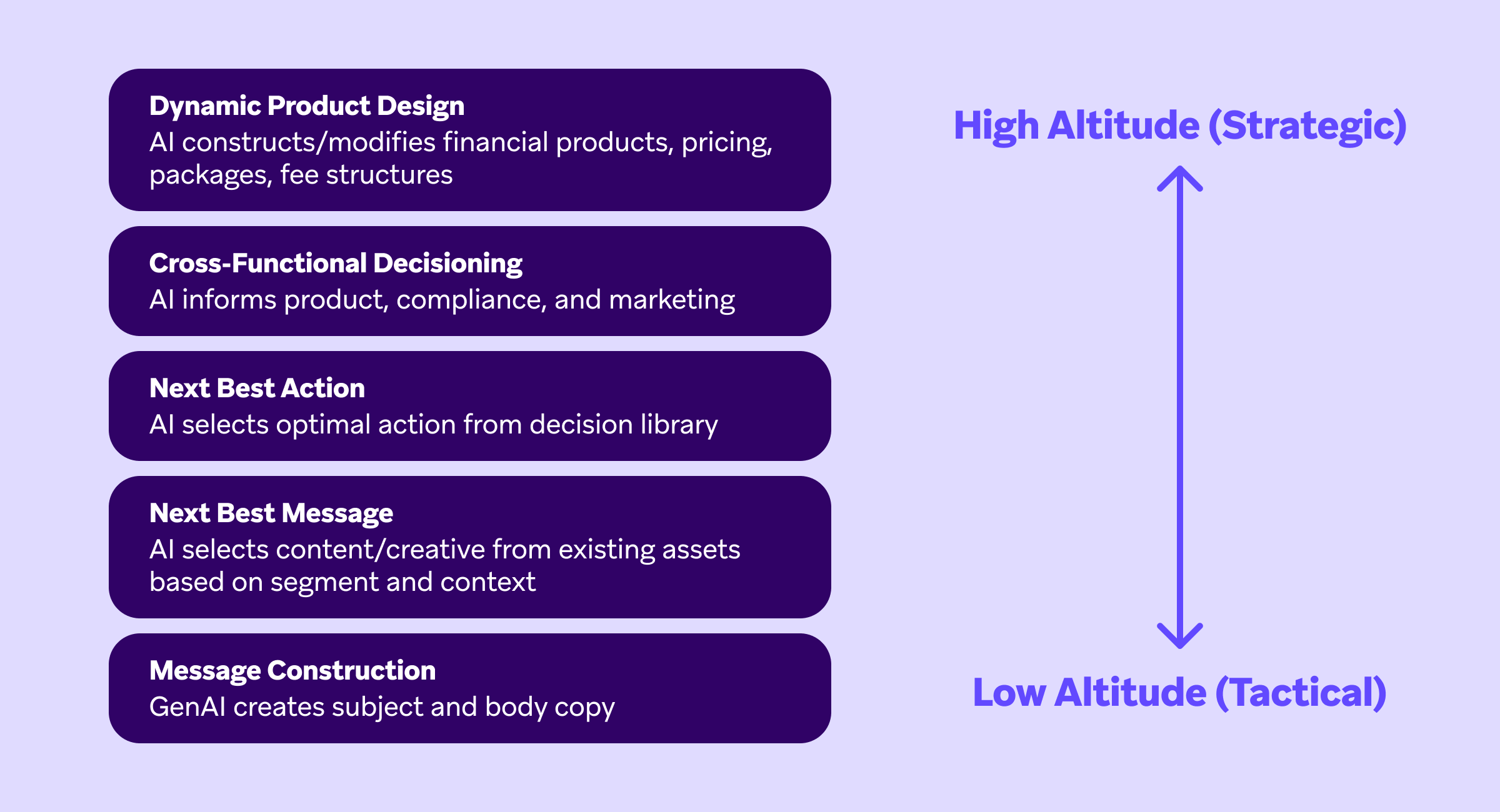
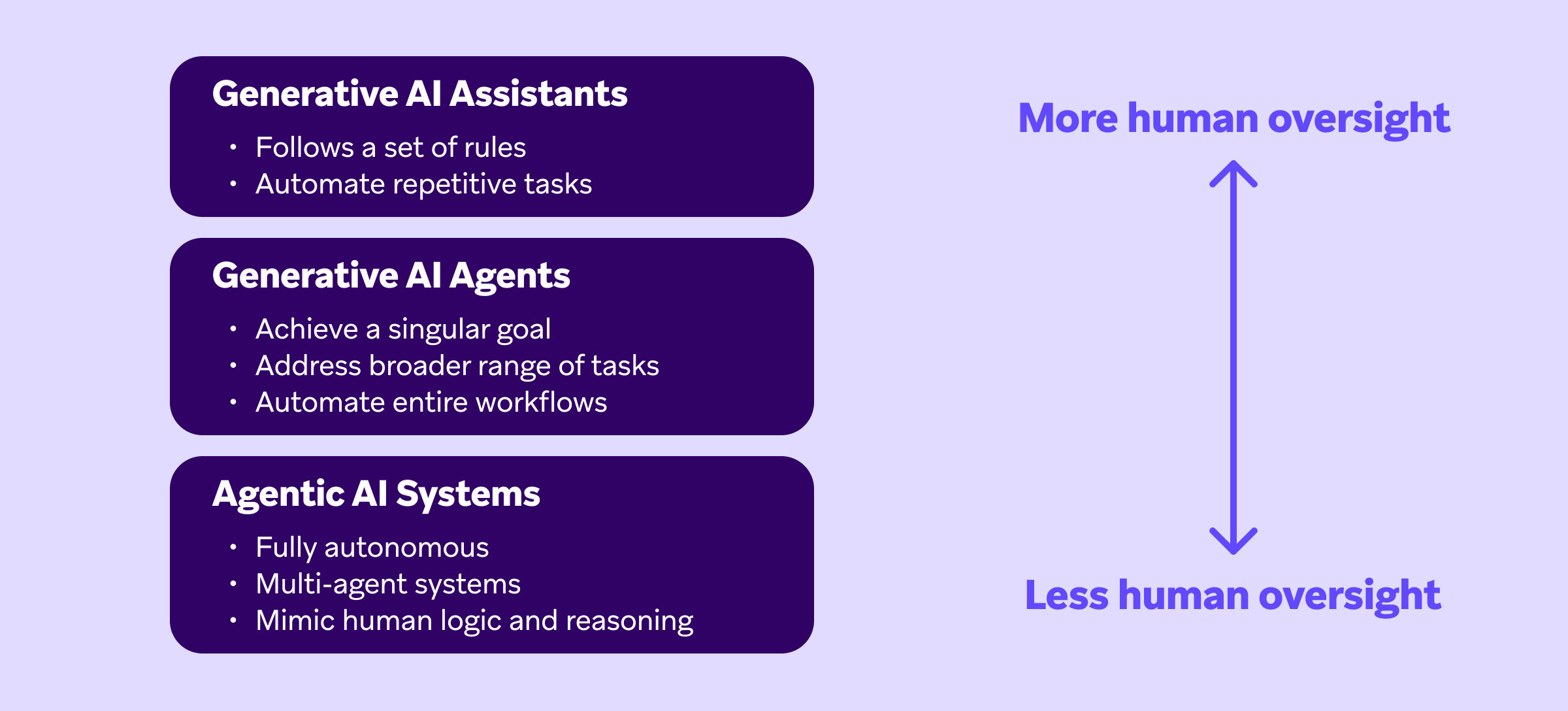
To meet customer and regulatory expectations, advanced FinServ firms are now using agentic AI systems.
Agentic AI is the latest generation of AI technology. It is fully autonomous, meaning it doesn’t just support decisions, it actively makes them. BrazeAI Decisioning Studio works through reinforcement learning, where agents optimize against defined outcomes, improving performance over time based on whether their actions move those metrics in the right direction. Reinforcement learning is trained exclusively on a brand’s data, making it less prone to errors as well.
Agentic AI can understand customer behaviour by testing, retesting, and personalizing every aspect of a marketing campaign. This means moving beyond now-table-stakes segment-level personalization, to true individual optimization, where each message and offer is tailored to every customer – and, critically, responsible and compliant with relevant regulations.
For example, in a banking context, an agentic system could recognise that a customer has recently missed a credit card payment but is still actively saving, and adjust communications accordingly, prioritizing repayment support and financial wellbeing messaging rather than promotional loan offers, ensuring both relevance and fiduciary appropriateness.
One Braze customer leveraged BrazeAI Decisioning Studio to increase card activation rates. Prior to personalizing the campaign with AI decisioning, the bank was emailing customers twice a week over a two week period with four email variations. With AI-driven experimentation, new credit card customers saw more than 10k different personalized journeys, resulting in a 92% increase in clicks and a 10% increase in card activation rates.
Agentic AI systems balance automation with governance
Marketers once had legitimate concerns about letting AI loose on their data with little oversight. Today, most AI models are sophisticated enough to work within the parameters of the regulatory environment and a brand’s guardrails to ensure maximum privacy and protection. Not all systems are created equally. Here’s what to look for in agentic AI implementation.
Multiple-agent structures
This means decisions are independently reviewed and validated by more than one agent before any action is taken. This adds a layer of consistency and control – for example, ensuring a customer message is relevant, compliant, and appropriate before it is sent – near-instantaneously.
Pre-planned fallback mechanisms
These define what a system should do when confidence in a decision is low or when data is missing. In these cases, AI automatically defaults to a safe, predetermined action – for example, offering a neutral savings offer rather than a high-risk loan.
Real-time observability
This provides continuous live visibility into how decisions are being made and executed. This lets humans monitor performance, understand why decisions were made, and intervene if necessary. It also provides an audit trail of decision-making to ensure they are defensible and transparent.
This means marketers don’t need to compromise on relevance, speed, or regulatory compliance – they can implement AI-powered personalization that builds trust, not breaks it.
Introducing the Braze AI-powered infrastructure for financial services brands
AI is already achieving efficiency outcomes. The next step for many brands is in leveraging autonomous agents to optimize customer outcomes. For aspiring Frontier Firms, agentic AI offers a practical way to reconcile two formerly competing priorities: deep personalization and enterprise-grade governance.
BrazeAI Decisioning Studio and Agent Console provide the infrastructure brands need to operationalize this shift, helping you move faster and more confidently with AI.
With Braze, you can orchestrate dynamic, adaptive customer journeys that respond in real time to customer behavior.
This means communication that is more relevant and relationship-driven, as well as governed with the rigor required in financial services – ensuring financial services brand engagement is as trusted as it is timely.
Be Absolutely Engaging.™
Sign up for regular updates from Braze.