Top AI marketing agents and their applications
Published on April 24, 2026/Last edited on April 24, 2026/9 min read


Team Braze
Contents
46% of consumers are either already using AI intermediaries to interact with brands or expect to do so by the end of 2026. That finding, from the Braze 2026 Global Customer Engagement Review, is already changing how marketing teams think about automation, personalization, and scale.
AI marketing agents are software systems powered by large language models (LLMs) that perceive context, make decisions, and execute multi-step tasks autonomously without waiting for a human to configure each action. They’re sometimes also referred to as AI marketing assistants.
Traditional marketing automation follows pre-set rules and static paths; AI agents reason toward defined goals, adapt to live behavioral signals, and coordinate across tools and channels in real time.
Marketing teams are beginning to deploy them across campaign planning, audience segmentation, content generation, and decisioning. The platforms making this possible range from purpose-built customer engagement tools to broader developer frameworks. Here's a look at how they work, which platforms lead the way, and where they're already making a difference.
What are AI marketing agents?
AI marketing agents are autonomous AI systems that use reasoning to perceive data inputs, plan a course of action, execute tasks, and refine their approach based on outcomes, all without step-by-step human instruction. They are goal-driven, not just trigger-driven.
LLM-powered reasoning allows agents to interpret context, weigh options, and determine the best next action, rather than matching a condition to a pre-written rule. This enables autonomous decision-making: instead of following a fixed instruction set, the agent draws on live data, past behavior, and its defined goal to choose what to do next—and does so continuously, without being prompted.
That decision-making plays out across multi-step workflows: Sequences of connected actions that the agent plans and executes end to end. Instead of completing one task and stopping, the agent moves through a chain of dependent steps, adapting at each stage based on what it observes.
AI task execution is how those decisions and workflows become real actions, calling on connected tools, data sources, and systems to get things done. The integration layer connecting marketing automation platforms, CDPs, content catalogs, APIs, and campaign execution systems is what gives agents their reach. Five components underpin how they operate: context, autonomous decision-makers, tools and integrations, an orchestration layer, and a feedback loop that sharpens decisions over time.
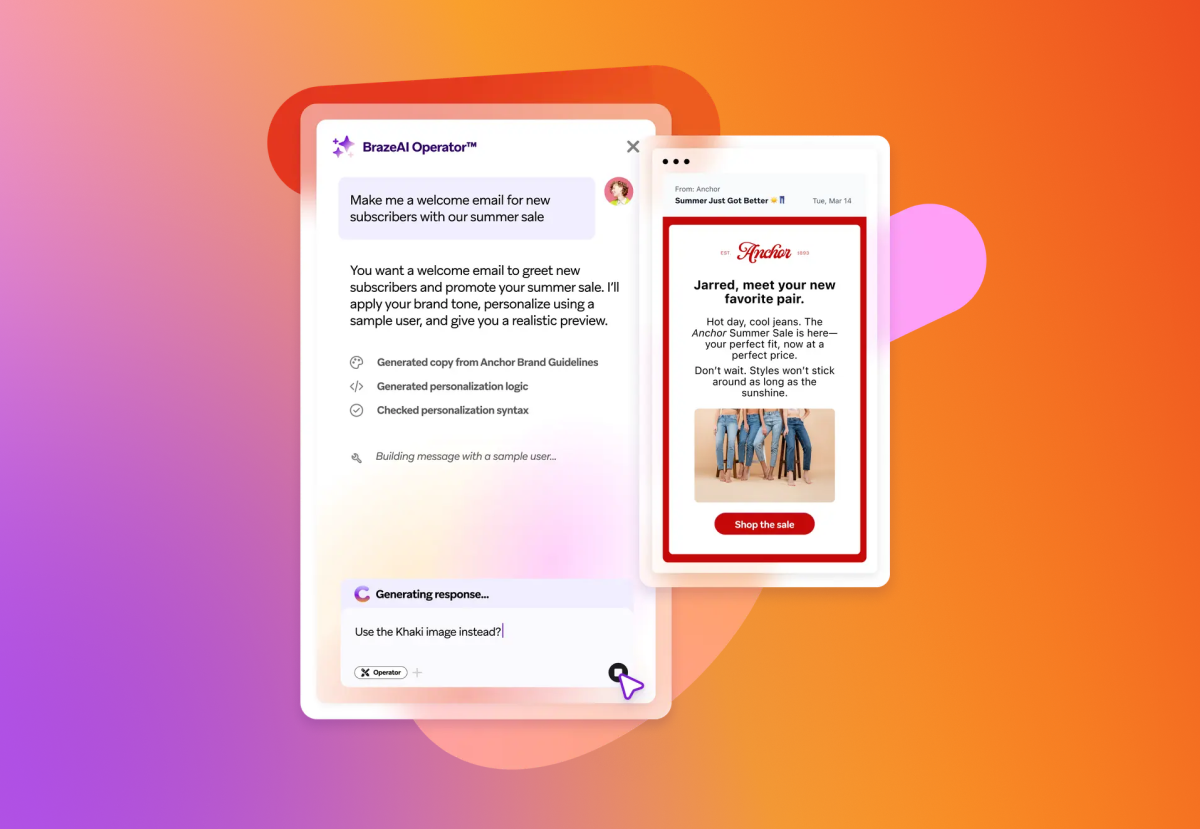
How AI agents work in marketing systems
AI agents work by embedding into the platforms marketers already use—reading data, making decisions, and triggering actions across the stack in real time.
Autonomous marketing agents and marketing automation platforms
Autonomous marketing agents and marketing automation platforms are where agents most visibly come to life. Unlike traditional automation, AI decisioning agents like BrazeAI™ agents orchestrate complex, multi-step campaigns across channels with continuous learning, optimizing each interaction in real time to deliver relevant customer experiences without manual intervention.
Embedded inside journey builders like Braze Canvas, an agent can read a customer's behavior mid-journey and determine the next best action—which message to send, which channel to use, whether to accelerate or pause a sequence—without the marketer needing to pre-map every possible path.
Campaign execution systems
Campaign execution systems are where agent decisions become customer experiences. Once an agent has determined what to do and for whom, it coordinates delivery across email, push, SMS, in-app, and other channels, adapting based on how each customer responds and feeding those results back into the next decision.
None of these systems works in isolation: Each one feeds back into the others. That connected loop is what separates agent-based AI architecture from traditional automation, and it's what allows AI marketing automation to keep up with customers as they actually behave, rather than as a campaign assumed they would.
For example, BrazeAI™ Agents are embedded directly within journey orchestration tools to autonomously interpret customer behavior mid-journey, selecting the optimal next message, channel, or timing. This helps eliminate the need for marketers to pre-map every possible path and enable truly adaptive engagement.
Top marketing AI agents and platforms
The agent landscape spans open-source developer frameworks and general-purpose AI tools that marketing teams are beginning to put to work. Here's a look at the platforms worth knowing.
1. BrazeAI™ Agents
Platform overview: BrazeAI™ Agents integrate advanced AI decisioning and automation directly within the Braze customer engagement platform, enabling marketers to create personalized, dynamic customer journeys at scale. These agents leverage customer data and AI-driven insights to optimize messaging and engagement in real time across multiple channels.
Agent capabilities: Context-aware decisioning, multi-step journey orchestration, continuous learning and optimization, and seamless integration with the Braze platform’s cross-channel journey orchestration and analytics tools.
Primary marketing use case: Personalized campaign execution, real-time customer journey adjustments, and AI-powered content generation to drive engagement and conversion.
Key differentiation: Deep integration with the Braze platform and its partner ecosystem, combining AI decisioning with robust data infrastructure and cross-channel orchestration to deliver highly relevant and effective customer experiences.
2. LangChain Agents
Platform overview: LangChain is an open-source framework for building AI agents. It combines language models with tools to create systems that can reason about tasks, decide what to do next, and work toward a goal iteratively—giving development teams control over how that process is structured. LangChain is helps small- to mid-sized organizations build agents from scratch, albeit with limited scope.
Agent capabilities: Highly composable agent architecture that works across virtually any model or data source, with deep support for multi-step reasoning and tool integration.
Primary marketing use case: Building custom agents for data enrichment, audience analysis, and internal workflow automation.
Key differentiation: Flexibility and composability. LangChain is framework-agnostic and built for teams that want full control over agent behavior.
3. AutoGPT
Platform overview: AutoGPT is one of the earliest autonomous agent platforms, designed to run AI assistants continuously in the cloud, activating based on triggers and executing tasks without manual input at each stage.
Agent capabilities: Always-on agent execution via a low-code interface, with reliable and predictable task performance built in.
Primary marketing use case: Automating content pipelines, prospect research, and outreach personalization at scale.
Key differentiation: Continuous, cloud-deployed agent execution with a low barrier to entry for non-developer users.
4. CrewAI
Platform overview: CrewAI is a multi-agent orchestration platform that lets teams build and deploy crews of specialized AI agents that work together toward a shared goal. Each agent in a crew has a defined role and set of tasks—and they collaborate, hand off work, and coordinate across complex processes in a way a single agent working alone couldn't manage.
Agent capabilities: Multi-agent coordination with full tracing, agent training, task guardrails, and serverless scaling across cloud or on-premises environments.
Primary marketing use case: Coordinating agents across lead enrichment, campaign content generation, and customer support automation.
Key differentiation: Purpose-built for multi-agent collaboration at enterprise scale, with observability and governance built into the platform from the start.
Applications of AI marketing assistants
Agents are already handling work that used to require significant manual effort across campaign planning, segmentation, content, and analysis. Here's where they're making the most immediate difference.
Campaign planning
Agents compress the planning cycle by pulling in behavioral data, identifying audience opportunities, recommending channel mixes, and generating initial campaign structures. A marketer defines the goal and the guardrails; the agent handles the groundwork.
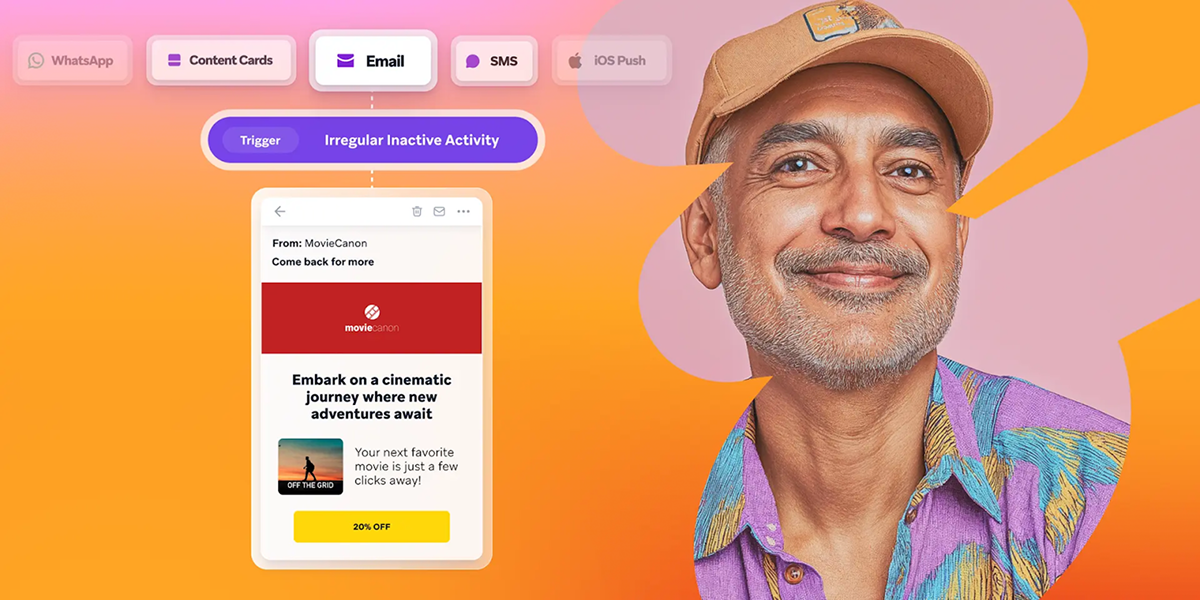
Agents in action: BrazeAI™ Agents can accelerate campaign planning by analyzing live behavioral data to identify audience opportunities and recommend channel mixes, while continuously updating customer segments to reflect customer engagement and preferences.
Customer segmentation
AI agents analyze behavioral signals, purchase history, engagement patterns, and real-time events to build and update segments continuously, moving customers in and out based on live data, not a last-month export. Targeting reflects who a customer is right now, not who they were when the segment was last refreshed.
Content optimization
Agents can test variants at scale, analyze what's resonating with which audiences, and adapt messaging based on performance signals—running concurrent tests across subject lines, copy, creative, and offers simultaneously, then automatically pushing the best-performing version for each individual.
Performance analysis
Agents pull data across channels, identify what drove results, flag anomalies, and generate plain-language summaries—turning work that might take days into something available in minutes. More usefully, they connect performance data back into active campaigns, creating a feedback loop that improves decisions in flight.
How marketing teams evaluate AI automation agents and technology
With a growing number of platforms offering agentic AI, the question for most marketing teams has shifted from whether to adopt to how to choose well. This framework covers five criteria worth evaluating before committing to any AI agent platform.
Criteria | Question to ask | What to look for |
|---|---|---|
Agentic resourcing efforts | How much time and effort do I need to build and oversee agents? | Agents should be easy to build, with robust support to help with any trickier agents. |
Time-to-value | How quickly will I see the value in the agents I’m building? | Agents should quickly allow marketers to gain value. |
AI reasoning capability | Can it handle ambiguity and determine the right next action when behavior doesn't follow a predicted path? | Agents that reason across multiple inputs and context types, not just match conditions to rules |
AI workflow orchestration and automation | How much of the execution layer can the agent genuinely take on, and what does it hand back to a human? | End-to-end multi-step workflow handling with guardrails that let marketers set boundaries without limiting adaptability |
AI workflow orchestration and automation | Does it connect to the tools and data sources you already rely on? | Clean connections to your campaign execution tools, content catalogs, and data warehouse |
Data inputs | What data is the agent working from—and how current is it? What kind of data is the agent able to work with? | Real-time behavioral signals, first-party customer data, and cross-channel engagement history, as well as how much data an agent and how complex that data is |
Transparency and governance | Can you see what the agent is doing, and can you intervene when needed? | Audit trails, explainable decision outputs, human-in-the-loop review options, and compliance controls |
1. AI reasoning capability
Question to ask: Can it handle ambiguity—interpreting a customer's natural language response, or determining the right next action when behavior doesn't follow a predicted path?
What to look for: Agents that reason across multiple inputs and context types, not just match conditions to rules. The more complex the customer interaction, the more this matters.
2. AI workflow orchestration and automation
Question to ask: How much of the execution layer can the agent genuinely take on, and what does it hand back to a human?
What to look for: Systems that handle multi-step workflows end to end—coordinating decisions across channels, timing, content, and audience without manual handoffs. Guardrails should let marketers set boundaries without constraining the agent's ability to adapt within them.
3. Integration flexibility
Question to ask: Does it connect to the tools and data sources you already rely on?
What to look for: Clean connections to your CDP, campaign execution tools, content catalogs, and data warehouse. The more composable the integration layer, the more value the agent can extract from data already in your stack.
4. Data inputs
Question to ask: What data is the agent actually working from—and how current is it? How does the data need to be explained to the agent in natural language?
What to look for: Platforms that ingest real-time behavioral signals, first-party customer data, and cross-channel engagement history. Agents working from static or delayed datasets will consistently underperform those with access to live data.
5. Transparency and governance
Question to ask: Can you see what the agent is doing, and can you intervene when needed?
What to look for: Audit trails, explainable decision outputs, human-in-the-loop review options, and clear frequency and compliance controls. Autonomous doesn't mean unaccountable.
AI marketing agent FAQs
What are AI marketing agents?
AI marketing agents are autonomous AI systems automated systems that use reasoning to perceive data, make decisions, execute multi-step tasks, and refine their approach based on outcomes—without step-by-step human instruction. Unlike traditional automation, they work toward a defined goal rather than following a fixed set of rules.
How do AI agents work in marketing platforms?
AI agents work in marketing platforms by connecting to customer data, campaign execution systems, and content tools, then using that information to make and act on decisions in real time. They can select the right message, channel, timing, and audience for each individual—and improve their decisions continuously through reinforcement learning and feedback loops.
What are examples of AI marketing agents?
Examples of AI marketing agents include BrazeAI™ Agents, which handle tasks like content optimization, sentiment scoring, and real-time journey personalization inside a customer engagement platform, as well as broader platforms like CrewAI, AutoGPT, and LangChain Agents, which let teams build and deploy custom agentic workflows across marketing and business operations.
What marketing tasks can AI agents perform?
AI agents can perform a wide range of marketing tasks, including campaign planning, dynamic audience segmentation, content variant testing, send-time optimization, product recommendations, data enrichment, performance analysis, and customer journey personalization—often executing these as connected steps within a single automated workflow.
How are AI agents different from marketing automation tools?
AI agents differ from traditional marketing automation tools in that automation follows predefined rules and static workflows, while agents reason toward a goal and adapt in real time based on live data and outcomes. Where automation asks "what did the customer do?", an agent asks "what should happen next?"—and acts on the answer autonomously.
Related Tags
Be Absolutely Engaging.™
Sign up for regular updates from Braze.