4 min read
Klover turned a testing plateau into its biggest open-rate wins with Braze Content Optimizer
Klover's Lifecycle team hit a wall testing two high-value weekly push notifications. After three years of manual, weekly creative testing, they weren’t able to beat the existing control for the first message. Meanwhile, the open rate didn’t budge on the second message.
Klover adopted Braze Content Optimizer, a Canvas step that automatically tests unique message-element combinations and shifts send volume toward the top performers in real time.
Content Optimizer beat long-standing controls on both use cases, with top-performing variants driving open-rate lifts of up to 47.3% and 22.7% respectively, plus a meaningful gain in incremental revenue contribution among Klover's least-engaged customer cohorts.

INDUSTRY
PRODUCTS USED
BY THE METRICS
47%
Open-rate lift on the top-performing variant, early-week eligibility reminder (vs. control)
22%
Open-rate lift on the top-performing variant, weekly cash-advance alert (vs. control)
17%
Overall lift in push notification opens using Braze Content Optimizer
Klover, based in Chicago, is a financial services company that offers cash advances to those who need them before a payday, providing an alternative to taking on a high-interest loan. Its business model helps people tighten up their finances, pay off debt, and repair their credit scores. This makes customer engagement central to the brand’s mission.
Klover's strategy centers on multi-journey, lifecycle-based experiences designed to keep their app, which provides helpful budgeting tools, in regular use and to help drive customer retention. The challenge, however, was that they relied on manual experimentation.
The brand actively embraces AI across their business and runs an internal hackathon to help build agentic solutions for everyday departmental problems. This made the release of Braze Content Optimizer an exciting possibility, opening a new door for the lifecycle marketing team.
Resolving a years-long testing plateau with real-time optimization
Braze Content Optimizer broke a three-year plateau on one of Klover's highest-value lifecycle messages: A weekly push notification that alerts users when demand for cash advances is high. For three years, the Lifecycle team tested new creative against the winning copy without beating it. But the problem wasn’t necessarily creative—instead, it was the constraints of manual testing on a weekly cadence, with limited variance per test.
A second weekly push faced a similar challenge. The team was testing early-week afternoon push notifications reminding users at the beginning of the week of their eligibility for a cash advance, but open rates remained lower than Klover had aimed for. Again, they were limited to a weekly learning cycle and, in both cases, were tracking the success of disparate variants across third-party tools like Airtable.
Klover tried Braze Content Optimizer, hoping to see some movement. Content Optimizer is a Canvas step that continuously experiments with combinations of message elements (subject lines, copy, and CTA buttons) and then automatically shifts send volume toward variants that are performing best. Instead of one hand-picked test per cycle, Content Optimizer scaled Klover's testing to 25 message combinations at once, adjusting automatically week over week.
What happened: Long-standing controls beaten within weeks
Weekly cash-advance alerts
Content Optimizer did not disappoint. For the weekly cash-advance alert, nine of the 25 variants beat the control the Lifecycle team spent three years trying to beat. The top variant delivered a 22.7% open-rate lift over the control, with the second-best variant close behind at 20.6%. They also learned that the problem was hidden in the body copy—not the push notification title—which was something the team’s weekly manual cadence never had the volume or variance to uncover.
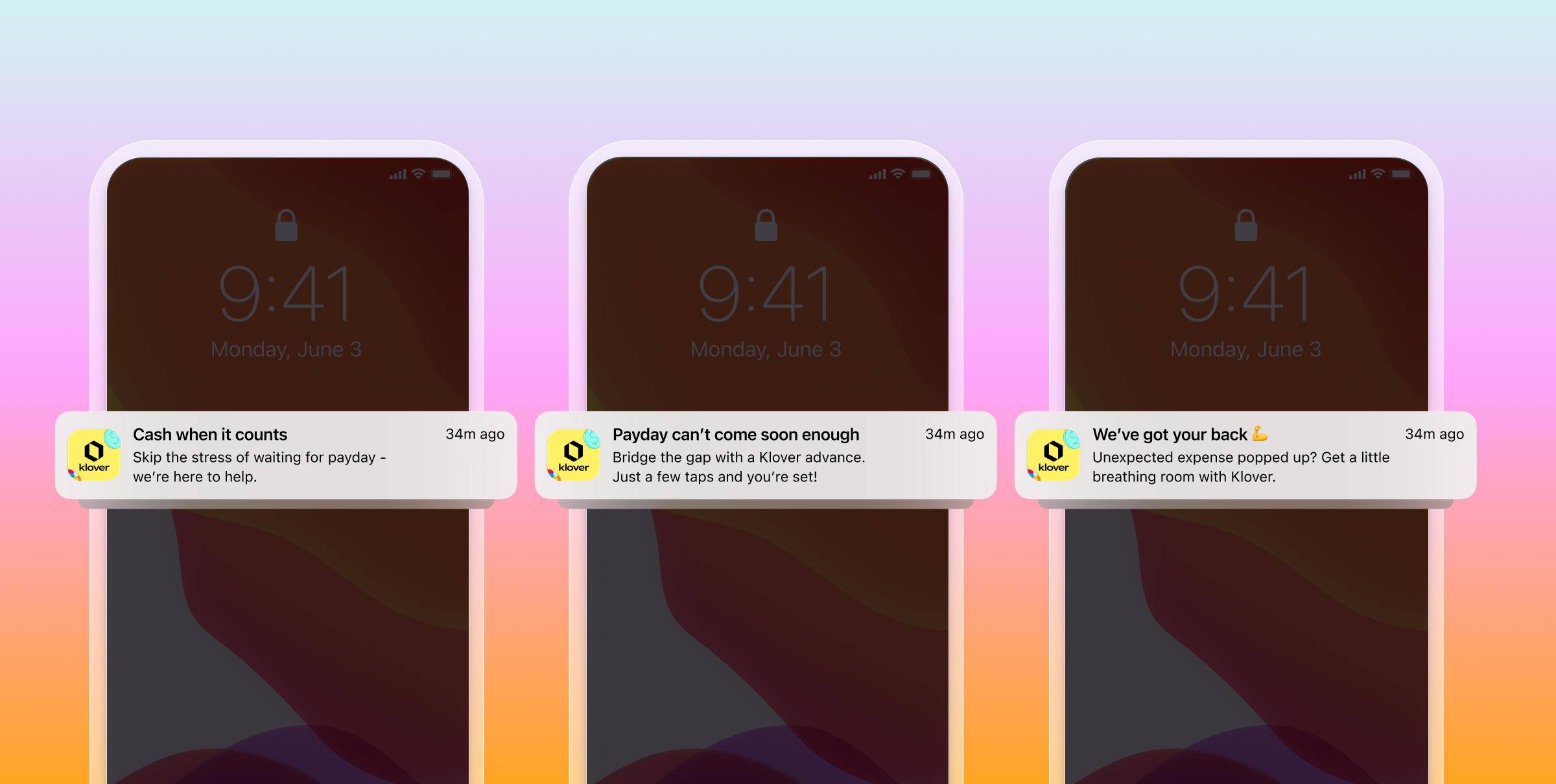
Examples of hypothetical message variants
Also notable, they learned that winning variants aren’t necessarily “one and done.” Over the course of testing, the title steadily became the de facto leader, while a new version of the body copy emerged partway through and slowly took allocation away from the prior winner. In a continuously optimizing system, "winning" is a dynamic, ongoing state.
Many cohorts receive this canvas, and Klover measured revenue impact along with open rates. The team saw incremental revenue contribution improve in cohorts that were historically harder to move, including one less-recently-engaged cohort that went from a near-flat baseline at 0.7% to 6.92%.
Early-week eligibility reminder
Here, Content Optimizer's rapid iteration beat the long-standing control even faster, and generated the larger relative lift between the two campaigns: a 47.3% open-rate lift for the top variant, and 43.9% for the second-best.
Klover is now expanding Content Optimizer beyond push notifications into email (where they can test up to 625 unique message combinations) and SMS (with a limit of 125 combinations), to apply the same automated testing to CTA and subject-line performance.
“Braze Content Optimizer broke a 3-year plateau on one of our highest-value lifecycle messages. It completely changes how and what we test, allowing us to drive incremental revenue across campaigns, channels, and cohorts.”

Brett Stewart
Director of Lifecycle Marketing, Klover Key Takeaways
Change the method, not just the copy
A/B testing is limited, and a plateau is often a signal that you’ll benefit from testing more elements, with more variants, via another technique.
Winning variants can shift over time
Winners aren't permanent. Even after Content Optimizer surfaced a top-performing variant, a new one quietly gained ground mid-flight—a sign that continuous optimization keeps paying off after the first win.
Automated experimentation can reach your tougher cohorts
Klover saw some of the clearest incremental gains with its least-engaged customers, not its most responsive.
FEATURED TOPICS
Check out more Case Studies
 Case Study3 min read
How BookBeat cut days of cross-market reporting to minutes with the Braze MCP Server
 Case Study3 min read
Uswitch turns AI-optimized subject lines and CTAs into a smarter path to smart meter connections
 Case Study3 min read
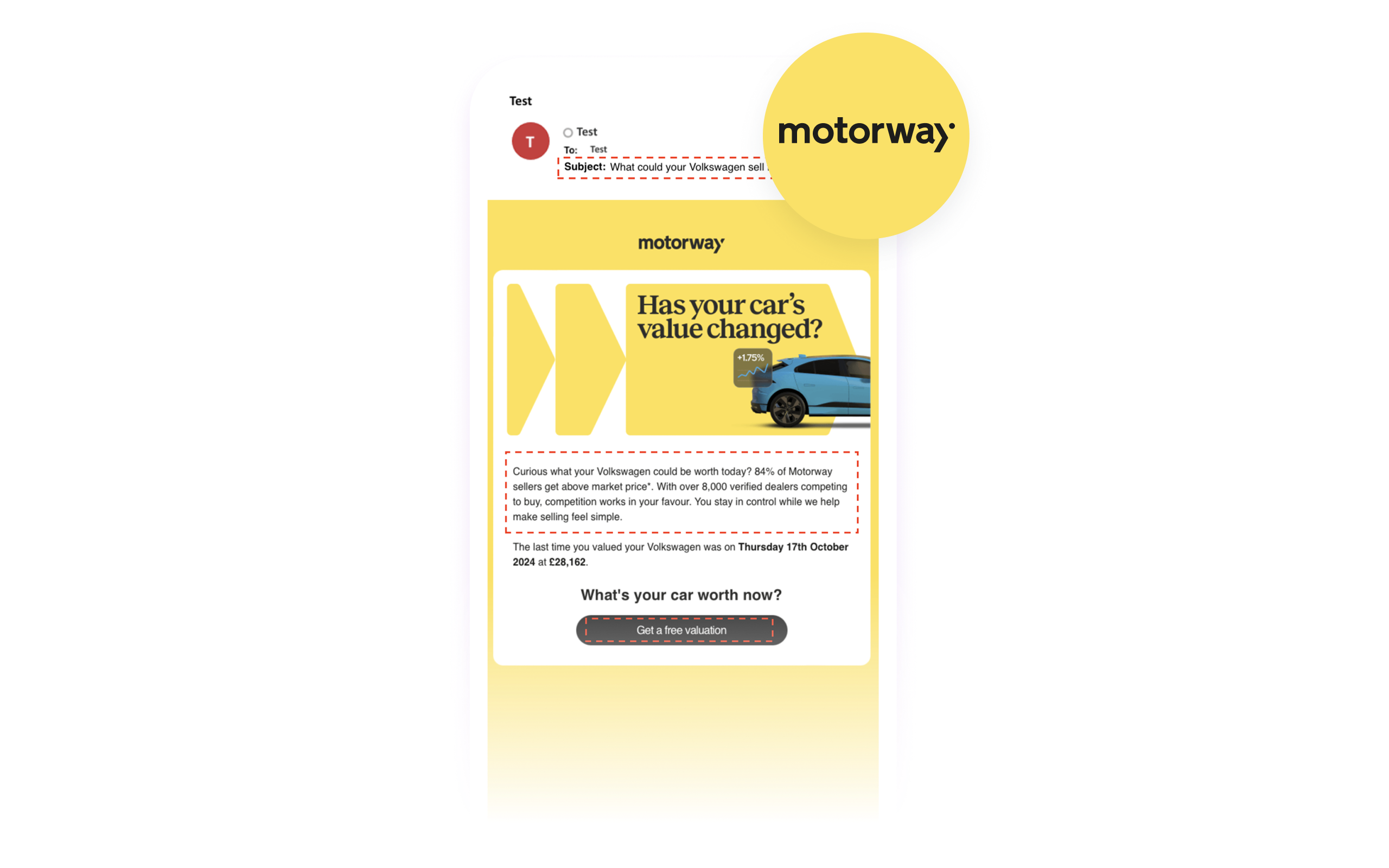
Motorway refuels its reactivation campaign into an always-on testing engine with BrazeAI Content Optimizer™