Every journey needs the right (Canvas) Context
Published on February 19, 2026/Last edited on February 19, 2026/7 min read
Team Braze
There’s nothing more human than change. We do it in all facets of life—our preferences and behaviors shift over time, influenced by experience, relationships, and outside factors (like the culture we live in) and can even waver in small ways from day to day. And because consumers are human beings, the ways that we interact with our favorite brands tend to shift, too. This evolving context can mean that interactions that were once valuable are no longer relevant, and as result they can become even irritating. After all, if you added a movie to your watchlist yesterday, that “personalized recommendation” you get to watch that very same movie today might feel repetitive and frustrating, rather than helpful.
That said, these shifts can make it really challenging for marketers to keep up with their customers—let alone personalizing experiences across their entire audience at scale. The truth is, each individual is on their own unique journey with each brand, and each journey has its own unique context—and as marketers, it’s our responsibility to engage with them on those terms. Historically, achieving this level of personalization has been a challenging one, taking significant time and involving workarounds that add complexity for marketers to maintain. Thankfully, Canvas Context from Braze makes it easy for marketers to personalize deeply relevant experiences for their customers at scale.
Your customers are dynamic; their journeys should be, too
If you want to deliver deeply tailored customer journeys, context and relevance are everything. Personalization is built on constantly changing behavioral and preferential data and you need to take the information at your disposal and use it to adapt the experiences you’re serving up to each user to reflect their real-life, real-time situation. After all, an appointment reminder that doesn’t adjust when that appointment is rescheduled is going to add confusion, not value.
To make that possible, marketers need two things: Access to specific, contextual user data and a simple, flexible way to use that data across the user journey. That’s why we’re so excited about the launch of Canvas Context.
This new feature in Braze Canvas lets marketers attach contextual data specific to each customer at any part of the journey—and then automatically act on that data in subsequent steps. With Canvas Context, marketers can personalize timing, incorporate new and relevant message copy, and branch users based on changing and in-the-moment user context. And because you can define these variables at any point in the journey and then reuse them in subsequent steps, the feature can make the experiences you serve up smarter, more personalized, and easier to maintain.
The Canvas Context feature is a combination of a new Context Step that can create dynamic context variables, enhancements to most of the existing Braze Canvas Steps (Delay, Audience Path, Decision Split, Action Path, Message), as well as other Canvas features (e.g. Exit Criteria, Preview User Paths). Canvas Context variables are user-journey-specific, so they impact a user’s path through a specific Canvas journey at a specific time. You can use context variables to:
- Set dynamic delay periods or dates based on each user’s data
- Insert personalized content into messages
- Dynamically branch user journeys based on new attributes or real-time actions
That, in turn, makes it much easier for marketers to keep up with their users’ shifting context and evolving preferences by serving up sophisticated personalization that matches the situations they’re in.
What Canvas Context makes possible
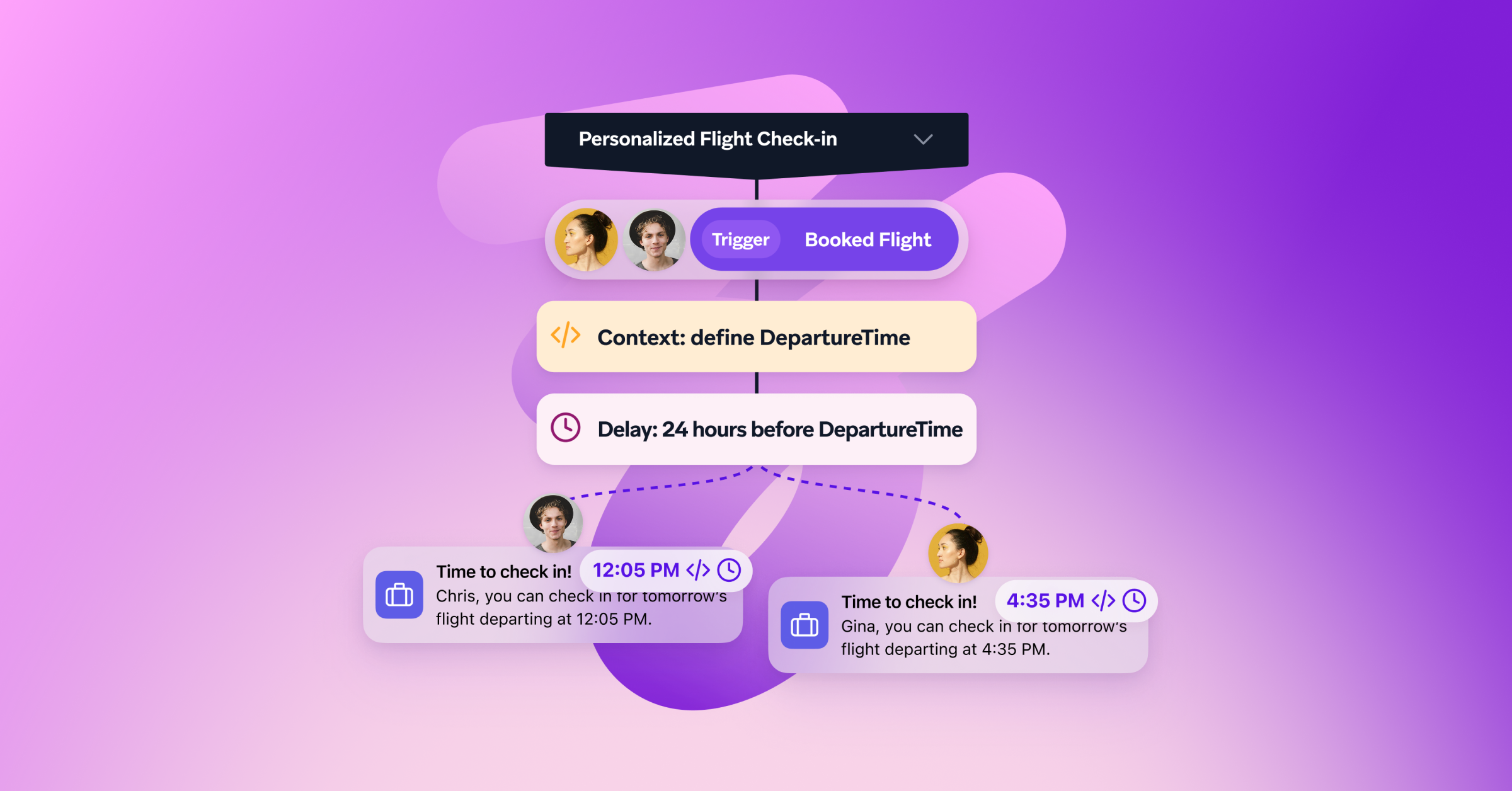
Canvas Context opens the door to a wide range of new use cases—so many, in fact, that this probably deserves a blog post of its own. For now, we’ll give you a preview with just one example to spark your imagination– Imagine that you just booked a flight to Stockholm, Sweden. You’d probably like to have the airline remind you of the date and time of your flight before it actually takes off, right? For an even better experience, you’d probably like regular reminders about your flight in the hours leading up to it, to minimize the chances that you somehow just miss it.
For marketers, making that happen once meant building a lot of different triggered campaigns to account for each time a plane may take off, each with their own copy and bespoke timing. In some cases, marketers might even need to pull in more technical teams to help build workarounds for this situation. With Canvas Context, marketers can achieve this outcome in a much simpler fashion. First, they'll set up a Canvas that adds users once each individual makes a reservation. Then, they'll set up a Context step to store users’ departure dates and a Delay Step personalized with this Context that holds the user until a personalized time. With this feature, marketers can simply add a message step with the content needed for the reminder, so if they want to send the message the day before or the hour before a flight, they can—and they can do it without a lot of time-intensive campaign building, allowing them to move faster, try more things, and give their customers the experience they expect.
Maybe later on in that same user journey, the customer might choose to upgrade to premium economy—deciding that the legroom would be advantageous for such a long flight. With Canvas Context, the brand can now log that user as a premium customer within a Context step. That, in turn makes it possible for them to use an Audience Path step to send that user down a journey branch that aligns with their new premium status, showcasing more with more personalized and white-glove touchpoints along the way.
What happens if that passenger gets hungry and decides to order an extra pasta salad to curb their appetite? With Canvas Context, the airline can append the name of the meal to the user in a Context Step at any point in their journey. Later on in subsequent steps and reminders, they can include “Pasta Salad” in the message copy leading up to their flight—further personalizing the messages they’re sending, giving them peace of mind that their food will be waiting for them, and also encouraging continued patronage of the brand.
Final thoughts
Customers expect experiences that fit their lives, their needs, and their changing context. Canvas Context makes it possible for marketers to serve up these experiences in sustainable, efficient ways that scale. That allows brands to:
- Deepen personalization with the ability to define and reference context to tailor messaging
- Fit experiences to each individual journey—this is true when different customers are on variable timelines, or even when the same customer is on the same journey multiple times
- Reduce the time and complexity needed to build a Canvas to handle fast-moving situations with shifting user context, maintain multiple linked Canvases, or engineer challenging integrations
Ready to learn more about Canvas Context? Check out our documentation now.
Forward-looking statements
This blog post contains “forward-looking statements” within the meaning of the “safe harbor” provisions of the Private Securities Litigation Reform Act of 1995, including but not limited to, statements regarding the performance of and expected benefits from Braze and its products and features. These forward-looking statements are based on the current assumptions, expectations and beliefs of Braze, and are subject to substantial risks, uncertainties and changes in circumstances that may cause actual results, performance or achievements to be materially different from any future results, performance or achievements expressed or implied by the forward-looking statements. Further information on potential factors that could affect Braze results are included in the Braze Annual Report on Form 10-Q for the fiscal quarter ended April 30, 2025, filed with the U.S. Securities and Exchange Commission on June 6, 2025, and the other public filings of Braze with the U.S. Securities and Exchange Commission. The forward-looking statements included in this blog post represent the views of Braze only as of the date of this blog post, and Braze assumes no obligation, and does not intend to update these forward-looking statements, except as required by law.
Related Tags
Be Absolutely Engaging.™
Sign up for regular updates from Braze.