AI decisioning use cases: Real examples in 2026
Published on January 16, 2026/Last edited on January 16, 2026/14 min read


Team Braze
BrazeSummary
AI decisioning operationalizes hundreds of daily choices by linking defined decision options, customer or operational signals, and outcome KPIs across marketing, supply chain, fraud, and patient care workflows. It applies learning systems to select offers, channels, timing, routes, or risk actions per entity and measures lift via randomized holdouts and incremental value metrics.
Show moreShow less
Contents
Every team already makes hundreds of small decisions a day, like who to contact, which offer to show, how to route a claim, or which order to fulfill first. The hard part is doing this consistently, at scale, without adding too much manual work.
AI decisioning turns those choices into repeatable processes that link data, guardrails, and outcomes. Instead of debating where to start in the abstract, teams can point to specific triggers, take specific actions, then improve them one by one.
In this guide you’ll see AI decisioning use cases in practical terms, across a number of industries and find out how you too can use Braze and AI decisioning into your customer engagement strategy.
Customer engagement and marketing use cases
AI decisioning is used in customer engagement and marketing to optimize a defined goal, such as purchase rate, activation, or retention, based on how each individual customer responds over time. The use cases below show how common lifecycle moments can be mapped to decision options and which metrics can be used to measure impact.
Purchase & revenue optimization:
How can AI decisioning maximize purchase rates?
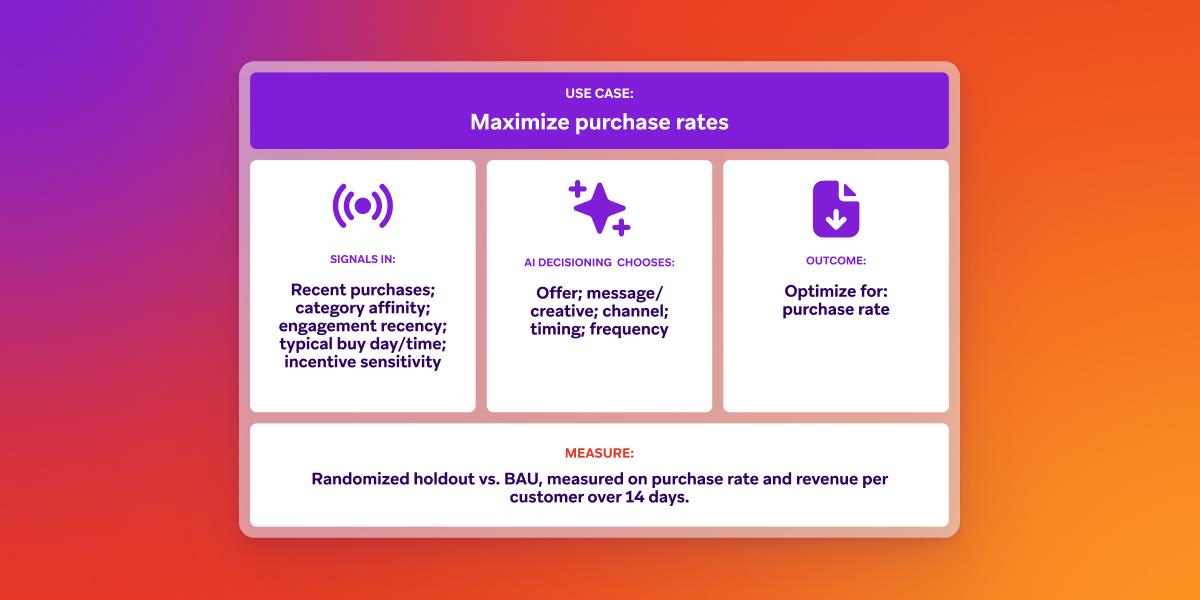
AI decisioning can maximize purchase rates by selecting the best mix of offer, creative, channel, timing, and frequency for each customer, tied to a purchase KPI.
To set it up, build a small “action bank” of viable offers and messages, then let decisioning learn which combinations drive purchases across different customer patterns.
Best for: Any industry with a strong customer lifecycle strategy and high message volume, such as retail or QSR
What AI decisioning chooses: offer, message/creative, channel, timing, frequency
Signals to use: recent purchases, category affinity, engagement recency, typical buy day/time, incentive sensitivity
How to measure lift: purchase rate and revenue per user vs. holdout (business-as-usual messaging)
How can AI decisioning drive upsell?
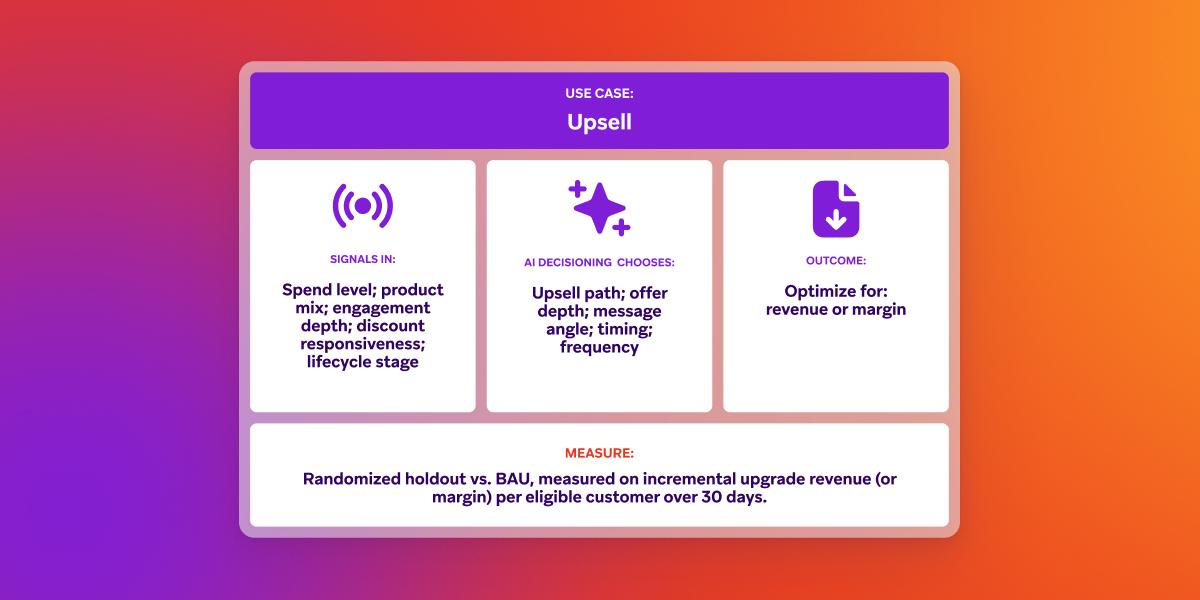
AI decisioning can drive upsell by choosing the right upgrade path, value message, and offer level for each customer, aligned to revenue or margin goals.
This is a strong fit when a flat discount strategy over-incentivizes customers who would have upgraded anyway.
Best for: premium tiers, bundles, and higher-margin categories
What AI decisioning chooses: upsell path, offer type and depth, message angle, timing, cadence
Signals to use: spend level, product mix, engagement depth, discount responsiveness, lifecycle stage
How to measure lift: incremental revenue per user and incremental margin vs. holdout
How can AI decisioning personalize cross-sell campaigns?
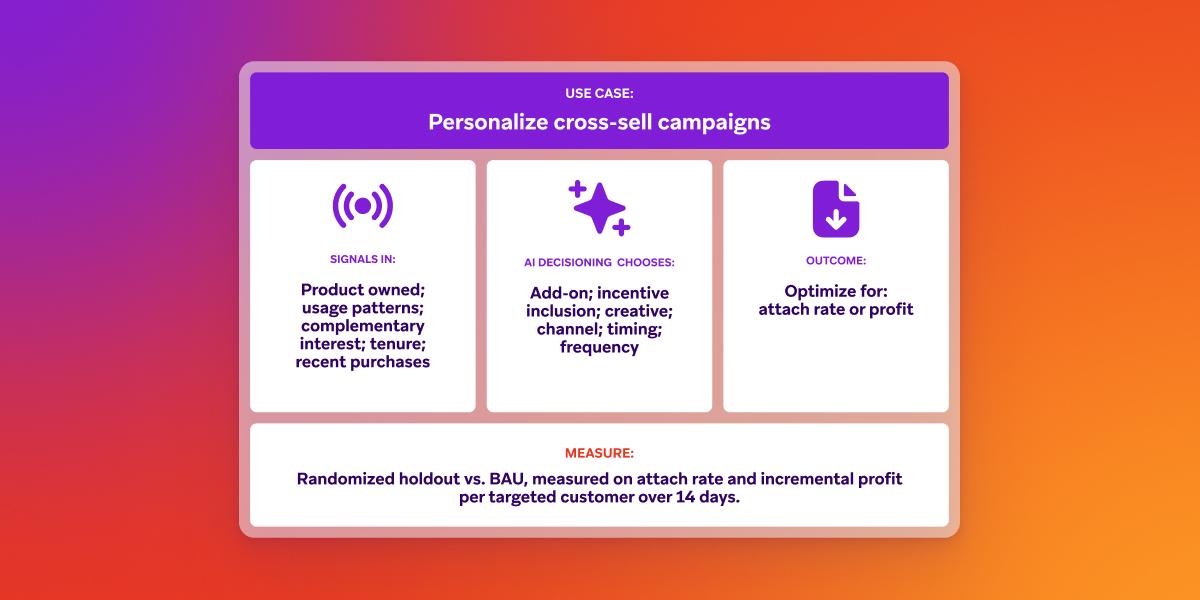
AI decisioning can personalize cross-sell by selecting which add-on to promote, whether to include an incentive, and how to sequence follow-ups by customer.
It’s especially useful when add-ons vary by margin, and customers adopt them for different reasons.
Best for: subscription bundles, marketplaces, retail add-ons, fintech product adoption
What AI decisioning chooses: cross-sell item, incentive inclusion, message/creative, channel, timing, cadence
Signals to use: current product owned, usage patterns, complementary interest, tenure, recent purchases
How to measure lift: incremental attach rate and incremental profit per user vs. holdout
Lifecycle & retention:
How can AI decisioning improve abandoned cart conversions?
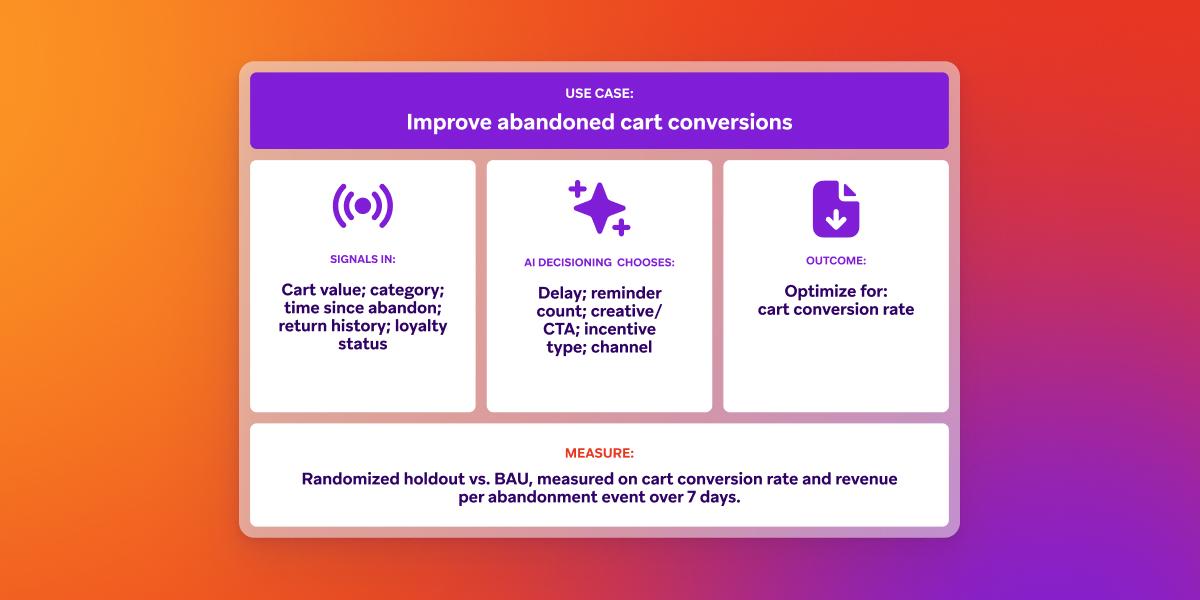
AI decisioning can improve abandoned cart conversions by choosing follow-up timing and channel, reminder count, and creative that best fits each shopper’s intent.
This works best when you offer multiple reminder strategies and keep incentive use inside clear guardrails.
Best for: ecommerce and travel bookings with clear cart intent signals
What AI decisioning chooses: delay to first message, number of reminders, creative/CTA, incentive type (optional), channel mix
Signals to use: cart value, category, time since abandon, return history, loyalty status
How to measure lift: cart conversion rate and revenue per abandonment vs. holdout
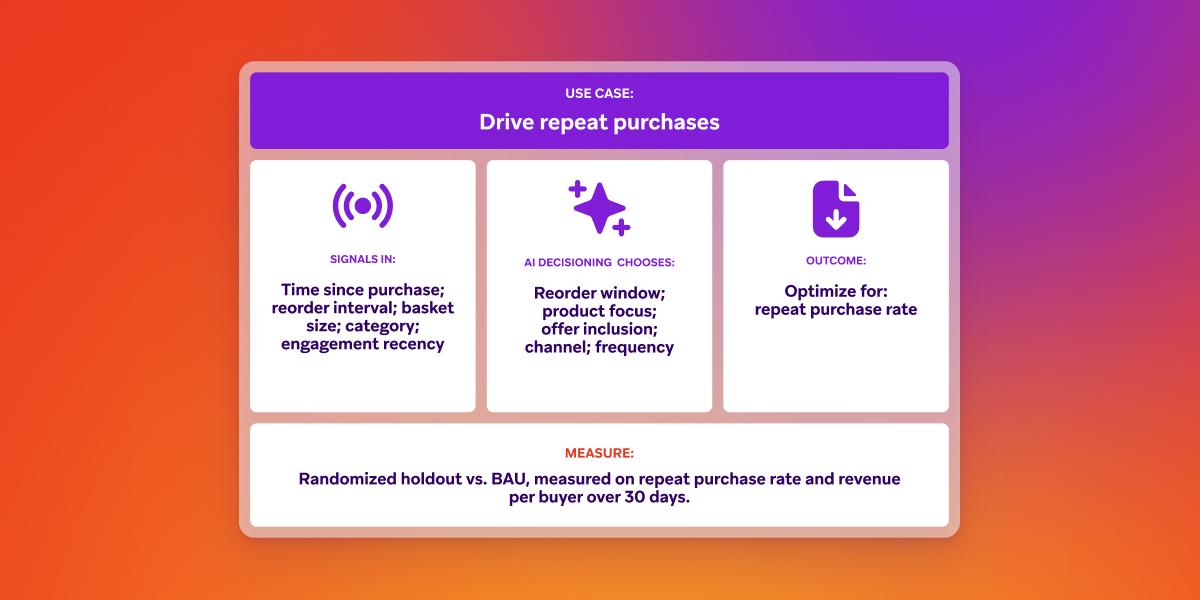
How can AI decisioning drive repeat purchases?
AI decisioning can drive repeat purchases by learning the best reorder timing, channel, and message type for each buyer.
This use case is easier to launch when you can define a “reorder window” and provide a few message and offer variants.
Best for: consumables, beauty, wellness, pet, and replenishment cycles
What AI decisioning chooses: reorder window, product focus, offer inclusion, channel, cadence
Signals to use: time since purchase, typical reorder interval, basket size, category, engagement recency
How to measure lift: repeat purchase rate and revenue per buyer vs. holdout
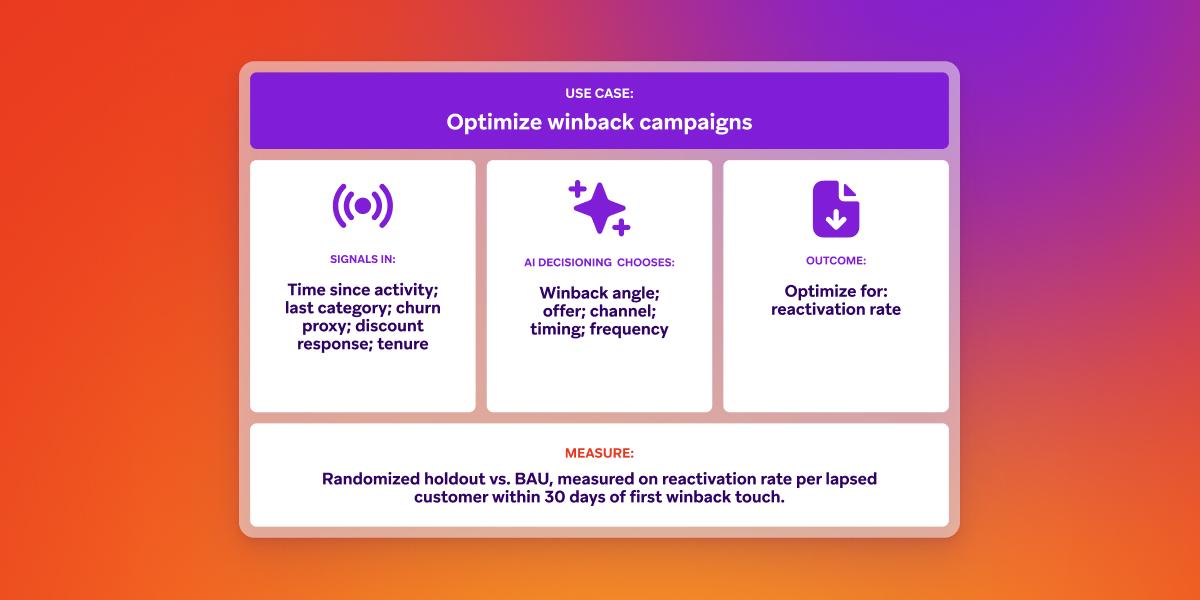
How can AI decisioning optimize winback campaigns?
AI decisioning can optimize winback by selecting the best reactivation message, channel, timing, and offer for each lapsed customer.
This is a good fit when lapsed customers vary widely in why they stopped engaging.
Best for: retail reactivation, app re-engagement, and subscription winback
What AI decisioning chooses: winback angle, offer inclusion, channel, timing, cadence
Signals to use: time since last activity, last category engaged, churn proxy, prior discount response, tenure
How to measure lift: reactivation rate and revenue per lapsed user vs. holdout
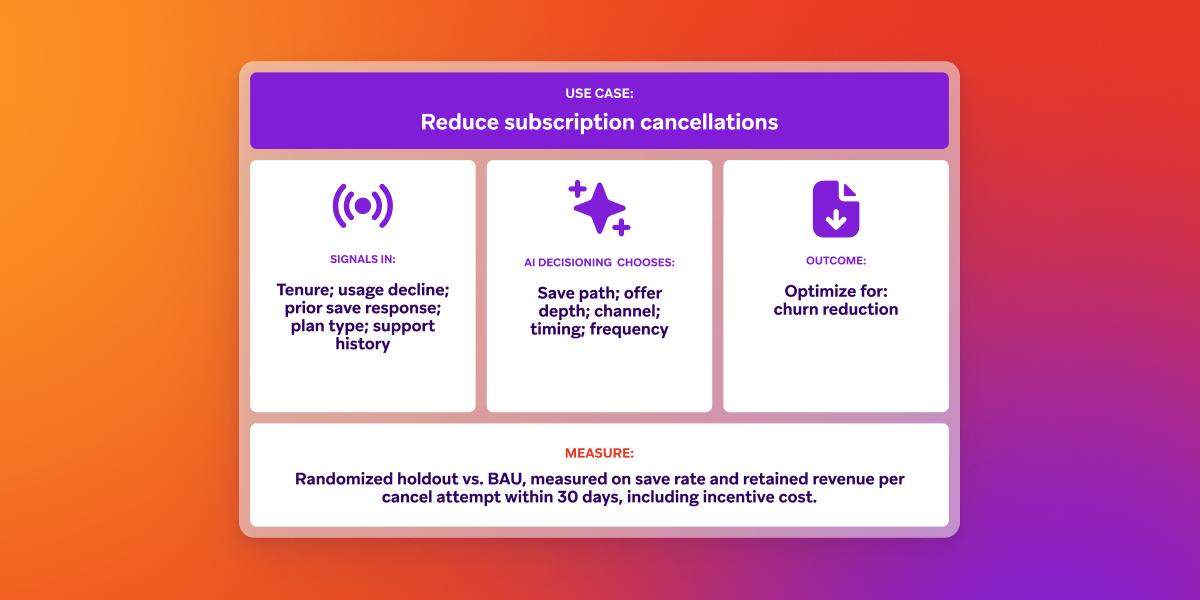
How can AI decisioning reduce subscription cancellations?
AI decisioning can reduce cancellations by selecting the best save action for each customer at cancel intent, while controlling incentive costs.
This is strongest when your action set includes non-discount options, such as pauses, downgrades, or benefit reminders.
Best for: subscription services with churn volume and multiple save paths
What AI decisioning chooses: save path, offer depth (optional), channel, timing, cadence
Signals to use: tenure, usage decline, prior save response, plan type, support history
How to measure lift: churn rate, retained revenue, and incentive cost per save vs. holdout
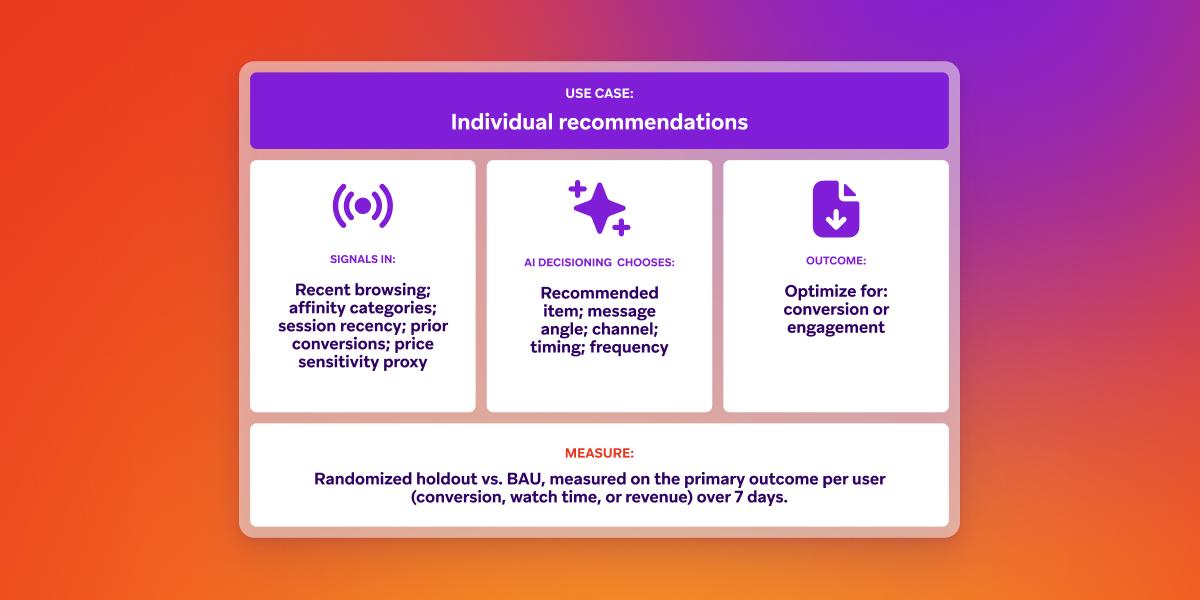
How can AI decisioning deliver individual recommendations?
AI decisioning can deliver individual recommendations by selecting the item most likely to drive the target outcome for each person, then learning from downstream actions.
Treat recommendations as a decision set (what you can show), tied to one primary KPI (what success means), so measurement stays clean.
Best for: streaming, media, retail, travel, and apps with multiple “next best” items
What AI decisioning chooses: recommended item, message angle, channel, timing, frequency
Signals to use: recent browsing, affinity categories, session recency, prior conversions, price sensitivity proxy
How to measure lift: primary KPI (conversion, watch time, revenue per user) vs. holdout
Advocacy & loyalty:
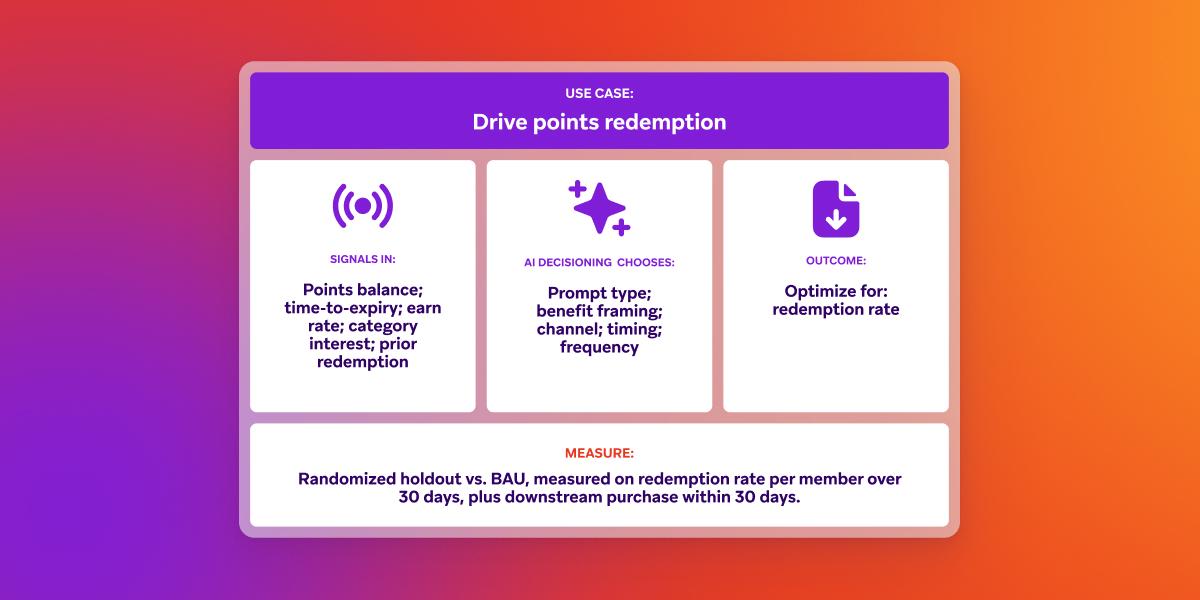
How can AI decisioning drive points redemption?
AI decisioning can drive points redemption by selecting the best redemption prompt, benefit framing, and timing for each loyalty member.
It also helps manage loyalty economics by learning when a reminder is enough versus when a stronger nudge is needed.
Best for: loyalty programs where redemption links to retention and repeat buying
What AI decisioning chooses: prompt type, benefit framing, channel, timing, cadence
Signals to use: points balance, time-to-expiry, earn rate, category interest, prior redemption behavior
How to measure lift: redemption rate and downstream repeat purchase vs. holdout
How can AI decisioning improve referral performance?
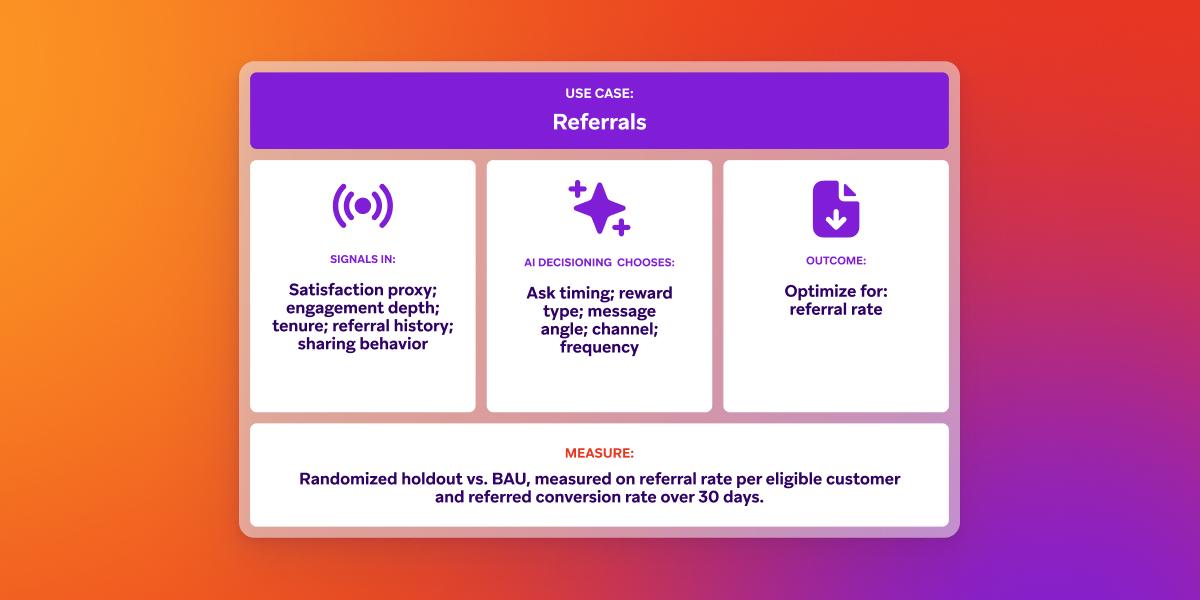
AI decisioning can improve referrals by choosing what to offer, who to ask, and when to ask, based on likelihood to refer and downstream value.
This works best when you have multiple referral prompts and reward structures available.
Best for: subscriptions, marketplaces, fintech, and apps with clear sharing moments
What AI decisioning chooses: ask timing, reward type, message angle, channel, follow-up cadence
Signals to use: satisfaction proxy, engagement depth, tenure, referral history, sharing behavior
How to measure lift: referral rate and referred conversion rate vs. holdout
How can AI decisioning optimize activations?
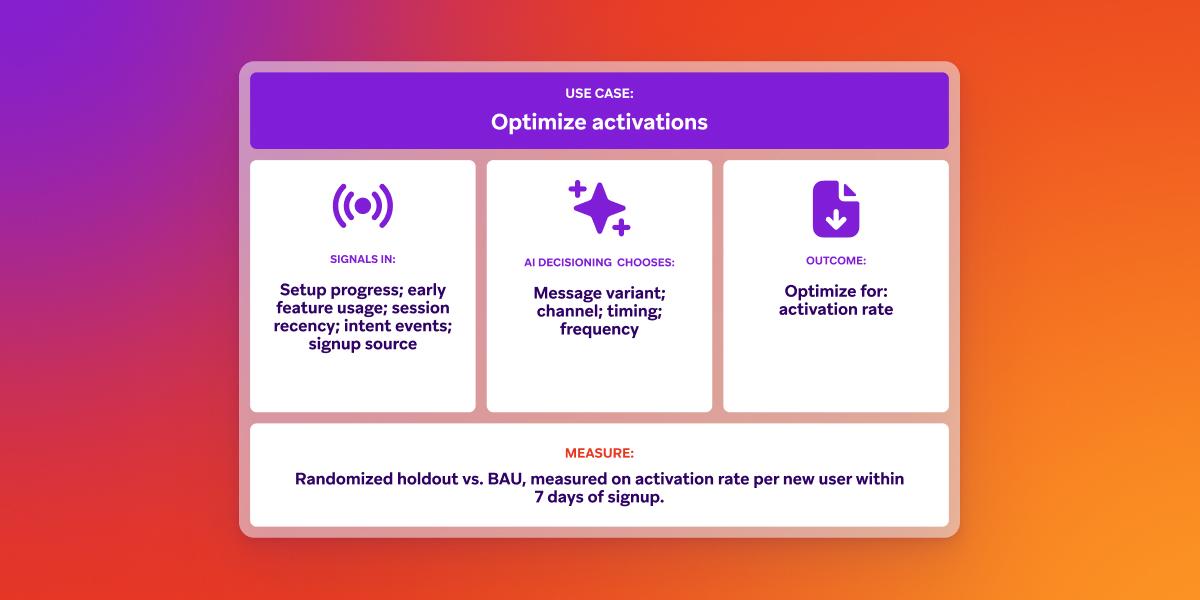
AI decisioning can optimize activations by selecting onboarding message variants, CTAs, cadence, and timing that move each user to the activation event faster.
Keep the scope tight by defining one activation milestone, then offering a small set of treatment options.
Best for: apps, fintech, SaaS trials, and subscriptions with a clear “activation” event
What AI decisioning chooses: onboarding message variant, channel, timing, cadence
Signals to use: setup progress, early feature usage, session recency, intent events, signup source
How to measure lift: activation rate and time-to-activation vs. holdout
Growth & monetization:
How can AI decisioning convert free to paid subscriptions?
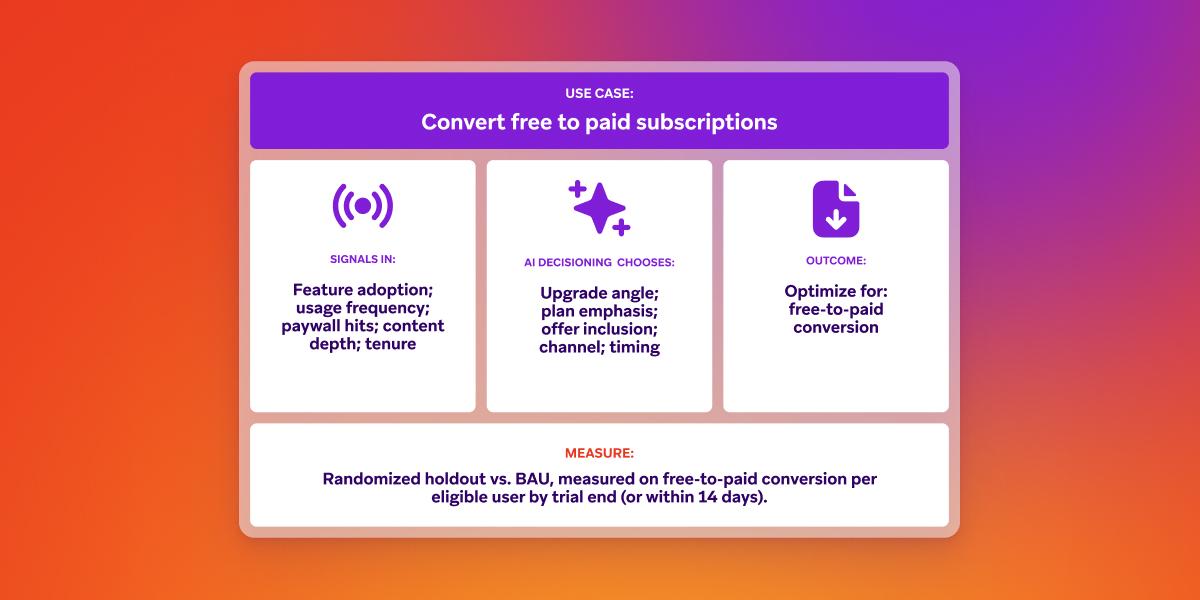
AI decisioning can convert free users to paid by choosing the right upgrade prompt, plan emphasis, and timing based on product engagement and conversion likelihood.
This is a strong subscription motion because the most useful signals come directly from usage behavior.
Best for: freemium apps, media subscriptions, and SaaS trials
What AI decisioning chooses: upgrade angle, plan emphasis, offer inclusion, channel, timing, cadence
Signals to use: feature adoption, usage frequency, paywall hits, content depth, tenure
How to measure lift: free-to-paid conversion rate vs. holdout
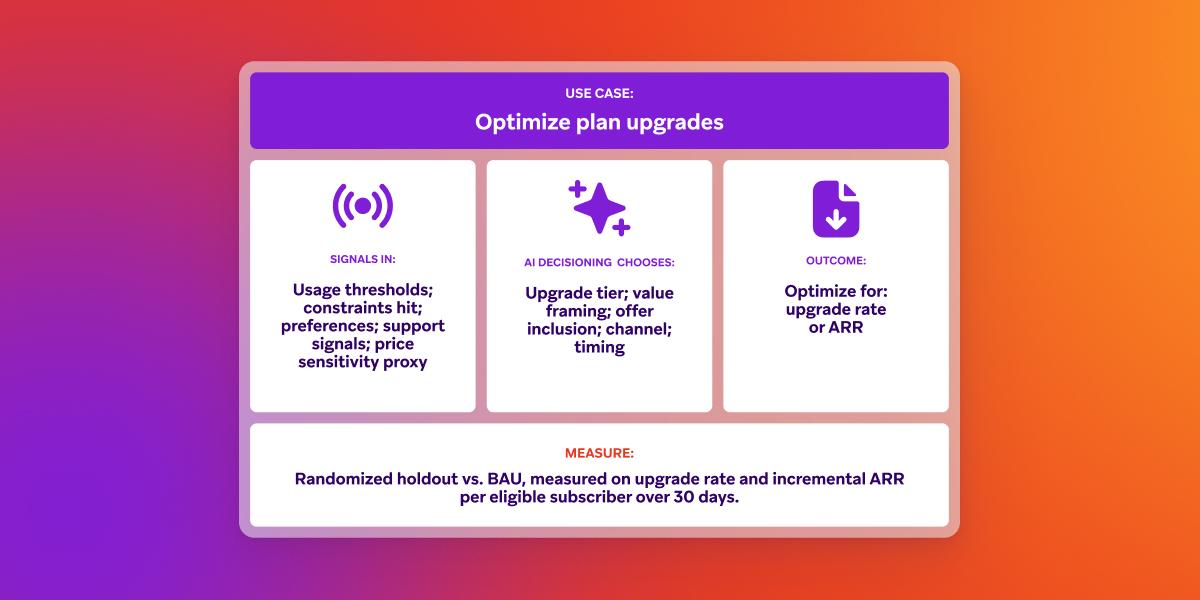
How can AI decisioning optimize plan upgrades?
AI decisioning can optimize plan upgrades by selecting which tier to recommend, how to frame value, and whether an incentive is needed for each subscriber.
It’s useful when different cohorts upgrade for different reasons, such as features, savings, or convenience.
Best for: tiered subscriptions, telecom plans, fintech products, and bundled services
What AI decisioning chooses: upgrade tier, value framing, offer inclusion, channel, timing, cadence
Signals to use: usage thresholds, constraints hit, preferences, support signals, price sensitivity proxy
How to measure lift: upgrade rate and incremental ARR per subscriber vs. holdout
How can AI decisioning improve contract renewals?
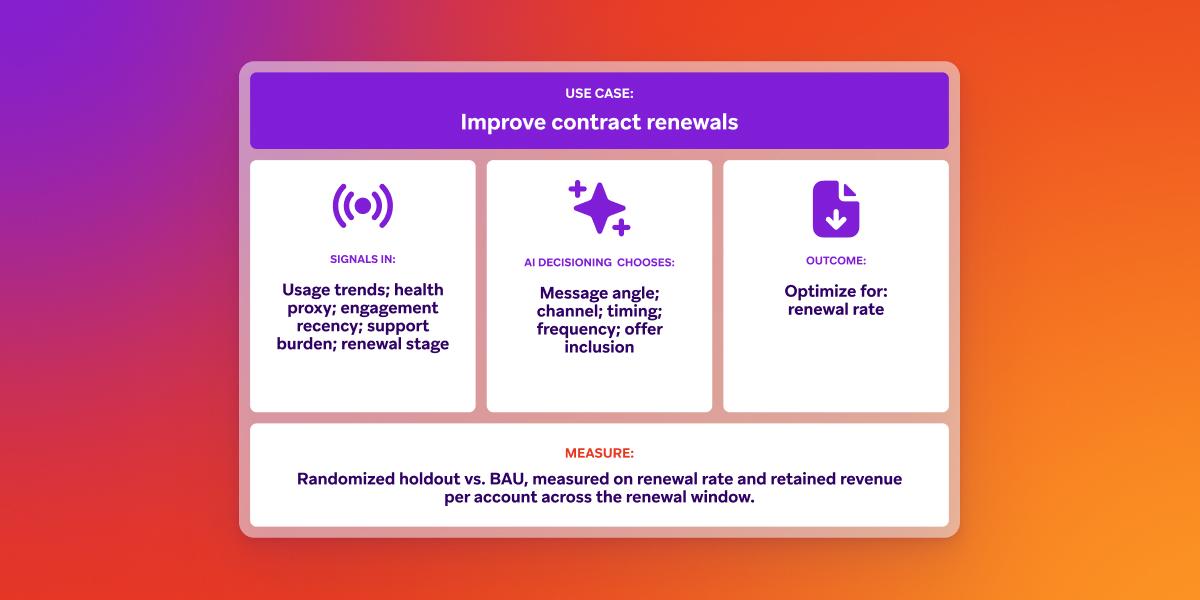
AI decisioning can improve contract renewals by choosing renewal messaging, timing, and value framing based on each customer’s usage and renewal risk.
It works best when renewal outreach starts early enough to adapt before the decision date.
Best for: annual contracts, memberships, and renewal windows
What AI decisioning chooses: message angle, channel mix, timing, cadence, offer inclusion (where allowed)
Signals to use: usage trends, health proxy, engagement recency, support burden, renewal stage
How to measure lift: renewal rate and retained revenue vs. holdout
How can AI decisioning personalize offers?
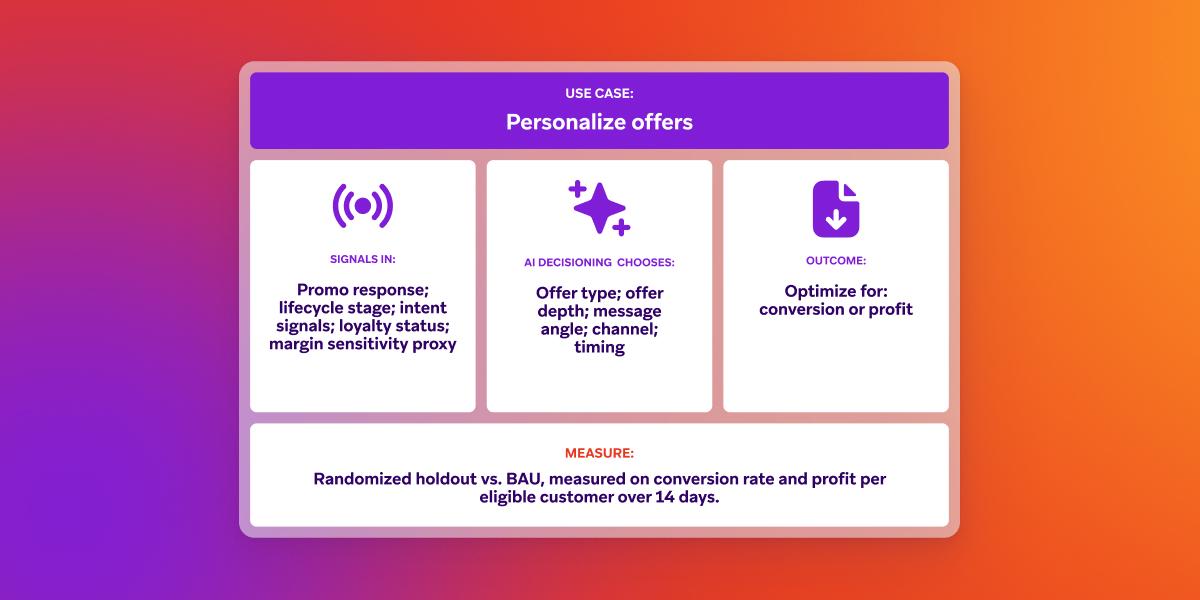
AI decisioning can personalize offers by selecting the right offer type and depth for each customer, aligned to conversion goals and value protection.
In practice, this often runs inside lifecycle moments, such as browse follow-up, cart, renewals, and winback.
Best for: brands that run multiple offer types and want to reduce blanket discounting
What AI decisioning chooses: offer type, offer depth, message angle, channel, timing, cadence
Signals to use: promo response, lifecycle stage, intent signals, loyalty status, margin sensitivity proxy
How to measure lift: conversion and profit per user vs. holdout
How can AI decisioning support a digital ads bidding strategy?
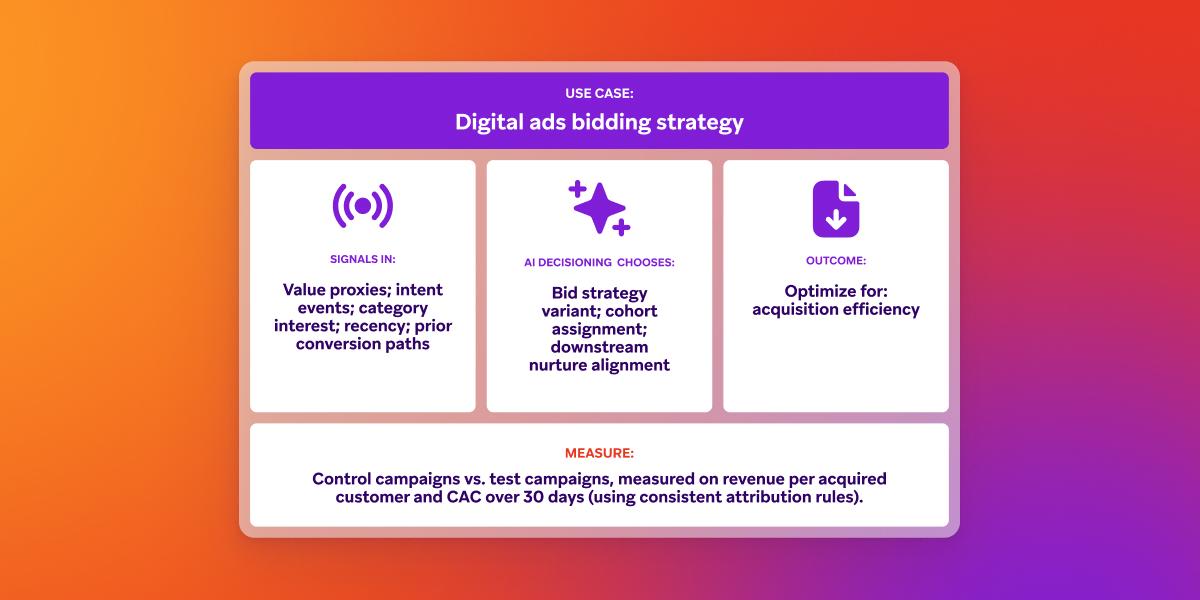
AI decisioning can support a digital ads bidding strategy by tailoring bid approaches using first-party signals, tied to downstream revenue outcomes.
This is typically framed as acquisition efficiency, with measurement focused on incremental value, not platform-only metrics.
Best for: brands with strong first-party data and clear post-click outcomes
What AI decisioning chooses: bid strategy variant by cohort, plus downstream nurture alignment
Signals to use: value proxies, intent events, category interest, recency, prior conversion paths
How to measure lift: revenue per acquired customer and CAC efficiency vs. control campaigns
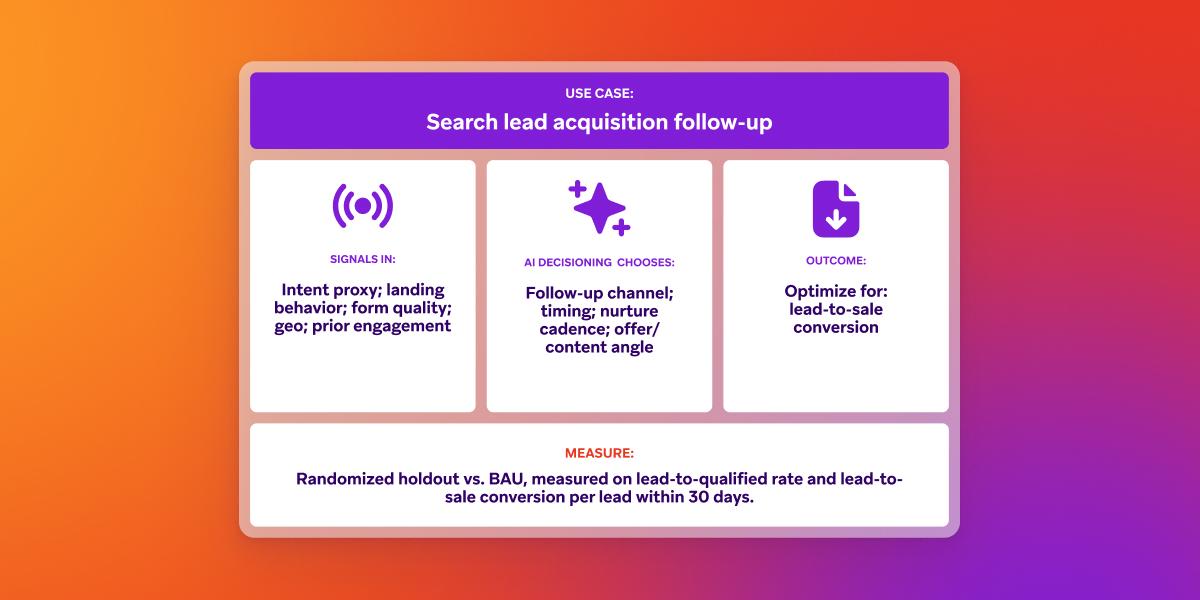
How can AI decisioning personalize search lead acquisition follow-up?
AI decisioning can improve lead acquisition by selecting the best follow-up path after a search-driven lead, based on intent and likelihood to convert.
This keeps the focus on what you control in owned channels: response speed, framing, and nurture sequencing.
Best for: high-intent lead gen where follow-up quality drives conversion
What AI decisioning chooses: follow-up channel, timing, nurture cadence, offer or content angle
Signals to use: intent proxy, landing behavior, form quality, geo, prior engagement
How to measure lift: lead-to-qualified rate and lead-to-sale conversion vs. holdout
Kayo sports puts 1:1 fandom to work
Kayo Sports is Australia’s sports streaming service, built to give fans fast access to live and on-demand coverage across dozens of sports. Its team has invested in personalization across the subscriber journey, from sign-up through ongoing engagement.
The problem
Kayo needed a scalable way to engage a wide range of sports fans with more relevant content and recommendations across channels and devices. Its existing approach limited how far it could take personalization using its available data.
The solution
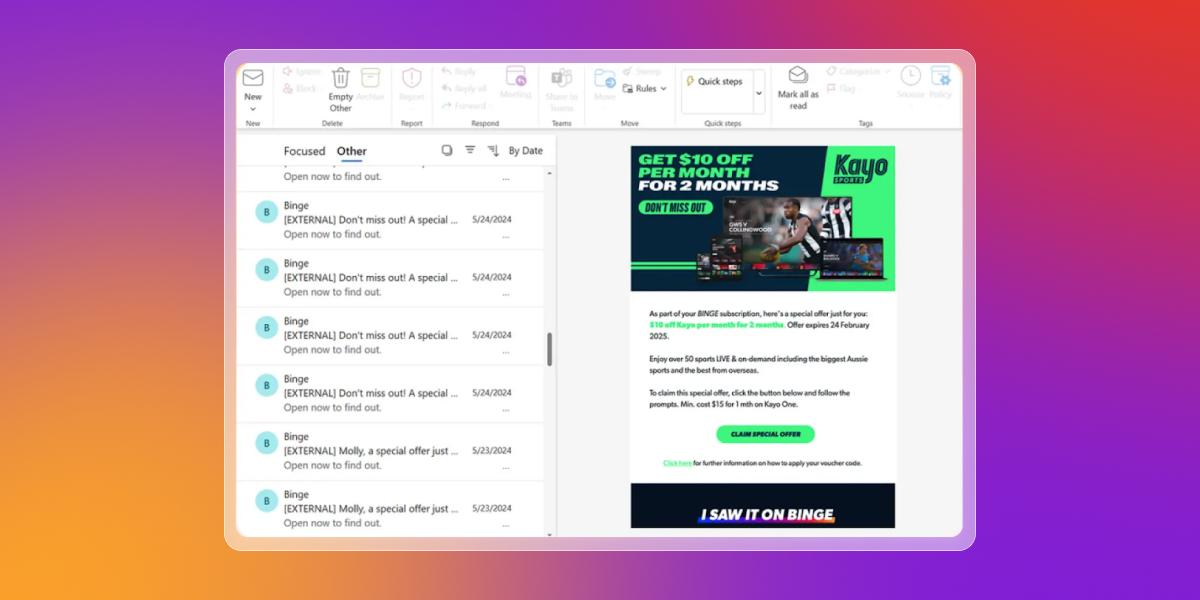
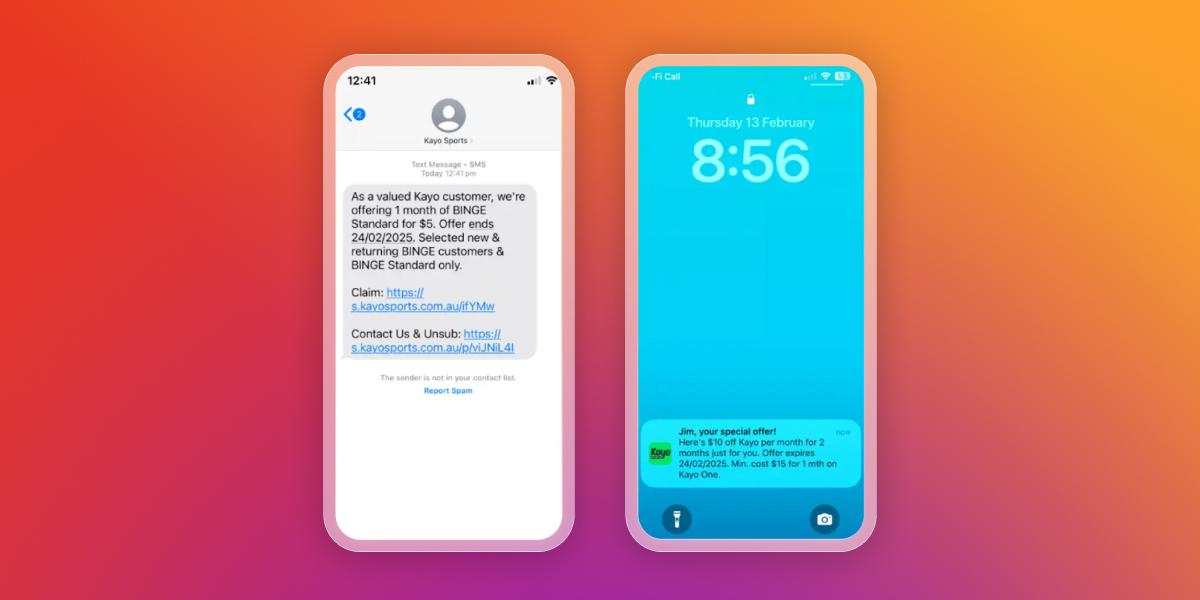
Kayo built “Customer Cortex,” a personalization engine that uses Braze and BrazeAI Decisioning Studio™ to support a 1:1 approach. AI decisioning selects the optimal mix of message, creative, channel, timing, frequency, and promotions for each subscriber, and expanded the number of potential actions from 300 to 1.2 million variations.
The results
- 14% increase in subscriptions in FY24
- 8% increase in average annual occupancy
- 105% increase in cross-sells
- Results delivered while average subscription prices increased by 20%
Supply chain and logistics use cases
AI decisioning can support supply chain and logistics teams by optimizing decisions that have clear inputs, multiple options, and measurable outcomes. Common use cases include:
- Demand forecasting: Analyze historical sales, market trends, and external factors (such as weather or economic indicators) to predict demand, optimize inventory levels, and reduce stockouts or overstock.
- Route optimization: Use traffic patterns, weather conditions, and delivery schedules to identify efficient routes, reducing fuel costs and improving delivery times.
- Inventory management: Monitor inventory in real time and predict reorder timing based on usage patterns and lead times to control carrying costs.
- Supplier selection and risk management: Evaluate suppliers using performance history, financial stability, and geopolitical risk signals to support supplier decisions and reduce disruption risk.
- Warehouse automation: Optimize warehouse operations using AI-powered robotics and automation for inventory handling, picking, packing, and shipping to improve efficiency and reduce errors.
- Predictive maintenance: Use equipment and vehicle data to predict maintenance needs, reduce downtime, and extend asset lifespan.
Fraud detection and risk management use cases
AI decisioning can support fraud and risk teams by improving detection, prioritization, and response speed across high-volume workflows. Common use cases include:
- Transaction monitoring: Analyze transaction patterns in real time to flag anomalies that may indicate fraud.
- User behavior analytics: Establish a baseline of normal behavior, then alert on deviations like unusual login locations or sudden changes in spend.
- Identity verification: Strengthen verification by analyzing biometrics (facial or voice recognition) and cross-referencing trusted databases to reduce identity theft.
- Predictive risk scoring: Assign risk scores to users or transactions based on factors like history, size, and frequency to prioritize manual review or step-up verification.
- Network analysis: Identify suspicious relationships and interaction patterns that suggest collusion or organized fraud.
- Automated claims processing: Flag claims with high-risk characteristics based on historical fraud patterns for faster, more accurate review.
Patient care use cases
AI decisioning can help healthcare organizations support clinical decisions, personalize care, and improve operational performance. Common use cases include:
- Predictive analytics for patient outcomes: Use historical patient data to predict treatment outcomes, improving care planning and reducing readmissions.
- Personalized treatment plans: Tailor therapies using signals such as genetics, lifestyle, and medical history.
- Clinical decision support systems (CDSS): Provide evidence-based recommendations during consultations, including test suggestions and drug interaction flags.
- Remote patient monitoring: Analyze wearable and device data to detect early warning signs and prompt timely interventions.
- Operational efficiency: Predict admissions, optimize staffing schedules, and streamline supply chain logistics to reduce wait times.
- NLP for patient communication: Use chatbots and virtual assistants for questions, scheduling, and medication reminders, and analyze patient sentiment to improve care delivery.
Cross-industry benefits
AI decisioning supports a wide range of teams by improving how decisions are made, executed, and refined over time. Common benefits include:
- Enhanced decision-making: Data-driven insights support faster, more accurate decisions.
- Increased efficiency: Automation reduces time spent on routine work.
- Cost reduction: Optimized resource allocation can reduce waste and operating costs.
- Improved customer experience: More relevant, timely interactions can increase satisfaction and loyalty.
- Predictive analytics: Forecasting supports proactive planning and risk management.
- Scalability: Systems can handle more data and decisions without linear cost increases.
- Enhanced accuracy: Reduced human error improves reliability in analysis and execution.
- Real-time insights: Decisions can be informed by current data as conditions change.
- Competitive advantage: Faster, smarter decisioning can support differentiation.
- Continuous learning and improvement: Outcomes feed back into future decisions, improving performance over time.
Final thoughts on AI decisioning use cases
AI decisioning use cases give teams a concrete way to turn “use more AI” into specific, testable changes. Each one connects a clear decision, the data behind it, and the outcome that matters—whether that’s higher conversion, lower fraud, or faster time to care.
The most effective programs start small, with a single journey, a defined risk decision, or one part of the supply chain, then expand as models prove their value and governance practices mature. Over time, those individual decisions add up to a more responsive, more consistent experience for customers and internal teams alike.
If you’re exploring how to bring these AI decisioning use cases into your own engagement strategy, this is a good moment to look at where Braze can help with orchestration, testing, and real-time decisioning. With the launch of BrazeAI Decisioning Studio™ Go, marketers can quickly configure AI decisioning agents, and deploy them to their core lifecycle campaigns without requiring data science or engineering support.
Frequently Asked Questions
What are the most common AI decisioning use cases?
The most common AI decisioning use cases include send-time optimization, channel selection, next-best-action, personalization, fraud detection, and credit or risk scoring. These AI decisioning use cases show up in marketing, finance, operations, and customer support.
How is AI decisioning used in marketing?
AI decisioning in marketing is used to decide who to contact, when to reach them, which channel to use, and what content or offer to send.
How does AI decisioning improve personalization?
AI decisioning improves personalization by using customer behavior, preferences, and context to decide which message, product, or experience to show next.
What data does AI decisioning require?
AI decisioning requires data such as events (clicks, purchases, logins), customer attributes (location, device, preferences), and contextual signals (time, channel, risk scores).
Which industries benefit most?
Industries that make frequent, repeatable decisions—like retail, eCommerce, financial services, insurance, media, entertainment, gaming, sports, travel and hospitality, telecommunications, utilities, and healthcare—benefit most from AI decisioning use cases. These sectors can tie decision quality directly to revenue, risk, and customer satisfaction.
What’s the difference between AI decisioning and automation?
The difference between AI decisioning and automation is that AI decisioning chooses between options based on data and models, while automation executes predefined steps. Many AI decisioning use cases combine both, with AI picking the action and automation carrying it out across systems and channels.
Be Absolutely Engaging.™
Sign up for regular updates from Braze.