What is lifecycle marketing? Strategies, stages, and real examples
Published on March 26, 2026/Last edited on March 26, 2026/13 min read
Team Braze
Contents
Customers don't experience your brand as a series of campaigns—they experience it as a relationship. Whether that relationship feels personal and relevant, or generic and forgettable, shapes everything that follows.
Most teams invest heavily in acquisition to start that relationship. But acquisition is only half the equation. According to the Braze 2026 Global Customer Engagement Review, 52% of consumers say most brands they encounter online are indistinguishable from one another—and sending more messages won't change how that feels.
Lifecycle marketing is the discipline built to make every interaction count, by treating customer engagement not as isolated moments but as a continuous relationship that evolves with customer behaviour. Here, you'll find a breakdown of how it works, why it matters for retention and long-term value, and how modern teams are using AI and real-time data to execute it more effectively.
Quick overview:
- Lifecycle marketing is a dynamic strategy that builds lasting customer relationships by continuously adapting communication based on real-time customer behavior and engagement signals to drive retention, loyalty, and sustainable growth.
Key Takeaways
- Lifecycle marketing treats customer engagement as an evolving relationship, using behavior-driven data to personalize messaging and timing across all stages from acquisition to long-term loyalty.
- Static, one-size-fits-all campaigns fail to capture the complexity of customer behavior; adaptive strategies powered by AI decisioning enable individualized interactions that help improve key goals like retention and lifetime value.
- Successful lifecycle marketing requires coordinated use of data, messaging, and timing, with continuous testing and optimization to respond to changing customer needs and maximize business impact.
What is lifecycle marketing?
Lifecycle marketing is the practice of engaging customers in ways that reflect where they are in their relationship with a brand—and that adapt as that relationship evolves.
Think about how you naturally adjust the way you communicate with people depending on how well you know them. Brands that do the same thing—recognizing that a first-time buyer needs something different from a loyal advocate, and acting on that—are practicing lifecycle marketing.
While the customer lifecycle has recognizable engagement stages, the relationship itself doesn't pause neatly between them. Continuity is what separates lifecycle marketing from a series of one-off campaigns.
A customer's relationship with a brand is always in motion, and the signals they send along the way—what they buy, what they ignore, how often they engage, when they go quiet—are what lifecycle marketing is built to respond to.
This approach has a direct impact on the metrics that matter most: retention, customer lifetime value (LTV), and sustainable growth. Brands that build engagement programs around real customer behavior, rather than assumed journeys, are better placed to keep people active over time and reduce the churn that comes from irrelevance.
Why is lifecycle marketing important?
Customer attention is harder to hold than it used to be, and acquisition costs continue to climb. The brands that stay ahead aren't necessarily spending more on acquisition—they're getting more out of the relationships they already have.
Static funnels fail because they assume a predictability that customers simply don't have. Fixed rules—send a welcome email when someone signs up, send a discount if they haven't purchased in 30 days—have their place, but they don't reflect the complexity of how real people behave. A customer who browses daily without converting needs something very different from one who buys once a year at high value. Treating them the same way is where relevance breaks down, and where customer relationships start to fray.
When communications reflect actual behavior and context, the impact is measurable. Braze research shows that when brands use data to accurately predict and meet customer needs, 23% of consumers say they are likely to make more purchases and 30% are more likely to be loyal. Every touchpoint becomes an opportunity to add value—which over time keeps acquisition costs in check and builds the kind of growth that compounds.
There's also a trust dimension worth considering. Lifecycle marketing earns continued permission to engage. The brands that maintain that permission longest are those that consistently show they understand their customers—not just at the point of acquisition, but at every point that follows.
What is a lifecycle marketing strategy?
A lifecycle marketing strategy is a coordinated plan for engaging customers throughout their brand relationship, built around the alignment of data, messaging, and timing—and designed to adapt as customer behavior changes.
The clearest distinction between a lifecycle strategy and a basic campaign calendar is intentionality. A campaign calendar schedules sends. A lifecycle strategy connects every engagement action to something meaningful about the customer—what they've done, what they're likely to do next, and what kind of communication will be most relevant to them at that moment. Every touchpoint is connected to a signal, not a date.
The foundation of that signal is data. Zero-party and first-party data give brands an accurate, consent-based picture of who each customer is and how they're engaging—and without that foundation, meaningful personalization at scale isn't possible. From there, the strategy takes shape around messaging that resonates with each customer based on where they are in their journey, and timing that's driven by individual behavior rather than a fixed schedule.
What separates modern lifecycle strategies from older approaches is the expectation of real-time decisioning. A lifecycle flow built six months ago may still be running on assumptions that no longer hold. Customer behavior shifts—seasonally, situationally, and in response to competing brands. A customer who received a re-engagement offer last week and came straight back to make a purchase shouldn't be getting a win-back discount today—but a static "if/then" flow won't know that. That mismatch wastes a send and can actively undermine the relationship. The cost adds up quickly.
The most effective strategies today are built for adaptation, using behavioral triggers and dynamic segmentation to respond to customers in the moment. Lifecycle optimization depends on exactly this kind of flexibility—and journey orchestration is what brings it to life, giving teams the ability to design, test, and refine multi-step customer journeys across channels from a single interface.
Key customer lifecycle marketing stages
Understanding the key engagement stages of the customer lifecycle gives teams a shared language for building and measuring their programs. Customers move through those stages in their own way and at their own pace—a lifecycle strategy that doesn't reflect that will always be one step behind.
Take two customers using the same ride-sharing app. One is a casual user looking for an occasional cheap ride. The other is a consultant who needs a reliable premium service every day. Same app, same acquisition channel, completely different needs and behaviors. The lifecycle strategy that serves one well will miss the other entirely if it treats them as interchangeable.
Onboarding and activation
The earliest stage is where the relationship is either formed or lost. New customers need to understand the value of what they've signed up for quickly, or they'll disengage before the relationship has a chance to develop. Onboarding campaigns guide users toward their first meaningful action—completing a profile, making a purchase, using a key feature. Activation is the signal that a customer has done enough to genuinely start experiencing what the brand offers.
Value realization and engagement
Once activated, the challenge becomes sustaining engagement with the things that deliver ongoing value. This stage is about deepening the relationship—helping customers discover more, use more, and feel more connected to the brand. Engagement at this phase tends to be personalized to behavior, surfacing relevant content or prompting exploration based on what each customer has already done.
Retention and re-engagement
Even engaged customers drift. Purchase frequency drops, sessions become less regular, open rates decline. Retention-focused lifecycle activity picks up on these signals early and responds before disengagement becomes churn. For customers who have already lapsed, re-engagement campaigns aim to rekindle the relationship with something timely and relevant—a well-placed offer, a reminder of past value, or a prompt that shows the brand has noticed their absence.
Long-term loyalty
The most valuable customers in a lifecycle program are those who've moved beyond transactional behavior. They buy more frequently, spend more per purchase, and are more likely to refer others. Lifecycle marketing at this stage shifts from activation and retention toward recognition and advocacy—rewarding consistent behavior and giving loyal customers reasons to deepen the relationship further.
Lifecycle programs that perform over time treat these stages as a framework for thinking rather than a prescribed sequence. They iterate based on results, adjust based on what the data shows, and stay responsive to how individual customers are actually moving—which sets up exactly the kind of adaptive approach that AI is now making possible at scale.
Lifecycle marketing examples
The principles of lifecycle marketing come to life when you see how brands apply them under real conditions—different industries, different challenges, different customer behaviors. These three examples show what a well-executed lifecycle strategy looks like, and what becomes possible when the right data meets the right engagement approach.
Nestlé Purina turns pet parenting moments into a 12X activation surge
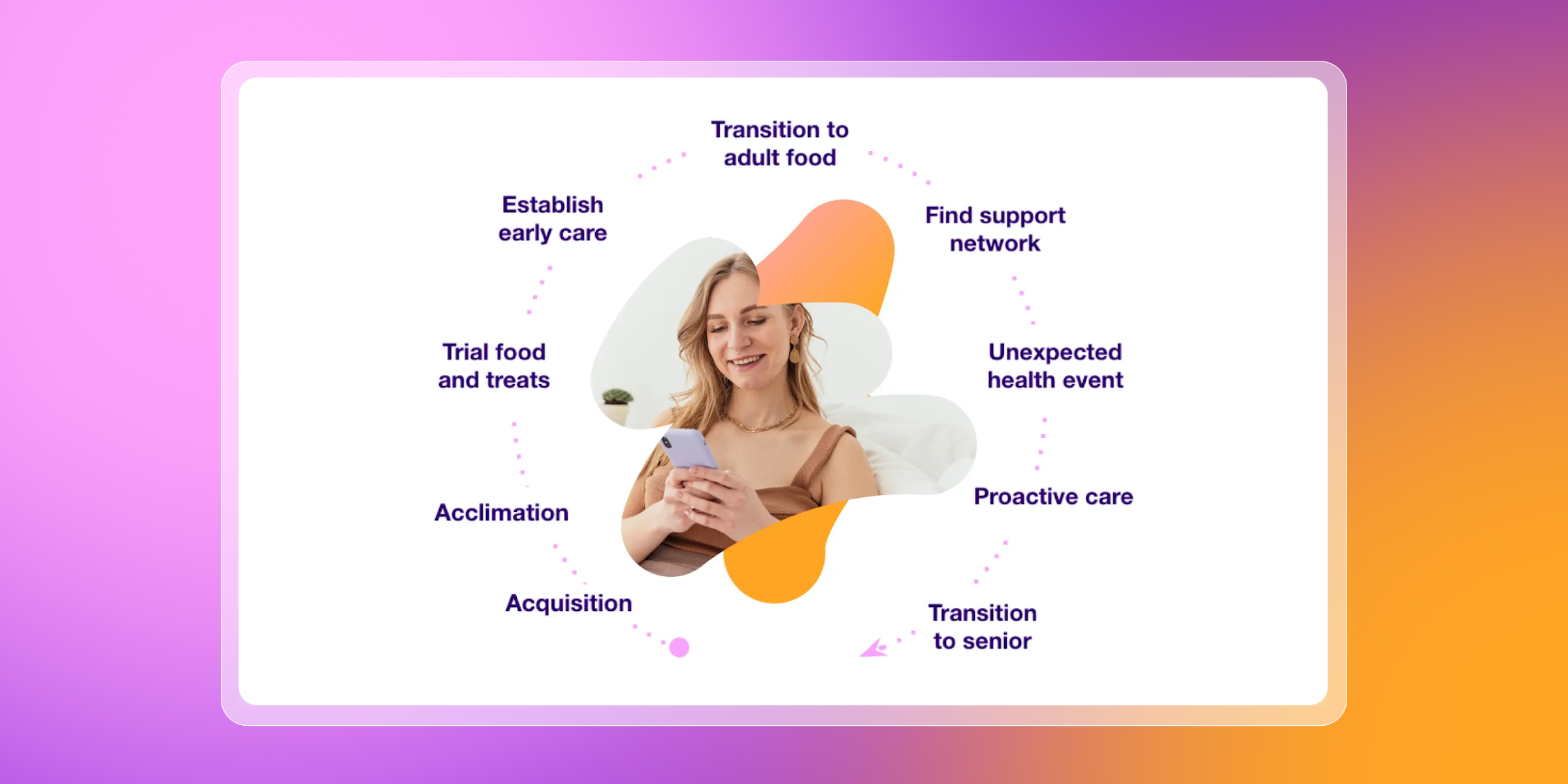
Nestlé Purina is one of the world's leading pet care companies, with a portfolio spanning food, treats, health, and wellness products for cats and dogs. Its myPurina app brings together its loyalty program and pet care tools in one place, giving the brand a direct channel to engage pet owners throughout the full lifetime of their pets.
The challenge
Pet owners receive recommendations from more sources than ever—social media, influencers, vets, fellow owners—making it harder for brands to cut through with communications that feel genuinely relevant. Purina had rich customer data, but its lifecycle activation capability was constrained by its dependency on a full CDP rollout that hadn't yet landed. Waiting wasn't an option.
The strategy
Rather than holding back for the ideal data architecture, Purina decoupled its Braze implementation from its CDP rollout and began streaming key behavioral events directly into the platform.
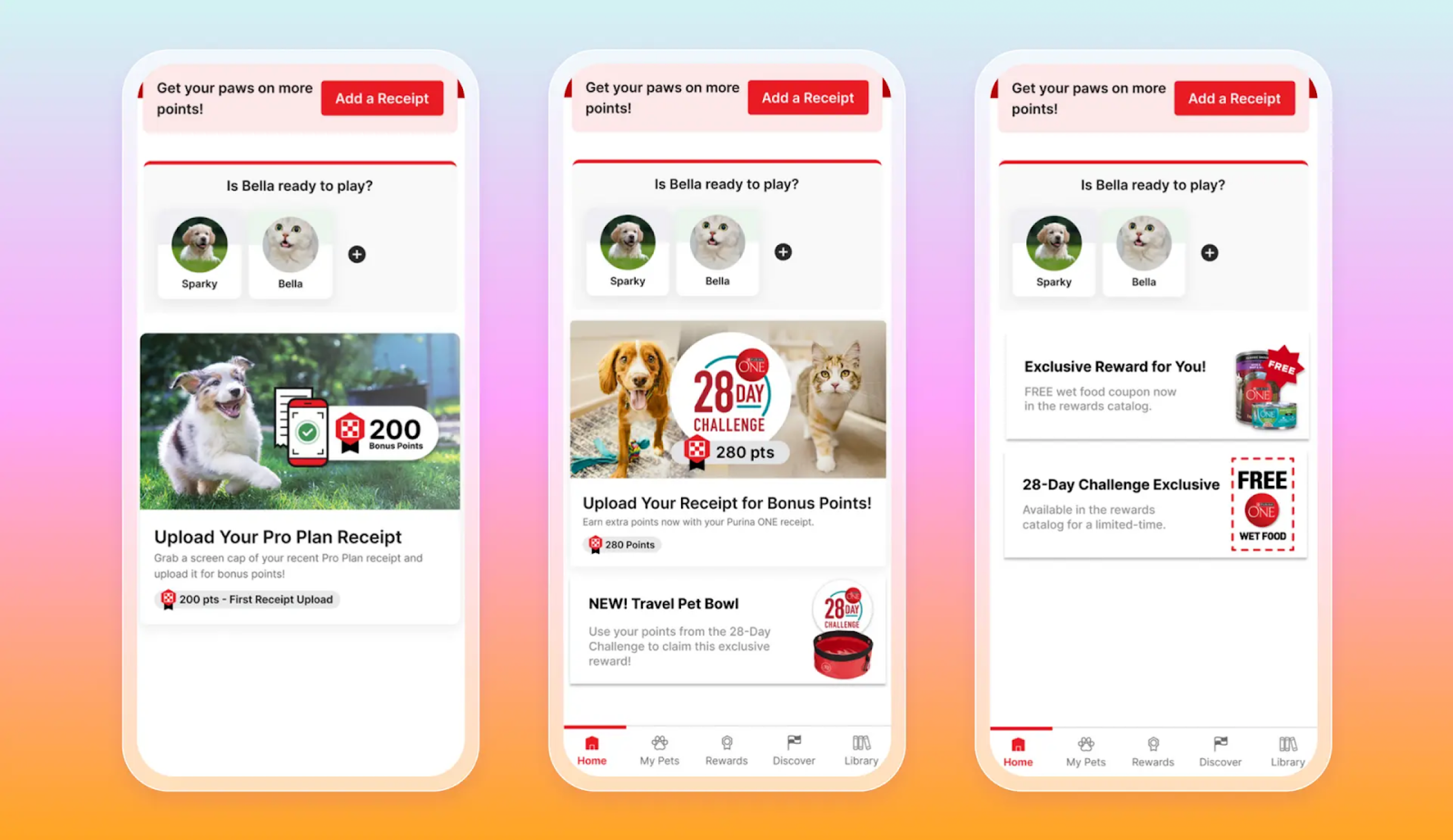
The team built detailed user profiles incorporating pet breed, age, behavior, purchase history, and loyalty data, then used that foundation to power targeted lifecycle activations—including upsell and cross-sell campaigns, in-app messaging tied to loyalty points, and highly segmented campaigns like a VIP offer for the Petivity Smart Litter Box Monitor, which used 50 audience conditions to identify the right customers.
The wins
- 12x increase in activation volume year over year
- Activation launch times cut in half compared to the previous year
Blacklane shifts into a higher gear with 194% lift in lifecycle conversion
Blacklane is a global premium chauffeur service that connects travelers with professional drivers worldwide. Great product—but turning first-time riders into habitual customers required an equally sharp engagement strategy.
The challenge
Blacklane's RFM tracking revealed significant gaps in conversion and retention across the customer lifecycle. The differentiators were clear; getting customers to come back consistently was the challenge.
The strategy
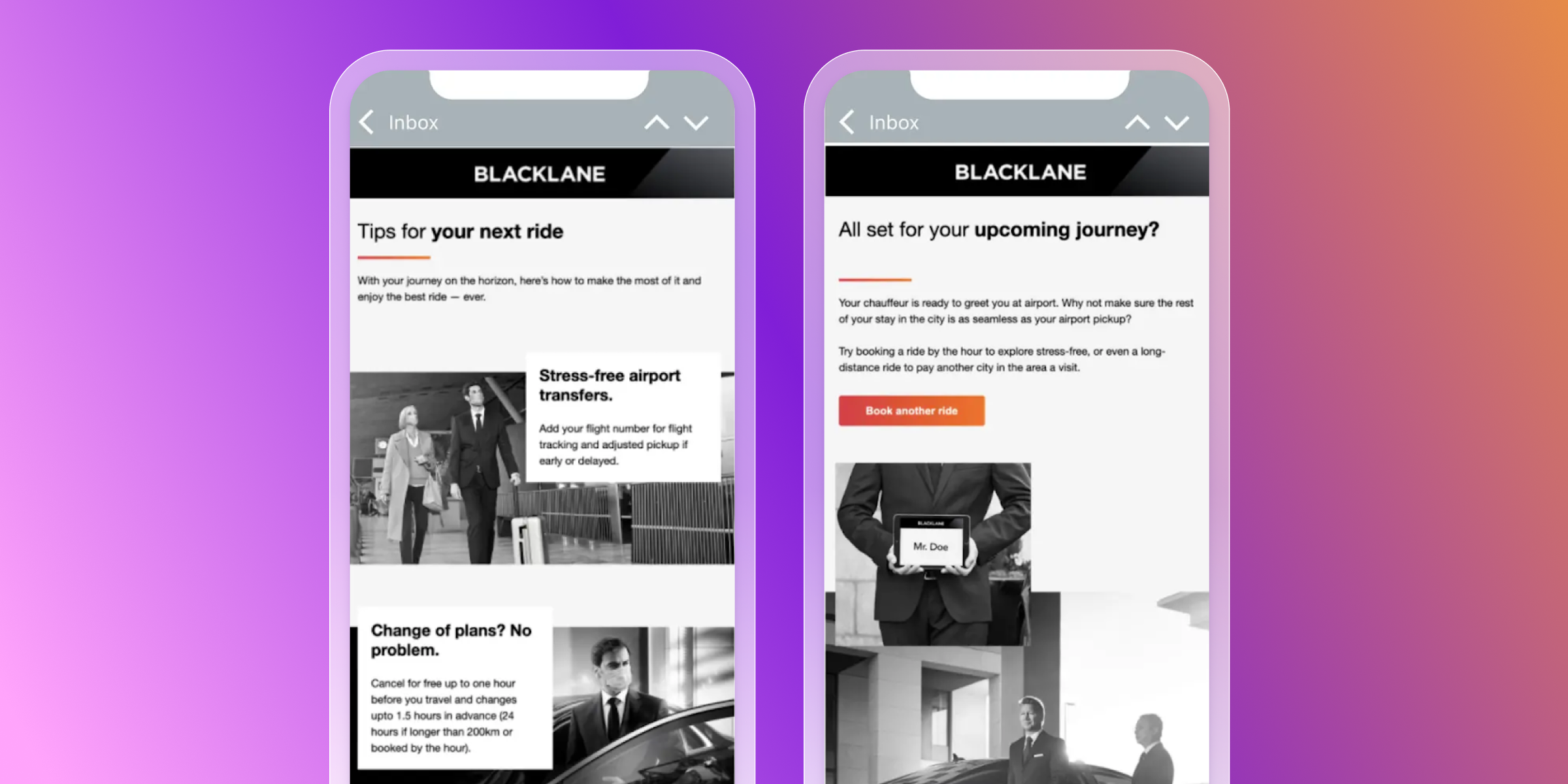
Using Braze, Blacklane built personalized cross-channel journeys tailored to each RFM segment—from first-time riders to lapsed customers—across email, push, in-app messages, and Content Cards. Post-ride surveys fed insight back into the strategy continuously.
The wins
- 194% improvement in lifecycle conversion
- 32% improvement in email open rate
- 33% improvement in push notification open rate
- 51% improvement in unsubscribe-to-open rate
Fiverr tests its way to a 21% revenue increase
Fiverr is a global marketplace connecting businesses with freelance talent. With millions of users and a critical first-purchase activation challenge, the team needed a smarter way to test what worked.
The challenge
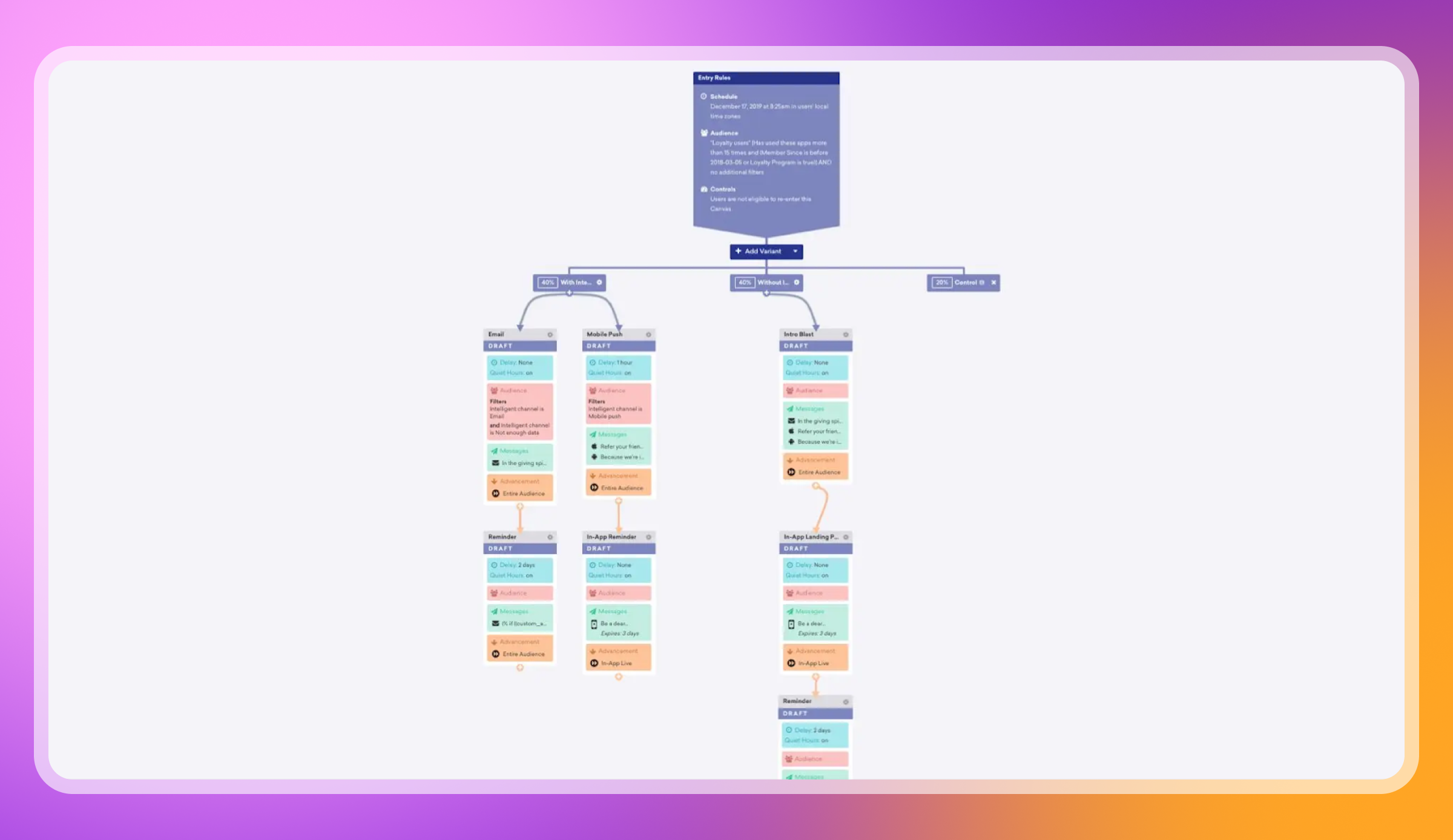
Getting new users to make their first purchase required more than a single campaign. Fiverr needed to test multiple lifecycle approaches simultaneously—without building separate campaigns for each one.
The strategy
Using Braze Canvas, Fiverr ran four first-purchase activation variants in parallel against a control group, comparing channel mix, timing, and creative within a single interface. The winning variant used Intelligent Timing and exception events across a cross-channel journey combining mobile push, web push, in-app messages, and email.
The wins
- 8.8% increase in purchases within three days
- 10.1% increase in average order value
- 20.9% increase in revenue
How AI is transforming lifecycle marketing
Automation made lifecycle marketing scalable. AI is making it intelligent—turning every customer interaction into a signal that can inform the next, and the one after that.
Lifecycle marketing automation
Automation is the operational backbone of any lifecycle program. It's what allows brands to trigger a welcome message the moment someone signs up, send a re-engagement campaign when a customer goes quiet, or pause a promotional flow when someone has already converted. Without it, lifecycle marketing at scale simply isn't possible.
The limitation is that automation executes instructions—it doesn't make judgments. A well-built automated flow will do exactly what it's been told, every time. But customers don't always behave the way they were expected to when the flow was built. Behavior shifts, contexts change, and a system built on static "if/then" logic will eventually deliver the wrong message to the wrong person, because the rules can't keep up.
Next best action—and what AI decisioning does differently
Many teams add intelligence to lifecycle programs through next best action (NBA) models. These use predictive models and business rules to recommend what a customer is most likely to do next—which product they might buy, which category they're drawn to—and then use that prediction to determine what to send. The approach has merit, but it has a core limitation: Knowing what a customer is likely to do without any intervention is not the same as knowing what action will actually change their behavior.
A customer who would have converted anyway doesn't need an incentive. A customer who has gone quiet for reasons the model doesn't understand won't be brought back by an offer for something they no longer need. NBA models also tend to optimize for a single dimension—usually the product or offer—while leaving the rest of the decisions (channel, timing, message, frequency, incentive depth) to static rules built on segments that can quickly go stale.
AI decisioning works differently. Rather than predicting behavior and building rules around that prediction, AI decisioning uses reinforcement learning agents that continuously experiment across every dimension that matters to a customer interaction—what to offer, which channel to use, what message to send, when to send it, how often to make contact, and whether to reach out at all. The agents receive a reward signal when they hit a defined goal, such as a conversion, a renewal, or a reduction in churn, and update their decisions accordingly. Over time, they discover the combinations that work best for each user—not each segment, each individual person.
This is what makes BrazeAI Decisioning Studio™ different from traditional automation or rule-based personalization. Teams set the goal, define the available actions and guardrails, and the system runs continuous 1:1 experiments that get more effective with every interaction. A lifecycle program powered by AI decisioning doesn't need to be rebuilt when customer behavior changes—it adapts as it learns.
Lifecycle marketing FAQs
What is lifecycle marketing?
Lifecycle marketing is a strategy that treats customer communication as an ongoing relationship rather than a series of one-off campaigns. It connects messaging to real customer behavior at every stage of the journey—from first purchase to long-term loyalty—to drive more relevant interactions and stronger business outcomes.
What is a lifecycle marketing strategy?
A lifecycle marketing strategy is a plan for engaging customers at every stage of their relationship with a brand. Rather than following fixed schedules, it maps messaging, channels, and timing to real customer behaviors and signals, keeping communication relevant as needs and intentions shift across the customer lifecycle.
How does lifecycle marketing improve customer retention?
Lifecycle marketing improves customer retention by connecting communication to actual customer behavior rather than assumptions. When messaging reflects where someone genuinely is in their journey—acknowledging loyalty, responding to declining engagement, or timing outreach to match intent—customers are more likely to stay connected and less likely to drift away.
How does AI change lifecycle marketing?
AI changes lifecycle marketing by replacing static rules with continuous, behavior-informed experimentation. AI decisioning agents test combinations of message, channel, offer, timing, and frequency for each individual customer, learning which choices drive the best outcomes and updating their decisions as behavior evolves—without requiring manual rebuilds every time something changes.
What are examples of lifecycle marketing?
Lifecycle marketing examples include a welcome series that adapts based on early customer behavior, a re-engagement campaign triggered when a loyal customer goes quiet, and retention messaging shaped by purchase history and channel preferences. What connects the best examples is that they respond to real signals rather than broad assumptions about what a segment might want.
Related Tags
Be Absolutely Engaging.™
Sign up for regular updates from Braze.