Under the Hood: The Nuts and Bolts of Using Braze with a CDP
Published on January 13, 2020/Last edited on January 13, 2020/6 min read

David Willis
Technical Program Manager, BrazeWhen Braze customers choose to pair our platform with a customer data platform (CDP), how they approach that process can have a big impact on the overall success of their customer engagement efforts. To help marketers leverage these technologies more effectively together, let’s explore the value you can see when using Braze with a CDP and what it takes to get that sort of connection up and running.
Braze and CDPs: Supporting Bi-Directional Data Flows
At a high level, using Braze together with a CDP can support a bi-directional flow of data that enables you to easily collect, connect, and take action upon your data across any customer touchpoint. CDPs are able to do this by collecting data from two primary sources:
- Web and mobile applications
- Backend servers and third-party systems
At the same time, these solutions can connect all of the engagement and additional data collected and streamed by the Braze platform in near real time. That makes it possible for your brand’s existing technology solutions—think analytics platforms, recommendation engines, etc.—to access and analyze nuanced user engagement data across email, push notification, and other messaging channels, supporting thoughtful iteration and more impactful user outreach.
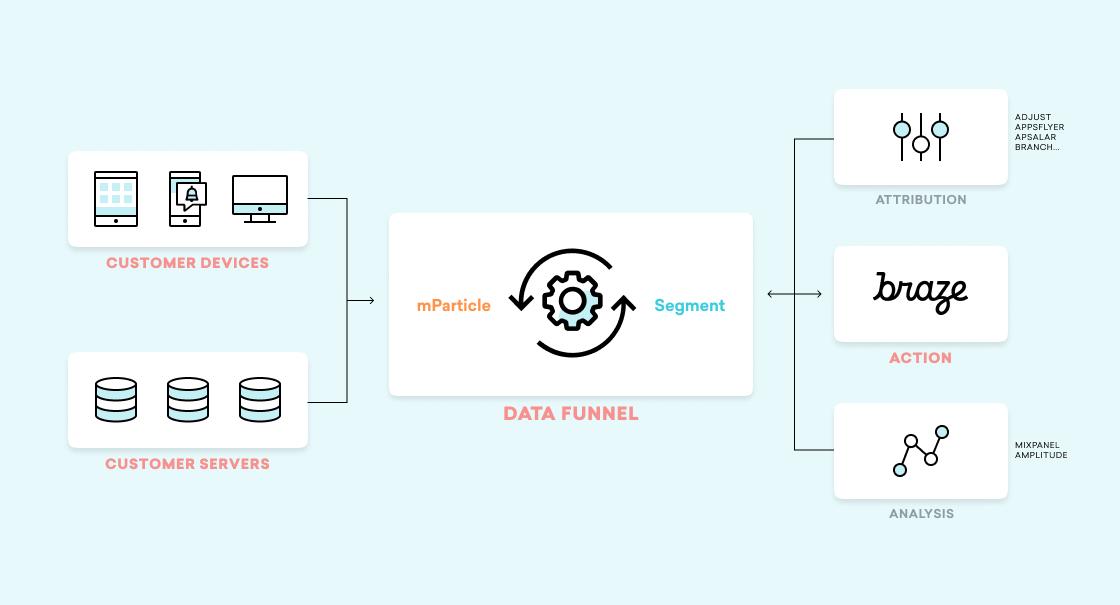
That connection with your web and mobile applications, which is known as side-by-side (SBS) integrations, is based on a mapping between the Braze platform’s mobile SDKs and the ones associated with your CDP. Separately, data from your backend servers or other third-party systems can be routed to the Braze platform’s REST APIs, resulting in what’s known as a server-to-server (S2S) integration. Let’s dig a little deeper into the differences between these two key integration types and the distinct functionalities they can support:
1. Side-by-Side (SBS) Integrations
For many brands, one of the main advantages of using a CDP is being able to use a single tool to take care of centralizing, tracking, and routing all your user data. However, if your CDP of choice is doing all the data-routing work, it raises the question of why you would even need your engineering team to add the Braze SDK to your company’s mobile and web applications. It’s a great question, and the reason it’s so important has to do with the key role that the Braze SDK plays when it comes to messaging.
At its core, the Braze SDK provides two essential functions:
- Displaying mobile and web messaging channels: The Braze SDK processes and displays the push, in-app message, and Content Card campaigns you create within Braze; without it, you’d lose your ability to display mobile and web messaging at the right time and to the right users.
- Tracking message engagements: The Braze SDK makes it possible to track any interaction a user has with a message, such as a push notification open, a button click, or an in-app message impression.
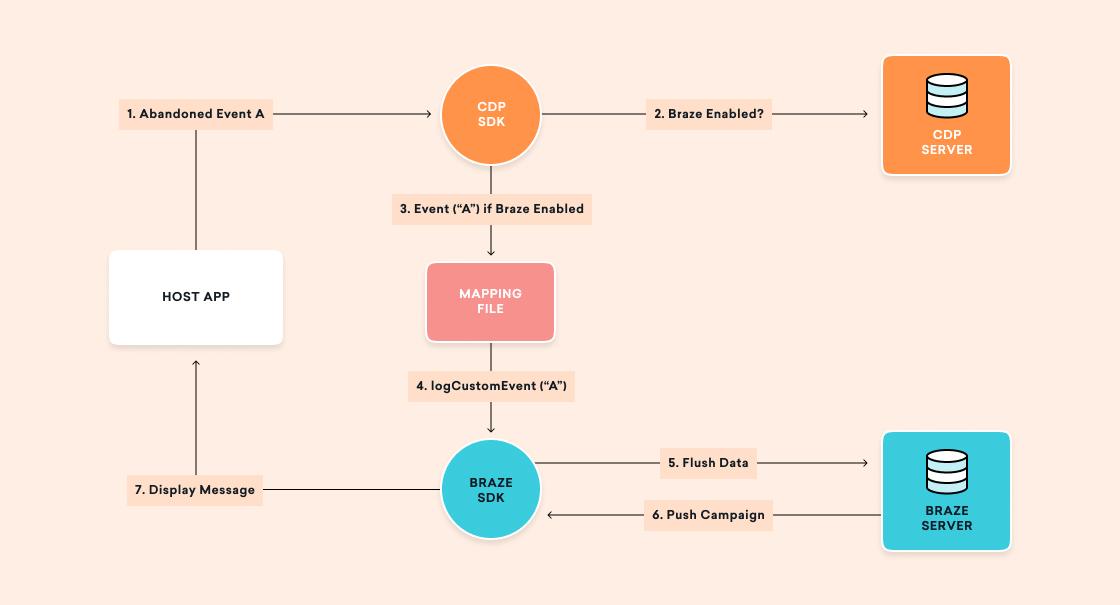
With a SBS integration, the SDK associated with your chosen CDP are bundled with both the Braze SDK and a mapping file, which serves as an interface between the two SDKs. Your CDP’s integration documentation (mParticle and Segment) should provide detailed instructions on adding the bundled SDKs to your applications. Those instructions will also point your development team to specific Braze code implementation steps for messaging channels, giving you access to all the newest features associated with push, in-app messaging, and Content Cards.
In contrast, all the user behavior data you’re tagging through the CDP’s SDK will automatically be mapped to Braze. Whether you’re tagging user emails, favorite music genres, or abandoned cart events, the CDP methods your developers invoke will be mapped to the equivalent Braze methods for you. What does that look like? Well, for instance, both mParticle’s `mParticle.logEvent()` and Segment’s `analytics.track()` methods are mapped to the Braze `appboy.logCustomEvent` when your developers tag an “abandoned cart” or “song added to playlist” event. Because this data will be passed to Braze, it’s then possible to use this data to trigger responsive push or in-app message campaigns based on these behavioral cues.
2. Server-to-Server (S2S) Integrations
In connection with data that originates from your company’s backend systems or databases, CDPs generally provide server-side libraries that developers can use to forward calls to a host of different companies’ APIs. This makes it possible for you to send user account information from your internal systems to both your BI tools and to Braze without requiring your developers to write multiple scripts that adhere to each tool’s respective API. The only work your team will need to do here is inputting the necessary API credentials into your CDP dashboard to ensure data is passed to the relevant account (see mParticle and Segment documentation).
Passing Braze Engagement Data to a CDP
For Braze customers, our SDK plays an instrumental role in capturing messaging engagement statistics—from data on email clicks, push opens, and the like. This data can provide valuable insight into the effectiveness of your marketing campaigns and can be streamed on an ongoing basis using the Braze platform’s Currents data export feature.
While Currents is often used to stream information into data storage solutions like Amazon S3 or Google Cloud Storage, it also makes it possible to funnel engagement data directly to your chosen CDP. And once it’s there, you have the ability to forward that messaging data to any other element of your tech stack for data synthesis or analysis—allowing for richer customer engagement insights. As with the S2S integration, all you need to get up and running with the feature is inputting several keys into your Braze and CDP dashboards (mParticle and Segment documentation).
Final Thoughts
Ensuring that you’re set up to use Braze and a CDP together effectively doesn’t just happen. But while bumps are possible, we believe that customer processes are often streamlined by a joint integration.
For one thing, CDPs provide thorough data mapping exercises, working with your team to tag relevant user behavior for analysis, attribution, or marketing. That means that when the time comes for your team to add Braze to your tech stack, that user data can often be automatically passed over to the Braze platform to power your team’s personalized messaging campaigns. Beyond tagging, CDPs can also help break down silos in your data infrastructure, connecting different sources of valuable information that don’t traditionally mix well. This data, which could have required a lot of coordination to pass to a new partner like Braze or a BI tool, will now also be accessible. Completing the loop, all the message engagement data that’s captured by the Braze SDK and backend can now be easily made available to the rest of your tech ecosystem, supporting true data agility within your stack.
Ultimately, with the right planning and resource allocation, your development work with the CDP and Braze will help create more holistic views of your customers, allowing for improved personalization, deeper data analysis, and a singular source of truth.
To learn more about how Braze can partner with other technology solutions to support more impactful customer engagement, check out our exclusive look at the six pillars of the Braze Alloys partnership hub.
Be Absolutely Engaging.™
Sign up for regular updates from Braze.